William Liu
Mastering Language Models: From Architecture to Optimization
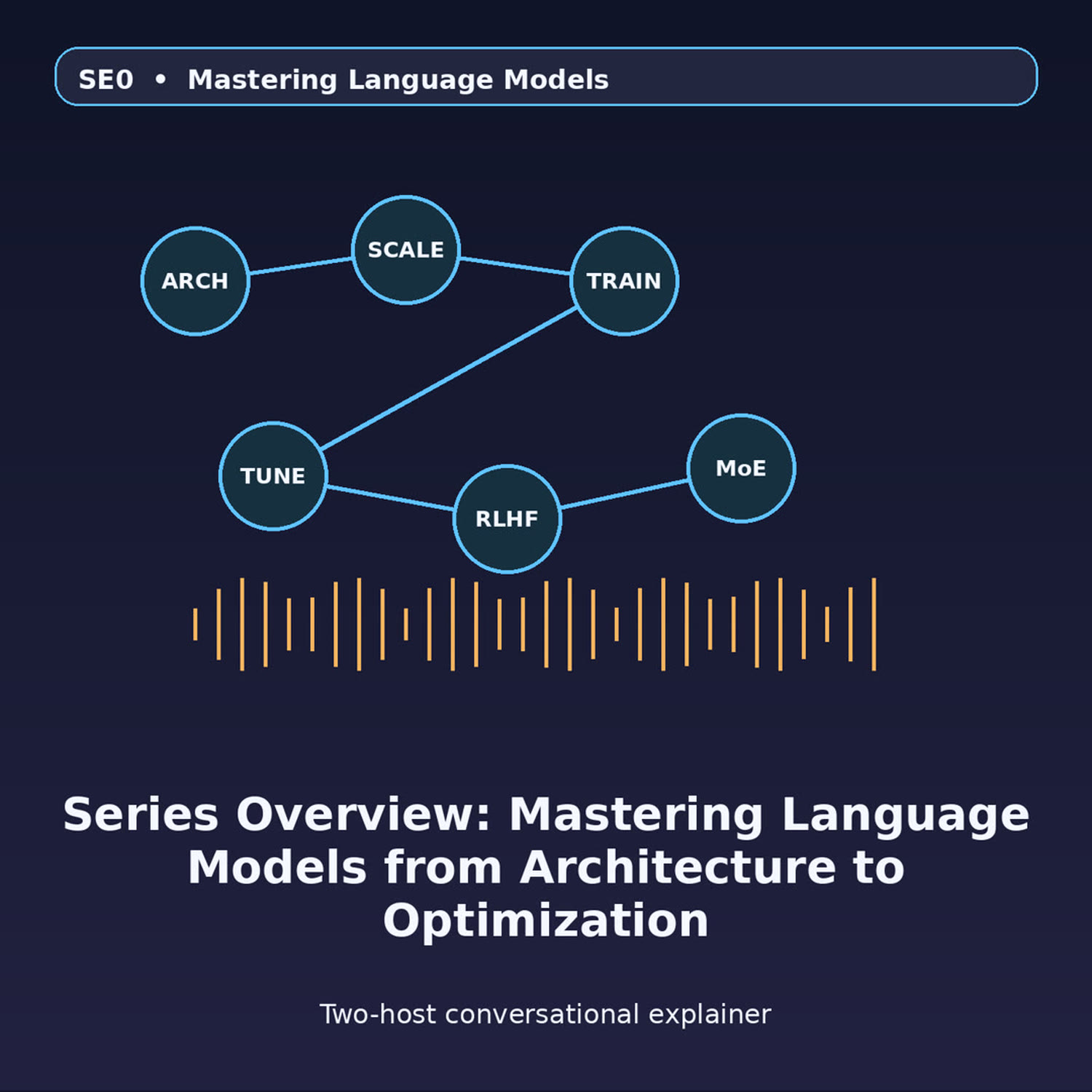
Maya and Leo open the series with the map: seven stops from the Transformer blueprint to the machinery under massive models, anchored by a three-person startup building an insurance-claims assistant on eight GPUs. They lay out the mental models every LLM expert shares — trust curves, find the bottleneck, separate capability from behavior — then stage the field's cleanest fight on air: bigger models versus more data, from OpenAI's 2020 scaling curves to Chinchilla's flip to the serving-cost era that ran past both camps. Plus trailers for the live attention debate and the alignment fight to come...
Koniecznie odwiedź stronę podcastu i wesprzyj twórcę: www.williamliu.ai
Autor
William Liu
Kategoria
Strona podcastu
Ostatni odcinek
24 cze 2026
Gdzie słuchać?
Podcasty w aplikacji Replaio Radio Już wkrótcePodcasty trafią do aplikacji już wkrótce. Zainstaluj teraz i jako pierwszy zobacz nowe podejście do podcastów
 Zainstaluj za darmo
Android 5 mln+ pobrań · ocena 4,8
iOS niedługo
Zainstaluj za darmo
Android 5 mln+ pobrań · ocena 4,8
iOS niedługo
Odcinki
T7E5 · Recent Advances in Optimization Methods for Machine Learning: A Systematic Review 24.06.2026 13:43
In the finale of Topic 7 and the series, Maya and Leo unpack a 2025 systematic review of optimization methods for machine learning — the optimizer that decides whether a ninety-day run converges. They map the gradient-based family as a lineage of flaw-fixes (SGD, momentum, Nesterov, AdaGrad, RMSProp, Adam, AdamW), touch second-order/quasi-Newton and large-batch methods (LARS, LAMB), and perform th...
T7E4 · AutoML from Basics to State-of-the-Art Techniques 23.06.2026 13:44
Maya and Leo trace AutoML from grid and random search through Bayesian optimization, neural architecture search, and automated pipeline construction (TPOT, AutoGluon, Auto-Keras), then ask where automated search beats expert hand-tuning when both draw from the same fixed ninety-day compute budget. The episode's spine: the unit of automation keeps growing, the real enemy is the cost of one evaluati...
T7E3 · The Pile: An 800GB Dataset of Diverse Text for Language Modeling 22.06.2026 13:26
The Pile reframes training data as a design choice. EleutherAI assembled an 825-gibibyte English corpus from twenty-two diverse sub-datasets — books, code, biomedical and physics papers, legal opinions, dialogue, and a filtered slice of the open web — and showed that diversity improves a model's general, cross-domain ability. In a controlled comparison against raw and cleaned web crawl, the divers...
T7E2 · Mixture-of-Experts Operator Transformer for Large-Scale PDE Pre-Training 21.06.2026 12:50
Maya and Leo follow the sparsely-gated Mixture-of-Experts idea out of language and into scientific machine learning. The paper, MoE-POT, is an operator transformer pre-trained across many families of partial differential equations — fluid flow, heat, waves — where a layer-wise router sends each chunk of a physical field to a few specialized experts plus a couple of always-on shared experts. They e...
T7E1 · Outrageously Large Neural Networks: The Sparsely-Gated Mixture-of-Experts Layer 20.06.2026 15:41
Maya and Leo unpack the 2017 paper that started sparse scaling. They walk from the wall it was hitting — capacity and compute welded together in dense models — to the central move: a Mixture-of-Experts layer where a noisy top-k gating network routes each token to just a few of up to thousands of experts, so total capacity can grow a thousand-fold without compute-per-word following. They explain ex...
T7E0 · Mixture-of-Experts Models and Handling Massive Models: Sparsity, Data, and Optimization 19.06.2026 14:37
Maya and Leo open Topic 7 by going underneath massive models to the machinery that makes them possible. Using one small lab training a large sparse model on a fixed ninety-day compute budget, they explain sparsity and Mixture-of-Experts, the router and load balancing, why diverse training data is a design choice, how AutoML automates tuning, and what it takes for any of it to converge — staging th...
T6E4 · DeepSeek-V4-Flash 18.06.2026 13:57
Maya and Leo unpack DeepSeek-V4-Flash as an efficiency stack for million-token context: hybrid compressed attention, sparse expert activation, low-precision serving, and specialist distillation. They stage the field's real arguments — how hard to compress long-context memory, and when a local Flash-class model should escalate to a Pro-class or hosted one — and land on a managed-memory mental model...
T6E3 · DeepSeek-V3 Technical Report 17.06.2026 14:42
Maya and Leo unpack DeepSeek-V3 as a sparse, infrastructure-heavy route to frontier open-weight capability. They explain MoE routing, MLA cache compression, auxiliary-loss-free load balancing, DualPipe, FP8 training, multi-token prediction, GRPO post-training, benchmark caveats, and why deployment complexity matters for teams choosing between local, hosted, dense, and sparse models. Sources: • Dee...
T6E2 · The Llama 3 Herd of Models 16.06.2026 14:06
Maya and Leo unpack Meta's Llama 3 Herd of Models paper as a deployment portfolio: dense architecture, massive curated data, post-training with SFT, rejection sampling and DPO, long-context and tool-use training, safety rails, and a staged debate over the trade-offs of open-weight release. Sources: • The Llama 3 Herd of Models: https://arxiv.org/pdf/2407.21783 • Llama 2: Open Foundation and Fine-T...
T6E1 · Llama 2: Open Foundation and Fine-Tuned Chat Models 15.06.2026 15:16
This episode unpacks the Llama 2 paper as more than a model announcement: it is a stack of base weights, chat tuning, RLHF, safety work, evaluation caveats, and release terms. Maya and Leo connect the paper to a practical on-device assistant team deciding how to use open weights responsibly. Sources: • Llama 2: Open Foundation and Fine-Tuned Chat Models: https://arxiv.org/pdf/2307.09288 • Llama 2...
T6E0 · The Latest in Fine-Tuned and Open Models: From LLaMA to DeepSeek 14.06.2026 15:19
Maya and Leo introduce Topic 6 by mapping open-weight and fine-tuned model families as deployable engineering components. Using an on-device coding and data-analysis assistant, they explain Llama, fine-tuning, deployment envelopes, private evaluation, ecosystem trade-offs, and why sparse models like DeepSeek complicate the open-model frontier. Sources: • Llama 2: Open Foundation and Fine-Tuned Cha...
T5E9 · Reinforcement Learning from Human Feedback: Progress and Challenges 27.04.2026 12:03
This episode closes Topic 5 with John Schulman's Berkeley EECS colloquium on RLHF progress and challenges — the architect of PPO and ChatGPT-era preference tuning grading his own pipeline. Maya and Leo walk the progress column (comparisons make negative feedback usable where intuition outruns specification) and four challenge landmarks: the Applause Meter, the Tired Jury, the Smooth Talker, and th...
T5E8 · Robust Reinforcement Learning from Human Feedback for Large Language Models Fine-Tuning 27.04.2026 13:22
Maya and Leo close in on the repair episode of the RLHF arc: VRPO, a variance-reduced preference optimization method for fine-tuning language models when human labels are scarce and the Bradley-Terry assumptions are misspecified. Through a water-utility calibration story, they unpack the control-variate maneuver — keep the human-labeled loss in charge, subtract an auxiliary judge's prediction on e...
T5E7 · RLHF Deciphered: A Critical Analysis of Reinforcement Learning from Human Feedback for LLMs 27.04.2026 13:37
Maya and Leo take a deep breath after the method war and inspect the instrument every RLHF pipeline depends on: the reward model. Through the lens of RLHF Deciphered, they map the gap between the oracular reward nobody has and the fitted surface everyone trains — the coverage holes in human feedback, the misgeneralized scores an optimizer happily paves into behavior, the whole-answer labels that s...
T5E6 · Direct Preference Optimization: Your Language Model is Secretly a Reward Model 27.04.2026 13:09
Maya and Leo unpack Direct Preference Optimization, the 2023 paper whose napkin-worthy algebra showed the reward model was hiding inside the language model all along. They walk the old two-stage RLHF pipeline, then the substitution that cancels the reward variable and leaves a supervised-looking classification loss, the implicit reward you can read off the tuned model's margin over its reference,...
T5E5 · Constitutional AI: Harmlessness from AI Feedback 27.04.2026 13:32
Maya and Leo dig into Constitutional AI, the Anthropic paper that swaps many human harmlessness labels for a short written constitution: the model critiques and rewrites its own risky answers, then an AI judge compares candidate replies against the principles to drive reinforcement learning from AI feedback. Using a healthcare scheduling assistant, they show why critique-before-revision matters, w...
T5E4 · Training a Helpful and Harmless Assistant with Reinforcement Learning from Human Feedback 27.04.2026 14:02
Maya and Leo dig into Anthropic's helpful-and-harmless RLHF paper: two opposite data-collection payrolls, one preference model serving two masters, the weekly online refresh that keeps the judge informed, the split-judge robustness test that exposes reward gaming, and a staged fight over whether the alignment tax is real. Sources: • Training a Helpful and Harmless Assistant with Reinforcement Lear...
T5E3 · Training Language Models to Follow Instructions with Human Feedback 27.04.2026 14:03
Maya and Leo dig into the InstructGPT paper — the moment the human-feedback recipe grew from a summarization trick into the way assistants get made. They walk the pipeline as three stations and a punch list (the Apprenticeship, the Ranking Desk, the Governor, the Punch List), stage the scale-versus-feedback argument over the famous result that humans preferred a 1.3B-parameter aligned model to the...
T5E2 · Learning to Summarize with Human Feedback 27.04.2026 13:05
Maya and Leo dig into OpenAI's Learning to Summarize from Human Feedback — the paper where pairwise human picks replaced reference matching as the training target. They walk the pipeline as three stations (the Two-Card Choice, the Borrowed Judge, the Tether), stage the real fight between preference optimization and cheap reproducible metrics, and end on the over-optimization curve where the judge'...
T5E1 · Proximal Policy Optimization Algorithms 27.04.2026 14:11
Maya and Leo open the Topic 5 deep dives with the paper that made preference optimization practical: Proximal Policy Optimization. Starting from a physical-therapy brace that stops paying out range past a set angle, they unpack why step size is existential when a policy generates its own training data, how the clipped probability ratio and the pessimistic minimum make updates safe to repeat, why b...
T5E0 · Reinforcement Learning from Human Feedback (RLHF) 26.04.2026 14:02
A topic overview of RLHF: how human comparisons become preference data, how reward models and cautious optimization steer assistant behavior, why the PPO pipeline and DPO represent a genuine method war, and where feedback loops can be gamed or go brittle. Sources: • Proximal Policy Optimization Algorithms: https://arxiv.org/pdf/1707.06347 • Learning to Summarize with Human Feedback: https://arxiv....
T4E4 · Continual Learning of Large Language Models: A Comprehensive Survey 26.04.2026 15:47
Topic 4 closes by stretching specialization across time. Maya opens with an interpreter in Lisbon losing words in her own first language — first-language attrition as the human face of catastrophic forgetting — and the survey behind the episode maps the machine version: erosion with good manners, where the model stays fluent while old domains, formats, and safety behaviors quietly slip. The hosts...
T4E3 · LowRA: Accurate and Efficient LoRA Fine-Tuning of LLMs under 2 Bits 26.04.2026 13:51
The paper that asks how few bits an adapter can survive on. Maya opens with a mosaic master firing a portrait in four tile shades, and the analogy turns out to be the method: LowRA pushes LoRA fine-tuning below two bits per parameter through three deliberate decisions — the Palette (which values the codes stand for), the Cut Lines (where bucket boundaries sit), and the Bit Budget (where bits get s...
T4E2 · QLoRA: Efficient Finetuning of Quantized LLMs 26.04.2026 14:11
The paper that put large-model fine-tuning on a single GPU. Maya and Leo open QLoRA's central rule — read the compressed thing, write somewhere else — and follow gradients through a frozen four-bit base into full-precision LoRA adapters. Along the way: NF4's bell-curve-shaped buckets, double quantization's compress-the-labels trick, paged optimizers as the relief valve that saves hour-nine runs, a...
T4E1 · LoRA: Low-Rank Adaptation of Large Language Models 26.04.2026 13:38
The paper that made fine-tuning feel modular. Maya and Leo open up LoRA's central trick — freeze the pretrained weights and learn the update as the product of two thin matrices, around sixty-five thousand trainable numbers standing in for sixteen million — then follow it through the merge fork (flatten for zero-overhead serving, or keep adapters swappable on one frozen base), the rank and alpha di...
Podobne podcasty







Słuchaj podcastu Mastering Language Models: From Architecture to Optimization w Replaio
Radio i podcasty w jednej aplikacji - za darmo, bez zakładania konta. Zainstaluj już dziś i nie przegap premiery
Replaio nie jest wydawcą podcastów; nazwy audycji, okładki i audio należą do ich autorów i są rozpowszechniane przez publiczne kanały RSS