William Liu
Mastering Language Models: From Architecture to Optimization
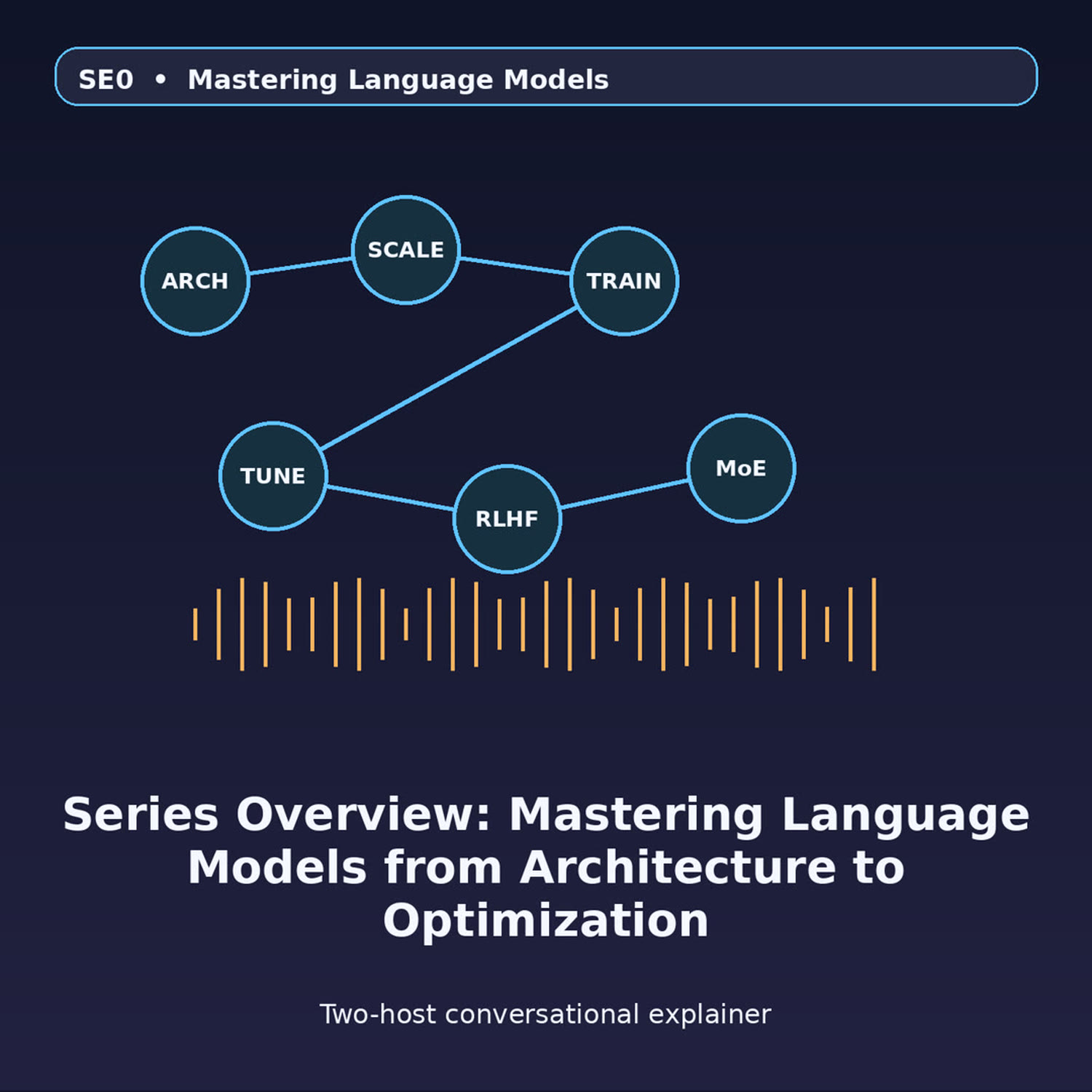
Maya and Leo open the series with the map: seven stops from the Transformer blueprint to the machinery under massive models, anchored by a three-person startup building an insurance-claims assistant on eight GPUs. They lay out the mental models every LLM expert shares — trust curves, find the bottleneck, separate capability from behavior — then stage the field's cleanest fight on air: bigger models versus more data, from OpenAI's 2020 scaling curves to Chinchilla's flip to the serving-cost era that ran past both camps. Plus trailers for the live attention debate and the alignment fight to come...
Author
William Liu
Category
Podcast website
Latest episode
Jun 24, 2026
Where to listen?
Podcasts in the app Replaio Radio Coming soonPodcasts are coming to the app soon. Install now and be the first to see a whole new take on podcasts
 Install for free
Android 5M+ downloads · 4.8 rating
iOS soon
Install for free
Android 5M+ downloads · 4.8 rating
iOS soon
Episodes
T7E5 · Recent Advances in Optimization Methods for Machine Learning: A Systematic Review 24.06.2026 13:43
In the finale of Topic 7 and the series, Maya and Leo unpack a 2025 systematic review of optimization methods for machine learning — the optimizer that decides whether a ninety-day run converges. They map the gradient-based family as a lineage of flaw-fixes (SGD, momentum, Nesterov, AdaGrad, RMSProp, Adam, AdamW), touch second-order/quasi-Newton and large-batch methods (LARS, LAMB), and perform th...
T7E4 · AutoML from Basics to State-of-the-Art Techniques 23.06.2026 13:44
Maya and Leo trace AutoML from grid and random search through Bayesian optimization, neural architecture search, and automated pipeline construction (TPOT, AutoGluon, Auto-Keras), then ask where automated search beats expert hand-tuning when both draw from the same fixed ninety-day compute budget. The episode's spine: the unit of automation keeps growing, the real enemy is the cost of one evaluati...
T7E3 · The Pile: An 800GB Dataset of Diverse Text for Language Modeling 22.06.2026 13:26
The Pile reframes training data as a design choice. EleutherAI assembled an 825-gibibyte English corpus from twenty-two diverse sub-datasets — books, code, biomedical and physics papers, legal opinions, dialogue, and a filtered slice of the open web — and showed that diversity improves a model's general, cross-domain ability. In a controlled comparison against raw and cleaned web crawl, the divers...
T7E2 · Mixture-of-Experts Operator Transformer for Large-Scale PDE Pre-Training 21.06.2026 12:50
Maya and Leo follow the sparsely-gated Mixture-of-Experts idea out of language and into scientific machine learning. The paper, MoE-POT, is an operator transformer pre-trained across many families of partial differential equations — fluid flow, heat, waves — where a layer-wise router sends each chunk of a physical field to a few specialized experts plus a couple of always-on shared experts. They e...
T7E1 · Outrageously Large Neural Networks: The Sparsely-Gated Mixture-of-Experts Layer 20.06.2026 15:41
Maya and Leo unpack the 2017 paper that started sparse scaling. They walk from the wall it was hitting — capacity and compute welded together in dense models — to the central move: a Mixture-of-Experts layer where a noisy top-k gating network routes each token to just a few of up to thousands of experts, so total capacity can grow a thousand-fold without compute-per-word following. They explain ex...
T7E0 · Mixture-of-Experts Models and Handling Massive Models: Sparsity, Data, and Optimization 19.06.2026 14:37
Maya and Leo open Topic 7 by going underneath massive models to the machinery that makes them possible. Using one small lab training a large sparse model on a fixed ninety-day compute budget, they explain sparsity and Mixture-of-Experts, the router and load balancing, why diverse training data is a design choice, how AutoML automates tuning, and what it takes for any of it to converge — staging th...
T6E4 · DeepSeek-V4-Flash 18.06.2026 13:57
Maya and Leo unpack DeepSeek-V4-Flash as an efficiency stack for million-token context: hybrid compressed attention, sparse expert activation, low-precision serving, and specialist distillation. They stage the field's real arguments — how hard to compress long-context memory, and when a local Flash-class model should escalate to a Pro-class or hosted one — and land on a managed-memory mental model...
T6E3 · DeepSeek-V3 Technical Report 17.06.2026 14:42
Maya and Leo unpack DeepSeek-V3 as a sparse, infrastructure-heavy route to frontier open-weight capability. They explain MoE routing, MLA cache compression, auxiliary-loss-free load balancing, DualPipe, FP8 training, multi-token prediction, GRPO post-training, benchmark caveats, and why deployment complexity matters for teams choosing between local, hosted, dense, and sparse models. Sources: • Dee...
T6E2 · The Llama 3 Herd of Models 16.06.2026 14:06
Maya and Leo unpack Meta's Llama 3 Herd of Models paper as a deployment portfolio: dense architecture, massive curated data, post-training with SFT, rejection sampling and DPO, long-context and tool-use training, safety rails, and a staged debate over the trade-offs of open-weight release. Sources: • The Llama 3 Herd of Models: https://arxiv.org/pdf/2407.21783 • Llama 2: Open Foundation and Fine-T...
T6E1 · Llama 2: Open Foundation and Fine-Tuned Chat Models 15.06.2026 15:16
This episode unpacks the Llama 2 paper as more than a model announcement: it is a stack of base weights, chat tuning, RLHF, safety work, evaluation caveats, and release terms. Maya and Leo connect the paper to a practical on-device assistant team deciding how to use open weights responsibly. Sources: • Llama 2: Open Foundation and Fine-Tuned Chat Models: https://arxiv.org/pdf/2307.09288 • Llama 2...
T6E0 · The Latest in Fine-Tuned and Open Models: From LLaMA to DeepSeek 14.06.2026 15:19
Maya and Leo introduce Topic 6 by mapping open-weight and fine-tuned model families as deployable engineering components. Using an on-device coding and data-analysis assistant, they explain Llama, fine-tuning, deployment envelopes, private evaluation, ecosystem trade-offs, and why sparse models like DeepSeek complicate the open-model frontier. Sources: • Llama 2: Open Foundation and Fine-Tuned Cha...
T5E9 · Reinforcement Learning from Human Feedback: Progress and Challenges 27.04.2026 12:03
This episode closes Topic 5 with John Schulman's Berkeley EECS colloquium on RLHF progress and challenges — the architect of PPO and ChatGPT-era preference tuning grading his own pipeline. Maya and Leo walk the progress column (comparisons make negative feedback usable where intuition outruns specification) and four challenge landmarks: the Applause Meter, the Tired Jury, the Smooth Talker, and th...
T5E8 · Robust Reinforcement Learning from Human Feedback for Large Language Models Fine-Tuning 27.04.2026 13:22
Maya and Leo close in on the repair episode of the RLHF arc: VRPO, a variance-reduced preference optimization method for fine-tuning language models when human labels are scarce and the Bradley-Terry assumptions are misspecified. Through a water-utility calibration story, they unpack the control-variate maneuver — keep the human-labeled loss in charge, subtract an auxiliary judge's prediction on e...
T5E7 · RLHF Deciphered: A Critical Analysis of Reinforcement Learning from Human Feedback for LLMs 27.04.2026 13:37
Maya and Leo take a deep breath after the method war and inspect the instrument every RLHF pipeline depends on: the reward model. Through the lens of RLHF Deciphered, they map the gap between the oracular reward nobody has and the fitted surface everyone trains — the coverage holes in human feedback, the misgeneralized scores an optimizer happily paves into behavior, the whole-answer labels that s...
T5E6 · Direct Preference Optimization: Your Language Model is Secretly a Reward Model 27.04.2026 13:09
Maya and Leo unpack Direct Preference Optimization, the 2023 paper whose napkin-worthy algebra showed the reward model was hiding inside the language model all along. They walk the old two-stage RLHF pipeline, then the substitution that cancels the reward variable and leaves a supervised-looking classification loss, the implicit reward you can read off the tuned model's margin over its reference,...
T5E5 · Constitutional AI: Harmlessness from AI Feedback 27.04.2026 13:32
Maya and Leo dig into Constitutional AI, the Anthropic paper that swaps many human harmlessness labels for a short written constitution: the model critiques and rewrites its own risky answers, then an AI judge compares candidate replies against the principles to drive reinforcement learning from AI feedback. Using a healthcare scheduling assistant, they show why critique-before-revision matters, w...
T5E4 · Training a Helpful and Harmless Assistant with Reinforcement Learning from Human Feedback 27.04.2026 14:02
Maya and Leo dig into Anthropic's helpful-and-harmless RLHF paper: two opposite data-collection payrolls, one preference model serving two masters, the weekly online refresh that keeps the judge informed, the split-judge robustness test that exposes reward gaming, and a staged fight over whether the alignment tax is real. Sources: • Training a Helpful and Harmless Assistant with Reinforcement Lear...
T5E3 · Training Language Models to Follow Instructions with Human Feedback 27.04.2026 14:03
Maya and Leo dig into the InstructGPT paper — the moment the human-feedback recipe grew from a summarization trick into the way assistants get made. They walk the pipeline as three stations and a punch list (the Apprenticeship, the Ranking Desk, the Governor, the Punch List), stage the scale-versus-feedback argument over the famous result that humans preferred a 1.3B-parameter aligned model to the...
T5E2 · Learning to Summarize with Human Feedback 27.04.2026 13:05
Maya and Leo dig into OpenAI's Learning to Summarize from Human Feedback — the paper where pairwise human picks replaced reference matching as the training target. They walk the pipeline as three stations (the Two-Card Choice, the Borrowed Judge, the Tether), stage the real fight between preference optimization and cheap reproducible metrics, and end on the over-optimization curve where the judge'...
T5E1 · Proximal Policy Optimization Algorithms 27.04.2026 14:11
Maya and Leo open the Topic 5 deep dives with the paper that made preference optimization practical: Proximal Policy Optimization. Starting from a physical-therapy brace that stops paying out range past a set angle, they unpack why step size is existential when a policy generates its own training data, how the clipped probability ratio and the pessimistic minimum make updates safe to repeat, why b...
T5E0 · Reinforcement Learning from Human Feedback (RLHF) 26.04.2026 14:02
A topic overview of RLHF: how human comparisons become preference data, how reward models and cautious optimization steer assistant behavior, why the PPO pipeline and DPO represent a genuine method war, and where feedback loops can be gamed or go brittle. Sources: • Proximal Policy Optimization Algorithms: https://arxiv.org/pdf/1707.06347 • Learning to Summarize with Human Feedback: https://arxiv....
T4E4 · Continual Learning of Large Language Models: A Comprehensive Survey 26.04.2026 15:47
Topic 4 closes by stretching specialization across time. Maya opens with an interpreter in Lisbon losing words in her own first language — first-language attrition as the human face of catastrophic forgetting — and the survey behind the episode maps the machine version: erosion with good manners, where the model stays fluent while old domains, formats, and safety behaviors quietly slip. The hosts...
T4E3 · LowRA: Accurate and Efficient LoRA Fine-Tuning of LLMs under 2 Bits 26.04.2026 13:51
The paper that asks how few bits an adapter can survive on. Maya opens with a mosaic master firing a portrait in four tile shades, and the analogy turns out to be the method: LowRA pushes LoRA fine-tuning below two bits per parameter through three deliberate decisions — the Palette (which values the codes stand for), the Cut Lines (where bucket boundaries sit), and the Bit Budget (where bits get s...
T4E2 · QLoRA: Efficient Finetuning of Quantized LLMs 26.04.2026 14:11
The paper that put large-model fine-tuning on a single GPU. Maya and Leo open QLoRA's central rule — read the compressed thing, write somewhere else — and follow gradients through a frozen four-bit base into full-precision LoRA adapters. Along the way: NF4's bell-curve-shaped buckets, double quantization's compress-the-labels trick, paged optimizers as the relief valve that saves hour-nine runs, a...
T4E1 · LoRA: Low-Rank Adaptation of Large Language Models 26.04.2026 13:38
The paper that made fine-tuning feel modular. Maya and Leo open up LoRA's central trick — freeze the pretrained weights and learn the update as the product of two thin matrices, around sixty-five thousand trainable numbers standing in for sixteen million — then follow it through the merge fork (flatten for zero-overhead serving, or keep adapters swappable on one frozen base), the rank and alpha di...
Similar podcasts







Listen to the Mastering Language Models: From Architecture to Optimization podcast in Replaio
Radio and podcasts in one app - free, with no sign-up. Install today and do not miss the launch
Replaio is not a podcast publisher; show names, artwork and audio belong to their authors and are distributed through public RSS feeds.