Med School Audio - Medical Knowledge Reimagined & Learning Made Memorable.
Clinical Deep Dives
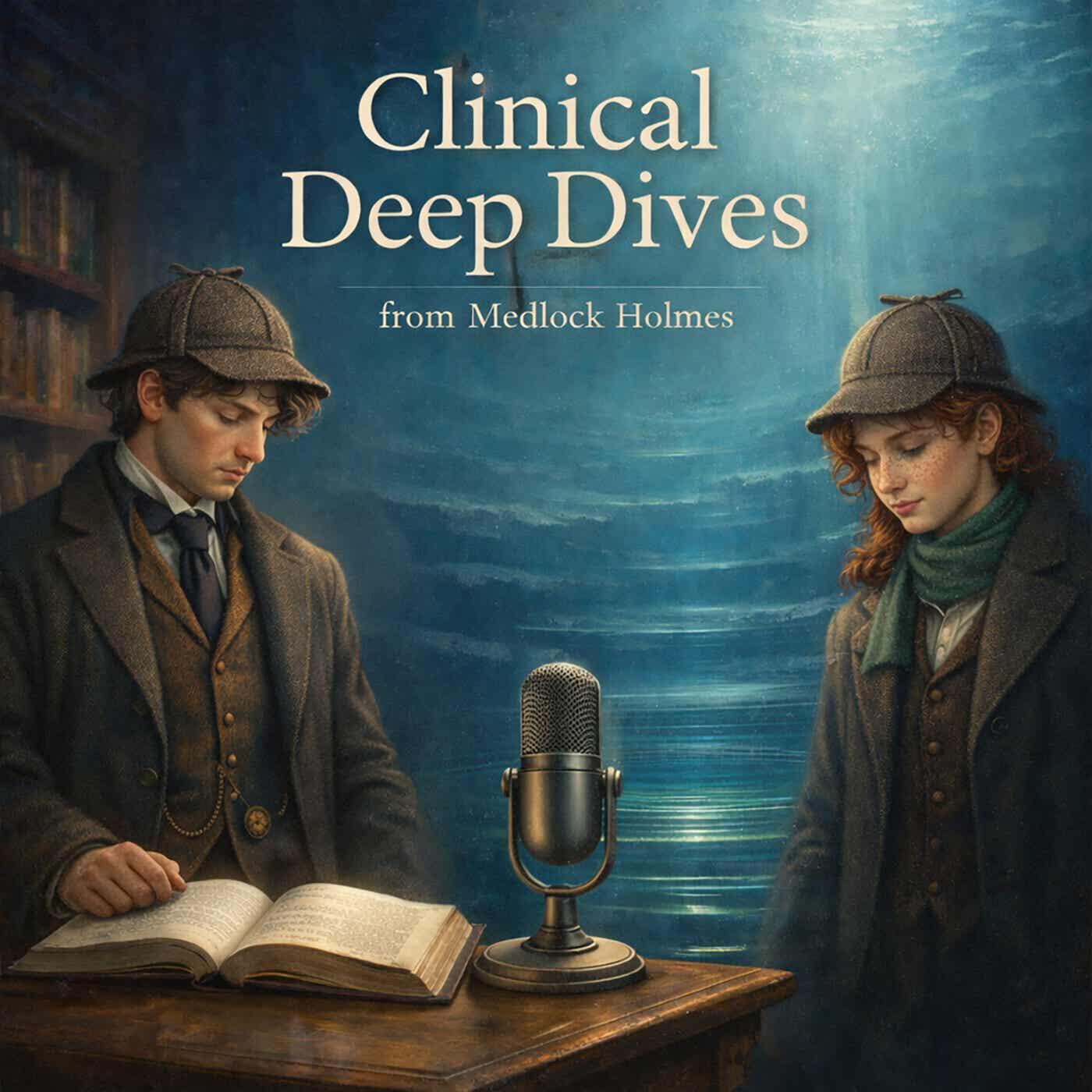
Clinical Deep Dives is a Medlock Holmes podcast for clinicians and learners who want understanding, not just information. Using classic medical and surgical texts as a guide and the generative power of AI, each episode explores ideas with curiosity and clarity, designed for learning on the move and knowledge that actually sticks. drmanaankarray.substack.com
Koniecznie odwiedź stronę podcastu i wesprzyj twórcę: drmanaankarray.substack.com
Autor
Med School Audio - Medical Knowledge Reimagined & Learning Made Memorable.
Kategoria
Strona podcastu
Ostatni odcinek
31 paź 2026
Gdzie słuchać?
Podcasty w aplikacji Replaio Radio Już wkrótcePodcasty trafią do aplikacji już wkrótce. Zainstaluj teraz i jako pierwszy zobacz nowe podejście do podcastów
 Zainstaluj za darmo
Android prawie 10 mln pobrań · ocena 4,8
iOS niedługo
Odcinki
PSYCH 069: Psychiatric Rating Scales 23.07.2026 46:37
This chapter explores psychiatric rating scales, the structured tools used to quantify symptoms, monitor change, and support clinical decision-making. Psychiatry deals with many phenomena that are inherently subjective—mood, anxiety, psychosis, cognition, functioning, and quality of life. Rating scales provide a common language through which these experiences can be systematically assessed. At the...
PSYCH 068: Principles and Applications of Quantitative Electroencephalography in Psychiatry 22.07.2026 51:55
This chapter explores quantitative electroencephalography (qEEG), a powerful technique that transforms the brain’s electrical activity into measurable patterns that can be analysed, compared, and interpreted. While conventional EEG allows clinicians to observe brain wave activity, qEEG extends this capability by applying advanced computational methods to reveal underlying neural dynamics. Every th...
PSYCH 067: Medical Assessment and Laboratory Testing in Psychiatry 21.07.2026 1:12:26
This chapter explores one of the most important principles in psychiatric practice: psychiatric symptoms do not always originate from psychiatric illness. The assessment of patients presenting with psychological or behavioural symptoms requires careful consideration of underlying medical, neurological, endocrine, infectious, metabolic, and pharmacological causes. Psychiatry occupies a unique posit...
PSYCH 066: Personality Assessment of Adults 20.07.2026 1:14:52
This chapter explores the assessment of personality—the enduring patterns of thinking, feeling, relating, and behaving that shape how individuals experience themselves and the world around them. While psychiatric symptoms may fluctuate across time, personality provides the deeper framework through which those experiences are interpreted and expressed. Personality assessment seeks to understand the...
PSYCH 065: Neuropsychological Assessment of Adults 19.07.2026 50:59
This chapter explores the science and practice of neuropsychological assessment—the systematic evaluation of cognitive functioning to better understand the relationship between brain, behaviour, and mental processes. While psychiatric interviews reveal subjective experience and emotional functioning, neuropsychological assessment examines how the brain performs its most complex tasks. Attention, m...
PSYCH 064: Practice Guidelines in Psychiatry 18.07.2026 48:04
This chapter explores the role of practice guidelines in modern psychiatric care. As psychiatry has evolved into an increasingly evidence-based discipline, clinicians have been challenged to integrate scientific knowledge, clinical expertise, and individual patient needs into coherent treatment decisions. Practice guidelines serve as navigational tools within this complex landscape. At their core,...
PSYCH 063: The Psychiatric Report and Outline for a Psychiatric Examination 17.07.2026 43:55
This chapter explores the art and discipline of transforming psychiatric assessment into a structured psychiatric report. While interviews and examinations gather information, the report is where that information is analysed, organised, and communicated. Psychiatric reports serve many purposes. They guide clinical care, facilitate communication between professionals, support legal and administrati...
PSYCH 062: Psychiatric Interview, History, and Mental Status Examination of the Adult Patient 16.07.2026 58:37
This chapter explores the foundations of psychiatric assessment: the psychiatric interview, the comprehensive clinical history, and the mental status examination (MSE). Together, these form the primary tools through which psychiatrists understand the experiences, symptoms, strengths, and struggles of the people they seek to help. Unlike many areas of medicine, psychiatry relies heavily upon narrat...
PSYCH 061: Approaches from Philosophy and Psychology 15.07.2026 51:52
This chapter explores the philosophical and psychological foundations that underpin our understanding of personality and psychopathology. It moves beyond empirical observation into the deeper questions that shape how we conceptualise human experience. Philosophical traditions have long grappled with the nature of self, consciousness, free will, and meaning. These questions are not abstract - they...
PSYCH 060: Other Psychodynamic Schools 14.07.2026 54:36
This chapter explores the evolution of psychodynamic thought beyond classical psychoanalysis, highlighting a range of schools that expand, refine, and sometimes challenge Freud’s original ideas. These approaches share a common foundation - the importance of unconscious processes, early relationships, and internal conflict - but diverge in how they conceptualise the structure and dynamics of the mi...
PSYCH 059: Erik Erikson 13.07.2026 52:09
This chapter explores Erik Erikson’s influential model of psychosocial development, which extends the understanding of human growth across the entire lifespan. Unlike earlier theories that focused primarily on childhood, Erikson proposed that development continues through a sequence of stages, each defined by a central psychological task. Each stage presents a tension - a conflict between two oppo...
PSYCH 058: Psychoanalytic Theories and Treatment 12.07.2026 58:29
This chapter explores the foundations and evolution of psychoanalytic theory, focusing on how unconscious processes shape thought, emotion, and behaviour. Originating in the work of Freud and developed across multiple schools in North America and Great Britain, psychoanalysis offers a framework for understanding the inner world of the mind. At its core is the concept of the unconscious - mental pr...
PSYCH 057: Statistics and Experimental Design 11.07.2026 58:16
This chapter provides the methodological backbone of psychiatric research - the tools that allow us to move from observation to reliable knowledge. Statistics and experimental design are not merely technical disciplines; they are the architecture through which truth is approximated. At its core, experimental design is about structure. How do we ask a question in a way that produces a meaningful an...
PSYCH 056: Epidemiology in Psychiatry 10.07.2026 1:03:17
Epidemiology provides the lens through which psychiatry steps back and examines mental illness at the level of populations. Rather than focusing on individual cases, it asks broader questions: how common are disorders, who is affected, and what factors influence risk and outcome? This chapter introduces the foundational concepts of psychiatric epidemiology, including incidence, prevalence, risk fa...
PSYCH 055: Evolutionary Foundations of Psychiatry 09.07.2026 1:09:35
This chapter explores psychiatric phenomena through an evolutionary lens - asking not only how mental disorders occur, but why the human mind is vulnerable to them in the first place. Evolutionary psychiatry proposes that many features of the mind are shaped by natural selection to solve problems of survival and reproduction. Emotions such as fear, anxiety, attachment, and even low mood may have e...
PSYCH 054: Transcultural Psychiatry 08.07.2026 48:46
This chapter explores how culture shapes every aspect of mental health - from symptom expression and explanatory models to help-seeking behaviours and treatment outcomes. Transcultural psychiatry challenges the assumption that psychiatric disorders are universal in form and meaning. Culture provides the framework through which individuals interpret distress. The same underlying experience may be d...
PSYCH 053: Neurocentrism: Addiction and the Courtroom 07.07.2026 38:31
This chapter examines the growing influence of neuroscience in legal and societal understandings of behaviour - particularly in the context of addiction. Neurocentrism refers to the tendency to explain complex human actions primarily, or exclusively, in terms of brain function. In addiction, advances in neuroscience have highlighted changes in reward pathways, impulse control, and decision-making...
PSYCH 052: Neuroscience of Psychoanalytic Object Relations 06.07.2026 46:54
This chapter bridges two historically separate domains: psychoanalytic object relations theory and contemporary neuroscience. It explores how early relationships are not merely psychological experiences, but biologically embedded processes that shape the developing brain. Object relations theory proposes that internal representations of self and others are formed through early interactions with ca...
PSYCH 051: Normality and Mental Health 05.07.2026 52:26
This chapter challenges one of the most deceptively simple questions in psychiatry: what does it mean to be “normal”? Rather than defining normality as the absence of illness, contemporary perspectives frame mental health as a dynamic process - the capacity to adapt to internal and external demands, sustain relationships, regulate emotion, and pursue meaningful goals. Statistical, cultural, and fu...
PSYCH 050: Biology of Memory 04.07.2026 1:00:31
This chapter explores how memory is encoded, stored, and retrieved within the brain - not as a static archive, but as a dynamic and evolving biological process. Memory begins with encoding, where experience is transformed into neural activity. This is followed by consolidation, during which fragile traces are stabilised through synaptic and systems-level changes. Retrieval then reactivates these t...
PSYCH 049: Learning Theory 03.07.2026 59:14
Learning theory provides one of the most powerful frameworks for understanding how behaviour is acquired, maintained, and changed. At its core, it asks a deceptively simple question: how do experiences shape what we do? This chapter explores the foundational models of learning, including classical conditioning, operant conditioning, and observational learning. Classical conditioning links stimuli...
PSYCH 048: Piaget and Cognitive Development 02.07.2026 1:05:55
This chapter explores how human cognition develops across childhood through the pioneering work of Jean Piaget. Rather than viewing children as miniature adults, Piaget proposed that thinking evolves through distinct stages, each representing a qualitatively different way of understanding the world. At the core of his theory are two fundamental processes: assimilation and accommodation. Assimilati...
PSYCH 047: Sensation, Perception, and Cognition 01.07.2026 1:01:28
This chapter explores how the mind transforms raw sensory input into meaningful experience. Sensation begins as the detection of physical stimuli - light, sound, touch - but perception is the act of organising and interpreting these signals into a coherent reality. The key insight is that perception is not passive. The brain actively predicts, filters, and shapes incoming information based on prio...
PSYCH 046: Catatonia 30.06.2026 54:25
Catatonia is one of the most striking and often misunderstood syndromes in psychiatry. It is not defined by a single disorder, but by a pattern of motor, behavioural, and physiological abnormalities that reflect a profound disturbance in the regulation of action. In this episode, we explore how catatonia can present across a spectrum - from marked immobility, mutism, and withdrawal, to states of a...
PSYCH 045: Neuropsychiatry of Neurometabolic and Neuroendocrine Disorders 29.06.2026 52:18
The brain does not function in isolation. It is deeply dependent on metabolic processes and hormonal regulation - systems that operate throughout the body but exert powerful influence on cognition, mood, and behaviour. This chapter explores how disturbances in these systems manifest neuropsychiatrically. In this episode, we examine how metabolic disorders - including inborn errors and acquired con...
Podobne podcasty








Słuchaj podcastu Clinical Deep Dives w Replaio
Radio i podcasty w jednej aplikacji - za darmo, bez zakładania konta. Zainstaluj już dziś i nie przegap premiery
Replaio nie jest wydawcą podcastów; nazwy audycji, okładki i audio należą do ich autorów i są rozpowszechniane przez publiczne kanały RSS