Med School Audio - Medical Knowledge Reimagined & Learning Made Memorable.
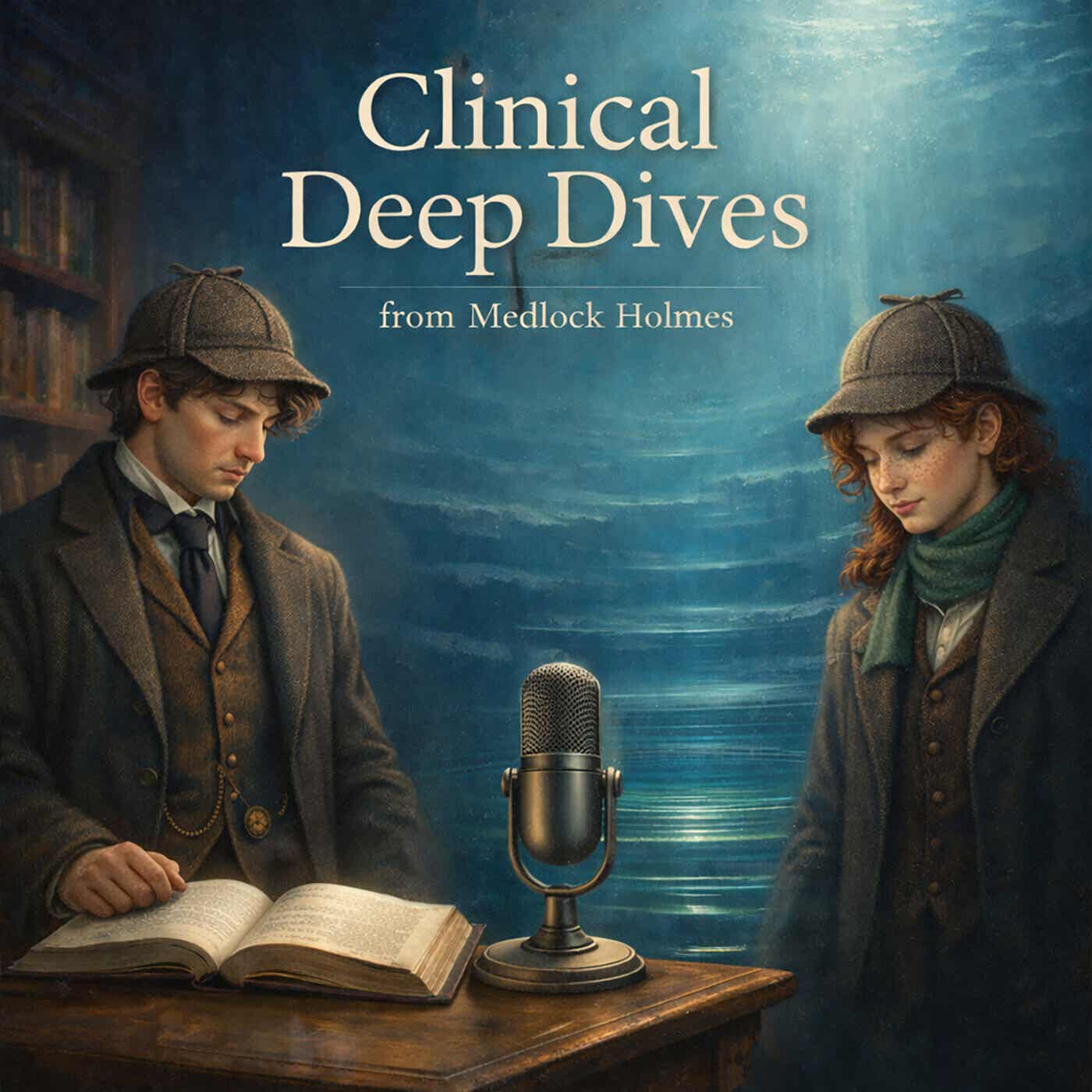
Clinical Deep Dives
Clinical Deep Dives is a Medlock Holmes podcast for clinicians and learners who want understanding, not just information. Using classic medical and surgical texts as a guide and the generative power of AI, each episode explores ideas with curiosity and clarity, designed for learning on the move and knowledge that actually sticks. drmanaankarray.substack.com
Be sure to visit the podcast's website and support the creator: drmanaankarray.substack.com
Author
Med School Audio - Medical Knowledge Reimagined & Learning Made Memorable.
Category
Podcast website
Latest episode
Oct 17, 2026
Where to listen?
Podcasts in the app Replaio Radio Coming soonPodcasts are coming to the app soon. Install now and be the first to see a whole new take on podcasts
 Install for free
Android almost 10M downloads · 4.8 rating
iOS soon
Install for free
Android almost 10M downloads · 4.8 rating
iOS soon
Episodes
PSYCH 155: Psychiatric Care of Burn Patients 17.10.2026 58:25
from survival towards recovery. Medlock Holmes enters The House of Fire and Recovery. At the entrance stands a patient whose burns have been dressed, whose vital signs have stabilised and whose surgeons are cautiously optimistic. The immediate danger has passed. Yet the patient cannot sleep. Every time they close their eyes, they see the flames. They recoil when a nurse approaches to change a dres...
PSYCH 154: Organ Transplantation 16.10.2026 1:02:24
recovery and life with a transplanted organ. Medlock Holmes enters The Hall of Second Lives . At its centre stands an enormous clock. Around it wait patients with failing hearts, lungs, livers and kidneys. Above them hangs a second clock whose hands move unpredictably. No one knows when an organ will become available. For some, it will arrive in time. For others, it will not. Holmes immediately un...
PSYCH 153: Psychocutaneous Disorders 15.10.2026 55:49
how visible skin disease can reshape identity, relationships and mental health. Episode Description Medlock Holmes enters The Gallery of the Skin , an unusual medical chamber lined entirely with mirrors. Unlike the hidden organs of the body, the skin cannot easily conceal its illness. A lesion may be painful or itchy - but it can also be seen . A scar can change appearance. Hair loss can change id...
PSYCH 152: Psychiatric Morbidity Following Critical Illness 14.10.2026 47:16
and the difficult task of rebuilding an ordinary life. Medlock Holmes enters The Recovery Ward . The monitors have stopped alarming. The ventilator has been disconnected. The infection has been treated. The patient has survived. By conventional medical measures, the emergency is over. Yet Holmes notices something strange. The patient cannot remember parts of his admission, but vividly remembers te...
PSYCH 151: Stress and Psychiatry 13.10.2026 48:58
and resilience. Medlock Holmes enters The Stress Laboratory , where an enormous brass apparatus is being subjected to pressure. At first, the mystery appears straightforward: apply enough force and eventually something breaks. But Holmes quickly discovers that human beings do not behave like identical pieces of metal. Two people can encounter the same loss, illness, humiliation or threat and follo...
PSYCH 150: The Terminally Ill Patient 12.10.2026 48:34
Medlock Holmes enters The Last Ward , a quiet wing of the hospital where medicine appears to be running out of doors. Behind the patients lie operating theatres, chemotherapy suites, dialysis machines and intensive-care units. Ahead lies a doorway that medicine cannot ultimately prevent anyone from reaching. But Holmes immediately notices something important. The doctors have not disappeared. Neit...
PSYCH 149: Psycho-Oncology 11.10.2026 59:13
and the end of life. Medlock Holmes enters The House of Cancer , expecting to investigate a disease of abnormal cells. But he quickly discovers that cancer never occupies only one room. In the laboratory, cells divide uncontrollably. In the adjoining rooms, entirely different processes are unfolding: a newly diagnosed patient sits stunned after hearing the word cancer ; another cannot sleep before...
PSYCH 148: Endocrine and Metabolic Disorders 10.10.2026 1:06:17
meaning disturbances of thyroid, adrenal, metabolic and reproductive systems can present as depression, anxiety, mania, psychosis or cognitive change. Episode Description Medlock Holmes enters The Hormonal Control Room , a vast Neo-Victorian laboratory where the brain and body communicate through an intricate network of chemical messengers. At its centre stands the hypothalamus , connected to the...
PSYCH 147: Diabetes - Psychosocial Issues and Psychiatric Disorders 09.10.2026 53:44
making mental health inseparable from metabolic health. Episode Description Medlock Holmes enters The Metabolic Control Room , an immense Neo-Victorian chamber built around a glowing bloodstream. At its centre sits a vast brass dial labelled GLUCOSE , connected to the pancreas, brain, heart, kidneys, eyes and peripheral nerves. At first, the machinery seems straightforward. In type 1 diabetes , au...
PSYCH 146: Respiratory Disorders 08.10.2026 59:58
and psychiatric treatment. Episode Description Medlock Holmes enters The Chamber of Breath , an immense Neo-Victorian respiratory laboratory where a pair of mechanical lungs expands and contracts beneath an intricate network connecting the lungs, brain, emotions and behaviour . At first, the mystery appears entirely pulmonary. Asthma narrows reactive airways. COPD progressively restricts airflow....
PSYCH 145: Obesity 07.10.2026 1:10:10
the development and management of obesity. Medlock Holmes enters The Great Energy Exchange , an immense Neo-Victorian metabolic laboratory where every calorie entering the body passes through a bewildering network of biological, psychological and environmental machinery. At first, the equation appears almost embarrassingly simple: ENERGY IN > ENERGY OUT → WEIGHT GAIN But Holmes quickly discovers t...
PSYCH 144: Gastrointestinal Disorders 06.10.2026 43:52
and the extraordinary bidirectional conversation of the brain–gut–microbiome axis. Medlock Holmes enters The Great Gut–Brain Exchange , an immense Neo-Victorian communication network in which the brain and gastrointestinal tract are joined by constantly moving signals. Messages travel downward through the autonomic nervous system, HPA axis and neuroendocrine pathways, while sensory, immune, hormon...
PSYCH 143: Cardiovascular Disorders 05.10.2026 57:08
Medlock Holmes enters The Engine Room of the Heart , where an enormous mechanical heart is connected to the brain by networks carrying stress, emotion, behaviour, autonomic signals and medication effects . The relationship is strikingly bidirectional. Cardiovascular disease can produce anxiety, depression, cognitive disturbance and trauma-related symptoms, while psychiatric disorders and psycholog...
PSYCH 142: Consultation-Liaison Psychiatry and Psychosomatic Medicine 04.10.2026 54:29
Medlock Holmes enters The Hospital of Two Wings . For generations, one wing has been labelled BODY and the other MIND . Patients are routinely carried from one to the other, as though every symptom must belong exclusively to one side. Holmes immediately notices the flaw. A bridge connects them. Consultation-liaison psychiatry operates on this bridge: the part of psychiatry concerned with psychiatr...
PSYCH 141: Personality Disorders 03.10.2026 45:53
Personality disorder emerges not because someone has a distinctive personality, but when enduring patterns become sufficiently inflexible and maladaptive to repeatedly disrupt the self, relationships and functioning. Medlock Holmes enters The House of Personality , an extraordinary mansion that has been under construction since childhood. Its foundations contain inherited temperament. Its rooms ha...
PSYCH 140: Adjustment Disorders 02.10.2026 55:33
Medlock Holmes enters The House of Adaptation , where people arrive carrying the weight of events that have changed their lives: relationship breakdown, financial hardship, illness, unemployment, conflict, relocation, bereavement and unexpected transitions. But Holmes immediately encounters psychiatry’s central difficulty with adjustment disorder: “When does distress become disorder?” Adjustment d...
PSYCH 139: Kleptomania 01.10.2026 43:09
Medlock Holmes enters a vast Neo-Victorian department store where an unusual investigation is underway. An object has been stolen. But the person who took it did not need it. The object had little personal importance. They could easily have afforded it. They may not even use it afterwards - sometimes the stolen objects are hidden, hoarded, given away or even secretly returned. So Holmes asks the q...
PSYCH 138: Pyromania 30.09.2026 44:41
and subsequent pleasure or relief. Medlock Holmes enters a vast Neo-Victorian fire investigation chamber where one question dominates the room: WHY WAS THE FIRE SET? Pyromania is not simply fire setting, and most people who deliberately start fires do not have pyromania. The diagnosis requires repeated, deliberate and purposeful fire setting accompanied by increasing tension or emotional arousal b...
PSYCH 137: Intermittent Explosive Disorder 29.09.2026 40:44
Medlock Holmes enters an immense Neo-Victorian institution known as The Hall of Impulsive Aggression . At first, the building seems calm. Then a small bell rings. Someone makes a dismissive remark. A door slams. A criticism is heard. A minor disagreement begins. Within seconds, an enormous brass pressure chamber erupts. The explosion is dramatic, but brief. Then silence. The whole event has lasted...
PSYCH 136: Sleep Disorders 28.09.2026 52:25
Sleep disorders arise when the mechanisms controlling sleep quantity, timing, breathing, movement, arousal or dream-state boundaries become disrupted - and the consequences can range from chronic distress to accidents, cardiovascular disease and major functional impairment. Medlock Holmes enters an immense Neo-Victorian institution called The Grand Observatory of Sleep and Wakefulness . At first g...
PSYCH 135: Feeding and Eating Disorders 27.09.2026 56:32
health become entangled - sometimes producing profound malnutrition, dangerous compensatory behaviours, loss of control over eating, nutritional deficiency, medical instability and substantial psychosocial impairment. Medlock Holmes enters an immense Neo-Victorian institution called The House of Eating, Weight and Regulation . At first, the building appears deceptively ordinary. At its centre is a...
PSYCH 134: Sexual Addiction 26.09.2026 44:05
The central clinical question is not “How much sex is too much?” but “Has sexual behaviour become the person's primary way of regulating distress, reward and self-experience?” Medlock Holmes enters an immense Neo-Victorian institution called The House of Driven Behaviour . At first, nothing in the building looks inherently pathological. There are rooms devoted to: sexual fantasy masturbation roman...
PSYCH 133: Gender Identity, Gender Diversity, and Gender Dysphoria/Incongruence 25.09.2026 56:56
Medlock Holmes enters an immense Neo-Victorian institution called The Grand Observatory of Gender . At its centre stands a transparent human figure surrounded by several rotating brass rings. One is labelled: SEX CHARACTERISTICS Another: GENDER IDENTITY Another: GENDER EXPRESSION Another: SEXUAL ORIENTATION Another: SOCIAL ROLE The rings frequently align. Sometimes they do not. Holmes immediately...
PSYCH 132: Paraphilic Disorders 24.09.2026 52:50
Medlock Holmes enters an immense Neo-Victorian institution called The Tribunal of Sexual Interest, Consent and Harm . At its centre stands a large brass balance. On one side: UNUSUAL SEXUAL INTEREST On the other: DISTRESS • IMPAIRMENT • HARM • NONCONSENT Holmes quickly discovers the central distinction in modern psychiatric classification: A PARAPHILIA IS NOT AUTOMATICALLY A PARAPHILIC DISORDER. D...
PSYCH 131: Homosexuality, Gay and Lesbian Identities, and Homosexual Behaviour 23.09.2026 39:54
Medlock Holmes enters an immense Neo-Victorian institution called The Hall of Sexual Identity and Social Meaning . At its centre is a large brass compass with three separate needles: DESIRE • BEHAVIOUR • IDENTITY Holmes notices immediately that the needles do not always point in the same direction. A person may experience same-sex attraction without acting on it. Another may have same-sex relation...
Similar podcasts




Listen to the Clinical Deep Dives podcast in Replaio
Radio and podcasts in one app - free, with no sign-up. Install today and do not miss the launch
Replaio is not a podcast publisher; show names, artwork and audio belong to their authors and are distributed through public RSS feeds.