Med School Audio - Medical Knowledge Reimagined & Learning Made Memorable.
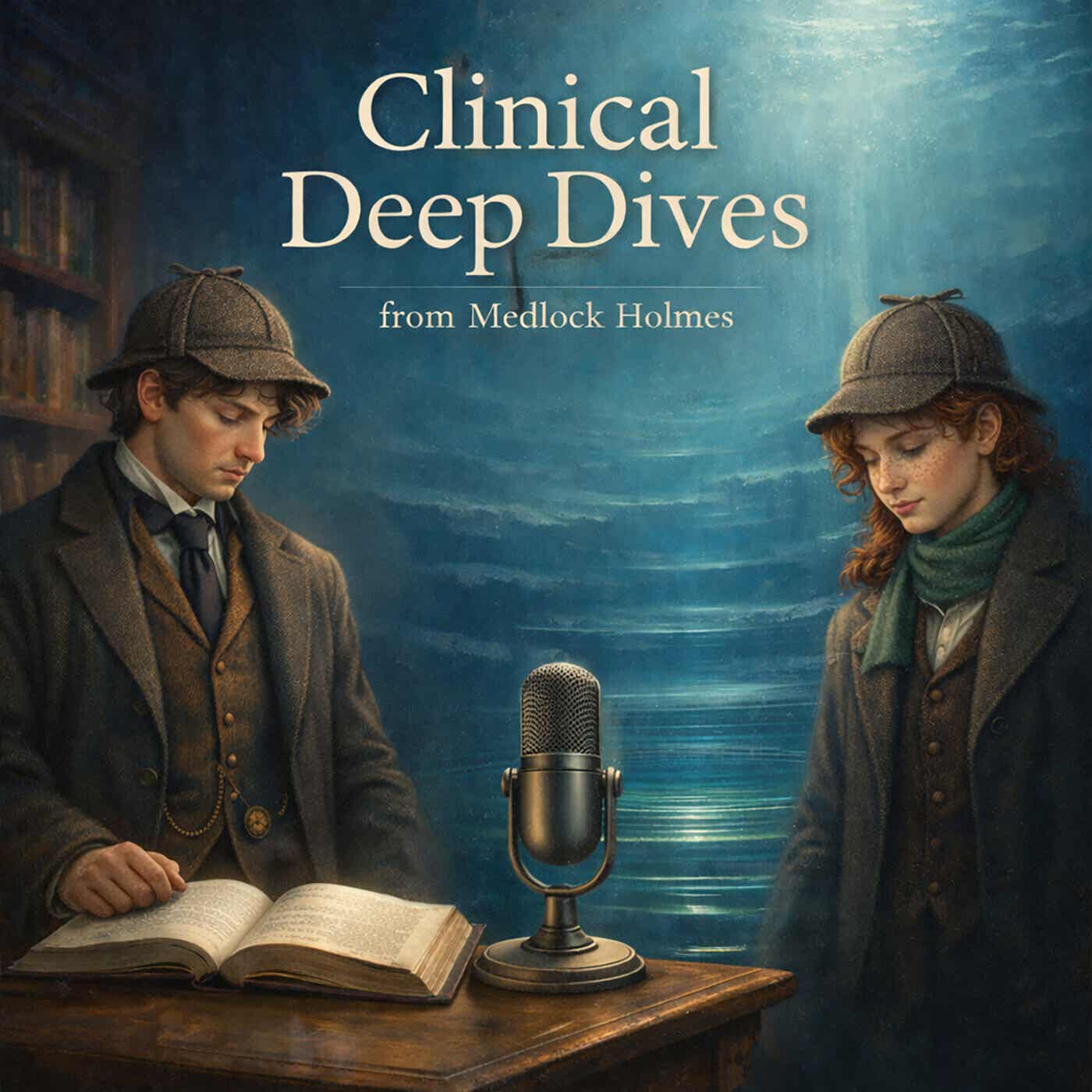
Clinical Deep Dives
Clinical Deep Dives is a Medlock Holmes podcast for clinicians and learners who want understanding, not just information. Using classic medical and surgical texts as a guide and the generative power of AI, each episode explores ideas with curiosity and clarity, designed for learning on the move and knowledge that actually sticks. drmanaankarray.substack.com
Koniecznie odwiedź stronę podcastu i wesprzyj twórcę: drmanaankarray.substack.com
Autor
Med School Audio - Medical Knowledge Reimagined & Learning Made Memorable.
Kategoria
Strona podcastu
Ostatni odcinek
19 paź 2026
Gdzie słuchać?
Podcasty w aplikacji Replaio Radio Już wkrótcePodcasty trafią do aplikacji już wkrótce. Zainstaluj teraz i jako pierwszy zobacz nowe podejście do podcastów
 Zainstaluj za darmo
Android prawie 10 mln pobrań · ocena 4,8
iOS niedługo
Zainstaluj za darmo
Android prawie 10 mln pobrań · ocena 4,8
iOS niedługo
Odcinki
PSYCH 132: Paraphilic Disorders 24.09.2026 52:50
Medlock Holmes enters an immense Neo-Victorian institution called The Tribunal of Sexual Interest, Consent and Harm . At its centre stands a large brass balance. On one side: UNUSUAL SEXUAL INTEREST On the other: DISTRESS • IMPAIRMENT • HARM • NONCONSENT Holmes quickly discovers the central distinction in modern psychiatric classification: A PARAPHILIA IS NOT AUTOMATICALLY A PARAPHILIC DISORDER. D...
PSYCH 131: Homosexuality, Gay and Lesbian Identities, and Homosexual Behaviour 23.09.2026 39:54
Medlock Holmes enters an immense Neo-Victorian institution called The Hall of Sexual Identity and Social Meaning . At its centre is a large brass compass with three separate needles: DESIRE • BEHAVIOUR • IDENTITY Holmes notices immediately that the needles do not always point in the same direction. A person may experience same-sex attraction without acting on it. Another may have same-sex relation...
PSYCH 130: Normal Human Sexuality and Sexual Dysfunctions 22.09.2026 57:59
Medlock Holmes enters an immense Neo-Victorian institution called The Grand Observatory of Human Sexuality . It is part anatomy theatre, part neuroscience laboratory, part relationship clinic and part cultural museum. At its centre stands an enormous brass instrument labelled: SEXUAL FUNCTION Seven interlocking systems surround it: BODY • BRAIN • HORMONES • DESIRE • RELATIONSHIP • LEARNING • CULTU...
PSYCH 129: Dissociative Disorders 21.09.2026 48:30
Medlock Holmes enters an extraordinary Neo-Victorian building called The House of Disconnected Rooms . From outside, it appears to be one house. Inside, however, corridors terminate unexpectedly, doors open into rooms that seem unaware of one another, clocks show different times, mirrors reflect unfamiliar faces, and sections of the archive are inaccessible from the main library. Nothing has disap...
PSYCH 128: Factitious Disorder 20.09.2026 45:19
At first, the cases look extraordinary. A patient presents with recurrent sepsis caused by unusual organisms. Another has persistent wounds that never heal. Another reports repeated seizures that vanish under observation. One produces dramatic laboratory abnormalities. Another travels from hospital to hospital under changing identities. In a paediatric ward, a child appears inexplicably ill whenev...
PSYCH 127: Somatic Symptom and Related Disorders 19.09.2026 56:22
Medlock Holmes enters an immense Neo-Victorian medical complex called The House of Bodily Signals . Every corridor is crowded. One patient reports abdominal pain. Another dizziness. Another weakness. Another chest discomfort. Another is convinced that a subtle bodily sensation means serious disease. One patient has undergone scan after scan without reassurance. Another has genuine physical illness...
PSYCH 126: Post-Traumatic Stress Disorder 18.09.2026 49:38
Medlock Holmes enters an immense Neo-Victorian institution called The Citadel of the Unfinished Alarm . At the centre is a vast clock frozen at the moment of trauma. Outside the citadel, the danger has passed. Inside, however, bells continue to ring. A veteran ducks at the sound of a car backfiring. A survivor avoids a street that resembles the place of an assault. Another wakes from the same nigh...
PSYCH 125: Gambling Disorder 17.09.2026 50:10
Medlock Holmes enters an immense Neo-Victorian casino called The House of the Endless Chase . At first, the place appears glamorous. Roulette wheels turn beneath chandeliers. Cards slide across green felt. Slot machines sing. Sports odds flicker across brass boards. Online betting screens glow in distant alcoves. But Holmes notices something that ordinary gamblers do not. Almost every corridor lea...
PSYCH 124: Obsessive-Compulsive and Related Disorders 16.09.2026 51:51
Medlock Holmes leaves the Grand Dispensary of Anxiety and enters an entirely different institution: The Grand House of Repetition . At first, everything appears orderly. Doors are locked. Hands are washed. Objects are aligned. Possessions are carefully preserved. Then Holmes notices something unsettling. The same actions are happening again. And again. And again. A man checks a locked door for the...
PSYCH 123: Anxiety Disorders - Somatic Therapies 15.09.2026 42:54
Medlock Holmes enters an immense Neo-Victorian treatment complex called The Grand Pharmacological Dispensary of Anxiety . Rows of treatment pathways stretch before him. Some contain SSRIs and SNRIs. Others hold benzodiazepines, pregabalin, buspirone, beta-blockers, older antidepressants, antipsychotics, neurostimulation devices, and emerging experimental therapies. But Holmes immediately notices t...
PSYCH 122: Anxiety Disorders - Cognitive-Behavioural Therapy 14.09.2026 50:58
Medlock Holmes enters an immense Victorian experimental laboratory called The Institute of Fear and Learning . Around him, patients are trapped within apparently different mysteries. One avoids dogs. Another fears crowded trains because a panic attack might occur. Another rehearses every sentence before speaking, terrified of humiliation. Another spends hours worrying about disasters that may neve...
PSYCH 121: Anxiety Disorders - Neuroimaging and Neuroanatomical Circuits 13.09.2026 45:20
Medlock Holmes enters the Grand Neuroanatomical Theatre of Fear . At the centre hangs an enormous transparent brain. The amygdala glows brightly. But Holmes does not stop there. Around it are the hippocampus. The medial and orbital prefrontal cortex. The anterior cingulate cortex. The insula. The thalamus. The hypothalamus. The bed nucleus of the stria terminalis. The periaqueductal grey. The locu...
PSYCH 120: Anxiety Disorders - Neurobiology and Neuroscience 12.09.2026 1:21:15
Medlock Holmes enters the Neurobiological Citadel of Fear . At its centre stands an enormous transparent brain. It is not silent. Signals move constantly between the amygdala, hippocampus, prefrontal cortex, thalamus, hypothalamus, locus coeruleus, and brainstem. Some pathways detect threat. Others generate autonomic responses. Others encode memories. Others decide whether a stimulus is dangerous....
PSYCH 119: Anxiety Disorders - Epidemiology 11.09.2026 54:35
Medlock Holmes enters the Global Atlas of Anxiety . At the centre floats an enormous illuminated globe. Every continent is marked. Every age group is represented. And across the map, the same message appears: Anxiety disorders are everywhere. Epidemiology asks more than how many people are affected. It asks: Who develops anxiety? When does it begin? Which disorders persist? What travels with them?...
PSYCH 118: Anxiety Disorders - Clinical Features 10.09.2026 1:06:10
Medlock Holmes enters the Grand Gallery of Anxious Minds . At the entrance, every patient appears to have the same complaint: “I am anxious.” But Holmes knows that this is only the beginning of the investigation. Anxiety is found across psychiatry. The diagnosis depends not simply on the presence of fear, but on what is feared, when it occurs, what the person predicts will happen, and what they do...
PSYCH 117: Anxiety Disorders - Introduction and Overview 09.09.2026 40:49
Medlock Holmes enters the Grand Observatory of Fear and Anxiety . At the centre stand two enormous warning systems. One is labelled: FEAR The other: ANXIETY At first they appear identical. Both activate the body. Both sharpen attention. Both pull behaviour towards avoidance. Both exist to protect the organism from harm. But Holmes quickly sees the difference. Fear is immediate. A threat is here. A...
PSYCH 116: Mood Disorders - Neurobiology 08.09.2026 25:13
Medlock Holmes enters the Grand Neurobiological Observatory of Mood . At its centre is not one brain map, but an enormous interconnected city of systems. One district controls attention and executive function. Another processes salience and threat. Another turns inward towards memory, self-reflection, and rumination. Another regulates movement. Another tracks reward and motivation. Above them all,...
PSYCH 115: Mood Disorders - Psychotherapy 07.09.2026 38:01
Medlock Holmes enters the House of Therapeutic Conversations . Unlike the pharmacological observatory, there are no bottles, serum levels, or receptor maps here. Instead, there are rooms. Each room represents a different way of understanding and changing mood disorder. One contains memories, conflicts, and unresolved relationships. Another contains automatic thoughts and deeply held beliefs. Anoth...
PSYCH 114: Mood Disorders - Pharmacologic Treatment of Depression and Bipolar Disorders 06.09.2026 40:31
Medlock Holmes enters the Grand Pharmacological Observatory of Mood . At its centre stands an enormous control table. Two major pathways emerge from it. One is labelled: MAJOR DEPRESSIVE DISORDER The other: BIPOLAR DISORDER At first, the pathways appear similar. Both contain depression. Both contain impaired function. Both may involve suicidality, anxiety, sleep disturbance, and psychotic features...
PSYCH 113: Mood Disorders - Suicidal Behaviou 05.09.2026 37:26
Medlock Holmes enters the Observatory of the Suicidal Mind . At first, the room appears to contain a familiar psychiatric chart: Depression → Suicide Risk Holmes immediately rejects it. The relationship is far more complex. Mood disorders are among the strongest contributors to suicidal behaviour, but most people with depression do not die by suicide, and suicidal crises can occur outside formal d...
PSYCH 112: Mood Disorders - Intrapsychic and Interpersonal Aspects 04.09.2026 41:28
Medlock Holmes enters the Hall of Inner Worlds , where three different investigative rooms attempt to explain the same depressed patient. The first is the Psychodynamic Chamber . Here, the focus is on what lies beneath conscious experience: loss, unconscious conflict, guilt, anger turned inward, injured self-esteem, and the enduring influence of early relationships. Freud’s classic account of mela...
PSYCH 111: Mood Disorders - Clinical Features 03.09.2026 34:41
Medlock Holmes enters the Theatre of Mood . At first, the stage appears simple. One side is darkened by depression. The other glows with mania. But as the lights rise, Holmes realises that mood is only one part of the performance. Behind every emotional state lies an entire orchestra of change. Movement slows or accelerates. Sleep contracts or expands. Appetite disappears or increases. Thought bec...
PSYCH 110: Mood Disorders - Epidemiology 02.09.2026 34:54
Medlock Holmes enters the Atlas of Human Mood . It is an extraordinary observatory. Suspended at its centre is an enormous illuminated globe. Across every continent, thousands of small lights pulse between blue and gold. Blue represents depression . Gold represents mania and hypomania . But the lights are not distributed randomly. Holmes notices patterns. They cluster differently according to sex....
PSYCH 109: Mood Disorders - Historical Introduction and Conceptual Overview 01.09.2026 38:08
Medlock Holmes enters the Great Museum of the Emotional Mind . It is unlike any museum he has visited before. Instead of paintings, its galleries contain theories . Instead of fossils, there are abandoned explanations of human suffering. And running through the centre of the building is an enormous pendulum. At one extreme is engraved: MELANCHOLIA At the other: MANIA The pendulum has been swinging...
PSYCH 108: Other Psychotic Disorders 31.08.2026 41:44
Medlock Holmes enters the Grand Railway Terminus of Psychosis . Every platform begins in the same central hall. A patient may arrive with hallucinations. Another with delusions. Another with disorganised speech, bizarre behaviour, perplexity, agitation, or catatonic stillness. At first glance, all appear to be travelling towards the same destination. But the departures board tells a different stor...
Podobne podcasty





Słuchaj podcastu Clinical Deep Dives w Replaio
Radio i podcasty w jednej aplikacji - za darmo, bez zakładania konta. Zainstaluj już dziś i nie przegap premiery
Replaio nie jest wydawcą podcastów; nazwy audycji, okładki i audio należą do ich autorów i są rozpowszechniane przez publiczne kanały RSS