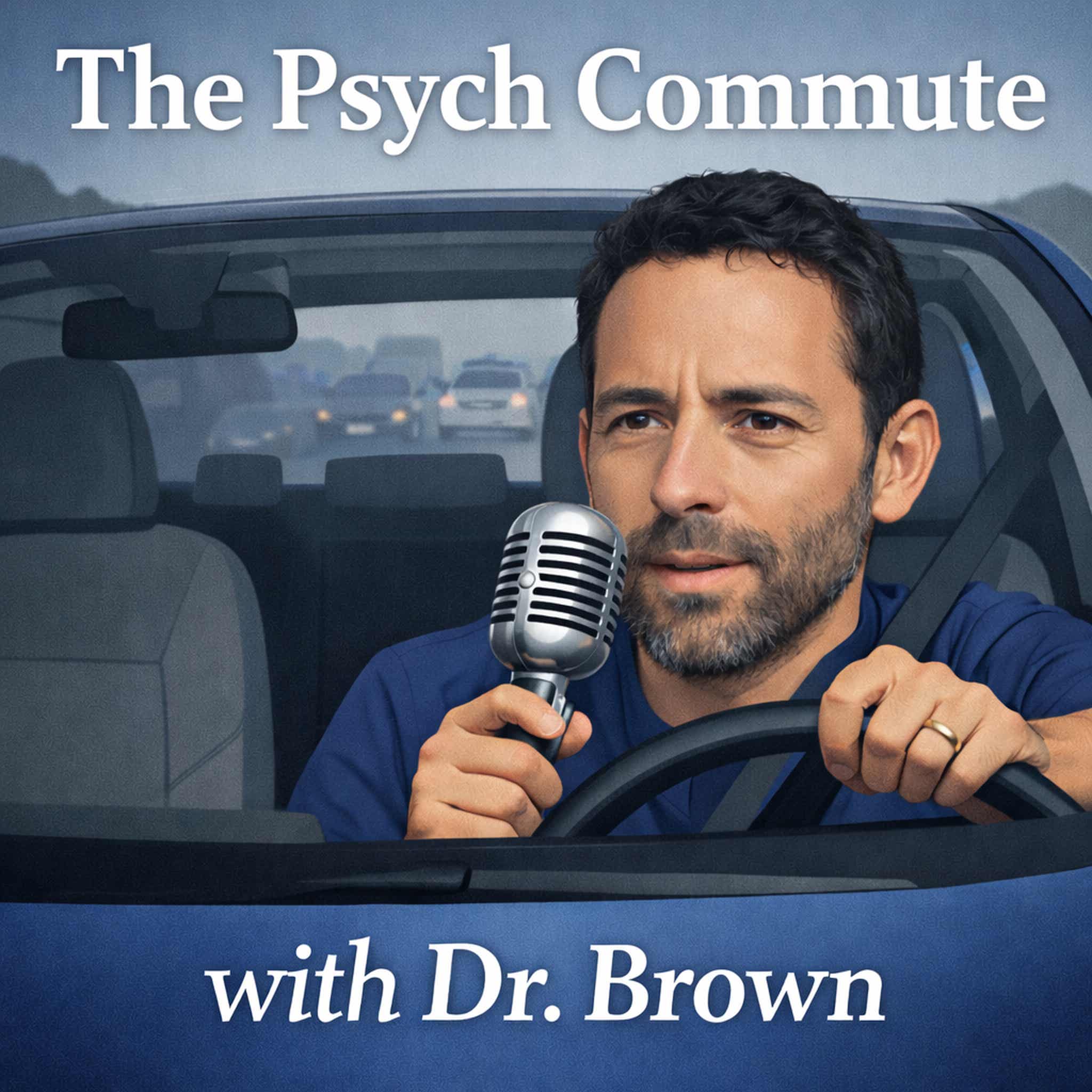
Brandon Lee Brown, MD
The Psych Commute with Dr. Brown
Thoughts on psychiatry, medicine, neuroscience, artificial intelligence, problem-solving, and decision-making from a practicing physician, psychiatrist, and neuroscientist recorded during his commute from work. brandonbrownmd.substack.com
Be sure to visit the podcast's website and support the creator: brandonbrownmd.substack.com
Author
Brandon Lee Brown, MD
Category
Podcast website
Latest episode
May 4, 2026
Where to listen?
Podcasts in the app Replaio Radio Coming soonPodcasts are coming to the app soon. Install now and be the first to see a whole new take on podcasts
 Install for free
Android almost 10M downloads · 4.8 rating
iOS soon
Install for free
Android almost 10M downloads · 4.8 rating
iOS soon
Episodes
#31 - DEAPL for making clinical decisions 04.05.2026 11:18
In this episode of The Psych Commute , Dr. Brandon Brown introduces a practical clinical decision-making framework: DEAL and its more detailed version, DEAPL, designed for moments of uncertainty when time and information are limited. Using a tense inpatient case of a severely dysregulated patient with seizure-like activity in a resource-constrained psychiatric setting, he walks through how to syst...
#30 Why I write my notes backward 18.02.2026 7:54
I write my notes backward. Not in the traditional SOAP format (Subjective, Objective, Assessment, Plan), but essentially in reverse: Assessment & Plan → Data (Subjective + Objective) So instead of SOAP, it’s more like AP–SO . This format isn’t unheard of in medicine. It’s fairly common in internal medicine. But in psychiatry, it’s unusual enough that when colleagues cover for me, they sometimes co...
#29 Simulated Case: Altered Mental Status 17.02.2026 12:18
On this episode of The Psych Commute , we try something a quite different. Instead of discussing a random idea as I drive home as usual, we run a fully simulated inpatient consult using AI voice actors (but I wrote the script with no AI involvement). The patient: a 65-year-old nursing home resident with schizophrenia sent to the ED for “altered mental status.” The workup is normal. The ED thinks i...
#28 Mapping Mental Illness in Genetic Space 09.02.2026 9:44
Mapping Psychiatric Disorders with GWAS I wanted to write record a brief episode about a paper I just read that came out in December 2025. The title is Mapping the genetic landscape across fourteen psychiatric disorders published in Nature. At a high level, this was a genome-wide association study (GWAS) looking across a large number of psychiatric diagnoses. The basic goal was to identify genetic...
#28 How I do my rounds for inpatient psych 05.02.2026 9:20
I’ve worked in very high-volume settings. In a prior job, I did moonlighting where I would round on thirty-something patients per day, sometimes with ten or more admissions in a single day. Efficiency mattered a lot there, because otherwise you simply could not get through the work. I don’t recommend that kind of volume, by the way. Fortunately, academic medicine is more reasonable. I’m capped at...
#27 Focused Ultrasound in Psychiatry 31.01.2026 11:31
I want to talk about focused ultrasound and its potential role in psychiatry. Right now, it is not an established psychiatric treatment, but it is being actively studied and I think there is a good chance it becomes part of our clinical toolkit in the next several years (albeit perhaps only at academic centers initially). Small clinical trials are already underway, and the technology itself is fur...
#26 ECT for PTSD 29.01.2026 7:10
Electroconvulsive therapy (ECT) is not FDA-approved for post-traumatic stress disorder (PTSD), and it doesn’t have an established clinical indication for PTSD in the way it does for severe depression, mania, catatonia, or treatment-resistant psychotic disorders. That said, over the past several years there has been mounting evidence suggesting that ECT may be helpful for some patients with particu...
#25 External combined nerve stimulator for depression, now approved 28.01.2026 10:31
I recently read the randomized controlled trial for a new neuromodulation device called ProlivRX . It’s an external nerve stimulator that is now FDA approved for major depressive disorder in patients who are already on antidepressants and haven’t benefited from them. This comes on the heels of the recent FDA approval of the Flow Neuroscience FLX-100 transcranial direct current stimulation (tDCS) d...
#24 The First Non-Antipsychotic Antipsychotic 24.01.2026 12:46
In this episode, I break down one of the most interesting new developments in schizophrenia treatment: a medication that treats psychosis without dopamine blockade. And it also works for negative symptoms. I’m talking about xanomeline–trospium, brand name Cobenfy, a muscarinic-based therapy that targets M1 and M4 receptors, avoids extrapyramidal symptoms and metabolic side effects, and is not tech...
#23 Let's stop talking about neurotransmitters 21.01.2026 9:24
We spend a lot of time explaining psychiatric medications in terms of neurotransmitters and receptors, but that may be the wrong level of abstraction. In this episode, I argue that psychiatric illness is better understood as a problem of brain circuits and information processing, not low-level mechanisms like receptors, and that this helps explain why treatments like ECT and clozapine work when ot...
#22 FDA Approves At-Home Brain Stimulation for Depression 15.01.2026 12:34
There’s a new FDA-approved treatment for depression that you can do entirely at home called the FL-100 device by Flow Neuroscience. In this episode, I talk about transcranial direct current stimulation, or tDCS, a low-level brain stimulation technique that’s been around for years but just received FDA approval based on a large clinical trial. I break down how it works, what the data actually show,...
#21 Mental Status Exam 12.01.2026 20:55
What exactly is the mental status exam, and why does it matter so much in psychiatry? In this episode, I walk through the mental status examination point-by-point. I cover what each section is really trying to capture, how much variation there is between clinicians, and how a well-written MSE should let you imagine what it was like to sit in the room with the patient. We talk through appearance, b...
#20 The end of psych meds? 09.01.2026 11:10
In this episode, I talk about some genuinely exciting developments in transcranial magnetic stimulation, including new accelerated and even one-day TMS protocols that may outperform traditional antidepressant treatments, both in efficacy and cost. Conventional TMS usually takes nine weeks of daily treatment but new advances are making a full course of treatment possible in a single day, with surpr...
#19 Brief Psychotic Episodes 08.01.2026 9:55
Can a panic attack trigger a full psychotic episode that resolves within hours? In this episode, we discuss apparently rare and fascinating clinical presentations where panic attacks appear to precipitate brief psychotic symptoms, including hallucinations, paranoia, and disorganized behavior, followed by rapid and complete recovery. We discuss the differential diagnosis for this presentation and h...
#18 - thoughts on insomnia 02.01.2026 20:33
Insomnia is one of the most common clinical problems in psychiatry, both as a symptom of primary psychiatric disorders like mood and anxiety disorders, and as a primary sleep disorder. In this episode I share my thoughts on how to manage insomnia in clinical practice and make some points about how we often give up too quickly on trazodone and how we can increase the adenosine in our brains. Note:...
#17 - Clinical Reasoning Styles 30.12.2025 11:01
How do you clinch the diagnosis efficiently? In this audio essay I review some of the main clinical reasoning styles that physicians of all specialties must use when presented with a new clinical case. Namely, we discuss inductive reasoning, deductive reasoning, and pattern-matching. Being able to identify which reasoning process you’re using in a case could save you from diagnostic errors. In a f...
#16 - How I do brief one-session psychotherapy 18.12.2025 21:29
In this episode I introduce a condensed version of David Burn’s (author of the famous books Feeling Good and Feeling Great that popularize CBT) version of CBT that he calls TEAM CBT, where TEAM is an acronym that stands for Testing, Empathy, Assessment of resistance, and Methods. I use this approach with appropriate patients on the inpatient unit with good success and I have developed a worksheet...
#15 - Aripiprazole 17.12.2025 18:42
In this episode I give a broad overview of aripiprazole including details from the official prescribing information as well as weaving in my own clinical experience and opinions. I talk about my experience using aripiprazole off-label as monotherapy for severe depressive episodes. This is a public episode. If you would like to discuss this with other subscribers or get access to bonus episodes, vi...
#14 - Down Syndrome Regression Disorder 12.12.2025 6:39
Down syndrome regression disorder (DSRD) is a condition in which a patient with Down syndrome has an unexplained regression of previously attained functional milestones, e.g. going from verbal to non-verbal. It is often associated with catatonia and thus can respond well to ECT and that is often where psychiatry gets involved. This is a public episode. If you would like to discuss this with other...
#13 - Acute Mania 08.12.2025 14:41
In this episode, I give some general thoughts on managing acute mania in terms of pharmacological treatments but also just on trying to find common ground with a patient who may or may not believe they have mania or bipolar disorder. This is a public episode. If you would like to discuss this with other subscribers or get access to bonus episodes, visit brandonbrownmd.substack.com
#12 - Clozapine 05.12.2025 14:31
In this episode I briefly discuss my thoughts on clozapine. Clozapine remains psychiatry’s most effective yet most cautiously used antipsychotic. This episode reviews when to consider it, introduces the CLOSE mnemonic to remember its boxed warnings, and outlines standard-of-care dosing and monitoring strategies that support safe use. This is a public episode. If you would like to discuss this with...
#11 - The LETTER Framework for Teaching 25.11.2025 16:27
In this episode, I talk about my framework for teaching/coaching trainees in bite sized pieces when you’re busy. This works for psychiatry but also for any medical specialty. I introduce a simple five-step framework I use when listening to trainees give case presentations — the LETTER mnemonic (Listen, Explore, Test, Teach, Encourage/Reinforce). It’s designed to help attendings and senior resident...
#10 - Should I Let Them Go? Clinical Decision-Making in Psychiatry 22.11.2025 25:56
In this episode, I break down how psychiatrists make clinical decisions especially in regards to involuntary holds when the clinical situation is not entirely clear. Drawing on real inpatient cases, I walk through how to use a “best-case vs. worst-case” framework to guide safe, defensible decisions. Please note this is for general education only and is not specific medical advice. Rules around inv...
#9 Process-Based Formulation: Seeing Psychiatric Disorders Through Causal Networks 20.11.2025 16:19
In this episode I introduce what I call process-based formulation, a way of understanding difficult, “treatment-resistant” presentations by mapping causal loops and feedback processes, rather than hunting for a single diagnosis or cause. I contrast the classic medical model (differential diagnosis → one primary etiology → one treatment) with situations where suffering is maintained by self-perpetu...
#8 - Do Antidepressants Work in Bipolar Depression? 18.11.2025 10:14
In this episode of Dr. Brown’s Psych Commute , I opine on a question that bears a lot of disagreement: do antidepressants actually work in bipolar depression, or are they useless or even dangerous? I walk through the two main camps you’ll hear in psychiatry: * Those who argue antidepressants don’t work at all in bipolar depression and only increase the risk of mania, mixed states, and rapid cyclin...
Similar podcasts



Listen to the The Psych Commute with Dr. Brown podcast in Replaio
Radio and podcasts in one app - free, with no sign-up. Install today and do not miss the launch
Replaio is not a podcast publisher; show names, artwork and audio belong to their authors and are distributed through public RSS feeds.