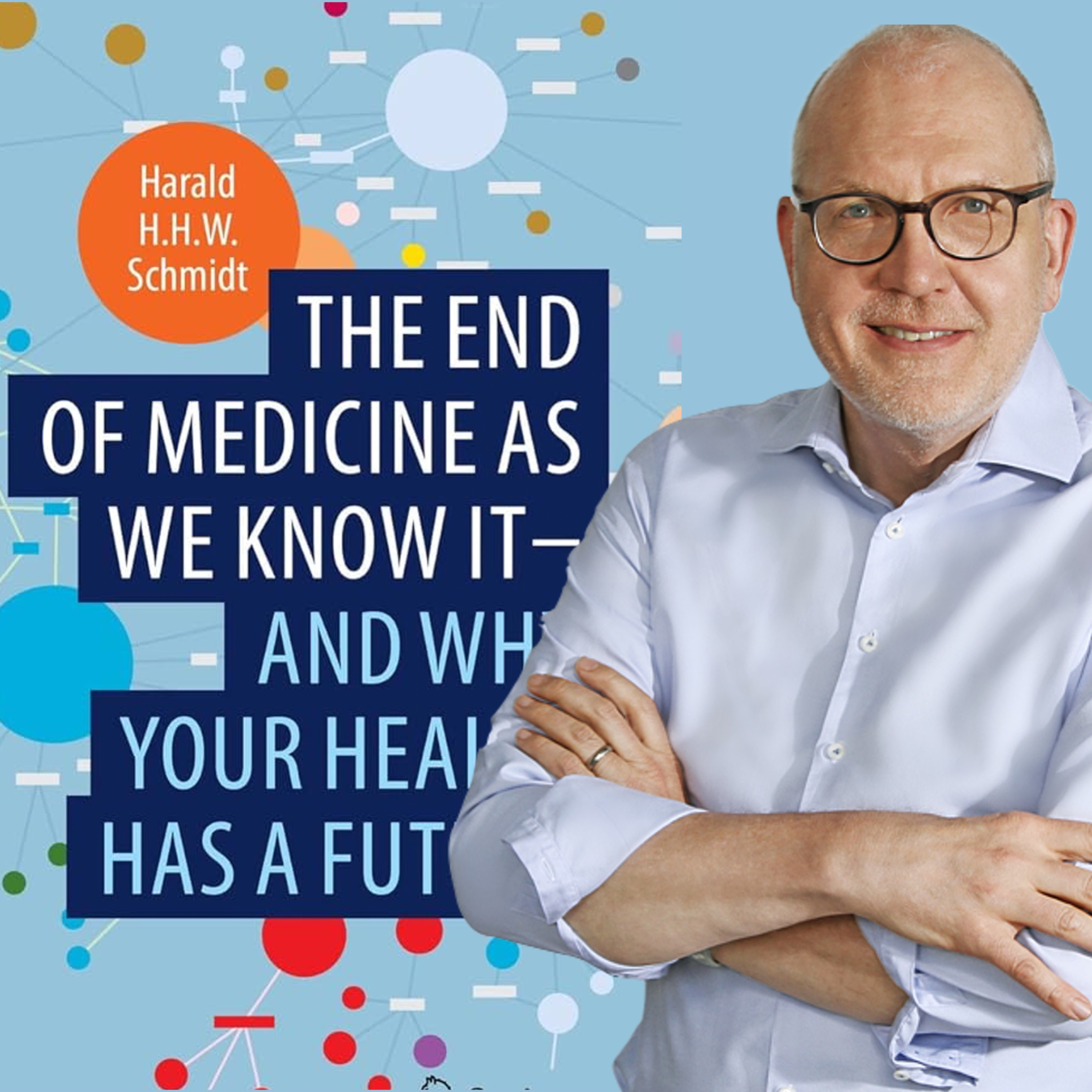
Harald H.H.W. Schmidt
The End of Medicine As We Know It
Teaser episodes for every chapter of the book published by Springer-Nature. Medicine is in crisis: we treat symptoms instead of causes, and most therapies help only few patients despite rising costs. In this series, Harald Schmidt shows why medicine as we know it will end—and how digitalization, AI and systems medicine will make healthcare precise, preventive and affordable. Those who embrace their digital twin will benefit from this revolution. Website: https://haraldschmidt.onlineContact: podcast@haraldschmidt.online
Be sure to visit the podcast's website and support the creator: podcasters.spotify.com
Author
Harald H.H.W. Schmidt
Category
Podcast website
Latest episode
Nov 23, 2025
Where to listen?
Podcasts in the app Replaio Radio Coming soonPodcasts are coming to the app soon. Install now and be the first to see a whole new take on podcasts
 Install for free
Android almost 10M downloads · 4.8 rating
iOS soon
Install for free
Android almost 10M downloads · 4.8 rating
iOS soon
Episodes
Bonus Episode: Interview with Future Proof 23.11.2025 15:18
Host : Jonathan McCrea, newstalk
Bonus Episode: Interview with Talk Radio Europe 23.11.2025 26:15
Interview on "The End of Medicine As We Know It."
Bonus Episode: Interview with Times Radio 23.11.2025 7:16
Host : Hannah MacInnes
Epilogue: Nobody Is Sick Anymore 23.11.2025 3:35
In this final episode of The End of Medicine As We Know It , we return to Max , the man from the prologue, and look at how radically life has changed in a world shaped by genome sequencing, microbiome profiling, digital twins, continuous monitoring, and precision prevention. This is not science fiction anymore—it is a realistic vision of what the healthcare landscape may look like in just a few...
Digital Twin 23.11.2025 5:24
In this episode of The End of Medicine As We Know It , we explore one of the most powerful concepts in modern health: creating your digital twin . This means digitising everything that defines your biology—your genome, microbiome, exposome, health behaviours, medications, and medical history—and building a personalised, lifelong data model that protects you from disease before it develops. We ex...
Self-Therapy 23.11.2025 4:09
In this episode of The End of Medicine As We Know It , we move from diagnosis to action . While gene therapy can eliminate some diseases entirely, most health risks come from genetically influenced vulnerabilities that interact with lifestyle, behaviour, and environment. These risks cannot simply be removed—but they can be controlled with personalised, targeted self-therapy. You’ll learn why g...
Self-Diagnosis 23.11.2025 3:10
In this final episode of The End of Medicine As We Know It , we turn from future visions to practical tools you can use today . Instead of waiting for the new era of precision medicine to arrive, you can already take your first steps toward smart, data-driven self-care —starting with modern symptom checkers . Millions of people search the Internet for symptoms every day. But “Dr. Google” rarel...
Interjection 2: Superhumans 23.11.2025 4:17
In this interlude of The End of Medicine As We Know It we step back from the technical details of precision medicine and take a wide, philosophical view of the coming era. The transformation driven by Big Data, machine learning, and genome engineering is not only changing medicine—it is changing what it means to be human. With disease prevention, early detection, and gene editing becoming routi...
Well-Tech 23.11.2025 6:10
In this episode of The End of Medicine As We Know It , we explore the rise of Well-Tech : a radically new, technology-driven health ecosystem built around precision prevention, personalised diagnostics, and real cures instead of chronic management. This is the point where everything learned in genomics, microbiome science, exposome research, big data, and AI comes together to redefine what “heal...
Healed 23.11.2025 5:10
In this episode of The End of Medicine As We Know It , we look at the difference between treating disease and truly healing it. Using a simple but powerful analogy—a faulty car component—we explore how medicine is now shifting away from chronic symptom management toward precise, data-driven, mechanism-based curative interventions . Imagine your old car: repairs every few months, ongoing chec...
Big Data Medicine 23.11.2025 4:09
In this episode of The End of Medicine As We Know It , we explore one of the most disruptive forces in modern healthcare: Big Data Medicine . When billions of data points from genomes, microbiomes, wearables, imaging, lab tests, lifestyle apps, and electronic health records converge, the only way to analyse them is through machine learning —the mathematical core of today’s so-called artificial...
Your Exposome 23.11.2025 5:43
In this episode of The End of Medicine As We Know It , we explore the exposome —the complete set of environmental factors that influence your biology from before birth until the end of life. Even if you fully understand your genome, microbiome, proteome, metabolome, and transcriptome , you still cannot predict your true health risks without understanding your exposome. It is the missing piece...
Outnumbered 23.11.2025 6:56
In this episode of The End of Medicine As We Know It , we dive into one of the most surprising facts in modern biology: you are outnumbered by your own microbes. Your body contains around 30 trillion human cells—but about 38 trillion bacteria live in and on you. And because each bacterial strain has its own genes, your microbiome carries 150 times more genetic information than your own geno...
Know Your Genes 23.11.2025 5:09
What can your DNA reveal about your health, ancestry, and future? In this episode of The End of Medicine As We Know It , we explore one of the most transformative topics in modern medicine: your personal genome. We discuss why knowing your genetic makeup will soon become a standard part of prevention, diagnostics, and treatment—and how you can benefit from it today. You will learn • how DNA testi...
Research for Patients 22.11.2025 5:01
If biomedical research is to truly serve patients, it must abandon the incentives that have steered it astray: chasing high-impact publications instead of medical progress. The issue is not the brilliance of scientists — it is the system. Today, careers, funding, and prestige depend on Nature, Cell and Science papers, not on whether research improves diagnosis, treatment, or outcomes. A future res...
Re-discover the whole patient 22.11.2025 7:25
Medicine’s future will not be an improved version of today — it will be something fundamentally new. To overcome the failures of organ-based, symptom-driven care, we must rethink how we understand disease, how we deliver care, and how we finance it. The next revolution will rely on Big Data , global digital infrastructure, and a shift from treating organs to understanding the whole human being ....
Interjection 1: How healthy do you want to be? 22.11.2025 3:56
Before entering the new world of medicine, this episode pauses to ask a deeper question: What does it mean to feel healthy? Drawing on Klaus Dörner and Byung-Chul Han, we explore how the pursuit of perfect well-being can become a trap: declining pain tolerance, hyper-attention to minor discomfort, and an expanding definition of disease. When health becomes a commodity, demanded and consumed like...
Organ-based Medicine 22.11.2025 7:18
The greatest flaw in modern medicine isn’t poor research or bad incentives — it is the very structure of the system itself: medicine divided by organs. Because we rarely understand the true causes of disease, we wait for symptoms, give diseases symptom-based names, and treat only what we can see. Organ specialists inherit this logic, leading patients with a single underlying cause to receive multi...
Research, Not for Patients 22.11.2025 6:34
Biomedical research should uncover disease mechanisms and deliver new therapies — yet most of it never reaches patients. Instead, basic science has become a self-reinforcing system built around publications, prestige, and grants. Clinicians rarely produce meaningful innovations, and pivotal clinical trials are largely industry-run. Worse, over half of all biomedical studies are not reproducible ...
The end of Big Pharma 22.11.2025 5:46
The core problem is structural: because diseases are defined by symptoms and organs rather than mechanisms, pharma can only create symptom-relief drugs with very low precision — the same concept that produces staggering NNT values. As mechanistic understanding fails, so does drug development. Facing dwindling innovation, some companies increasingly rely on legal grey zones or outright fraud to mai...
False incentives 22.11.2025 9:06
Healthcare systems differ widely — single-payer, socialized medicine, insurance mandates, hybrids — but all share one fundamental flaw: incentives reward disease care , not health . Prevention receives barely 1% of total spending. Hospitals maximize revenue through more cases, more procedures, and higher severity, not better outcomes. The result: unnecessary surgeries, inflated use of X-rays a...
Male and low income = double whammy 22.11.2025 5:18
Health systems matter far less than we think. Whether you live in the U.S. with private insurance or in the U.K. with tax-funded care, healthy life expectancy barely differs. What truly determines how long — and how well — we live is education and income . Higher education adds up to nine years of life; the gap in healthy years between low- and high-income groups reaches 14 years . Gender adds...
No prevention 22.11.2025 4:49
Why are chronic diseases rising — and why are they shortening life expectancy in countries like the U.S. and U.K.? This chapter reveals a simple but uncomfortable truth: the vast majority of chronic illness is preventable, yet our healthcare systems invest almost nothing in real prevention. Just 15 common conditions —from depression and back pain to diabetes, heart disease, COPD and cancer—drive ...
Chronic disease? 22.11.2025 5:27
What does it actually mean to be “chronically ill”? Medicine has no clear definition. For many patients, it means lifelong treatment, constant appointments, and deep social, emotional, and financial consequences. Chronic illness often leads to isolation — and loneliness, in turn, worsens disease. This episode explores the hidden burden of chronic disease and reveals a surprising truth: outside of...
Don’t Rely on Your Prescription 22.11.2025 5:32
When you take a medication, you naturally assume it will help you. Why else would you swallow it every day? But for millions of people, this hope is an illusion. Modern medicine routinely prescribes drugs that work only for a small minority of patients — and we usually have no idea who that minority is. Some common drugs, such as cholesterol-lowering medications, help only 1 in 50 patients....
Similar podcasts




Listen to the The End of Medicine As We Know It podcast in Replaio
Radio and podcasts in one app - free, with no sign-up. Install today and do not miss the launch
Replaio is not a podcast publisher; show names, artwork and audio belong to their authors and are distributed through public RSS feeds.