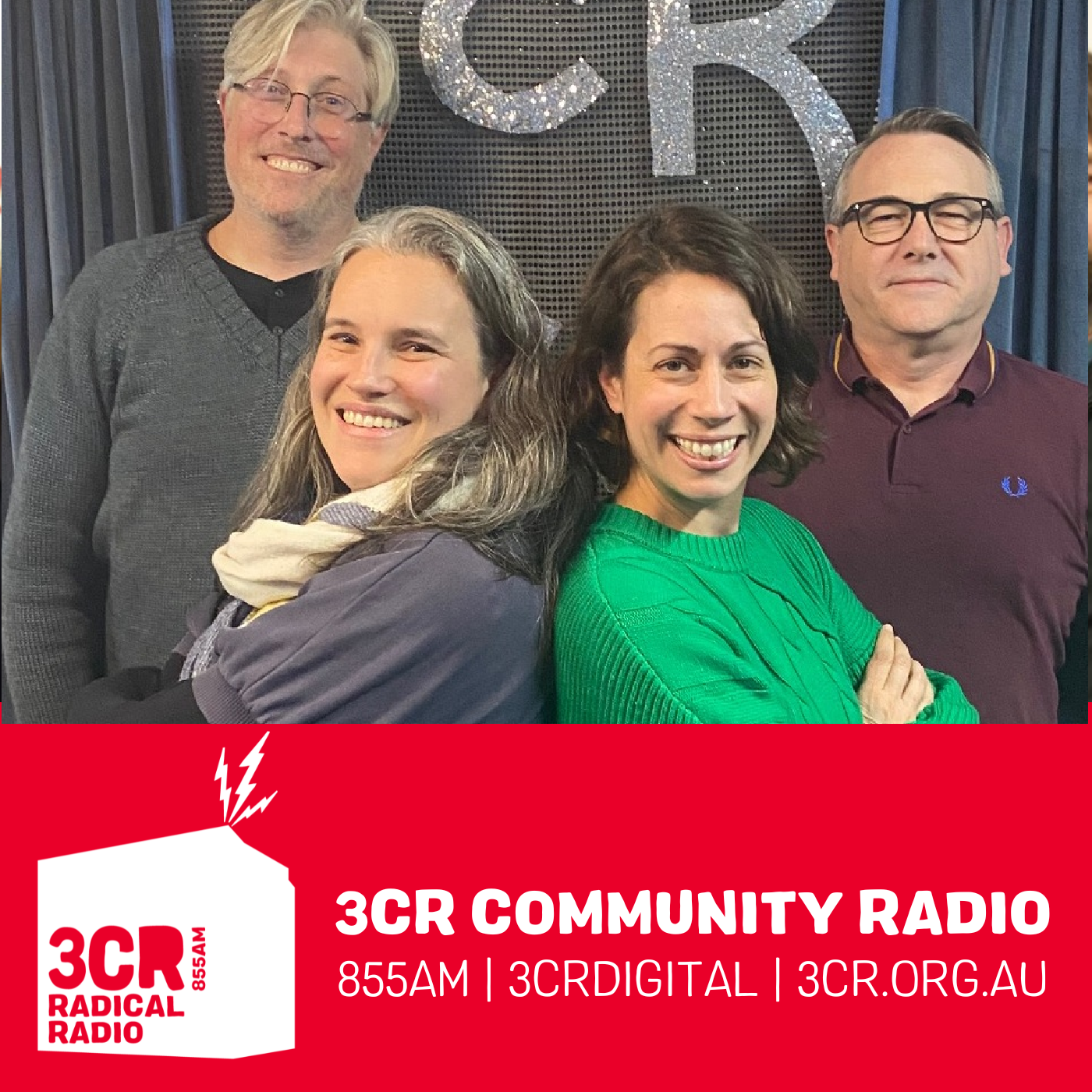
Chris Lassig, Stuart Burns, Claire Farrugia and Linden Ashcroft.
Lost in Science
Lost in Science is your weekly hit of mind-blowing science, strange facts, and big ideas. From cutting-edge discoveries to the science behind everyday life, our curious and passionate hosts make it fun, fast, and fascinating. If it’s weird, wonderful, or just worth knowing - we’re on it.
Be sure to visit the podcast's website and support the creator: www.3cr.org.au
Author
Chris Lassig, Stuart Burns, Claire Farrugia and Linden Ashcroft.
Category
Podcast website
Latest episode
Jul 8, 2026
Where to listen?
Podcasts in the app Replaio Radio Coming soonPodcasts are coming to the app soon. Install now and be the first to see a whole new take on podcasts
 Install for free
Android almost 10M downloads · 4.8 rating
iOS soon
Install for free
Android almost 10M downloads · 4.8 rating
iOS soon
Episodes
Llama nanobodies and nearby black holes 31.07.2024
This week, Cat tells us about nanobodies, the smaller versions of antibodies that camelids like llamas and alpacas have, and how they could help combat HIV; and Chris clues us into the closest known black hole in our galaxy, and a much larger one thousands of times the mass of our Sun, hidden inside a star cluster. Jianliang Xu et al., Ultrapotent Broadly Neutralizing Human-llama Bispecific Antibo...
Back in Time 24.07.2024
All we can do is step back in time. This week we go back to Claire's first ever story on the air about virgin births in the animal kingdom, and also listen back to Dr. Manisha Bhardwaj tell us about how bacteria may save bats from a dreaded fungal disease in her first story on the show.
Sleep Patterns and Space Health 17.07.2024
This week on Lost in Science, are you an early bird or a night owl? How does your sleep preference affect your body? Stu delves into the latest research on sleep, uncovering fascinating insights and practical tips. Meanwhile, Cat takes us on a cosmic journey, exploring the health challenges astronauts face in microgravity. From space illnesses to the science of sleep, tune in for an out-of-this-wo...
Woolly megabeasts and how they went extinct 10.07.2024
In our woolliest episode ever, Claire tells the tale of the woolly mammoth and new research on the last known individual, called Lonely Boy; and coincidentally Chris excavates a new study on the population dynamics of the woolly rhinoceros, and its extinction from climate change and human hunting. Dehasque et al. 2024. Temporal dynamics of woolly mammoth genome erosion prior to extinction. https:/...
Do tattoos cause cancer and are brains gendered? 03.07.2024
Chris looks into a recent paper connecting cancer cases with tattoos to check the figures, while Stu talks to Dr. Adam Osth, Associate Professor of Psychology at the University of Melbourne about a recent study from Stanford which claims to show there is no continuum of brain function between genders.
Vampire facials and flapping wings 19.06.2024
This week, Stu looks at the effectiveness or not of platelet-rich plasma for treating musculoskeletal injuries in sports medicine, and for so-called vampire facials in beauty treatment; and Chris digs into a new study on the physics of flight and the surprisingly simple formula for the frequency of flapping wings, which he then uses to calculate whether a human could fly by flapping their arms. Je...
Celestial Spheres and plant roots on acid 12.06.2024
Chris looks at how likely we are to find Dyson Spheres orbiting distant stars and Stu finds out whether plants can use complex molecules as nutrient sources
Orangutan Medicine and Artillery Fungi 05.06.2024
This week on the show, Claire delves into groundbreaking research showing orangutans self-medicating with pharmaceutically active plants, marking the first recorded instance of animals treating themselves this way. Meanwhile, Stu explores cannonball or artillery fungi, a type of fungus capable of shooting its spores over six meters, and discusses the havoc they can wreak on homeowners. Tune in for...
AI scientific authors & exotic exoplanets 29.05.2024
This week, Chris dives back into the murky world of research misconduct, to try to find out how much AI tools like ChatGPT are being used to write scientific papers, and how much of a problem it is; and Cat updates us on the search for planets orbiting other stars, including a pink, fluffy, fairy-floss planet. Andrew Gray 2024, ChatGPT "contamination": estimating the prevalence of LLMs in the scho...
Lost In Science... Flashback! 22.05.2024
Nothing is ever truly Lost in Science, we can always discover it again. This week Stu raids the archives of Lost in Science to find some stories from years gone by and presenters who have moved along. Chris talks about the oldest known fossils, Beth Askham talks about zombie bacteria and Stu talks bout the toughest substance known to animal kind, all stories from 2015!
How does the Sun cause auroras, and does social media rot kids’ brains? 15.05.2024
This week, Chris gazes at the recent spectacular auroras, and explains how matter ejected from the Sun leads to pretty lights in the sky; and Stu digs deep to find out what the actual research says about the effect of social media and internet use on the mental health of young people.
Quantum Computing and Macro fossil macropods 08.05.2024
Chris tries to figure out if the federal government's promise of a quantum computing centre in Brisbane is huge or a mere quanta, and Stu talks to Isaac Kerr from Flinders University about the discovery of 3 very large kangaroo-like fossil relatives of modern marsupials .
Blood Breakthroughs and Pig Kidney Transplants 01.05.2024
This week on Lost in Science, Claire explores revolutionary research that uses a gut bacteria enzyme to convert blood types, aiming to make all blood donations universally compatible. And Catriona discusses the latest in organ transplants, including a successful pig kidney transplant into a human facilitated by groundbreaking CRISPR gene editing. Tune in to learn how these innovative scientific br...
Long Covid treatment and recovery 24.04.2024
This week, Chris talks to rehabilitation specialist Professor Steven Faux about his new book on Long Covid, to find out what we know about it and its causes, and current best practice for treatment and recovery. We also speak to comedian Alanta Colley about the Sci Fight comedy debates, with the next event on 2 May 2024 discussing Elon Musk’s Neuralink brain implants. Long Covid by Professor Steve...
Ant Invasion & Bird Evolution 17.04.2024
This week on Lost in Science, Stu examines the invasive fire ant crisis and innovative control measures. Meanwhile, Chris explores bird evolution, spotlighting the Hoatzin, or "stink bird," known for its unique digestion and ancient traits. Tune in to discover how science is tackling ecological threats and unraveling avian mysteries.
Out of the Sun 10.04.2024
Even though we’re staying out of the Sun this week, we can’t stop thinking about it! Cat tells us all about the Sun’s corona, its crown-like atmosphere, and the solar wind of particles streaming out from it; and Claire runs us through the science and history of solar eclipses.
Energy costs of AI and energy transfer in forests 03.04.2024
Chris looks into the energy costs and economics of AI and how wider use will affect them, while Stu looks into the science of some of the claims around the supposed forest communication networks some authors have described.
Infectious diseases - TB vaccines & big COVID data 27.03.2024
This week on the show Catriona takes us into the realm of tuberculosis vaccines, describing the latest breakthroughs and how they diverge from conventional approaches. From novel formulations to enhanced efficacy, explore the promising advancements reshaping the fight against TB. Meanwhile, Stu delves into COVID-19 research, analyzing global data to uncover insights into mortality rates and the ef...
Antarctic life and Great Barrier Reef bleaching 20.03.2024
We’re getting into hot and cold water this week, as Claire talks to Dr Jarrod McKenna about the importance of Antarctica and its wildlife, including plankton, whales and penguins; and Chris speaks to Dr Maya Srinivasan from James Cook University about the current mass coral-bleaching event on the Great Barrier Reef, what causes it, how corals can recover, and what needs to be done to protect the r...
What colour are blueberries anyway? And what's happening with the moon boom? 13.03.2024
This week on Lost in Science, Chris asks the question are blueberries blue? And answers it with a question, what is colour anyway? And Stu looks to the skies to wonder why the sudden renewed interest in landing stuff on the moon, and whether anyone is having much success doing so.
International Women's Day: Breast cancer screeners and AI innovators 06.03.2024
Join Claire and Catriona this International Women's Day for a special edition of Lost in Science! Catriona explores cutting-edge technology transforming breast cancer screening, enhancing efficacy. Discover the latest breakthroughs shaping the future of healthcare. Meanwhile, Claire spotlights two pioneering women at the forefront of Artificial Intelligence, unraveling the mysteries of AI innovati...
Sun-eating quasar and Moon-making crash 28.02.2024
This week, Catriona tells us about the brightest-known object in the universe, a quasar 12 billion light years away that’s in fact a supermassive black hole that gobbles an entire sun every day; and we replay Claire’s story about new evidence for another theorised cosmic event, the Moon’s formation through a collision of the early Earth with the Mars-sized protoplanet Theia. Wolf et al. 2024. The...
Night Parrot genome and how time flies 21.02.2024
This week on the show Claire chats to CSIRO researcher Leo Joseph about the recent publication of the complete genome of the Night Parrot, the elusive nocturnal bird thought to be extinct for much of the 20th century, and what this means for conservation efforts for the bird. Also on the show, Chris asks the question, how can time fly without wings? Or more specifically, is there is any scientific...
Asbestos update and why moths go to light 14.02.2024
This week on the show Stu looks at the science of the material asbestos in light of this dangerous substance being found in mulch in public areas in Sydney. Also on the show, have you ever wondered why moths and generally insects are attracted to lights? Chris talks through some new research that sheds some light on the matter.
Love voles and Buruli ulcer mozzies 07.02.2024
This week, Catriona celebrates Valentine's Day the science way, showing what research on monogamous prairie voles can tell us about how hormones like dopamine and vasopressin affect our craving for love and affection; and Chris shares new research that suggests the bacteria that causes Buruli ulcer is spread between possums and humans by mosquitoes, and how to protect yourself from it. Lim et al....
Similar podcasts





Listen to the Lost in Science podcast in Replaio
Radio and podcasts in one app - free, with no sign-up. Install today and do not miss the launch
Replaio is not a podcast publisher; show names, artwork and audio belong to their authors and are distributed through public RSS feeds.