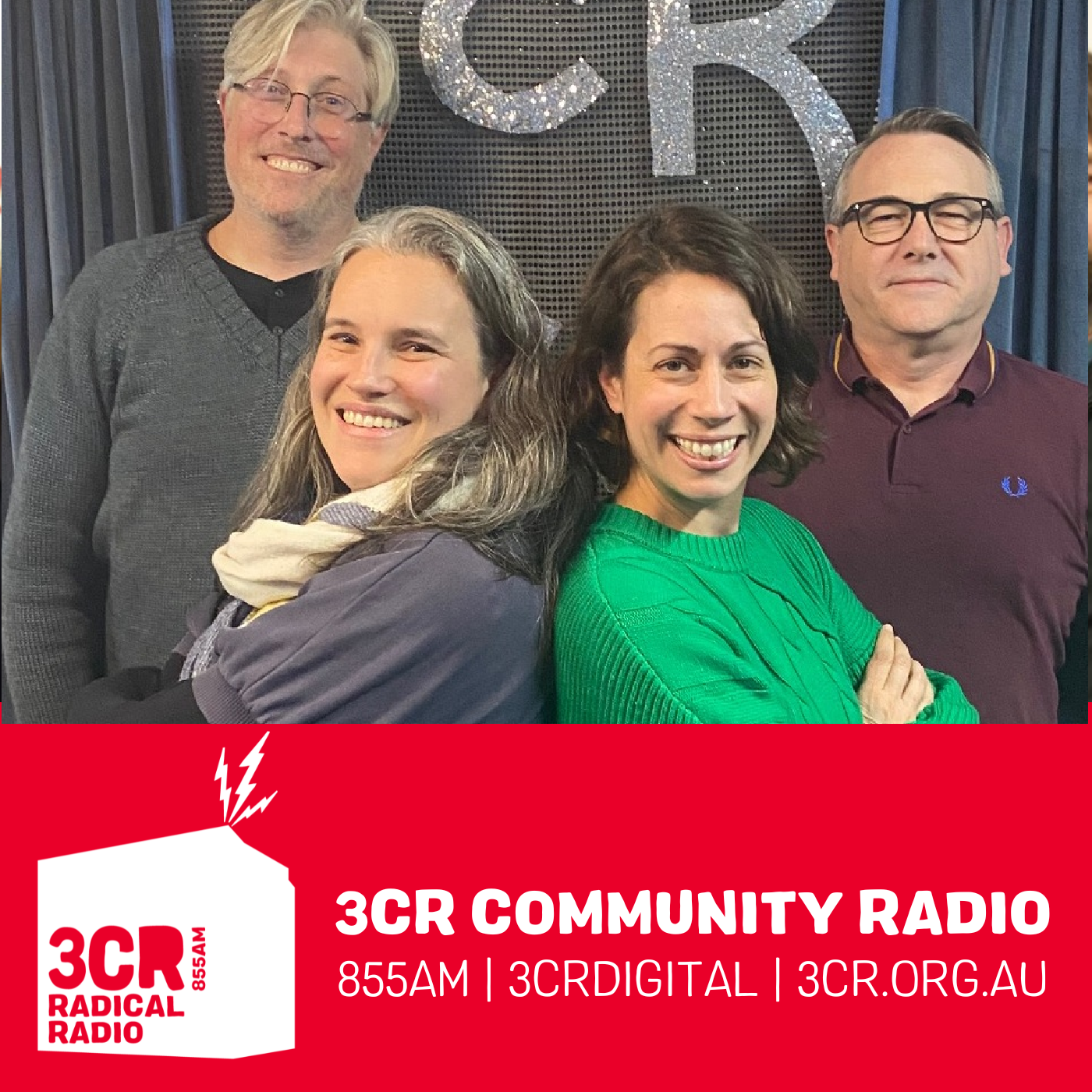
Chris Lassig, Stuart Burns, Claire Farrugia and Linden Ashcroft.
Lost in Science
Lost in Science is your weekly hit of mind-blowing science, strange facts, and big ideas. From cutting-edge discoveries to the science behind everyday life, our curious and passionate hosts make it fun, fast, and fascinating. If it’s weird, wonderful, or just worth knowing - we’re on it.
Be sure to visit the podcast's website and support the creator: www.3cr.org.au
Author
Chris Lassig, Stuart Burns, Claire Farrugia and Linden Ashcroft.
Category
Podcast website
Latest episode
Jul 8, 2026
Where to listen?
Podcasts in the app Replaio Radio Coming soonPodcasts are coming to the app soon. Install now and be the first to see a whole new take on podcasts
 Install for free
Android almost 10M downloads · 4.8 rating
iOS soon
Install for free
Android almost 10M downloads · 4.8 rating
iOS soon
Episodes
Summer Series: Satellite up the sky, and animal crossings 22.01.2025
Lost in Science summer series continues, Catriona talks about satellites causing problems for astronomers who can't see past them, and Claire explains how we can help native animals who can't necessarily see the danger in our roads.
Summer Series: Basics of alkaline water and great women in science herstory 15.01.2025
Our summer series continues with stories from past shows, this week Stu looks into the basic chemistry of alkaline water and why it isn't a panacea for anything much at all. And Chris talks about two historical female figures of scintific importance who may not be the household names they deserve to be.
Summer series: Animals teaching us how to love and how to fly 08.01.2025
Chris tells us about an amazing new discovery of dinosaur tracks in Britain, then we continue our replay of classic stories from the archive: Catriona shows what we can learn about love and affection from the hormones of monogamous prairie voles, and Chris shares the formula for the frequency of flapping wings to fly, and uses it to calculate how fast a human would need to flap their arms.
Summer Series: Bird Flu and Inverse Vaccines 01.01.2025
This week on Lost in Science, dive into our summer series as we revisit stories from the archives. Claire explores the impacts of bird flu on wild and domestic birds, while Catriona delves into the science of inverse vaccines and how they could help the body "forget" harmful immune responses.
End of year quiz and wrap up 25.12.2024
This week on Lost in Science, it’s our final show of the year! Chris challenges the team—and you—to a 2024 science quiz. Have you been paying attention to the biggest science stories of the year? Plus, Claire discusses some of the weird and wonderful research from 2024 worth celebrating. Join us for fun, facts, and a celebration of the science that shaped 2024!
Santa science: studying rivers from the sleigh & visiting every house 18.12.2024
For our Christmas episode, Linden speculates what Santa may see on his journey, such as changes in rivers as described in a recent study; and Cat crunches the numbers on how many houses Santa may need to visit, and how. Dongmei Feng, Colin J. Gleason ,More flow upstream and less flow downstream: The changing form and function of global rivers. Science 386,1305-1311(2024).DOI:10.1126/science.adl572...
New human species and Orangutan medicine 11.12.2024
This week on the show, Chris dives into the groundbreaking discovery of Homo juluensis, a newly identified hominin species that’s shaking up the story of human evolution. Meanwhile, we delve int the archive to revisit fascinating research detailing the first documented case of an orangutan using medicine on its own wounds.
Historical climate & alternative weather 04.12.2024
This week we welcome our new Lost in Science team member, climate scientist Linden Ashcroft, and learn all about her research compiling historical weather records to understand the patterns in our continent’s past (see lindenashcroft.com); and speaking of weather, Cat reveals some surprising ways to tell the weather, using crickets chirps, drying seaweed and moon haloes.
Fart charting & forever chemicals 27.11.2024
This week, Claire lets loose on flatulence, what we know, and how you can Chart Your Fart in a new CSIRO citizen science project, https://research.csiro.au/cshw/projects/chart-your-fart/ And Stu tells us about the so-called forever chemicals PFAS, and new research into how to get rid of them.
Rhinopocalypse and how long is a piece of string theory 20.11.2024
Cat explains why a changing climate might be changing peoples' allergies, and Chris unravels the reasons string theory has fallen out of favour
Uplifting Discoveries and Positive Science 13.11.2024
This week on Lost in Science, we’re all about good news! Join us for a feel-good episode as we explore some uplifting innovations. We’ll uncover tree bark microbes munching on methane, affordable e-waste metal recycling, and the incredible reboot of Voyager 1. Science bringing a dash of the positive to the news!
Lightning Power and Alien Biology 06.11.2024
In this spine-tingling Lost in Science Fiction special, Catriona channels her inner Doc Brown to explore if harnessing lightning could actually be a viable renewable energy source—just like Back to the Future! Meanwhile, Chris dives into the biology of the iconic Xenomorphs from the Alien universe, dissecting what makes these terrifying creatures tick. Tune in for a Halloween episode that’s out of...
Lost in Science Fiction rewind 30.10.2024
Some classic stories from our annual Lost in Science Fiction specials from years gone by. Chris and Stu talk Star Trek with popular culture researcher Andrew Lynch, Claire gets stuck into a hearty meal of Soylent Green, and Catriona wonders aloud why we still don't have hoverboards and flying cars
Puberty blockers & smartphones on the brain 23.10.2024
This week, Cat takes us through the science of puberty blockers, and how they can help young people sort out their gender identity; and Stu calls up the long list of research into the effects of smartphone use.
Gut Health, Chronic Disease & Space Junk 16.10.2024
This week on Lost in Science, Claire chats with Dr. Matthew Snelson about how our diet affects gutmicrobiome health and the link with chronic diseases. And we dig into the archives with Chris to explore space junk—who's responsible for putting it up there, tracking it, and bringing it down.
Close call elections and more moony news 09.10.2024
Is it just Chris or are elections getting closer and closer of late? He spoke to psephologist Adrian Beaumont and was surprised by what he was told. And Stu has been looking at the moon and finding out there's more discoveries about the moon all the time, and not just regarding our local satellite(s).
Short-term mini-moons & cave diving for fossils 02.10.2024
This week, Cat tells us what makes a moon, and how they can only orbit us temporarily like Earth’s latest mini-moon 2024 PT5; and Claire takes us underground and underwater as she speaks to palaeontologist Meg Walker about diving for megafauna fossils in South Australia’s limestone caves.
Wow! Signal Mystery and Microbes on the Move 25.09.2024
This week on Lost in Science, Chris investigates fresh research into the mysterious Wow! signal detected by the Big Ear radio telescope, and could it be evidence of a weird cosmic outburst? Meanwhile, Stu takes us on a journey through the sky—examining how microbes hitch a ride on atmospheric currents, traveling vast distances across the planet. How far can these tiny travelers go, and where do th...
An Ignobel time of the year 18.09.2024
How can a plant imitate the leaves of a plastic plant when it has no eyes, and no brain? How can a dead fish swim? Can animals breathe through their bums? These are the questions that have driven scientists and philosophers to insomnia and madness for centuries, but now, the Ignobel prizes has brought their answers to light. This week on Lost in Science
Invisible mice & whale secrets 11.09.2024
This week, Stu tells us about new research making animals invisible, or rather their tissue transparent, using a common food dye; and Cat tells us about how humpback whales make and use nets of bubbles as tools for hunting, and recently discovered secrets of their mating and birth. Zihao Ou et al. Achieving optical transparency in live animals with absorbing molecules. Science 385, eadm6869(2024)....
Back in time: Cat Taste & Wombat Citizen Science 04.09.2024
This week on Lost in Science, we're taking a trip back in time to revisit two fascinating stories! First up, Chris dives into the curious world of cat taste—exploring why our feline friends are such picky eaters and the evolutionary reasons behind their unique palate. Then, Claire catches up with Dr. Julie Old to chat about the incredible wombat and the groundbreaking citizen science project, WomS...
Long Covid risk & skyglow pollution 28.08.2024
This week, Chris speaks to virologist Assoc. Prof. Kirsty Short from the University of Queensland about their new online calculator which estimates your risk of adverse COVID-19 outcomes and Long Covid; and Cat tells us about how skyglow blocks our view of the stars and First Nations' Sky Country, and why it should be possible to fix. COVID-19 Risk Calculator: https://corical.immunisationcoalition...
Croc Defence and Cellular Aging 21.08.2024
This week on the show, Claire dives into an innovative strategy to protect freshwater crocodiles from deadly cane toad poisoning by, surprisingly, giving them a taste of food poisoning first. Meanwhile, Stu explores groundbreaking research into cellular aging, shedding light on what really makes us age and how we might slow down the clock.
Possible signs of Martian life & slow Olympic swimming pools 14.08.2024
This week, Chris talks to astrobiologist David Flannery about the discovery by NASA’s Perseverance Rover of potential biosignatures in a rock on Mars, and what’s needed to verify it; and Cat examines the question of whether the swimming pool at the Paris Olympics was really slower to swim in.
The naming of things, and how dangerous are pollutants? 07.08.2024
Stu looks at some name changes in the botanical world that may not change everyone's world, but could have a positive impact for some. Claire talks to Ollie Jones about the true risk of some chemicals that get a lot of attention from the media, but may not be as threatening as they are made out to be.
Similar podcasts



Listen to the Lost in Science podcast in Replaio
Radio and podcasts in one app - free, with no sign-up. Install today and do not miss the launch
Replaio is not a podcast publisher; show names, artwork and audio belong to their authors and are distributed through public RSS feeds.