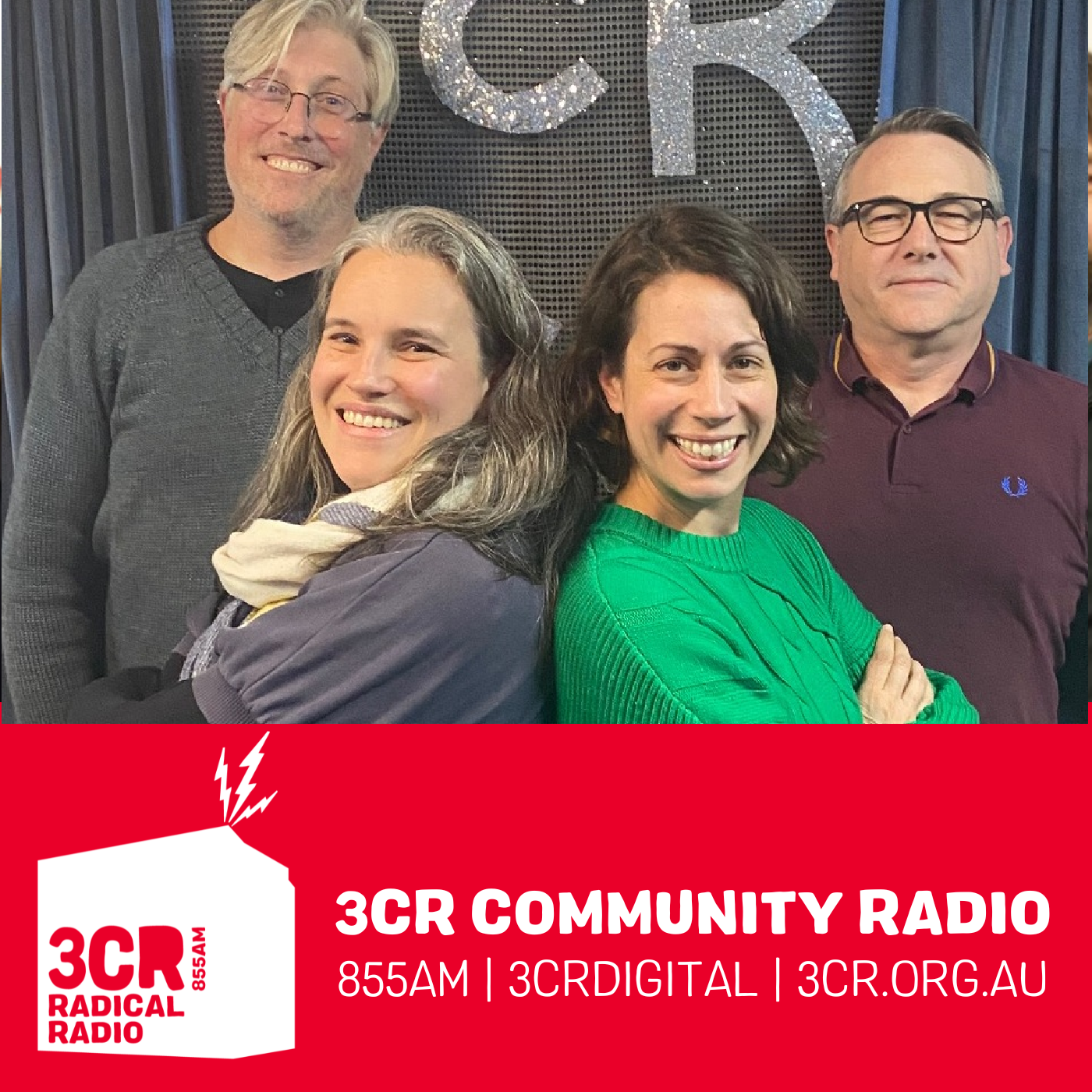
Chris Lassig, Stuart Burns, Claire Farrugia and Linden Ashcroft.
Lost in Science
Lost in Science is your weekly hit of mind-blowing science, strange facts, and big ideas. From cutting-edge discoveries to the science behind everyday life, our curious and passionate hosts make it fun, fast, and fascinating. If it’s weird, wonderful, or just worth knowing - we’re on it.
Be sure to visit the podcast's website and support the creator: www.3cr.org.au
Author
Chris Lassig, Stuart Burns, Claire Farrugia and Linden Ashcroft.
Category
Podcast website
Latest episode
Jul 8, 2026
Where to listen?
Podcasts in the app Replaio Radio Coming soonPodcasts are coming to the app soon. Install now and be the first to see a whole new take on podcasts
 Install for free
Android almost 10M downloads · 4.8 rating
iOS soon
Install for free
Android almost 10M downloads · 4.8 rating
iOS soon
Episodes
Artificial cells and carbon capture 08.07.2026
This week, Chris checks out the sensation of human-made SpudCells, which are not exactly alive but can do many of the things living cells can, as announced recently in press releases rather than peer review; and Stu checks in on carbon capture and storage for removing greenhouse gases from the atmosphere, and how it’s unlikely to deliver on its promise.
Pickle juice & Venus flytraps 01.07.2026
This week, Stu investigates whether there’s any science behind the use of pickle juice for muscle cramps, as observed in use in the World Cup; while Chris reveals some recent research by physicists on how Venus flytraps are able to snap shut so quickly.
Lost in Science 1.0 24.06.2026
Another step back in time to an earlier iteration of the show where former hosts present a range of stories on biodiversity and strange animal discoveries.
Science of Quicksand & Attractive Mozzie Repellent 17.06.2026
This week on Lost in Science, Chris gets stuck into the science of quicksand, exploring how this famous movie menace is actually a fascinating non-Newtonian fluid. Meanwhile, Claire investigates surprising new research into DEET, the world's most popular insect repellent, revealing that mosquitoes may be able to learn to associate it with a tasty meal, and even become attracted to it.
Step Back in Time 10.06.2026
In honour of our home stations 3CR's 50th anniversary we are delving deep into the archives for a show full of former presenter's stories
The making of a museum with Ben Francischelli 03.06.2026
Linden chats to Ben Francischelli about the birth and life of Prehistoric Bayside, a museum in Melbourne's southeast dedicated to marine fossils found in the area. In this extended chat, Ben explores how his career has led to building his own museum collection, what that involves, and the incredible fossils you can find in Melbourne's blue backyard.
Type1Screen with Dr. John Wentworth 27.05.2026
Stu catches up with Dr. John Wentworth from the Royal Melbourne Hospital to talk about Type1Screen, a nationwide project aiming to identify people at risk of developing Type 1 diabetes in order to develop treatments to prevent progression of the illness. See https://type1screen.org/ for more details
Time, Species and David Attenborough 20.05.2026
This week on Lost in Science, Stu explores new research into how animals perceive time differently — and how that perception is tied to the pace of their lives. Why does a fly seem to react in slow motion compared to us, and what does that reveal about survival, metabolism and evolution? Also on the show, we celebrate the 100th birthday of David Attenborough by taking a tour through some of the re...
Pointy things and leaches 13.05.2026
Chris follows the trail of research trying to answer the question of why sharp things in nature like teeth and stingers all have a similar shape, and whether it’s due to evolution or physics; and Linden latches onto leaches, how they’re still used in medicine but are also inspiring robots and weather prediction.
Happy Dog Science Project with Dr Mia Cobb 06.05.2026
Linden chats to Dr Mia Cobb, Chaser Innovation and John McKenzie Research Fellow at The University of Melbourne. Mia shares her career journey that led her to be a canine welfare researcher. Dogs do so much for us, but how can we use science to make sure we are giving them their best lives?
Chimpan A to Chimpan Zee and all natural nukes 29.04.2026
While people talk about the weather in speculative terms, it's interesting to note that chimps may do the same, but they also share some darker human traits we may not be so proud of. And Stu finds that (of course) not everything natural is safe or good, exploring the natural (but extinct) nuclear reactors of Gabon.
Imperfect AI physicians, and perfect pasta physics 22.04.2026
This week, Stu looks into the accuracy of AI as a medical search tool, and finds that published studies give mixed results; and Chris expands on last year's Ig Nobel Prizes to find out more about the physics of a perfect pasta sauce, and the role of emulsifiers.
Australia's Artemis Assistance & Citizen Science Month 15.04.2026
Claire and Linden talk all things Artemis II this week, with a special focus on how Australia is contributing to the program. We congratulate amateur astronomers from southeastern Queensland for their recent award, and explore how you can take part in international Citizen Science Month. To find a project for you, check out SciStarter, the Australian Citizen Science Association, or Zooniverse.
Baby brain rewiring & cabbage kitchen chemistry 08.04.2026
This week on Lost in Science, Claire dives into something very close to home — pregnancy — unpacking fascinating new research showing how both first and second pregnancies can reshape the brain for the long term, and what those changes might actually mean for how we think, feel and parent. Plus, it’s school holidays, and Linden’s in the kitchen cooking up some hands-on science with a true unsung h...
Dino Sails in the Sunset and Oils ain't Oils 01.04.2026
This week we go from fossils to fossil fuels, as Chris looks into the misclassification of the Dimetrodon and wonders why they didn't get bigger via giant spiders, and Stu drills down into the realities of Australia's oil reserves, and why our supply isn't what some people think it is.
CO2 in blood and artificial dinosaur eggs 25.03.2026
This week, Chris checks out a study showing carbon dioxide levels in human blood rising with greenhouse gas emissions, and contemplates the health effects; and Linden unearths a Taiwanese study that crafted artificial dinosaur eggs to determine whether the oviraptor Heyuannia sat on their nest to incubate them.
Sharks, Parasites & Oldest Known Rock Art 18.03.2026
This week on Lost in Science, Claire chats with veterinary parasitologist Professor Shokoofeh Shamsi about the recent spate of shark encounters and why we still don’t fully understand animal behaviour in these moments. From parasites to changing ocean environments, it turns out there’s a whole ecosystem of missing pieces—and a growing call for deeper research to help us make sense of it all. Meanw...
Post Punk Physics and Toxic Tick Bites 11.03.2026
Stu looks into the scientific origin of a famous album cover and how it reveals the legacy of a pioneering female astrophysicist, and Chris looks into the strange story of a tiny insect bite that can lead to anaphylaxis of a carnivorous kind.
International Women's Day 2026 04.03.2026
For our International Women's Day Special, Linden and Claire talk statistics around how to Balance the Scales for women in STEM in Australia. We also hear from women in STEM from across Australia about what International Women's Day means to them.
Reef atmosphere & parasite infections 25.02.2026
This week, Linden talks to atmospheric chemist Rob Ryan about the effect on coral of changes in the air over the Great Barrier Reef; and Stu updates us on some recent findings on parasites, including a self-experiment from a researcher’s encounter with a sand flea (Tunga penetrans).
Echidna egg evolution & AI changing suspicious minds 18.02.2026
This week on Lost in Science, Claire dives headfirst into the evolutionary echidna-and-egg conundrum: which came first — the placental mammal or the mammalian egg of our humble monotreme cousins? Then Stu explores fascinating new research into how artificial intelligence might help bring people back from conspiracy theories — not by arguing louder, but by engaging directly with the evidence that c...
The science of auroras, and the winter Olympics 11.02.2026
How can skiiers and ice skaters go so fast? It turns out, we're still not sure! And what ingredients are needed to see the northern or southern lights? Find out with Chris and Linden on this week's episode of Lost in Science. Additional show notes:To receive alerts from the Bureau of Meteorology's Space Weather Service, head to their Space Weather Service mailing list page.
Tracking the Buruli ulcer in Victoria 04.02.2026
Welcome back the team for a new year, and Stu talks to Professor Tim Stinear from the Doherty institute and Director of the WHO collaborative centre on Buruli ulcer about a project tracking the prevalence of the ulcer using environmental surveillance to assess presence and provenance of the bacteria.
Summer series: ADHD & water fluoridation 28.01.2026
Continuing our January tradition of playing highlights from the past year, Chris responds to media reports of possible over-diagnosis and over-medication of ADHD by looking at the data and current research and best practice; meanwhile Claire gets her teeth into a new, large longitudinal study that showed water fluoridation did not harm cognition or IQ.
Summer series 3: Euan Ritchie, Clancy Lester and Australian conservation 21.01.2026
This week Linden revisits two conversations from 2025 with champions of conservation: Professor Euan Ritchie from Deakin University and Clancy "The Bee Man" Lester. Euan and Linden discuss the 'de-extinction' of the dire wolf that was reported back in April 2025, and Clancy recounts his experiences exploring the Amazon looking for some insects to rival Australia's amazing creepy crawlies.
Similar podcasts





Listen to the Lost in Science podcast in Replaio
Radio and podcasts in one app - free, with no sign-up. Install today and do not miss the launch
Replaio is not a podcast publisher; show names, artwork and audio belong to their authors and are distributed through public RSS feeds.