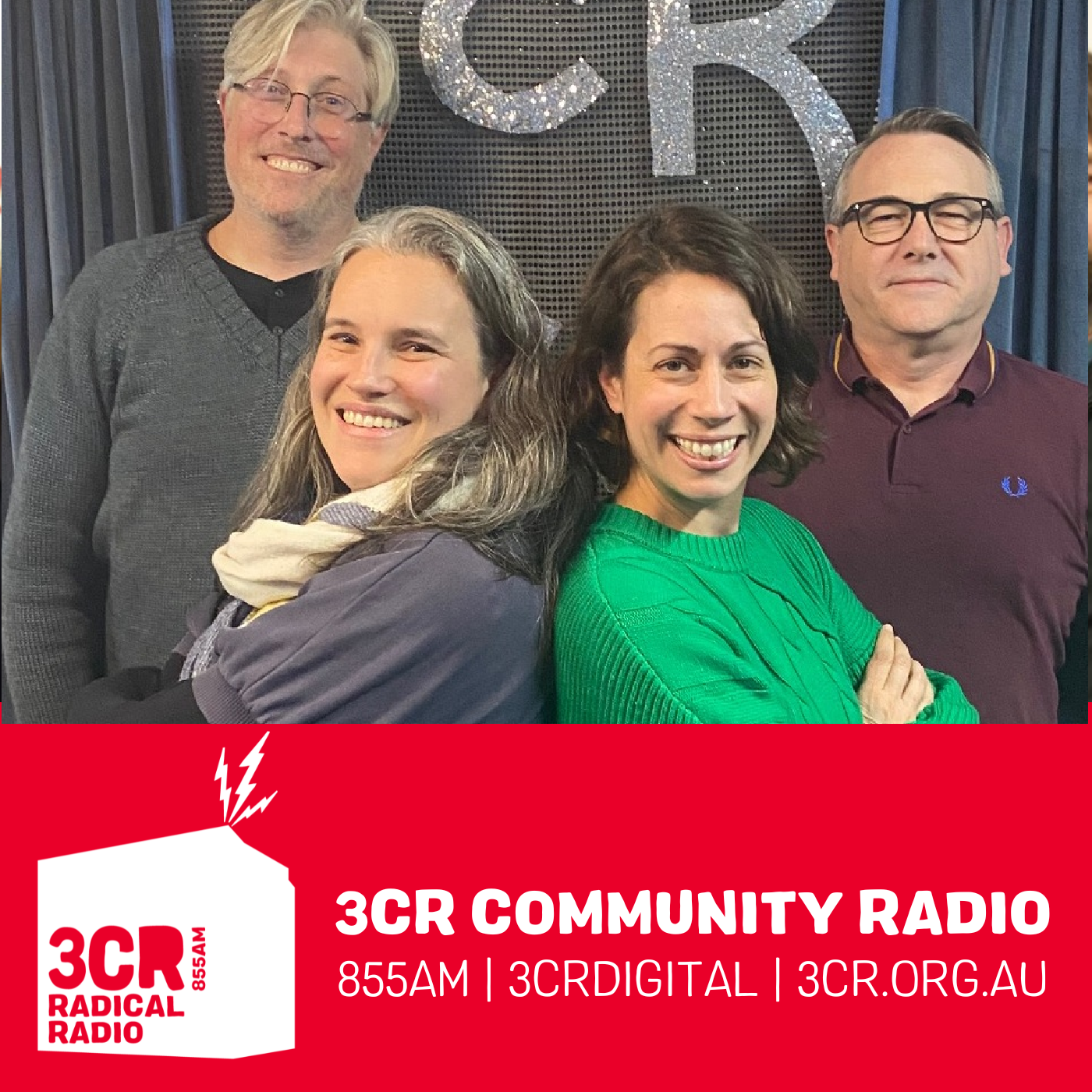
Chris Lassig, Stuart Burns, Claire Farrugia and Linden Ashcroft.
Lost in Science
Lost in Science is your weekly hit of mind-blowing science, strange facts, and big ideas. From cutting-edge discoveries to the science behind everyday life, our curious and passionate hosts make it fun, fast, and fascinating. If it’s weird, wonderful, or just worth knowing - we’re on it.
Be sure to visit the podcast's website and support the creator: www.3cr.org.au
Author
Chris Lassig, Stuart Burns, Claire Farrugia and Linden Ashcroft.
Category
Podcast website
Latest episode
Jul 8, 2026
Where to listen?
Podcasts in the app Replaio Radio Coming soonPodcasts are coming to the app soon. Install now and be the first to see a whole new take on podcasts
 Install for free
Android almost 10M downloads · 4.8 rating
iOS soon
Install for free
Android almost 10M downloads · 4.8 rating
iOS soon
Episodes
Summer Series: Physics vs evolution, Defrosted pathogens & jumping nematodes 31.01.2024
The final Summer Series for the year, Chris talks Physics vs evolution, Claire talks about pathogens defrosting in long frozen ice and Stu discovers nematodes lurking everywhere, and some that can jump!
Summer Series: Australian animals in danger and how science is saving them 31.01.2024
This week on our Summer Series Claire speaks to Dr Kylie Cairns all about dingoes, and her groundbreaking research using new genetic tools that has changed the way we understand the lineage of dingoes, as well as discovering endangered dragons with Jo Sumners from Museum Victoria.
Summer Series: Antimicrobial ants & gene therapy 17.01.2024
This week on the summer series we reach back into the archives to hear from microbiologist Dee Carter about her research into the active antimicrobial and antifungal molecules produced by the honeypot ant. Also on the we revisit Chris's story, which explains the new clinical trial taking place in NSW using gene therapy to treat muscular dystrophy in children.
Summer Series: Life on Earth and clever gulls 10.01.2024
This week on our summer series we bring back one of our favourite interviews with geologist Ashleigh Hood and her research studying the origins of life on Earth and how it has been sustained for billions of years. Also on the show Stu takes a look at the research showing that the humble seagulls might be a lot smarter than we give them credit for.
Summer series: clogged pipes & conspiracies 03.01.2024
It's the Lost in Science Summer Series, in which we replay some of our favourite stories from the past year! This week, Claire tells us why certain things, like fats and oils, leftover paint, flushable wipes, bamboo nappy liners and cat poo should not go down the drain or sewer; and Stu runs down research about how to prevent or pull people away from beliefs in conspiracy theories.
End of Year Quiz and Environmental impact of AI 03.01.2024
Our last show for the year looks back at one of the big themes of the year, Artificial Intelligence and Machine Learning - it is having an impact on society, but what environmental impact does it have? And Chris tests our listening skills with an end of year quiz.
Sciencemas! Fake vs real trees and El Niño in Australia 20.12.2023
Stu looks at the sustainability of artificial vs real Christmas trees and why they might be an odd choice for Australia. While Chris looks into why the El Niño climate cycle is acting strange for us in Australia this year.
Moon origin and space water 13.12.2023
This week, Claire tells us about new evidence for the leading theory of how the Moon was formed, through a collision of the early Earth with the Mars-sized protoplanet Theia; and Catriona updates us on where water can be found in our Solar System, and where it may have come from. Qian Yuan et al. 2023. Moon-forming impactor as a source of Earth’s basal mantle anomalies. https://doi.org/10.1038/s41...
Sitting sickness & bat viruses 06.12.2023
This week, Catriona tells us about the health dangers of sitting, and new research giving the good news that any alternative form of activity is beneficial; and Chris looks into why bats harbour such dangerous viruses, with a new study that predicts high virulence for viruses from them and a surprising other order of mammals. Blodgett et al. 2023. Device-measured physical activity and cardiometabo...
Giant ancient eagles & potato disease breakthroughs 29.11.2023
This week on the show we speak to Dr Ellen Mather about the huge birds of prey that ruled ancient Australian skies, including the new discovery of an Australian vulture and giant eagle. Also on the show, Stu talks about the new research helping to protect potatoes against disease like the horrid potato blight.
Physics vs Biology, and Viruses vs Bacteria 22.11.2023
Chris looks into the new theory that supposedly bridges the potentially non-existent gap between physics and biology, and Stu talks to Jeremy Barr about his research into bacteriophages and what impact they may have in our own bodies.
Life at the EXTREME 15.11.2023
This week on the show we are going EXTREME (all caps needed) as we take a look at life living on the edge, at the extremities of existence. Stu talks about some of the weirdest plants living in the most extreme salinity conditions. And Cat chats us through how extremophile life around the world has surprised us and helped humans innovate new technologies.
Wombat apps & reproducibility gaps 08.11.2023
This week, Claire speaks to zoologist Julie Old from Western Sydney University about finding out more about wombat populations and the threats they face, through the citizen science project WomSAT, which you can join at https://www.womsat.org.au/. And Chris talks to ecologist Hannah Fraser from the University of Melbourne about her new study on research reproducibility in which hundreds of researc...
The microbial origins of brains, and microbial threats to them 01.11.2023
Chris looks into the unlikely origin of human brain cells, and Claire looks at the possibility of unlikely threats to our modern brains
Lost in Science Fiction: AI and hyperspace 25.10.2023
This week on the show it's Lost in Science Fiction, our annual Halloween extravaganza where we deep dive into what's real and what's dubious in the scifi world. Stu brings us the years hottest topic, Artificial Intelligence, and how it has been treated by scifi cinema. And ever wondered if we could really travel to different galaxies faster than the speed of light? Could hyperdrive be real? Chris...
Sate-light pollution and silky spider worms 18.10.2023
This week Catriona looks up into the increasingly bright night sky and asks how much light pollution is coming from the new satellite constellations being launched by private companies, and Stu pulls on a thread about the origins of silk, what animals it comes from, how that might be changing, and why.
Quantum dots & asteroid dust 11.10.2023
This week, Chris introduces us to quantum dots, the nanoparticles whose discovery won the Nobel Prize in Chemistry 2023 for Moungi Bawendi, Louis Brus and Alexei Ekimov; and Claire explains the story and significance of NASA’s OSIRIS-Rex mission that recently returned to Earth samples from the asteroid Bennu.
Double creature feature; big dinos and hybrid species 04.10.2023
This week on the show it's a double creature feature. Chris answers a question we have all wondered; why are dinosaurs so big, and looks at some new research along the way. And Stu delves into the world of hybrid species. You might have heard of a mule, or a liger, but why do some animals hybridise and some do not?
Ignobel 2023 and water on... water on the moon 27.09.2023
Stu runs through the winners of the least most wanted prize in science, the Ignobel prize for 2023, and Chris takes a look at some new research about water on the moon which might help the numerous missions currently underway to find it
Life on distant worlds and protecting it on ours 20.09.2023
Neptune is too far from the sun to support life, apparently, but a recently discovered Neptune-like exoplanet has shown signs of life in recent surveys, what does this mean? Chris explains in this week's show. While Stu returns from a holiday with a tale of disease control measures and people who have a beef with them, and why they should think twice about why quarantine exists.
Compost Coach and cat taste 13.09.2023
This week on the show Claire is joined by author and compost educator Kate Flood, aka Compostable Kate, to get down and dirty on the science of compost. Kate talks about some of the misconceptions of composting and how you can create a biodiverse ecosystem in your own home! Also on the show Chris revists one of our most hard hitting stories of all time, cat taste buds! That's right, our feline fri...
Cancer immunotherapy & hand-clapping physics 06.09.2023
This week, Catriona tells us about exciting new developments in using chimaeric antigen receptor (CAR) T cells against all forms of blood cancer; and Chris shares what physics can tell us about hand clapping, particularly the best way to clap for measuring acoustics. Wellhausen et al. 2023 “Epitope base editing CD45 in hematopoietic cells enables universal blood cancer immune therapy”: https://doi...
Natural gas in the home and room temperature Superconductor stories 30.08.2023
This week on the show Claire takes a look at a controversial and hot topic - natural gas! Specically about some of the research that shows the adverse health risks of using methane to heat and cook at home. Also on the show, Chris revisits the latest research around the elusive room temperature superconductors. Could it be too good to be true? Only science knows!
Topological switching, exercise and immunity and Albany Pitcher Plants 23.08.2023
Gotta get back in time: one from the vaults this week, Chris talks to Mark Edmonds about topological switching, Claire chats to Catriona in her first appearance on the show about her PhD research and Stu talks to Adam Cross about Albany pitcher plants from WA in these flashbacks from 2019.
Antimicrobial Honeyants and historical zoology 16.08.2023
This week on the show Claire chats to Professor Dee Carter about an unlikely candidate in the fight against antibiotic resistance - the honeyant, and new research showing the unique antimicrobial activity of their honey. Also on the show, Stu gets historical and chats about some of the big mistakes of the past in zoology and botany, and how we are still paying them.
Similar podcasts




Listen to the Lost in Science podcast in Replaio
Radio and podcasts in one app - free, with no sign-up. Install today and do not miss the launch
Replaio is not a podcast publisher; show names, artwork and audio belong to their authors and are distributed through public RSS feeds.