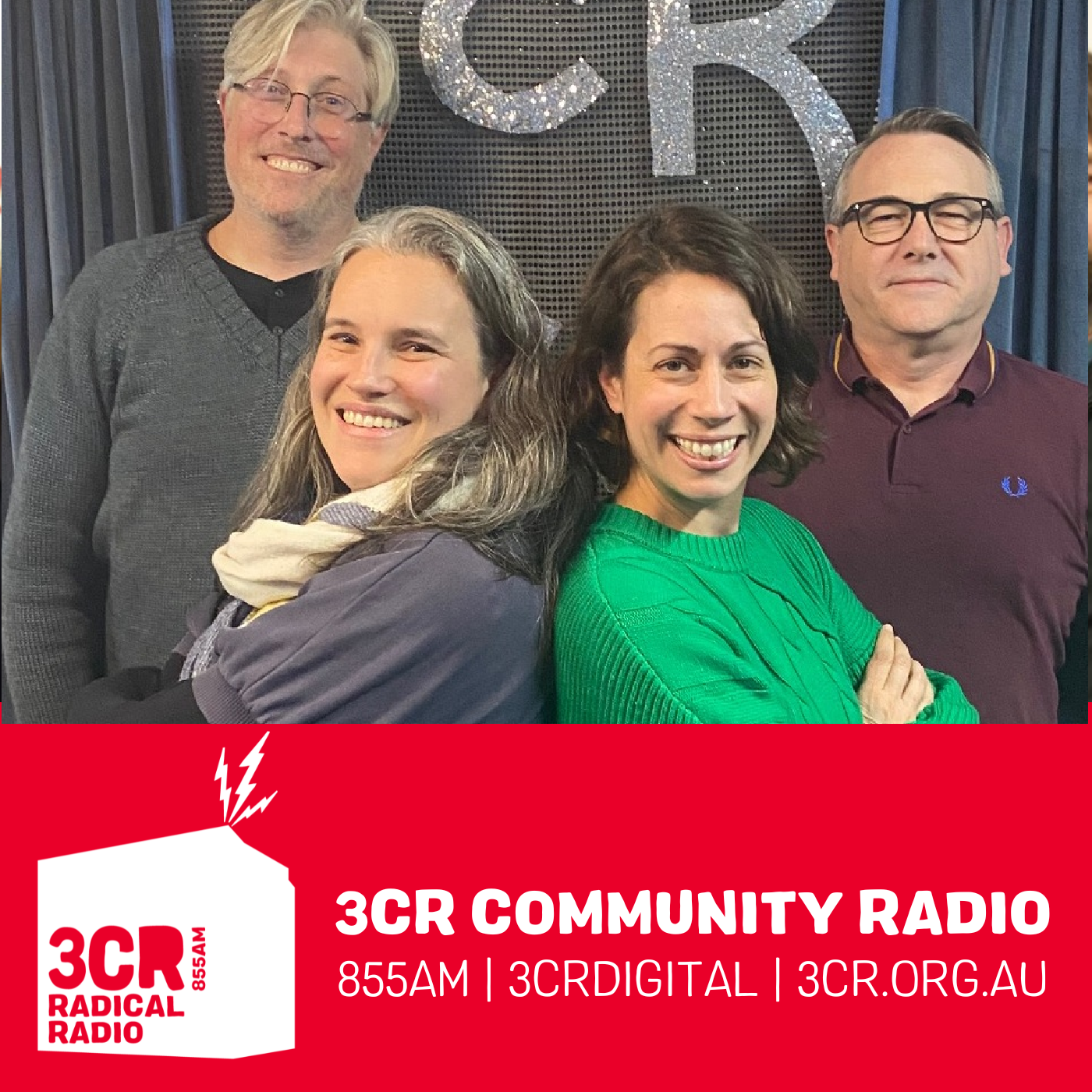
Chris Lassig, Stuart Burns, Claire Farrugia and Linden Ashcroft.
Lost in Science
Lost in Science is your weekly hit of mind-blowing science, strange facts, and big ideas. From cutting-edge discoveries to the science behind everyday life, our curious and passionate hosts make it fun, fast, and fascinating. If it’s weird, wonderful, or just worth knowing - we’re on it.
Author
Chris Lassig, Stuart Burns, Claire Farrugia and Linden Ashcroft.
Category
Podcast website
Latest episode
Jul 8, 2026
Where to listen?
Podcasts in the app Replaio Radio Coming soonPodcasts are coming to the app soon. Install now and be the first to see a whole new take on podcasts
 Install for free
Android 5M+ downloads · 4.8 rating
iOS soon
Install for free
Android 5M+ downloads · 4.8 rating
iOS soon
Episodes
Lost in Science Fiction: Back to the Future, Eternal Sunshine & Star Wars 28.10.2015
Celebrate Halloween the Lost in Science way with our annual Lost in Science Fiction episode! SPECULATE on the science of the Force and whether, being a long time ago in a galaxy far, far away, we could actually watch Star Wars: Episode VII—The Force Awakens if we had a powerful enough telescope. PICK APART the feasibility of memory erasure as seen in Michel Gondry's romance/sci-fi/comedy/drama Ete...
Winners! Nobel for medicine, Victorian engineer of the year, and the metal silver. 21.10.2015
The Nobel Prize for medicine was awarded to three researchers for groundbreaking work on parasitic diseases of the developing world. The winner of Engineer of the year, Dr. Nicky Eshtiaghi, discusses her work investigating new ways to use human waste generated by growing citiesAnd we ponder why silver is only ever second prize when it's so useful.
Extreme life, extreme gravitational waves and extremely small optics 14.10.2015
Extremophiles are the toughest organisms on the planet, able to thrive in extremes of hot, cold, acid, alkaline, pressure and even deep underground inside rocks. The champion is the deceptively cute tardigrade or waterbear, which can even survive the vacuum of space (if you missed it, go listen to Mal Webb's Waterbear song).Possibly even more extreme are supermassive black holes, which are expecte...
Supercomputers for Sight, Waters of Mars, "Robot vs Star" wars 07.10.2015
We talk to Dr. Juan Nunez-Iglesias about how teaching a supercomputer how to see is helping us figure out how we see. We discuss the history and implications of finding liquid water on Mars. We find out how a "Terminator" poison injecting robot is leading the way in Star wars on the Great Barrier reef.
Fireballs in the sky, Ig Nobel prize for unboiling an egg, and prunes against cancer 30.09.2015
If you see a shooting star, don't just make a wish, report it! You can record your sightings using the Fireballs in the Sky citizen science app and help Curtin University's Desert Fireball Network figure out where they came from—and possibly where they landed. Find out more at fireballsinthesky.com.au. It's also the time of year when science's greatest prizes, the Ig Nobel Prizes, are awarded to r...
Cachexia breakthrough, new human ancestor, nano-scale biophotonics 23.09.2015
Amelia Johnston from Latrobe University talks to us about Cachexia, a wasting disease commonly associated with cancer which often puts an end to treatment, and how their new research has shown it may be possible to reverse it. We learn about the discover of thousands of bones of a previously unknown human ancestor, Homo naledi, in a cave in South Africa, and how it they cast doubts about existing...
Songbirds in the city, sugar in the diet, and serious problems in science 16.09.2015
Songbirds in the city, such as the Great Tit (Parus major), are learning to sing their mating calls at a higher pitch to cut through the urban clamour. But while this may help them be heard, the different tune may hamper their mating success. Sugar is today's popular dietary villain, but does it make sense to demonise a single nutrient? Dr Alan Barclay from the Dietitians Association of Australia...
Cane toads, courtship and Quinn 02.09.2015
The cane toad, Bufo marinus, is arguably the most hated pest in Australia (although some argue for the Common Myna), but how did it get here? Find out how it was introduced as a misguided attempt at a biological control, and why that went horribly wrong. To balance them out with some more attractive animals—or at least, animals trying to be attractive—we take a look at some bizarre courtship displ...
Chatting with a science star and catching dust from stars with solid smoke 26.08.2015
That stuff pictured above is aerogel, aka "solid smoke", which was used on NASA's Stardust probe to capture dust from comet Wild 2 and return it to Earth—along with a handful of precious samples of interstellar dust, giving a rare glimpse of material from outside our Solar System. In this show, Stu also talks to British scientist Maggie Aderin-Pocock, host of the long-running astronomy TV show The...
Australian championship soccer robots; Music is as important as food; Who is the SciBabe? 19.08.2015
Sean Harris from UNSW was part of the Australian team who competed in the RoboCup, the world soccer Robot championship in China this year, he explains how his team won. We discover how music is considered as important as eating and reproduction according to our brains' response to musical cues, and why that may be an evolutionary advantage. Yvette d'Entremont is a well known skeptical blogger who...
National Science Week, Year of Light and talking about curing cancer 12.08.2015
Everything gets a little more sciencey in National Science Week, on from 16-23 August. We do a round-up of some of the top events around the country, and take a look at this year's theme for the International Year of Light. We also talk to lung cancer researcher Kate Sutherland about Science in the Square, celebrating 100 years of the Walter and Eliza Hall Institute of Medical Research (WEHI) and...
Amanda Bauer on becoming a star, Mystery sleeping sickness, Maremmas: guardian (dogs) of the galaxy (of wildlife) 05.08.2015
Amanda Bauer is a research astronomer who studies the formation of stars and why galaxies stop forming stars as they get older, and tells us about the upcoming Space Jam event at the Powerhouse museum in Sydney for Science WeekThe cause of a mystery illness in a town called Kalachi in Kazakhstan remains difficult to pin down. Italian Maremma dogs have been used for years to guard livestock, but in...
Friendly pitcher plants, bandicoot arms and the linguistics of taxonomy 29.07.2015
Carnivorous plants aren't always scary: some form mutually beneficial symbiotic relationships with animals. The Fanged Pitcher-Plant from Borneo, Nepenthes bicalcarata (yes it actually has fangs), provides a home for carpenter ants, Camponotus schmitzi. And another species, Nepenthes hemsleyana, "communicates" with bats to encourage them to roost inside it, then feeds off their poop. Kathleen Garl...
Hagfish gills; rewilding; let there be light! 22.07.2015
The unfortunately named Hagfish or Slime Eel reveals a lot about how fish evolved, remaining fairly similar to its form 300 million years ago. It has gills, but doesn't need them to breathe, so what are they for? Rewilding is the protection of natural habitat by reintroduction of native plants and animals and exclsuion of exotic species. But will it save our ecosystems? The Astronomy and Light Fes...
Body lice, Black Death and big, big plasma tubes 15.07.2015
Feeling itchy? You will be soon as you listen to our tale of body lice, Pediculus humanus corporis. These blood-sucking insects are believed to have diverged from head lice, Pediculus humanus capitis, when humans started wearing clothes—which evidence suggests could have been as long as 170,000 years ago. We also talk to astrophysicist Cleo Loi, who discovered giant plasma tubes in the Earth's mag...
Basking Sharks, Pink Rhino Horns, and Happy Birthday Hubble! 08.07.2015
Claire fills us in on the life of the Basking Shark, which has been found in Victorian waters for the first time in over 80 years near Portland. Manisha explains details about a program in Africa to prevent Rhinocerus horn poachers by dying and poisoning their horns. And Stu wishes the Hubble Space Telescope a (belated) Happy 25th anniversary in space.
Sunny sensibility and liquid metal 01.07.2015
Did you know that the phrase "mad as a hatter" comes from the use mercury in millinery? And that burning coal is the source of most mercury pollution? And that red mercury, a feared and much-sought ingredient of nuclear weapons, probably doesn't exist? Find out the truth about mercury, aka quicksilver, aka hydrargyrum, the only metallic element that's liquid at normal temperature and pressure. Spe...
One small leap for a second, virgin births in the real world 24.06.2015
All clocks are an analog of the earth spinning on its axis, which we divide up into minutes and seconds to tell the time. But the earth's rotation is not constant, and changes speed over time. The International Earth Rotation and Reference Systems Service decides when we need to add an extra second here and there to keep our clocks in sync with the actual length of a day. Chris explains more. Whil...
Bacteria vs bat disease and opium poppies, and centrifugal vs centripetal force 17.06.2015
Guest presenter and bat expert Manisha Bhardwaj tells us about a bacteria that helps fight white-nose syndrome, a fungal disease that's killing American bats, and how it's now being tested in the wild. Bacteria also contribute to medicine by producing drugs, e.g. genetically modified Escherichia coli is used to manufacture insulin for treating diabetes. Now American and Canadian scientists have fo...
Coal seam gas vs the environment; the benefits of optimism 10.06.2015
Continuing our investigation of the science of so-called unconventional gas extraction, we turn to Australia where coal seam gas is driving community and environmental concerns. Although fracking is rarely used here (see the latest industry statistics), and the entire vast Great Artesian Basin is unlikely to be depleted (see the image above), some local water supplies have been contaminated by lea...
Who discovered microbes? And what is fracking? 03.06.2015
Antonie van Leeuwenhoek was a Dutch fabric salesman who made his own microscopes. They were so powerful he saw things nobody had seen before: a world of microscopic "animalcules" invisible to the naked eye. Initially nobody believed his reports, but he went on to document many microscopic life forms for the first time in history. And when people say fracking, what do they mean? Non-conventional ga...
Violet, bird beaks and Pluto 27.05.2015
This week we find out that violet appears to be between blue and red due to the complicated way we see colour (see below).We also hear how scientists have turned chicken beaks into crocodile snouts in order to understand how birds evolved, and we take a look at poor, neglected dwarf planet Pluto, to be visited this year by the New Horizons spacecraft.
Measles, psephology and human embryo editing in detail 20.05.2015
Measles vaccinations may indirectly prevent other communicable illnesses by protecting the immune system from damage, especially in children. Psephology is the scientific analysis and evalation of elections, but in modern times it faces some problems. Is there a crisis in psephology? Also, how much have our weather predictions improved in recent times? Dr. Hannah Brown studies the relationships of...
Mercury, caffeine, and zombie bacteria 13.05.2015
This week we bid farewell to the MESSENGER spacecraft and everything it's revealed about the smallest and closest planet to the Sun, Mercury. We also learn that caffeine is the world's most widely used psychoactive drug, and that scientists are using zombie bacteria stuffed with silver as an antimicrobial Trojan horse.
Similar podcasts








Listen to the Lost in Science podcast in Replaio
Radio and podcasts in one app - free, with no sign-up. Install today and do not miss the launch
Replaio is not a podcast publisher; show names, artwork and audio belong to their authors and are distributed through public RSS feeds.