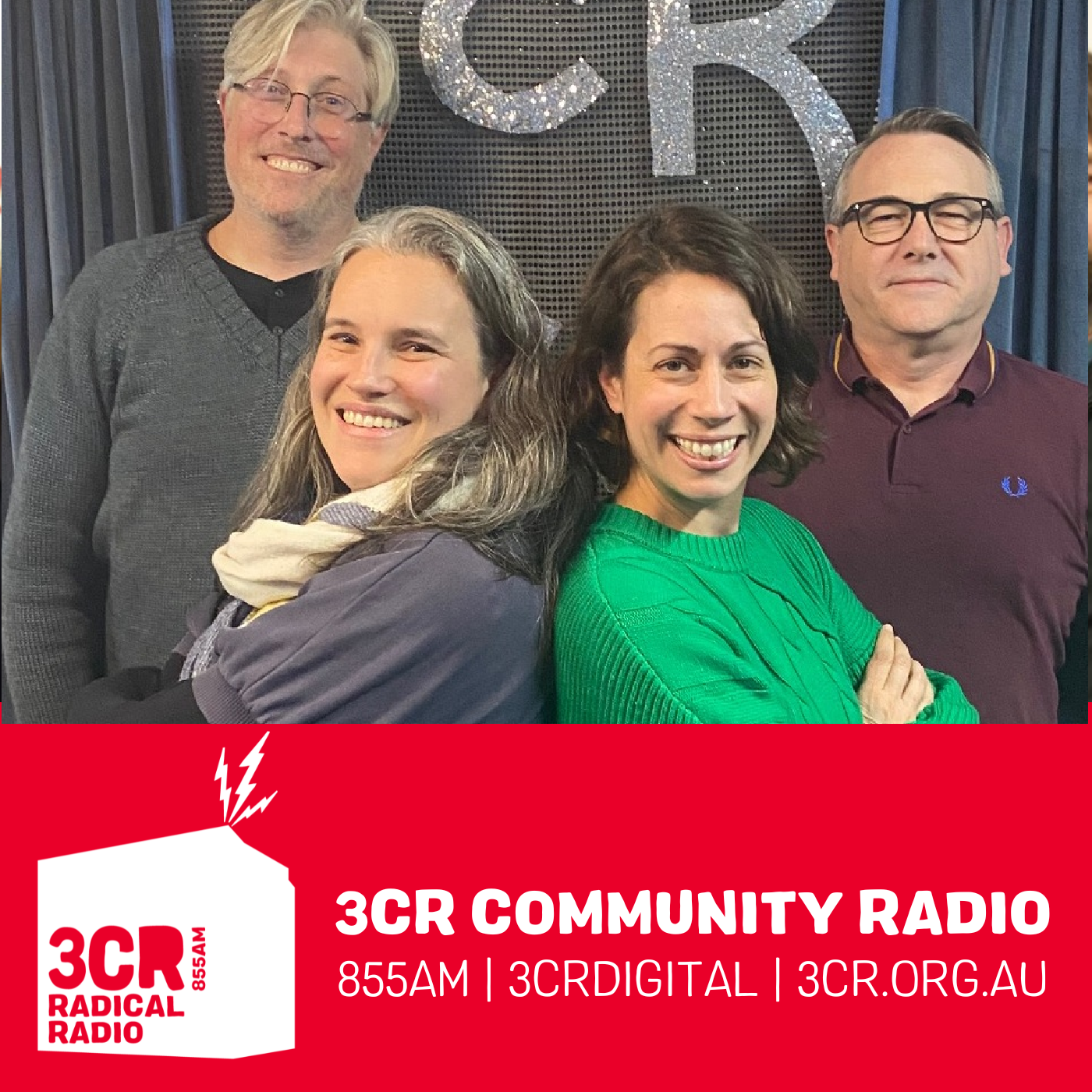
Chris Lassig, Stuart Burns, Claire Farrugia and Linden Ashcroft.
Lost in Science
Lost in Science is your weekly hit of mind-blowing science, strange facts, and big ideas. From cutting-edge discoveries to the science behind everyday life, our curious and passionate hosts make it fun, fast, and fascinating. If it’s weird, wonderful, or just worth knowing - we’re on it.
Author
Chris Lassig, Stuart Burns, Claire Farrugia and Linden Ashcroft.
Category
Podcast website
Latest episode
Jul 8, 2026
Where to listen?
Podcasts in the app Replaio Radio Coming soonPodcasts are coming to the app soon. Install now and be the first to see a whole new take on podcasts
 Install for free
Android 5M+ downloads · 4.8 rating
iOS soon
Install for free
Android 5M+ downloads · 4.8 rating
iOS soon
Episodes
Coral bleaching, bacterial comics and fantasy maths 20.04.2016
The Great Barrier Reef is being devastated by a coral bleaching event caused by rising temperatures. How bad is it, what's being done and what can we do? We talk to James Kerry, project manager of the National Coral Bleaching Taskforce, to find out. Speaking of symbiosis, we talk to Gregory Crocetti, one of the creators of the new graphic novel The Invisible War, about the life and death battle fo...
Bystander effect, wanderlust gene, and phytoestrogens 13.04.2016
We look at the bystander effect, the psychological phenomenon where people ignore those who need help, and what can be done to overcome it. We also examine the so-called "wanderlust gene", aka DRD4-7R, said to be associated with the urge to travel and the desire for novelty. And we find out whether the phytoestrogens in your soy and linseed are good for your health.
Hobbit extinction, Electric Dreams, Batmanisha 06.04.2016
New Evidence about early hominin known as the Hobbit (Homo floresiensis) show it may not have been a contemporary of modern humans. The new Tesla 3 from Elon Musk might be the electric car people are waiting for, or it might not. Lost in Science regular Manisha fills us in on her recent field work studying Australian Microbats.
Pregnant T-Rex, science birthdays and WD-40 30.03.2016
This week, Chris talks about WD-40 and its secret formula of hydrocarbons, Stu celebrates the birthdays of René Descartes and another scientist whose name is found in most laboratories, and Claire tells us about the discovery of a pregnant Tyrannosaurus Rex and the world's largest dinosaur.
Pirate Bay of science, cold and flu tablets and your cat's personality 23.03.2016
This week on Lost in Science we investigate the ethics and opportunities of Sci-Hub - Pirate Bay for scientific journal articles. This website was created in 2011 by scientist Alexandra Elbakyan, from Kazakhstan, in reaction to the high cost of scientific research papers behind paywalls. And did you know that all cold and flu tablets are not created equal? Stu looks into the chemistry and pharmaco...
The end of the universe, particle rumours and local Nobel hero Elizabeth Blackburn 16.03.2016
This week, Chris exposes rumours of new particle discoveries, Claire tells us about Australia's only female Nobel Prize winner, medical researcher Elizabeth Blackburn, and Stu gives us an estimate of how long we've got till the end of the universe.
Safety in medical trials; Ash the Trash; Ban the Bunny 09.03.2016
The design of a phase one drug trial in France is being widely questioned after one participant died after administration of a new drug. Countries with insufficient landfill space are using rubbish as a fuel source to generate energy. Rabbits have caused problems in Australia for agriculture and the natural environment since the 19th century, but removing them has shown positive results for native...
Women in science special 02.03.2016
For this special edition of Lost in Science we speak to three women at different stages of their career in science and technology about their research, what drives them, and who inspires them. We hear from Mechantronics Engineering student Alex Ware about her experiences and why Ada Lovelace is inspiring a new generation of women in technology. Also Maddy Yewers, PhD candidate and advocate for men...
Gravitational waves rock our world 24.02.2016
Everybody's excited about gravitational waves, but why? What do they mean? How were they found, with lasers? How can we possibly know they came from two black holes a billion years ago? How can a whole sun's worth of energy have been used up? How can gravity "wave", as it were? What do colliding black holes sound like? (Much more musical than you'd expect, it turns out.)Claire has some questions,...
Flossing, Zika and asexual evolution 10.02.2016
Flossing teeth: we all do it—or think we should do it—but is it scientific? Numerous scientific studies say flossing your teeth won't prevent tooth decay, and mouthwash may be just as good or better. Asexual organisms (that got your attention) are subject to the Meselson effect, in which genes on separate chromosomes evolve separately. And this could eventually cause Trypanosoma brucei gambiense—t...
Nucleosynthesis, a new planet and new antibiotic 03.02.2016
Maybe you have heard the buzz about a new planet in our solar system? This week Chris gets the scoop from Astronomer Dr Jonti Horner from the University of Southern Queensland about whether it exists, and importantly what will it be called. Exciting news on the fight against bacteria with British researchers publishing research looking at a new antibiotic developed from proteins isolated from huma...
Spiders from Mars, what colour is the sun, and scientific resolution keeping 27.01.2016
Announcements of Spiders from Mars may have had Bowie fans pricking up their ears, but the spring time Martian phenomenon happens every Martian year, and has been photogrpahed by the Mars recconnaissance orbiter. The sun is a mass of incandescent gas, but actually that's not entirely accurate as you can hear here. The sun is the most important star to all life on earth, but do you know what colour...
Summer stories: Dani Measday on feuding paleontologists, and Josh Richards on being super on Mars 20.01.2016
Our summer series comes to an end, with a final classic tale from the science storytelling event, the Laborastory. Museum conservator Dani Measday tells us all about the pioneer palaeontologists Othniel Charles Marsh and Edward Drinker Cope, whose bitter, competitive rivalry led to the Great Dinosaur Rush, aka "Bone Wars", of the 19th century. And for something different, we preview an extract fro...
Summer stories: Clare Hampson on Robert Knox and Ben McKenzie on Hedy Lamarr 13.01.2016
Summer continues, with our feature classic tales from the science storytelling event, the Laborastory. Pathologist and Doctor Blake's medical advisor Clare Hampson tells the story of Scottish anatomist and surgeon Robert Knox, and his connection to the notorious body-snatching murders of Burke and Hare. And actor, comedian, rogue nerd and ginger Ben Mckenzie talks about inventor and Hollywood actr...
Summer stories: Katie Mack on Stephen Hawking and her real science hero, and Chris Lassig on Edward Teller 06.01.2016
This summer (2016!) we're featuring classic tales from the science storytelling event, the Laborastory. Astrophysicist Katie Mack tells us what it was like to encounter the famous Stephen Hawking, but she also reveals her true science hero: her grandfather, Captain Sam Houston. Then, Lost in Science's own Chris Lassig speaks at the Laborastory's annual Halloween special of science villains, with t...
Summer stories: Cobi Smith on Rachel Carson and Daniel Horsley on Georg Cantor 30.12.2015
This summer we're featuring classic tales from the science storytelling event, the Laborastory. First up, science communicator Cobi Smith tells the story of American biologist Rachel Carson, whose writings about DDT—including the book Silent Spring—made her a villain to some and a hero to many. And then, mathematician Daniel Horsley explains how Georg Cantor's ideas about infinity, although eventu...
Lost in Sciencemas 2015! Scientists and theories born in December 23.12.2015
This year, why not have a rational festive season and celebrate the great science people and theories born in December? Like every physicist's favourites, Maxwell's equations, first presented 8 Dec 1864 (but published 1865—150 years ago!).Or Ada Lovelace, the world's first computer programmer (for a computer that hadn't even been built yet), born 10 Dec 1814.How about James Prescott Joule, master...
How your brain can taste, the science of flying V formations and citizen climate science 09.12.2015
This week scientists have found that when it comes to taste, our tongues aren't as important as we thought. A new study published in Nature shows that although our tongues can detect certain chemicals it is atually our brains that percieve the flavour. Have you ever wondered why do birds fly in a V formation? And when it comes to flying in a flock, how do they pick a leader? Surely not by democrat...
Antiobiotic resistance, electronic Roses and stuffed Brolgas 02.12.2015
This week: the recent discovery on a Chinese intensive pig farm of bacteria resistant to a last-resort antibiotic; Swedish scientists who've grown roses with embedded organic electronic circuits; and we talk to ecologist Inka Veltheim, who's using taxidermied brolgas to lure and track live ones.http://www.ozcranes.net/research/inka.htmlhttp://www.liu.se/forskning/forskningsnyheter/1.660308?l=enhtt...
Planet Venus, Caroline Herschel, and weird beer 18.11.2015
Why do people talk about Mars so much, when Venus is way closer to Earth in both distance and size? Possibly because it's a hell planet that would destroy all life. In other astronomy news, you ought to know the story of Caroline Herschel (1750–1848), discoverer of comets and the first woman to be paid for her work in science. And brewer Jon Seltin tells us about the strange and complex bacterial...
Processed meats cause cancer, controversial paeleontology and willy wonka vegetables 11.11.2015
This week we look at confronting health science, controversial paelontology and confusing physiology. You may have heard of the World Health Organisation's landmark study which puts processed meats such as bacon, sausage and ham alongside tobacco and asbestos as a class 1 cancer causing substance. But what what does this classification really mean for lovers of small goods and what other scientifi...
Cheesey crack, sibling rivalry, and De-extinction 04.11.2015
Widespread reports of cheese addiction are misinterpreting a psychology study regarding addiction-like behaviour related to foods with high fat and sugar concentrations. Common knowledge of sibling birth order affecting personality are based on old ideas from early psychological theories, now discredited by new research. Chris talks to the author of a new book Resurrection Science about the ethica...
Similar podcasts




Listen to the Lost in Science podcast in Replaio
Radio and podcasts in one app - free, with no sign-up. Install today and do not miss the launch
Replaio is not a podcast publisher; show names, artwork and audio belong to their authors and are distributed through public RSS feeds.