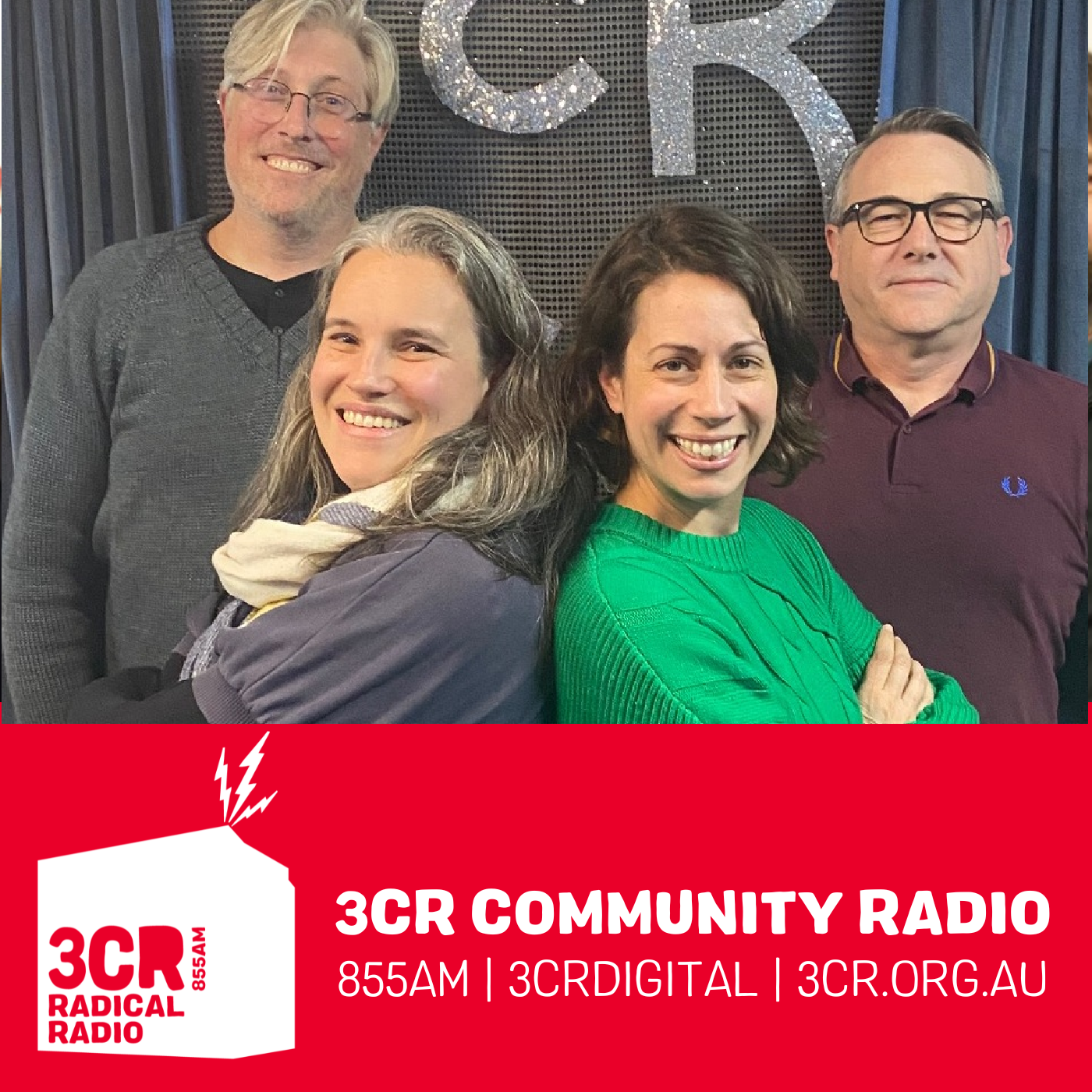
Chris Lassig, Stuart Burns, Claire Farrugia and Linden Ashcroft.
Lost in Science
Lost in Science is your weekly hit of mind-blowing science, strange facts, and big ideas. From cutting-edge discoveries to the science behind everyday life, our curious and passionate hosts make it fun, fast, and fascinating. If it’s weird, wonderful, or just worth knowing - we’re on it.
Author
Chris Lassig, Stuart Burns, Claire Farrugia and Linden Ashcroft.
Category
Podcast website
Latest episode
Jul 8, 2026
Where to listen?
Podcasts in the app Replaio Radio Coming soonPodcasts are coming to the app soon. Install now and be the first to see a whole new take on podcasts
 Install for free
Android 5M+ downloads · 4.8 rating
iOS soon
Install for free
Android 5M+ downloads · 4.8 rating
iOS soon
Episodes
International Women's Day 2019: incredible, underappreciated women of science 06.03.2019
For International Women's Day, we bring you the stories of three incredible women: Maria Sibylla Merian, whose science and illustrations gave us an understanding of the lifecycle of insects; Lise Meitner, one of the physicists who first acheived nuclear fission, but missed out on the Nobel Prize; and Margaret Wu, one of many women whose calculations made great contributions to science, but didn't...
Venus missions, champagne spoons and gravity driven space travel 27.02.2019
This week Stu talks about other lost explorers on planets in our solar system, Claire finds out if a spoon in your champagne bottle keeps the bubbles inside, and Chris finds out if gravity could help propel spacecraft to other stars
So many physics questions, wildlife on the Yorke Peninsula, and Transitions Film Festival 20.02.2019
This week, Chris exhausts everyone with a heap of listener questions about fundamental physics, Stu tells us about an ambitious plan to turn South Australia's Yorke Peninsula into a wildlife sanctuary, and Claire speaks to comedian Alanta Colley about the Transitions Film Festival and its stories of sustainability and improving the world. Find out more at https://www.transitionsfilmfestival.com/
Bio-bricks, gallium and water flow in the Murray-Darling 13.02.2019
Claire tells us about research at RMIT University into making bricks out of biosolids, aka treated sewage; Chris looks at how science is used or not used in managing water flows in the Murray-Darling Basin; and Stu brings us another element, the bizarre, unique gallium that melts in your hands.
Facing the elements, what is topological switching? And the diet of the future 06.02.2019
Stu celebrates the International Year of the Periodic Table, Chris talks to Dr. Mark Edmonds about his research into topological switching which will relax some of the boundaries to computing, and Claire finds out what a sustainable and healthy diet will really look like in the future.
Summer series: Sir John Gurdon and Ruth Benedict 30.01.2019
In the last of our 2019 summer series of tales from the Laborastory, stem cell researcher Megan Munsie tells the story of cloning pioneer Sir John Gurdon, and comedian Jess Moir talks about anthropologist Ruth Benedict.
Summer series: Jane Goodall & Chien-Shiung Wu 23.01.2019
This week our tales from the Laborastory feature comedian Alanta Colley with the story of everyone's favourite primatologist, Jane Goodall, as well as Lost in Science's own Chris Lassig talking about experimental particle physicist Chien-Shiung Wu.
Summer series: Veronika Megler and Christopher Polge 16.01.2019
This week our tales from the Laborastory feature comedian and game designer Ben McKenzie talking about Australian computer scientist Veronika Megler, creator of a revolutionary interactive adventure game in 1982; and reproductive scientist Kiri Beilby telling the story of English biologist Christopher Polge, pioneer of freezing sperm for artificial insemination.
Summer series: Henrik Dam and Grace Olive Wiley 02.01.2019
It's the Lost in Science summer series, featuring tales from the Laborastory! This week, dietitian and molecular biologist Matt Snelson tells the story of Henrik Dam, who discovered vitamin K; and ecologist and science communicator Lynette Plenderleith tells the story of herpetologist Grace Olive Wiley.
Christmas science, plants, animals and questions 19.12.2018
May your science be merry and bright
Mitochondrial DNA surprises, Planet Sounds and the tip of the tongue 12.12.2018
Claire find out that some humans have mitochondria from their father as well as their mother, Stu Listens to the music of the planets, and Chris finds out the science behind the sensation of having an answer on the tip of your tongue
CRISPR babies and crater queries 05.12.2018
This week, Chris digs into the controversy over the claim of babies born with genes edited by a rogue scientist using CRISPR technology; and Stu answers the question of why the side of the Moon facing us has so many craters with the Earth in the way.
Bugs in Space, Mysteries of the deep and brains in jars 28.11.2018
This week we look to the skies for mutating space bacteria, delve in the deep with mysterious local sea creatures, and wonder what it's like to wonder when you're a brain in a jar.
Krill, kilograms and wombat poos 21.11.2018
Claire tells us how the tiny crustaceans that are Antarctic krill may be more resistant to ocean acidification than thought; Stu explains the change to the definition of the kilogram that has just been agreed; and Chris shares the revelation of how wombats produce cubical faeces.
Invader week! Bugs in our brains, drugs in our waterways, and objects from interstellar space 14.11.2018
This week, Claire speaks to ecologist Erinn Richmond from Monash University about pharmaceutical drugs entering our waterways and the effect they may have on the environment; Stu tells us about the interstellar object ʻOumuamua and the chance that it's aliens; and Chris shares the startling discovery that gut bacteria may be living in our brains.
Carbon sequestration and Elephant Music 31.10.2018
Stu talks about a potential way to sequester atmospheric carbon dioxide in minerals that doesn't take the usual thousands of years, and Claire talks to Vicki Hallett about her work in acoustic ecology.
Lost in Science-Fiction! Soylent Green, Jurassic Park & 2001: Space Odyssey 24.10.2018
Our annual Lost in Science Fiction episode takes us back to the 70s for Soylent Green, Back to the 60s for 2001 a Space Odyssey, and back to the incorrectly identified Jurassic period for some more Jurassic World science.
Flying after migratory birds, an unsung female astronomer, and another final paper from Stephen Hawking 17.10.2018
This week, Chris reads yet another of Stephen Hawkings final papers, this one on the black hole information paradox; Claire speaks to Amelia Formby, who is planning a micro-light plane journey in honour of migratory shorebirds; and Stu tells us about astronomer Cecilia Payne, who worked out what stars are made of but didn't get enough credit for it.
Donna Strickland wins Nobel Prize for Physics; Environmental Film Festival; Greenhouse gas emissions missing targets 10.10.2018
Stu talks about Donna Strickland, winner of the 2018 Nobel Prize for Physics, and the third female winner of that prize in history. Claire talks to Chris Gerbing about the upcoming Environmental film festival, and Chris examines the governments latest greenhouse gas emissions figures and finds they are way off target.
Komodo Dragons and closer look at Glyphosate research 03.10.2018
This week on the show Claire checks in with the biggest lizards in the world, The Komodo Dragon and gives the low down on the weird and wonderful dragon science. And with the recent landmark USA ruling over the possible link between the herbicide RoundUp, also known as glyphosate, and cancer, Stu looks more closely at the recently published research claiming glyphosate has a negative impact on hon...
Great women of science, and tuskless elephants 26.09.2018
This week, Chris tells the stories of two great but under-appreciated women of science: Émilie du Châtelet, who brought Newton's work to Europe, and Mary Somerville, 19th century polymath and technically the world's first scientist. And Stu finds out how ivory poaching is putting selection pressure on African elephants causing them to evolve to be smaller in size and tuskless.
Do probiotics work? The 2018 Ignobel Prizes 19.09.2018
Claire looks into new research abotu probiotics which tests their claims of health benefits, while Chris and Stu take a trip to the 28th 1st annual Ig Nobel prizes to find out who are their favourite winners from this year.
Similar podcasts




Listen to the Lost in Science podcast in Replaio
Radio and podcasts in one app - free, with no sign-up. Install today and do not miss the launch
Replaio is not a podcast publisher; show names, artwork and audio belong to their authors and are distributed through public RSS feeds.