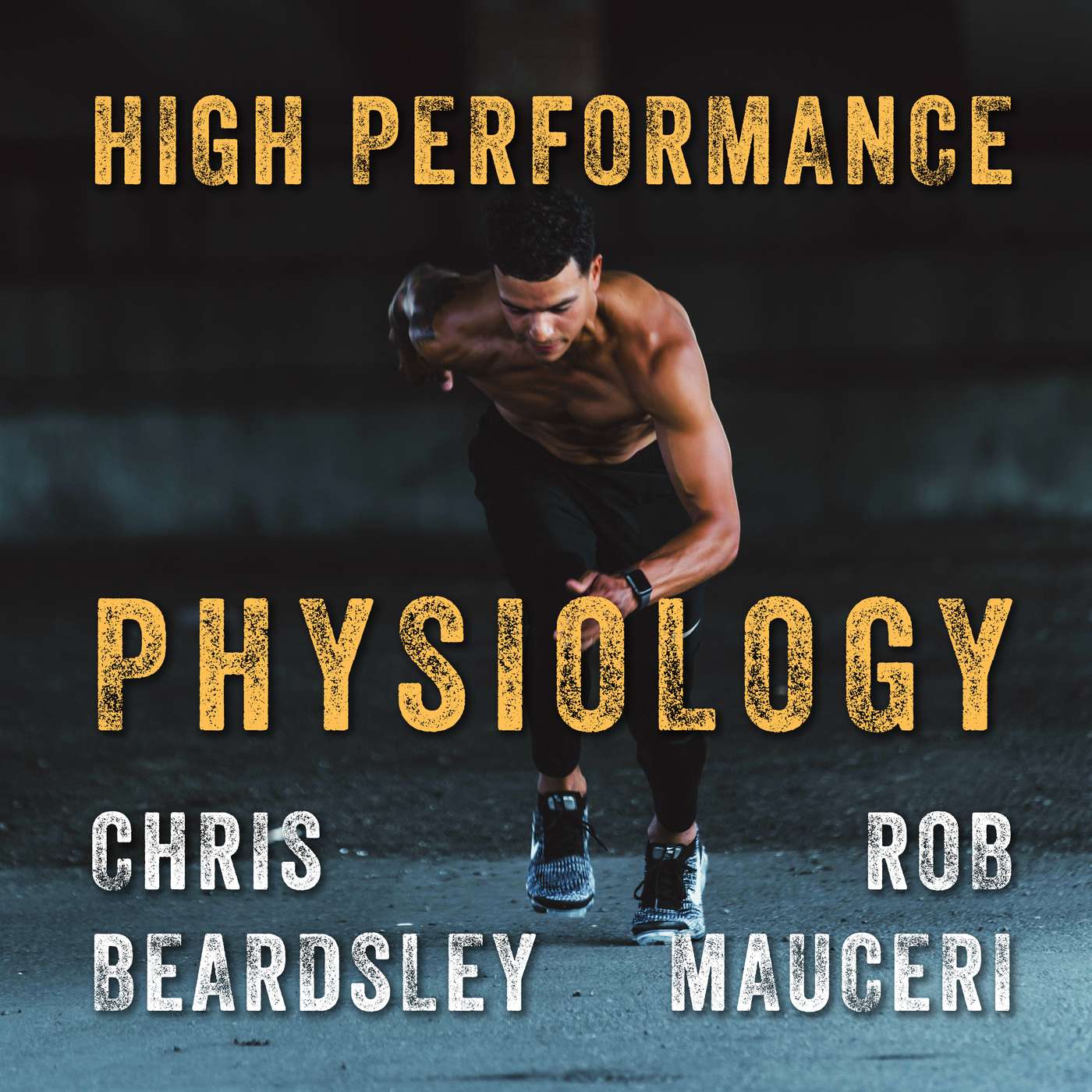
Chris Beardsley and Rob Mauceri
High Performance Physiology
The High Performance Physiology Podcast is co-hosted by Chris Beardsley and Rob Mauceri. Each episode showcases an example of how muscle physiology and biomechanics can be used to identify the best ways to train for athletic performance.
Where to listen?
Podcasts in the app Replaio Radio Coming soonPodcasts are coming to the app soon. Install now and be the first to see a whole new take on podcasts
 Install for free
Android almost 10M downloads · 4.8 rating
iOS soon
Install for free
Android almost 10M downloads · 4.8 rating
iOS soon
Episodes
30 Single-leg vertical jumping 04.07.2026 49:57
Following on from the earlier episode about two-leg vertical jumping, Chris and Rob tackle single-leg vertical jumping and explain how it relates to power training (with power cleans and jump squats).
29 Training while sick (colds and flu) 20.06.2026 22:31
Chris was sick this week so this week's episode is a short one covering some practical suggestions on how we can still get productive training sessions while suffering from either a cold or flu.
28 Combining bodybuilding and athletic training 05.06.2026 37:45
Chris and Rob describe exactly how to combine bodybuilding with athletic preparation training for people who want to pursue multiple goals at the same time. They give three separate options depending on whether the two goals have equal weighting or whether one goal is currently more important.
27 Strength without size 29.05.2026 34:06
In this very practical episode, Chris and Rob talk about how athletes can increase maximum strength without gaining weight (or without gaining too much muscle mass).
26 Contrast training 22.05.2026 43:20
Following directly on from last week's podcast episode on potentiation, Chris and Rob talk about contrast training from a physiological perspective. They explain why in most cases, a more traditional approach to athletic strength training workouts (starting with high-velocity exercises, moving on to heavy strength training exercises, and finishing with plyometrics) is much better than doing contra...
25 Potentiation 16.05.2026 43:09
Potentiation is a temporary and reversible increase in exercise performance as a result of a previous bout of exercise (note that this is the exact opposite of the fatigue definition). In this episode, Chris and Rob explain the physiology behind potentiation and describe the most effective ways of using the various different potentiation mechanisms in strength training workouts.
24 Tendon injuries 09.05.2026 36:57
Following on from the previous episode about muscle strain injuries, Chris and Rob talk about the physiology of tendon damage and how it likely leads to both tendinopathy and tendon ruptures. Afterwards, they describe how isometric training is probably the best training method for reducing the risk of such problems and Rob goes into detail about how he currently programs isometrics.
23 Muscle strain injury 01.05.2026 39:02
Chris and Rob talk about how muscle strain injuries happen, and what we can do in strength training programs to help reduce the risk of them happening.
22 Sprinting muscles 08.04.2026 36:59
Chris and Rob talk through what the literature says about the relationship between track sprinting performance and the muscle volumes of the hip extensors, hip flexors, knee extensors, knee flexors, and ankle plantar-flexors.
021 Speed training frequency 02.04.2026 31:31
Chris and Rob continue describing how their proposed workout plan template (speed, maximum strength, stretch-shortening cycle, and eccentric strength) can work even when speed exercises are varied greatly over the week.
20 Strength qualities 27.03.2026 35:58
Chris and Rob talk about the popular strength and conditioning idea that there multiple strength qualities across the force-velocity spectrum, from maximum strength to strength-speed to power to speed-strength to maximum speed. They also introduce the High Performance Physiology method for building strength training workouts for athletes.
019 Running economy 19.03.2026 23:16
Endurance running performance is determined by three components: [1] maximal aerobic capacity, [2] lactate threshold, and [3] running economy. In this episode, Chris and Rob talk about how strength training can contribute to improvements in running economy.
018 Structural balance 12.03.2026 32:15
Chris and Rob chat through what strength ratios between exercises can tell us (and what they cannot tell us) about writing athletic training programs.
017 Work capacity 05.03.2026 31:42
Continuing from the previous two episodes about powerlifting, Chris and Rob tackle the problem of "work capacity" in this context. What does work capacity mean? What are the underlying physiological adaptations that contribute to changes in work capacity? How should we train to improve work capacity?
016 Powerlifting part 2 19.02.2026 42:27
In this episode, Chris and Rob continue the powerlifting theme from the previous week. While the previous episode covered the main lifts, this episode is dedicated to accessory lifts to support gains in squat, bench press, and deadlift performance.
015 Powerlifting part 1 12.02.2026 41:07
In this introductory episode, Chris and Rob explain the underlying adaptations that contribute to powerlifting performance in general terms, and then discuss basic concepts like sets and reps, progression models, potentiation prior to the lifts, and the basic purpose of the training programs from a physiological point of view.
014 Transfer of training 06.02.2026 33:15
How do strength training programs transfer to sporting movements? What is the role of different exercises? Chris and Rob unpack the physiology and then go on to provide both positive and negative examples from existing training programs.
013 Rate of force development 30.01.2026 35:11
Chris and Rob explain the definitions of rate of force development and explosiveness in sporting contexts before going on to talk about how to develop these qualities in strength training programs.
012 Periodization 23.01.2026 40:06
In this long-awaited episode, Chris and Rob talk about periodization. While periodization itself is somewhat overrated, there are some benefits associated with aspects of it that can be replicated in other ways.
011 Deloads and tapers 16.01.2026 33:42
After a short break for the holidays, Chris and Rob are back for their first episode of 2026 talking about deloads. There are two scenarios in which deloads are taken: planned and unplanned. Planned deloads are written into a training program when fatigue is expected to accumulate. Unplanned deloads are taken when fatigue accidentally accumulates.
010 One arm chin ups 02.01.2026 37:36
Chris and Rob change the format for this episode. Rather than covering physiology and biomechanics and then talking about how that information guides strength training programs for athletic performance, they talk about their own experiences in training for a one arm chin up.
009 Sprinting 19.12.2025 46:10
Continuing on from the previous episodes discussing vertical jumping and throwing, Chris and Rob break down the way in which we can support the sprinting movement through targeted strength training.
008 Throwing and punching 10.12.2025 38:16
Building once again on previous episodes in which they talked about strength, speed, and power, the proximal to distal sequence, and vertical jumping, Chris and Rob now tackle how throwing and punching work, and discuss how to train to improve performance in those activities.
007 Vertical jumping 03.12.2025 37:52
In this episode, Chris and Rob build on previous podcast discussions about strength, speed, and power as well as on the proximal to distal sequence to explain [1] how vertical jumping works, and [2] how we can structure training programs to improve vertical jump height.
006 Eccentric training 27.11.2025 40:07
In this episode, Chris and Rob introduce eccentric training, starting with the underlying physiological adaptations and then going on to provide some commentary on practical programming. Contrary to what you will likely hear elsewhere, the important (transferable) adaptations caused by eccentric training are peripheral and not neural.
Similar podcasts








Listen to the High Performance Physiology podcast in Replaio
Radio and podcasts in one app - free, with no sign-up. Install today and do not miss the launch
Replaio is not a podcast publisher; show names, artwork and audio belong to their authors and are distributed through public RSS feeds.