Siva Prasad
Gita Acharan
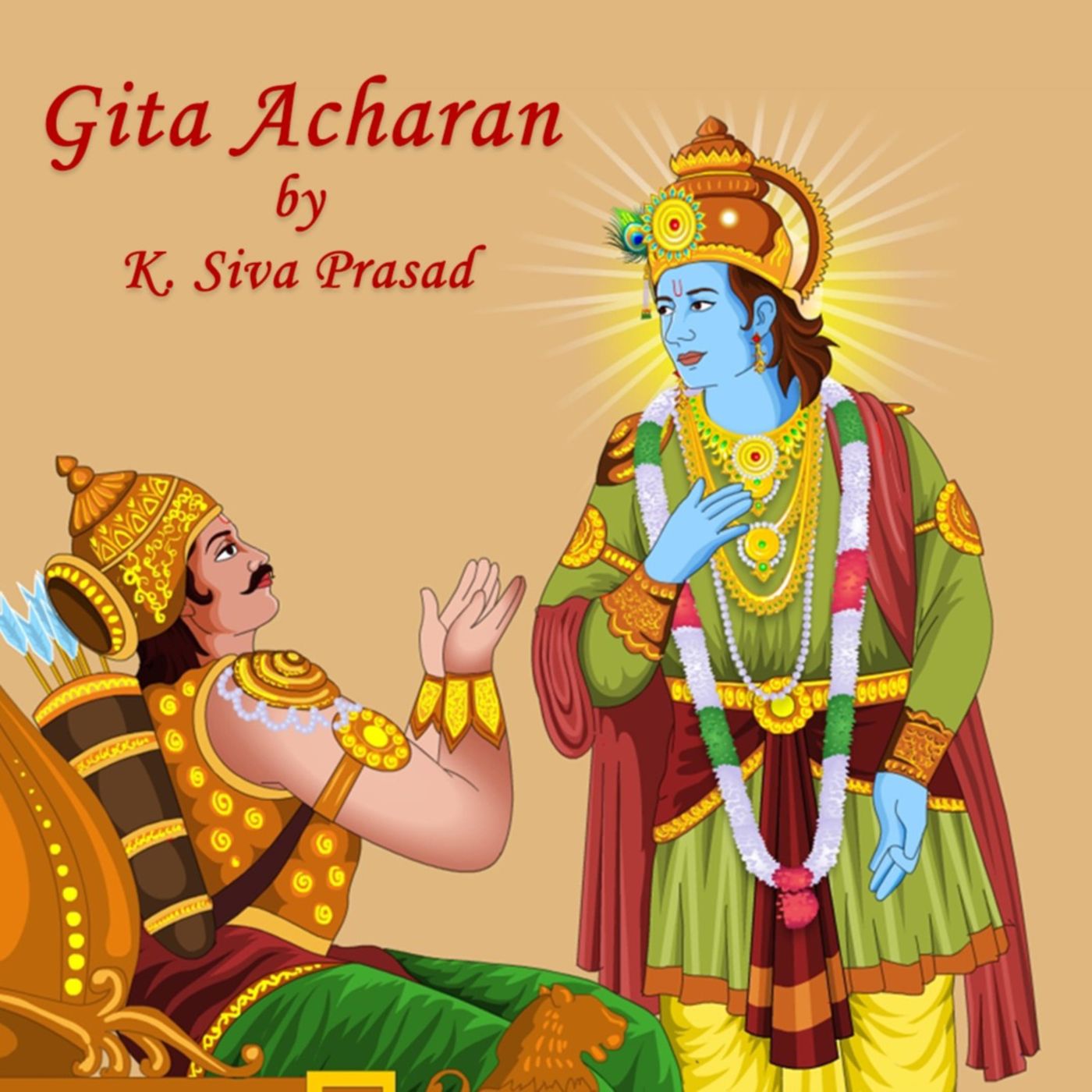
Bhagavad Gita is a conversation between Lord Krishna and Warrior Arjun. The Gita is Lord's guidance to humanity to be joyful and attain moksha (salvation) which is the ultimate freedom from all the polarities of the physical world. He shows many paths which can be adopted based on one's nature and conditioning. This podcast is an attempt to interpret the Gita using the context of present times. Siva Prasad is an Indian Administrative Service (IAS) officer. This podcast is the result of understanding the Gita by observing self and lives of people for more than 25 years, being in public life.
Where to listen?
Podcasts in the app Replaio Radio Coming soonPodcasts are coming to the app soon. Install now and be the first to see a whole new take on podcasts
 Install for free
Android 5M+ downloads · 4.8 rating
iOS soon
Install for free
Android 5M+ downloads · 4.8 rating
iOS soon
Episodes
49 Stithpragna (stoic) is internal phenomenon. 20.03.2021 4:27
Krishna says (2.54), in response to Arjun's query, sthithpragna (one with coherent intellect) is contented with self. Interestingly, Krishna didn't respond to the second part of Arjun's query as to how a sthithpragna speaks, sits and walks. 'Content with self' is purely an internal phenomenon and there is no way to measure it based on external behaviour. Maybe, in the given circumstances both an...
48 Contentment with the self 16.03.2021 3:54
Lord Krishna reveals what is pure sankhya(awareness) from verse 2.11 to 2.53, which was completely new territory for Arjun. Arjun wanted to know (2.54) about sthithpragna(one with coherent wisdom/intellect) who has attained samadhi (established in self) and how a sthithpragna speaks, sits and walks. Through clarifications to Arjun, (2.54 onwards) Krishna sets the standards and benchmarks to help o...
47 Non-oscillating intellect 05.03.2021 3:41
In the normal course of our lives we get perplexed when we hear conflicting opinions on the same subject -be it news, philosophy, others’ experiences and beliefs. Krishna says (2.53) that we will attain yoga when intellect remains nischal(non-oscillating) and steady in samadhi (established in self) despite hearing various opinions. The best metaphor for this verse is the tree with its visible up...
46 what is ours and what is not 28.02.2021 3:41
Krishna says (2.52) that when we cross moha-kalilam(darkness of delusion) using intellect, we become indifferent to what is being heard or will be heard. This implies that when we overcome moha, the inputs brought by our senses will lose the power to influence us at will. Krishna chose ‘hearing’ as the metaphor here, as we are frequently influenced by the words of others, both praise and criticism...
45. Illusionary bonds of birth and death 25.02.2021 3:41
Krishna says(2.51) that the wise use their balanced intellect and renounce the fruits of action to reach a state beyond polarities and get liberated from the bonds of birth and death. For a long time, humanity believed that the Sun rotates around a stationary earth and only later was it discovered that it is the Earth which is rotating around the Sun. Finally, our understanding aligned with the ex...
44. Balanced Decision making 22.02.2021 4:11
We all make several decisions for ourselves, our family and society based on a variety of factors. Krishna exhorts us to take this decision making to the next level when he says (2.50) ‘Yogah Karmasu Kaushalam’ (every action/deed is harmonious in yoga -of equanimity). It’s about dropping kartapan(doership) and ahankaar to experience the harmony that flows out, like the beauty and fragrance of a fl...
43. Labelling vanishes in Yoga. 20.02.2021 4:42
Our life revolves around labelling our deeds (actions/decisions) as well as those of others as good or bad. Krishna says (2.50) that endowed with intellect, one sheds both good and bad deeds, which implies that labelling goes once we attain Yoga (equanimity/middle). Our mind is full of filters/lenses which are imprinted in us through conditioning by our parents, family and friends during our form...
42. Facets of Ahankaar 16.02.2021 4:41
Krishna observes that Arjun is overwhelmed by the feeling of Aham-Karta (I am doer)- Ahankaar and it is responsible for his despondency. Krishna advises Arjun (2.41) to use coherent intellect (buddhi) to break Ahankaar and reach self (2.49). Ego is a small part of Ahankaar . It is called arrogance when one goes through pleasure polarity of success/win/profit and depression, unhappiness, anger whe...
41. Coherent intellect for internal travel. 14.02.2021 4:23
Yoga means union of the outer self with the inner self. It can be attained through many paths such as Karma (action), Bhakti, Sankhya (awareness), Buddhi (intellect) and so on. Depending on one’s nature, one attains yoga through means suited to him. Krishna tells Arjun (2.49) to seek refuge in buddhi as motivated karma is far inferior to buddhi yoga and miserable are they whose motive is to obtain...
40. Dropping sense of doership 05.02.2021 4:12
In the verse 2.48, Krishna asks Arjun, "To be steadfast in yoga (yoga being equanimity) while performing karma (actions) by renouncing the sangam (union/identify) with polarities like success and failure." In other words, whatever we do would be harmonious when we stop identifying with polarities. Our daily life involves making a series of decisions and choices. The ever judging mind keeps choosi...
39. Repetition is the key to mastery. 28.01.2021 4:15
Karna and Arjun were born to Kunti but ended up fighting for the opposite sides. Karna was cursed because of which his knowledge and experience of warfare didn't come to his rescue during the crucial fight with Arjun. He lost the war and was killed. This situation applies to all of us as we're like Karna, we learn a lot during our lives, gain knowledge and experience. But at crucial moments we th...
38. Action and reaction 25.01.2021 4:31
Krishna says that we have the right to do karma (action) but have no right over karma-phal (fruits of action). This does not mean that we gravitate towards akarma, which is inaction or mere reaction to circumstances. Though Krishna uses the word akarma (whose literal meaning is inaction), the context suggests that it connotes 'reaction'. Verse (2.47) talks of awareness and compassion; awareness t...
37. Vahi (same) Arjun Vahi Baan (arrow). 24.01.2021 3:53
Vahi Arjun Vahi Baan (Same Arjun Same Arrow), is often used to describe a situation when a successful/competent person fails to perform. Arjun, as a warrior, never lost a war. During the latter part of his life, he lost a minor battle in which he was supposed to save some family members from a group of bandits. He explains this situation to his brother and says: "I don't know what happened. I'm t...
36. Karma Phal (fruits of action) might not be what it seems. 21.01.2021 3:44
We are usually not prescient enough to understand whether the karma-phal (fruits of action) we currently desire will be good for us down the line. As in a failed relationship, at one moment, the only karma-phal a couple wanted was to be together but after some time they only want to separate. In fact, many regrets that people have today is on account of getting the karma phal which they desired de...
35. Karma Yoga as a way of life. 06.01.2021 3:37
Krishna says (2.47) that we have the right to perform our karma (action), but have no right over karma-phal (fruits of action). If one of our loved ones required surgery, we would look for a competent surgeon with character. His competence would ensure success of the surgery and his character would ensure that he wouldn't undertake any unnecessary surgery. In short, we are scouting for a surgeon w...
34. Focus on Karma not karma-phal (fruits of action). 06.01.2021 3:51
In the iconic verse 2.47 of the Gita, Krishna says that we have the right to do karma (action) but have no right over the karma-phal (fruits of action). He further says that karma-phal shouldn't be the motivating factor for any of our actions and also that, in consequence, we should not lean towards akarma (inaction). This is the most quoted verse from the Gita, possibly because of various dimensi...
33. Transcend vedas to be with self. 06.01.2021 4:02
Once, a group of friends were travelling and they had to cross a wide river. They made a boat and crossed the river. They then decided to carry the heavy boat with them for the rest of their journey, thinking that it would be useful. As a result, their journey got derailed. Here the river is a pain polarity and the boat is an instrument to overcome the polarity. Likewise, there are many instrument...
32. Coherent intellect leads to equanimity. 31.12.2020 4:11
Krishna says (2.41) in karma yoga, the buddhi (intellect) is coherent and the intellect of those who are irresolute is bahu-shakha (many-branched). Krishna says (2.48 & 2.38) that samatva (equanimity) is yoga , which is the union of two polarities we face, like pleasure and pain; winning and losing; and profit and loss. Karma yoga is the path to transcend these polarities, which ultimately res...
31. Small efforts bring big gains in Karma Yoga. 28.12.2020 4:06
Krishna assures (2.40) that even baby steps in the practice of karma yoga give results and this dharmam (discipline) protects us from great fears. The point to be noted is that while sankhya is pure awareness, karma yoga involves efforts. This is a definitive assurance from Lord Krishna for the seekers who have just started out on their spiritual journey and who find the effort daunting. Krishna u...
30. Writing on Water, Sand and Stone. 24.12.2020 3:58
Krishna says (2.39) that after elucidating about Sankhya (awareness) (2.11-2.38) he would now explain yoga (or Karma Yoga), the practice of which will free one from karma bandhan(bondage of action). While explaining Sankhya yoga, Krishna makes Arjun aware that he is that indestructible Chaitanya(consciousness) which doesn't have death. From this verse onwards Krishna starts explaining the same thr...
29. Balance is the key. 18.12.2020 4:22
Verse 2.38 captures the entire essence of the Gita. Krishna tells Arjuna that he would incur no sin when he fights or performs any karma, if he were to treat sukh(pleasure) and dukh(pain); labh(gain) and nasht(losses); and jaya(victory) and apajaya(defeat) with equipoise. This verse simply says that all our karmas are motivated and this motivation makes the karma impure or sinful. But we hardly k...
28. Shun all Dharmas(natures) to unite with Paramatma (supersoul). 09.12.2020 3:40
Krishna explains about swa-dharmam (2.31-2.37), Para-dharmam (other's nature) (3.35) and finally advises shunning all Dharmas (18.66) to unite with Paramatma. Arjun’s despondency arose out of his egocentric fear of damaging his reputation if he fought the war and killed his brethren. Krishna tells him (2.34-2.36) that he would damage his reputation even if he avoided battle, as fighting is his swa...
27. In harmony with Swa-Dharmam (own nature). 09.12.2020 3:57
Krishna explains Swa-dharmam (own nature) (2.31-2.37) and he tells Arjun that such an unsought battle at Kurukshetra opens the door to heaven (2.32) and escaping from it would result in loss of Swa-dharmam, fame and would incur sin (2.33). This advice to Arjun on the battlefield needs to be viewed in the right context. Krishna is actually talking about harmony and synergy with one's swa-dharmam an...
26. Rose Can never become a Lotus 03.12.2020 3:51
Krishna explains about Swa-dharmam (2.31-2.37) and advises Arjun that as a Kshatriya he should not hesitate to fight(2.31) as it is his Swa-dharmam. Krishna commences the Gita with 'that' which is eternal, un-manifested and pervades all. It is termed as atma for easy understanding. Then he talks about Swa-dharmam, which is one step before 'that' and subsequently comes to Karma. The journey to real...
25. Destination arrives when Ahankaar Departs 02.12.2020 3:53
Krishna says (2.29) some see 'this atma’ as a marvel, some speak of 'this atma’ as a marvel, others hear of 'this atma' as a marvel, and even then none know 'this atma’ at all. 'None' refers to an observer who is using his Indriyas (senses) to understand the observed (atma). Lord Krishna says that as long as there is a separation between these two, the observer cannot comprehend the atma. Once...
Similar podcasts








Listen to the Gita Acharan podcast in Replaio
Radio and podcasts in one app - free, with no sign-up. Install today and do not miss the launch
Replaio is not a podcast publisher; show names, artwork and audio belong to their authors and are distributed through public RSS feeds.