Siva Prasad
Gita Acharan
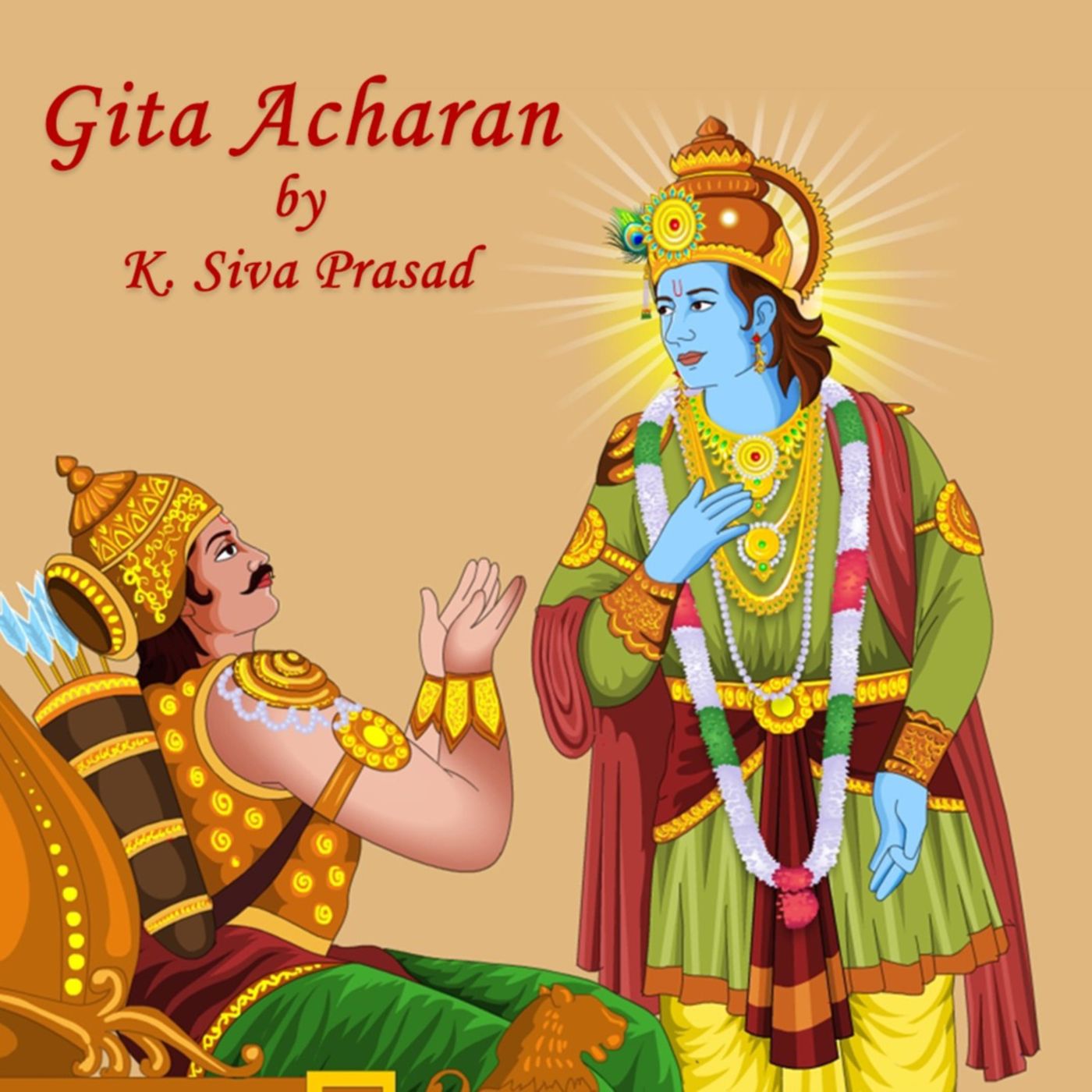
Bhagavad Gita is a conversation between Lord Krishna and Warrior Arjun. The Gita is Lord's guidance to humanity to be joyful and attain moksha (salvation) which is the ultimate freedom from all the polarities of the physical world. He shows many paths which can be adopted based on one's nature and conditioning. This podcast is an attempt to interpret the Gita using the context of present times. Siva Prasad is an Indian Administrative Service (IAS) officer. This podcast is the result of understanding the Gita by observing self and lives of people for more than 25 years, being in public life.
Where to listen?
Podcasts in the app Replaio Radio Coming soonPodcasts are coming to the app soon. Install now and be the first to see a whole new take on podcasts
 Install for free
Android 5M+ downloads · 4.8 rating
iOS soon
Install for free
Android 5M+ downloads · 4.8 rating
iOS soon
Episodes
74. Sraddha (Trust) brings Joy. 08.09.2021 3:56
Krishna says (3.31) that anyone who follows this teaching with sraddha will be joyful and will be liberated from karma bandhan (bondage of action). Sraddha is usually thought to mean belief or faith, but it is something beyond and the closest meaning is trust. In this state, we are free of doubt and all our questions dissipate. Humanity believed that the Sun was rotating around the earth until it...
73. Art of Surrender 30.08.2021 3:49
Krishna tells Arjun (3.30) to relinquish all actions unto HIM; to be devoid of egotism (nir-mama) and desires (nir-aasha); and to fight without fever. This verse is a summary of the Gita and it answers several of our doubts in daily life. Our first doubt is 'What to do', which arises because we are not happy with what we are doing as we feel that happiness is elsewhere in another action. But this...
72. Prisoner of Perceptions 14.08.2021 3:30
Krishna says that "Those sammohit (hypnotised) by the gunas which are qualities or characters of nature, are attached to the functions of the gunas; one with perfect knowledge should not unsettle the ignorant whose knowledge is imperfect. (3.29)" Apart from being the real karta (doer), gunas have the ability to hypnotise and cast a spell on us which makes us forget our true nature. We remain spell...
71. Interaction of Gunas 08.08.2021 3:06
Krishna says that (3.27) " Karmas (actions) in all situations are performed by the gunas which are qualities or characters of nature; one who is deluded by ahankaar thinks 'I am doer'. One (3.28) with true insight into the distinctions between gunas and karmas knows that gunas interact with gunas and hence he's not attached." All actions being nothing but interactions between gunas is a common th...
70. Give Time a Chance 04.08.2021 3:05
A fruit absorbs nutrients from its parent tree to grow and ripen. It then gets detached from the tree to start its own journey. The journey to freedom from the parent tree involves different actions to finally becoming a tree itself. An immature fruit, on the other hand, needs to be attached to the parent tree till it ripens. A ripe fruit shouldn't lure the immature fruit to leave the tree, as...
69. Actor as well as Audience 30.07.2021 3:58
In our daily life, we get attached to action which is described as aasakti which means interest or attachment or we are detached from it - virakti which means hatred or disinterested. However, Krishna refers to a third state, anaasakti which is dropping both attachment and detachment and is beyond both aasakti and virakti. He says (3.25) that the avidwan (ignorant) act with an attachment to action...
68. Lead by Example. 24.07.2021 3:38
Children always look to their parents to understand the world, learn new things, manners, behaviours etc. and that's why it's said that the best way to bring up a child is to lead by example by walking the talk. The same dependence continues in the later stages too. It might be dependence on friends, teachers, mentors etc. This implies that there are people who are always dependent on us and look...
67. Concerned and Un-Concerned. 17.07.2021 3:31
Krishna assures us that (3.19) by performing actions without attachment, one reaches the supreme and gives the example of King Janak (3.20) who attained perfection by action alone. Krishna emphasises the point that a king who lives in luxuries and has several responsibilities can also attain the supreme by performing all actions without attachment, implying that we too can similarly reach the sup...
66. Samarpan (Surrender) Or Sangharsh (Struggle) 11.07.2021 3:41
There are two ways of living. One is 'Sangharsh' -struggle and the other ‘Samarpan', which means surrender. Samarpan is not a helpless surrender like the surrender of the defeated in war, it's surrender with awareness and active acceptance. Struggle is to be ahead of others; to have more than what is given to us; to have something different than what we have. On the other hand, Samarpan is gratitu...
65. Selfless Actions hold Supreme Power 07.07.2021 3:37
Water is essential for life on earth and Krishna uses rain as an example (3.14) to explain selfless actions. Basically, rain is a part of a cycle where water evaporates because of heat, forming clouds thereafter. Given the right conditions, it comes down as rain. This process involves selfless actions and Krishna names them 'yagna'. Oceans let the water evaporate to form clouds and clouds sacrifi...
64. Always Do Your Best 06.07.2021 3:26
Krishna says (3.8), "Perform your obligatory actions, as action is superior to inaction; and even the maintenance of your body would not be possible by inaction. " Actions like gathering and consumption of food are essential for the survival of the human body. Further, the human body consists of so many organs, systems and chemicals which perform thousands of internal actions on a regular basis. E...
63. Delusion and Hypocrisy 04.07.2021 3:47
If we are not karta (doer) for karma (action), then who is karta? Krishna replies (3.5) "No one can stay for even a moment without performing karmas as all are compelled by gunas (characters) born of prakriti (nature) to perform actions." Three atomic particles, namely electron, proton and neutron form the entire physical world. Similarly, three gunas namely Satva, Tamo and Rajo are responsible f...
62. Renunciation of 'I' 02.07.2021 3:23
Krishna replies (3.3), "As I said earlier, in this world, there are two paths to salvation -for the wise through wisdom and for yogis through the path of action." This verse indicates that the path of awareness is for the intellect oriented and the path of action for the mind oriented. Krishna further clarifies (3.4), "Just by avoiding karma (action), one cannot attain nish-karma (actionlessness)...
61. Certainty for an Uncertain Mind. 02.07.2021 3:30
The third chapter of the Gita is known as 'Karma Yoga', which is an elaboration of verse 2.71 where Krishna said that nir-mama (sans-I) and nir-ahankaar (sans- I am doer) is the path to attain the eternal state. Arjun raises a doubt (3.1) "If you consider Buddhi (intellect/awareness) to be superior, why then do you engage me in terrible action of war instead of telling me (3.2) with nischay (cert...
60. Despondency to Enlightenment 23.06.2021 3:28
Krishna says (2.70) that one attains peace when they remain unmoved by desires, like an ocean that is unmoved by the waters entering it. He further says that (2.71) Nir-mama (sans -I) and nir- ahankaar (sans -I am doer) is the path for peace to reach the destination of the eternal state (2.72). None are deluded after attaining it. This eternal state is called moksha which is ultimate freedom, joy...
59. Physically Awake and Spiritually Asleep 23.06.2021 3:47
Krishna says (2.69), “That which is night to all beings is wakefulness for the self mastered; that in which beings are awake is night to the divinely perceptive sage." This verse brings out metaphorically, the idea of being physically awake but spiritually asleep and vice-versa. It also offers literal interpretations. There are two possibilities of living. One, where we are dependent on indriyas...
58. Desires and Four Stages of Life 13.06.2021 4:17
Krishna says (2.67) that the mind, which follows roving senses, carries away one's intellect as the wind carries away the boat on the water. The wind is a metaphor for our desires which drives our mind and senses making intellect (boat) unstable. In the context of desires, life is divided into four stages namely Brahmacharya (bachelor), Grihast (householder), Vanaprastha (facing forest) and Sanya...
57. Centred in the Middle 09.06.2021 3:51
Krishna says (2.66) that the 'ayukta’ (imbalanced) lacks both buddhi (intellect) and bhaav (emotions) and as a result, he will not get shanti and there is no joy for the peaceless. Krishna laid emphasis on equanimity (2.38 and 2.48) and this verse highlights the same from a different angle. Till one learns to centre oneself in the 'middle', one is likely to anchor oneself at one of the 'other' ce...
56. Cause and Effect in Spirituality 31.05.2021 4:00
Krishna says (2.65) that the intellect of the content is steady and all their dukh (sorrows) are destroyed. This runs contrary to our understanding that we become content once our desires are fulfilled and we attain sukh (pleasures) and destroy dukh. But Krishna tells us to first be content and that the rest automatically follows. For example, we conclude that we are not healthy if we have sympto...
55. Vicious and Virtuous Cycles 30.05.2021 4:01
Vicious and virtuous cycles are a sequence of events where one event leads to another and results in either disaster or joy respectively. If expenses are more than income, leading to borrowing and debt trap, it's a vicious cycle. If expenses are less than income, resulting in savings and wealth creation, it's a virtuous cycle. Krishna refers to these cycles in verses 2.62 to 2.64. Krishna says (2....
54. Automaticity of Indriyas (senses) 25.04.2021 3:52
Krishna cautions Arjun (2.60) that turbulent indriyas (senses) are capable of forcibly carrying away the mind of even an aspiring wise person. This verse is about the automaticity of indriyas to stimulus. The best example is of a smoker who's quite aware of the pitfalls of smoking, but finds it extremely difficult to quit it and laments that by the time he or she realises, the cigarette is alread...
53. Dropping of longing for sense objects 14.04.2021 4:09
Krishna says (2.59) "sense objects fall away from the abstinent person, but not ras(longing) and longing ceases only when one realizes the supreme." Indriyas have a physical instrument and a controller. The mind is a combination of controllers of all sense organs. Krishna advises us to focus on the controller which sustains the longing. Krishna uses the word 'ras' whose literal meaning is juice....
52. Wisdom is to know when to withdraw 13.04.2021 4:03
Krishna says (2.58) that wisdom gets established when one completely withdraws their indriyas(senses) from sense objects, like the tortoise withdrawing its limbs. Krishna lays emphasis on indriyas as they are the gateways between our inner self and outer world. He advises that we should withdraw our indriyas when we see ourselves getting attached to sense objects like the metaphorical tortoise wi...
51. Aversion is also an attachment 01.04.2021 4:27
We tend to assign one of three labels to a situation, a person or an outcome of a deed: good, bad or no label. Krishna refers to this third state and says (2.57) that a wise person is one who isn't filled with joy when coming across good nor does he hate bad and is always without attachment. This implies that the sthithpragna (one with coherent intellect) drops labelling(2.50) and takes facts as f...
50. Raag (attachment), Bhay(fear) and Krodh(anger) 28.03.2021 4:33
Krishna says (2.56) that Sthithpragna is one who is neither excited by sukh(pleasure) nor agitated by dukh(pain), is free from raag(attachment), bhay(fear) and krodh(anger). This is an extension of verse 2.38 where Krishna says to treat sukh(pleasure) and dukh(pain); labh(gain) and nasht(loss); and jaya(victory) and apajaya(defeat) with equipoise. All of us seek sukh but dukh invariably comes to...
Similar podcasts








Listen to the Gita Acharan podcast in Replaio
Radio and podcasts in one app - free, with no sign-up. Install today and do not miss the launch
Replaio is not a podcast publisher; show names, artwork and audio belong to their authors and are distributed through public RSS feeds.