Siva Prasad
Gita Acharan
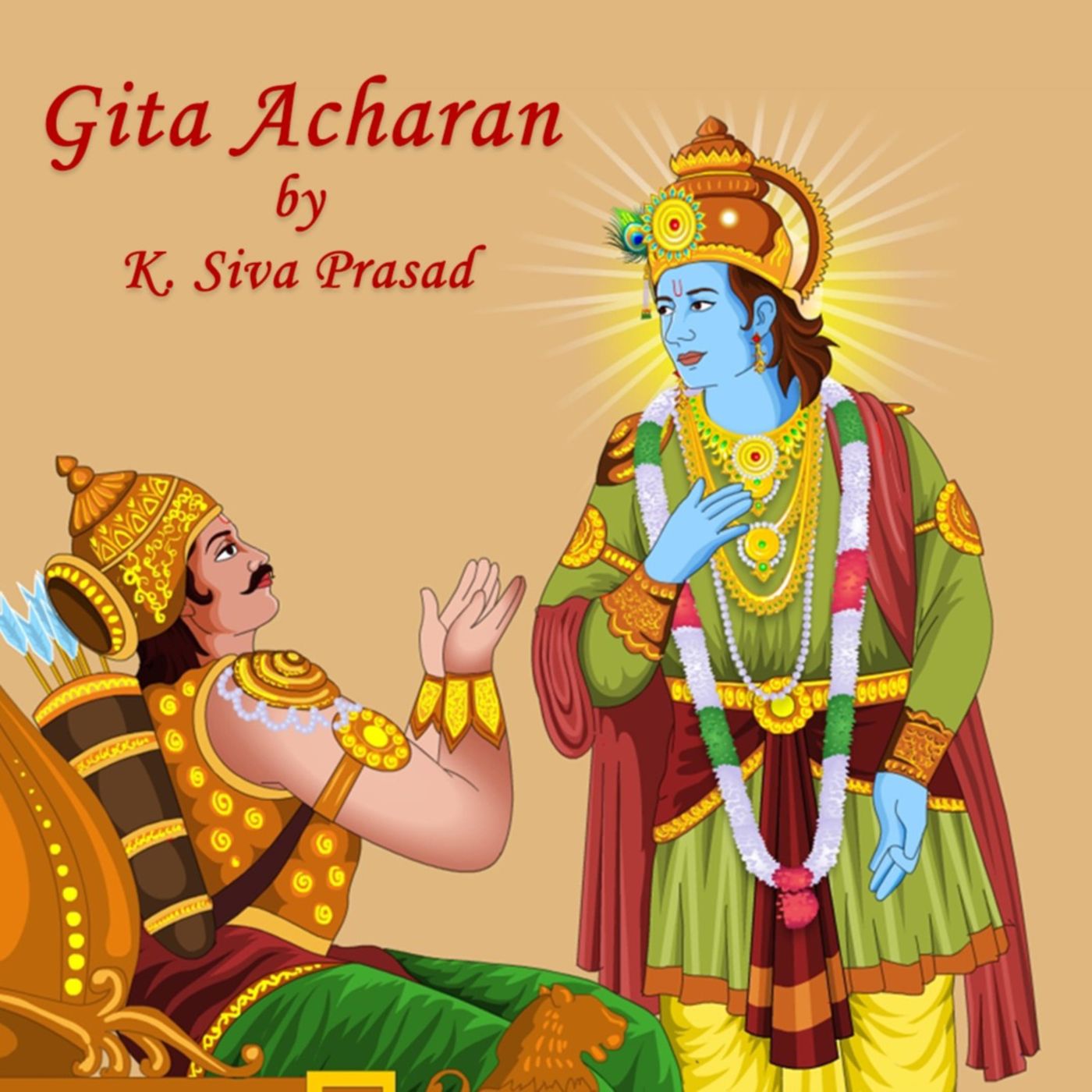
Bhagavad Gita is a conversation between Lord Krishna and Warrior Arjun. The Gita is Lord's guidance to humanity to be joyful and attain moksha (salvation) which is the ultimate freedom from all the polarities of the physical world. He shows many paths which can be adopted based on one's nature and conditioning. This podcast is an attempt to interpret the Gita using the context of present times. Siva Prasad is an Indian Administrative Service (IAS) officer. This podcast is the result of understanding the Gita by observing self and lives of people for more than 25 years, being in public life.
Where to listen?
Podcasts in the app Replaio Radio Coming soonPodcasts are coming to the app soon. Install now and be the first to see a whole new take on podcasts
 Install for free
Android 5M+ downloads · 4.8 rating
iOS soon
Install for free
Android 5M+ downloads · 4.8 rating
iOS soon
Episodes
99. Renounce Hatred Not Karma 06.03.2022 4:04
Out of ignorance, one tends to grab material possessions thereby leading to the bondage of action to accumulate. When the first ray of awareness sets in, one starts thinking of renunciation like Arjun is trying here. The confusion lies in what to renounce. The usual tendency is to renounce all karmas or actions, as we label them as good or bad by our ever judging mind and in this scheme of things,...
98. To Perform or Renounce 28.02.2022 4:01
Arjun asks, "O Krishna, you praise renunciation of actions (karma-sanyas) and yet you also advise their performance at the same time. Tell me with certainty, which is the better path." (5.1) On an earlier occasion too, Arjun was looking for certainty (3.2) between the paths of Sankhya (wisdom or awareness) and Karma (3.1). Krishna, however, does not advise renunciation of karma (action) and instea...
97. Sword of Wisdom. 14.02.2022 3:58
Krishna says, "He who has relinquished work by yoga and has torn apart his doubts by wisdom, becomes poised in the self; actions don't bind him (4.41). Therefore, take shelter in yoga by cutting this ignorance-borne doubt dwelling in your heart with the sword of wisdom." (4.42) Krishna advises us to use the sword of wisdom to free ourselves from the bondage of action (karma-bandhan). 'Regret' is...
96. Wisdom is In the Self. 09.02.2022 3:43
Once the creator was thinking about where to conceal 'that' wisdom after attaining which nothing is left to be attained. His wife suggests a high mountain or a deep sea but both were discarded as man can climb or swim. It was then decided to keep this wisdom inside man, while man searches for it outside for lifetimes. This metaphor makes it easy for us to understand when Krishna says, "Certainly,...
95. Raft of Wisdom for Sea of Sin. 07.02.2022 3:46
Arjun's despondency during the Kurukshetra war is due to his feeling that he is committing a sin. He feels that killing one’s teachers, relatives and friends (1.36) is nothing but sin and that we should turn away from such sinful action (1.38). He is even more perturbed by the fact that he and his brothers were preparing to kill their own brethren out of greed for the kingdom (1.45). Krishna repea...
94. Art of Learning. 31.01.2022 3:52
The ability to learn throughout life is a human endowment. The fundamental question is how to learn and what to learn. Krishna says, "Know 'that' by prostration, questioning and service, the wise who have realised the Truth will teach you the knowledge." (3.34) Prostration is humility, humbleness, willingness to understand others' points of view and open-mindedness which is an indication of overco...
93. Nectar of Contentment. 27.01.2022 3:52
Krishna talked about yagna (selfless actions) at two places (3.9 to 3.15 and 4.23 to 4.32). He cautions (3.9) that motivated actions bind us (karma-bandhan) and advises action to be performed without attachment. He further indicates that the selfless action of yagna holds the supreme power (3.15) and in the beginning, using this power the creator created (3.10). He gave many instances of yagna (4....
92. Joy through Breath 23.01.2022 3:57
Some activities in the human body like the beating of the heart are automatic though they may follow a set rhythm while some activities like the limbic system can be controlled. But breathing is unique as it is both automatic and can be controlled. In the context of yagna (selfless action) and breathing, Krishna says, "Some offer prana (incoming breath) into apana (outgoing breath) and apana into...
91. Study of Self 11.01.2022 3:49
Having ‘Fire in the belly' means being full of energy and enthusiasm for pursuing one's desires, interests and duties in the physical world. When such energy is used for self actualisation it is called 'yoga-agni' or the yogic flame. In this context, Krishna says that some offer all their sense activities and the functions of life force as oblations in the wisdom-kindled yogic flame of inner contr...
90. Sacrificing Sacrifice 31.12.2021 3:55
Yagna symbolises sacrifice or selfless actions. In this context, Krishna says (4.25), "Some yogis perform sacrifices to gods; others perform sacrifice by offering sacrifice itself in the fire of Brahman (Supreme God)." For one living without awareness, living is just gathering and preserving. The next higher stage of living is sacrificing things, thoughts and feelings. It's like sacrificing the se...
89. Liberating Oneself 27.12.2021 3:59
In the Gita, some words like anaasakti and veet-raag represent the crux of the Gita. While aasakthi (attachment) and virakti (detachment) are two polarities, anaasakti transcends these polarities. Similarly, veet-raag is neither raag (fondness) nor viraag (aversion) but transcends both. These polarities are nothing but the radiance of ahankaar (I the doer) and once dropped, one transcends all pola...
88. Facets of Sin 18.12.2021 3:44
The question of vikarma (prohibited action) or sin is very intriguing. Arjun is also in this very dilemma and says that sin alone will accrue by killing relations in battle (1.36). In fact, cultures have defined various karmas (actions) as sins and the list changes with time. In the modern context, countries have their penal codes which mandate some actions to be crimes or sins and thus punishable...
87. Ever Content 14.12.2021 3:40
A hungry fox tried to reach for grapes hanging high above, failed and moved on bringing itself to think that the grapes were sour. This familiar story presents several angles on the issue of handling disappointment, contentment and happiness. Contemporary psychology talks about 'synthesising happiness' as one of the functions of the human brain to help us move out of difficult situations. The fox...
86. Drop both Lust and Resolve 12.12.2021 3:46
Every culture evolved some dos and don'ts for peace in society and with the evolution of justice systems, some don’ts have become punishable crimes. Criminal jurisprudence requires both intention and execution to be present in a crime. Intention is the thought behind the crime and execution, the physical side. Proof of both components is essential to convict any person of a crime. If we take the...
85. Karma, Akarma and Vikarma 05.12.2021 3:52
‘Acts of commission and omission' is a phrase commonly used in the legal lexicon. A driver failing to apply brakes at the appropriate moment has committed an act of omission resulting in an accident. This act of 'omission' or akarma (inaction), leads to karma (action) of accident. Similarly, while performing any action, we choose from many different options available to us. When we exercise one o...
84. Ways of Liberated Souls 25.11.2021 3:44
Krishna says that actions do not taint him nor does he have a longing for fruits of action. He also says that whoever realises him is thus not bound by actions (4.14). This reinforces Krishna’s words (2.47) that we have right over karmas (actions) but not over karma-phal (fruits of action). As Paramatma, even he follows the same. Krishna tells us (4.13) that he is the non-doer...
83. Falsehood Thrives on Truth 20.11.2021 3:54
The world as we know it consists of both truth and falsehood. A careful examination would indicate that falsehood is nothing but a misinterpretation of the truth, either due to our circumstances or due to limitations of our senses and mind. In the well-known rope and snake analogy, the rope is the truth and the snake is the falsehood that doesn't exist without the rope. But, till...
82 . We Reap what We Sow 03.11.2021 3:46
The physical entities are governed by predictable behaviours and properties. Krishna gives insight into the relationship between the all powerful un-manifested and manifested when he says, “In whatever way people are devoted to Me, in that measure, I manifest Myself to them. All men, in every manner, pursue a path to Me.” (4.11) This is firstly an assurance from the Lord...
81. ‘I’ is inclusion 28.10.2021 3:59
In the Gita, both Arjun and Krishna use 'I' and 'ME', but the meaning and context of usage are different. Arjun’s 'I' refers to his physical body, possessions, feelings and beliefs extending to his family, friends and relatives. Our situation is no different to that of Arjun. Essentially, we consider some things to be exclusively ours and the remaining to be not. When Krishna uses 'I'...
80. Manifestation of Maya 21.10.2021 3:34
Just as a rotating wheel needs a stationary or changeless axle to rotate, the ever-changing manifested physical world needs the calm and changeless unmanifested entity to sustain its existence. Arjun, like us, is at the level of the manifested human body and is worrying about the death of his relatives, who are just manifested entities. Krishna, the supreme lord, presently in a manifested form exp...
79. Beyond Time 15.10.2021 3:20
Bhagavad Gita is a coherent blending of two levels and we need to be aware of this to understand the Gita. Sometimes Krishna comes as a friend or a guide to Arjun explaining the daily issues faced by humans. Sometimes he comes as Paramatma (super-soul) and in that state he says (4.1) that I gave this imperishable Yoga to Vivasat, which was handed down in succession to raja-rishis (royal rishis) an...
78. Power of Desire. 07.10.2021 3:26
A desire filled Tulsidas was desperate to meet his newlywed wife. He crossed a river at night mistaking a corpse to be a wooden log; used a snake as a rope to climb up the wall to meet his wife, only to be rebuked by her that he would be better off with an equal passion for Lord Rama. He was transformed that very moment and he went on to author the revered ‘Ram Charit Manas’. Tulsi’s story helps u...
77. Witness like a Mirror 27.09.2021 3:44
Krishna clarifies that just like fire is enveloped in smoke; a mirror by mal (dirt); an embryo by the womb; Wisdom is covered by desire that is an insatiable fire, which is the constant enemy of the wise (3.38-3.39). Earlier, Krishna had said that gunas have the capacity to hypnotise (sammohit) us. Desire, born out of rajo guna does the same. He further elaborated (3.40) that the senses, mind and...
76. Beware of Lust 23.09.2021 3:40
Arjun enquires, (3.36) "How can a man perform evil even against his will as if he is compelled." This is the most common question that arises when the first ray of awareness sets in. Krishna says (3.37) kaam and krodh (anger) are born out of rajo guna and are great evils full of insatiable craving. Beware of them to be the foulest enemies here on Earth. Krishna uses the word kaam which is an extr...
75. Dharma ( Reality) is ONE. 17.09.2021 3:25
Krishna says that (3.35) swa-dharmam (own-nature or reality) is superior to well accomplished para-dharmam (others nature or reality) even when the former is devoid of merit. It's better to die in swa-dharmam than to be fraught with fear in para-dharmam. This intricate verse creates more doubts than clarity in our minds. In a sense, this verse is purely contextual for Arjun in the Kurukshetra war....
Similar podcasts








Listen to the Gita Acharan podcast in Replaio
Radio and podcasts in one app - free, with no sign-up. Install today and do not miss the launch
Replaio is not a podcast publisher; show names, artwork and audio belong to their authors and are distributed through public RSS feeds.