Siva Prasad
Gita Acharan
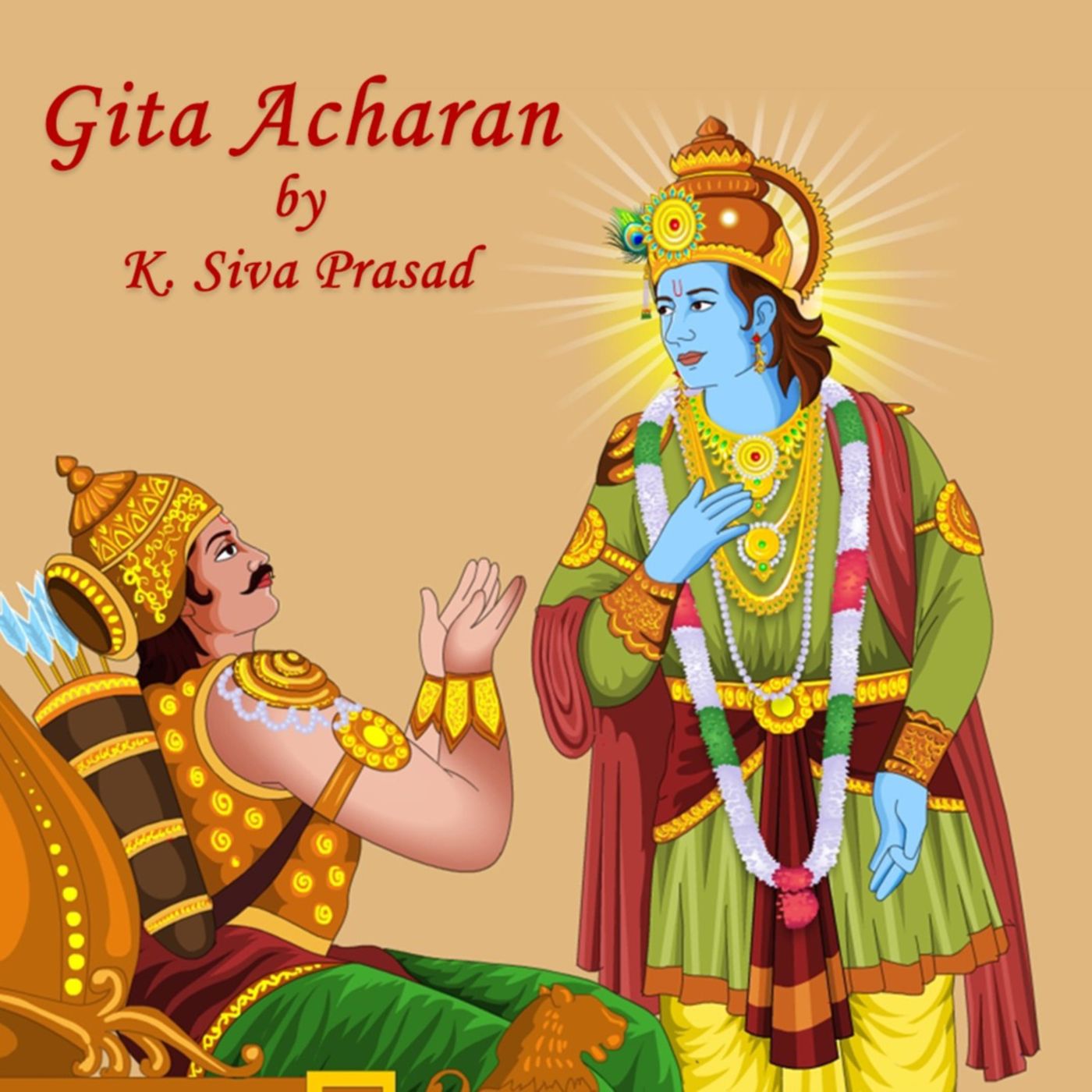
Bhagavad Gita is a conversation between Lord Krishna and Warrior Arjun. The Gita is Lord's guidance to humanity to be joyful and attain moksha (salvation) which is the ultimate freedom from all the polarities of the physical world. He shows many paths which can be adopted based on one's nature and conditioning. This podcast is an attempt to interpret the Gita using the context of present times. Siva Prasad is an Indian Administrative Service (IAS) officer. This podcast is the result of understanding the Gita by observing self and lives of people for more than 25 years, being in public life.
Where to listen?
Podcasts in the app Replaio Radio Coming soonPodcasts are coming to the app soon. Install now and be the first to see a whole new take on podcasts
 Install for free
Android 5M+ downloads · 4.8 rating
iOS soon
Install for free
Android 5M+ downloads · 4.8 rating
iOS soon
Episodes
24. Soul replaces old bodies 30.11.2020 3:57
Krishna says (2:19, 2:20) that Atma neither kills nor is killed and only the ignorant think otherwise. It is unborn, eternal, changeless and ancient. He further says that Atma changes physical bodies like we discard old cloths to wear new ones. In a scientific context this is well explained by the law of conservation of energy and the principle of inter-convertibility of mass and energy. If Atma...
23. Soul is un-manifested 24.11.2020 4:01
Krishna tells Arjun (2:25) that this(atma /soul) is said to be unmanifested, inconceivable and unchangeable, once you are aware of this, there is no need to grieve for the physical body. Krishna further says that (2:28) all the beings are unmanifest before their birth, they manifest between their birth and death and once again unmanifest after their death. Many cultures use the ocean and wave anal...
22. Balance is bliss 14.11.2020 4:03
At the very beginning of the Gita (2:14), Krishna says that the meeting of the indriyas(senses) with the external objects causes polarities of pleasure and pain. He tells Arjun to learn to tolerate them, as they are transient. In the contemporary world this is expressed as, 'This too shall pass'. If this is inculcated at experiential level, we can transcend these polarities to find them equally ac...
21. Creativity can not be destroyed 12.11.2020 4:00
Two types of wise men have guided humanity in its quest to understand the inner self. One approaches from the positive side and another from the negative, though the destination remains the same in both cases. The difference lies in the starting point of the journey and our choice of path depends on our nature. The positively-oriented describes 'that' which is indestructible, eternal, stable and p...
20. Death does not kill us 12.11.2020 4:01
Krishna tells Arjun, "There is no time, past, present or future, when you, I and these rulers on the battlefield are not present." He further adds that the 'material side' of the indestructible eternal 'living entity' is certain to perish and therefore the battle ahead must be fought. This eternal 'living entity' is known by many names such as atma, chaitanya, soul and consciousness. Krishna refer...
19. Creativity creates, not creator 06.11.2020 4:10
Dwelling further on Sat(real/permanence) and Asat(unreal/impermanence), Krishna tells us to contemplate on 'that' which is indestructible and which pervades all. The popular and easy understanding about creation is that it is the work of a creator. But Krishna points towards 'creativity', which is a constant evolutionary force. For example it causes sprouting from seeds. The sprout and the seed (b...
18. Sat(real) and Asat(unreal) 04.11.2020 3:49
Krishna says Sat(reality/permanence) never ceases to be and Asat(unreal/impermanence) has no existence. A Gyani is one who can distinguish between the two. The rope and snake analogy is often quoted in many cultures to understand the intricacies of Sat and Asat. A man reached back home at dusk and found a snake coiled at the entrance to his home. But in reality it was a rope left by children, that...
17. Four types of devotees 30.10.2020 3:39
Krishna says that there are four types of devotees. The first one wants to come out of difficulties and misery he is facing in life. Second one desires to have physical possessions and worldly pleasures. Most devotees fall in these two categories irrespective of culture, gender, belief systems and so on. Krishna says that these two kinds of devotees pray and perform rituals to various Devatas. It...
16. Transcending Gunas 30.10.2020 4:12
Krishna says that there is no kartha for any karma. Karma is in fact the result of the interaction among the three Gunas namely Satva, Rajo and Tamas which are a part of Prakriti - the nature. Krishna advises Arjun to transcend these Gunas to be free from sorrows. Arjun wanted to know how to be Guna-ateeth(transcending Gunas) and what a person would be like when he attains this state. Dwandwa-atee...
15. Equanimity 25.10.2020 3:51
Samatva (equanimity) is a common thread that runs across the Gita. Lord Krishna highlights Samatva bhav, Samatva drishti and Samatva buddhi at various places. Samatva is easy to understand but difficult to internalize. The degree of Samatva in us is an indicator of our progress in the spiritual journey. In the physical realm, most societies have accepted Samatva as equality before law for all ci...
14. Satva, Tamo and Rajo Gunas 24.10.2020 3:43
Most of us believe that we are the cause of all our actions and masters of our destiny. In the Gita, Lord Krishna says that interaction between Gunas (properties/characters) creates Karma, but not due to any Karta. Three Gunas are born out of Prakriti (mother nature) and bind the soul with the physical body. The three Gunas; Satva , Rajo and Tamas are present in each of us in different proportion...
13. Being Witness 24.10.2020 3:11
If one word could describe the entire Gita it would be ' Drishta ' (a witness), which appears in many contexts. An understanding of this is important as most of us think 'we' do things and control situations. Arjun, who was about sixty at the time of the Kurukshetra war, had lived a good life and enjoyed all luxuries. As a warrior he had tasted victory in many a battle. At the time of war, he felt...
12. Controlling Mind 20.10.2020 3:41
Arjuna compares the mind to the wind and wants to know as to how to control it, so that it maintains balance. Krishna says that it's certainly difficult, but it can be achieved through the practice of Vairagya. The mind is evolved to judge inputs brought in by the senses into safe and unsafe and uses memory while doing so. This ability helped us survive and prosper during evolution. The same ab...
11. Pain follows pleasure 18.10.2020 3:43
Transcending polarity or duality known as Dwandwa-atheeth, is another master key in the Gita. Krishna advises Arjun repeatedly to attain this state. The common question that intrigues humanity is 'How does unpleasantness and pain come to us even when we strive to make sincere efforts to attain pleasure'. Instead of looking deeper within, we reconcile ourselves by saying that maybe our efforts a...
10. Krishna in Corona 17.10.2020 3:33
The Gita contains many master keys which have the capacity to open up many doors and bypass the hurdles we face in the path of self realisation. One such master key is to see yourself in others and others in you. Krishna implores us to realize that its HIM in all of us and he is hinting at the un-manifested which is form-less. Krishna elsewhere asks us to raise ourselves to bow to a donkey or a...
9. We are our friend and enemy too 14.10.2020 3:23
In the Gita, Lord Krishna says that you yourself are your own friend and you yourself are your own foe. The following story of the trapped monkey illustrates it well. Some nuts are kept in an earthen pot with a narrow mouth -called surahi, in which the monkey's hand barely fits. The monkey inserts its hand by squeezing through the mouth of the pot and grabs a fist full of nuts. As the fist is fu...
8. manifested and Un-manifested 11.10.2020 3:21
A small change in the trim tab attached to the rudder changes the course of a large ship. Similarly, a nudge to study the Gita can reorient our course in life. Time available due to the current COVID-19 situation can be utilised to dive into the Gita. The Gita is an eternal text book from Kindergarten to Post Graduation, for internal realization and it is likely that in the first reading, very few...
7. Being Nimitta Matra 02.10.2020 3:33
The Gita was born in the battlefield and the current COVID-19 days are similar to the Kurukshetra battle. One phrase in the Gita neatly sums it up : nimitta maatra -just being an instrument (in the hands of the Almighty). Arjun wanted to see the reality of Krishna as it is (yathaarth) and needed an extra sense to grasp the same, just like the blind man needed an eye to see complete elephant. H...
6. Rule of law 26.09.2020 3:28
The Gita is about maintaining harmony in the inner world and the law is about maintaining order in the outer world. Any Karma has two parts, one is the intent and another is execution. In the words of law they are called, using Latin words, mens rea and actus reus, respectively, in the context of crime. For example, a surgeon and a murderer both plunge a knife into someone's stomach. The surgeon's...
2. Contradictions in Life 09.09.2020 3:28
Just as it is said,"All roads lead to Rome", all paths given in the Gita lead us to the Inner Self. Some of the paths appear to be in contrast with each other. However, this is like a circle where a journey on either side would take us to the same destination. The Gita operates at various levels. Sometimes Krishna comes to the level of Arjuna and sometimes he comes as the Super-soul (Paramatma). T...
5. Gyan, Bhakti and Karma Yoga 09.09.2020 3:57
Gita appears different to different people based on their orientation. There are three different paths given in Gita. Karma yoga, Sankhya yoga and Bhakthi yoga. Karma yoga is ideal for someone who is mind oriented. Sankhya yoga is for Intellect and Bhakti for heart oriented. In today's world, majority falls in the category of mind oriented. Its based on belief that we are tied up with chains and n...
4. Mind games 09.09.2020 3:37
Gita lays emphasis on our senses as they are the gateways between our inner and outer world. Neuroscience postulates, "Neurons that fire together wire together". The Gita's words too convey a similar message using the language of its time. Our brain has about a 100 billion neurons. Some of them are wired by DNA to take care of automatic functions of body and some are wired by us during our life ti...
3. It's Here and Now 09.09.2020 3:32
The Gita is about what we are. It is like being truthful apart from knowing the truth and that happens when we are centered (space) in the present moment (time) The underlying dilemma of Arjuna is what would happen to his image, in the eyes of world, if he kills his friends, relatives, elders and teachers for the sake of kingdom. This appears very logical and this is the first barrier to be crosse...
1. Start with Ahankaar 30.08.2020 3:41
Bhagavad Gita is a 700 verse conversation between Lord Krishna and Warrior Arjun in the battle field of Kurukshetra. Just before the start of war, Arjun gets the feeling that war would kill many of his friends and relatives and argues that this is bad from many points of view. Arjuns dilemma eminates from his presumption that " I am doer" - Aham karta and is also known as Ahankaar. This Ahankaar k...
Similar podcasts








Listen to the Gita Acharan podcast in Replaio
Radio and podcasts in one app - free, with no sign-up. Install today and do not miss the launch
Replaio is not a podcast publisher; show names, artwork and audio belong to their authors and are distributed through public RSS feeds.