Gareth Lock at The Human Diver
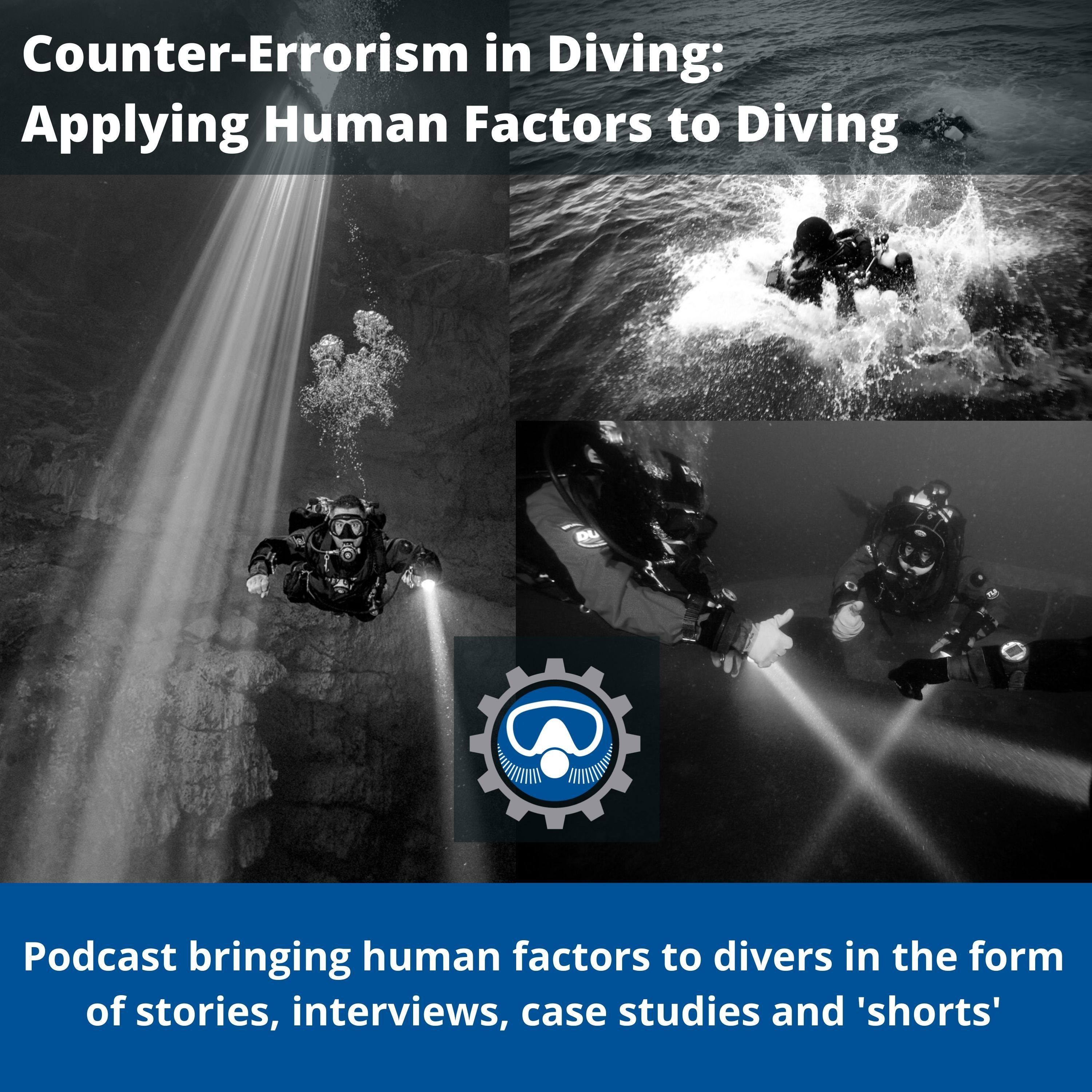
Counter-Errorism in Diving: Applying Human Factors to Diving
Human factors is a critical topic within the world of SCUBA diving, scientific diving, military diving, and commercial diving. This podcast is a mixture of interviews and 'shorts' which are audio versions of the weekly blog from The Human Diver. Each month we will look to have at least one interview and one case study discussion where we look at an event in detail and how human factors and non-technical skills contributed (or prevented) it from happening in the manner it did.
Author
Gareth Lock at The Human Diver
Category
Podcast website
Latest episode
Jul 11, 2026
Where to listen?
Podcasts in the app Replaio Radio Coming soonPodcasts are coming to the app soon. Install now and be the first to see a whole new take on podcasts
 Install for free
Android 5M+ downloads · 4.8 rating
iOS soon
Install for free
Android 5M+ downloads · 4.8 rating
iOS soon
Episodes
SH145: Cognitive Dissonance - Why you are right and I am wrong...Or are you? 05.02.2025 7:17
In this episode, we dive into cognitive dissonance—the psychological discomfort of confronting facts that challenge our beliefs—and how it impacts decision-making and safety in diving. Drawing on insights from Black Box Thinking by Matthew Syed and examples from aviation, justice, and diving, we explore why even highly educated individuals can resist change to protect their reputation. From miscon...
SH144: Just another brick in (under) the wall...taking action 01.02.2025 8:16
In this episode, we explore the gap between knowledge and action, focusing on how even small, intentional changes can lead to significant improvements in safety and performance. Drawing from examples like the WHO Safe Surgical Checklist and lessons from diving, we highlight the importance of applying what we know—whether through simple tools like checklists and debriefs or by understanding decisio...
SH143: 'Entirely Predictable' vs 'Managing Uncertainty': How many rolls on the dice? 29.01.2025 13:06
In this episode, we delve into the complexities of managing risk and uncertainty in diving, challenging the notion that accidents are "entirely predictable." Unlike measurable risks, diving involves countless variables that create uncertainty, often managed through mental shortcuts and biases. We discuss how hindsight bias, overconfidence, and peer pressure can cloud judgment, leading to poor deci...
SH142: The standard you walk past is the standard you accept 25.01.2025 6:58
The diving industry faces challenges in maintaining high safety standards due to a lack of effective feedback mechanisms and a fear of reprisal for reporting substandard practices. Feedback is essential for improving performance and preventing dangerous "normalization of deviance," but it’s often viewed as blame rather than an opportunity for learning. Without proper acknowledgment or action from...
SH141: We cannot improve if we don't learn. We can't learn if we don't understand. 22.01.2025 11:19
When discussing diving incidents, it’s vital to shift away from blame and hindsight bias and instead foster a culture of open dialogue to understand why decisions made sense at the time. Often, divers are doing their best with the resources, training, and information available, but situational awareness and decision-making are shaped by incomplete data, personal experience, and environmental facto...
SH140: Safety is not _the_ priority... 18.01.2025 11:12
Safety in diving is not a standalone priority but one of many factors, including time, money, resources, and productivity, that individuals and organizations must balance in a dynamic environment. Safety is best understood as reducing risk to an "acceptable level," but defining what is acceptable can be complex and context-dependent. Using principles like ALARP (As Low As Reasonably Practicable),...
SH139: What does Human Factors in Diving mean? 15.01.2025 8:55
Human factors in diving encompass everything from individual behavior to the interaction between divers, technology, and organizational systems. This podcast dives into the complexities of human factors, exploring how they influence safety, performance, and decision-making. Topics include cognitive biases, stress, and fatigue, as well as the gap between "Work as Imagined" and "Work as Done." We al...
SH138: Why ‘Human Error’ is a poor term if we are to improve diving safety 11.01.2025 25:00
This podcast explores the limitations of attributing diving accidents to "human error," a reductionist explanation that fails to address the complexities of real-world decision-making and system failures. By examining a case study involving oxygen toxicity during a rebreather dive, the episode delves into how biases, situational awareness, and flawed mental models contribute to adverse events. It...
SH137: Stop making stupid mistakes. If only they’d follow the rules 08.01.2025 16:49
In this episode, we explore a diving incident that highlights the critical importance of understanding human factors in high-risk activities like technical diving. A diver survived an oxygen toxicity seizure thanks to her buddy's quick thinking, but the investigation revealed a web of human errors, from outdated equipment to flawed decision-making. We discuss the lessons learned, the role of human...
SH136: Nine ways to stop your dive team improving 04.01.2025 7:48
Effective communication is critical for safety and performance in diving, yet many divers struggle to speak up due to fear of judgment, peer pressure, or an adversarial culture. This silence can lead to mistakes, unreported incidents, and missed opportunities for improvement. Leaders at all levels play a vital role in fostering open dialogue by responding to mistakes constructively, avoiding blame...
SH135: 17 Cognitive Biases which Contribute to Diving Accidents 01.01.2025 15:02
Cognitive biases and mental shortcuts significantly impact decision-making, especially in high-risk environments like diving, where errors can have critical or fatal consequences. Factors such as narcosis, reduced visibility, and altered sound perception exacerbate these biases, distorting reality and affecting safety. Common biases include anchoring, overconfidence, and confirmation bias, each in...
SH134: Human Error in Diving: Is it really that simple? 28.12.2024 12:58
This episode explores the complexities of human error in diving incidents, challenging the oversimplified blame often placed on individuals. Drawing on James Reason’s Swiss Cheese Model, we examine how both active failures (individual actions) and latent conditions (systemic weaknesses) contribute to accidents. We also discuss cognitive biases, such as hindsight and outcome bias, that hinder objec...
SH133: Blood, Banks and Diving: The value of knowledge, experience and training 25.12.2024 5:19
This episode dives into the importance of investing in skills and experience to prepare for unexpected challenges in diving and life. Using an analogy of red and white blood cells, we explore the balance between productivity and response readiness, emphasizing why both are essential. Drawing lessons from Captain Sullenberger’s emergency landing on the Hudson River, we highlight the value of delibe...
SH132: Leadership in Diving? Why is it needed, it is only a sport... 21.12.2024 12:55
This episode explores the critical role of leadership in diving, drawing on a challenging night dive on the Abu Nuhas reef and lessons from military aviation. The dive highlighted the importance of accountability, planning, and adapting leadership styles to the situation. Diving lacks formal leadership training, yet all divers—from instructors to dive center managers—play leadership roles. Drawing...
SH131: With Errors: Aviation Blames The System, The Diving Community Often Blames the Individual 18.12.2024 6:08
This episode dives into the lessons the diving community can learn from aviation safety practices, using the near-disaster of Air Canada Flight AC759 at San Francisco Airport as a starting point. In aviation, near-misses are thoroughly investigated to uncover systemic issues rather than just individual mistakes, fostering a culture of learning and improvement. By contrast, the diving industry ofte...
SH130: The Power of One 14.12.2024 7:33
In this episode, we explore how authority gradients—the imbalance of power or experience between individuals—can lead to critical mistakes in diving and other high-stakes environments. Drawing lessons from aviation, medicine, and real-world diving incidents, we discuss how the fear of questioning a more experienced person can prevent vital safety concerns from being raised. Whether it's a student...
SH129: We judge based on outcomes, not on process 11.12.2024 10:50
In this episode, we dive into the role of social conformity, biases, and decision-making in diving safety. Humans naturally seek group belonging, but this can lead to harsh judgments when incidents occur, particularly on social media. We explore how biases like hindsight and outcome bias affect our perceptions of accidents, often focusing on blame rather than understanding the decision-making proc...
SH128: I am biased...you are biased...we are all biased...! 07.12.2024 5:15
In this episode, we explore how cognitive biases—mental shortcuts that influence our decisions—affect our actions in complex and dynamic situations. Whether things go right or wrong, biases like overconfidence, expectation bias, and hindsight bias shape our thinking, often without us realizing it. We discuss practical ways to identify and reflect on these biases to improve decision-making, drawing...
SH127: Can divers learn from the US Forest Service? 04.12.2024 14:23
This podcast episode explores how the U.S. Forest Service uses structured Learning Reviews to improve safety in high-risk environments by focusing on understanding the context, mindset, and systemic factors behind incidents rather than assigning blame. Highlighting parallels to the diving community, we discuss the importance of storytelling, identifying gaps between "normal" and "ideal" operations...
SH126: Why did he make such an obvious mistake...? 30.11.2024 12:50
In this episode, we dive into the complexities of decision-making in high-risk environments, focusing on why some choices that lead to accidents might seem baffling but are understandable in context. We discuss Todd Conklin's and Chris Perrow's ideas on "Normal Accidents," highlighting how unforeseen events can occur despite experience and training due to factors like hindsight and outcome biases....
SH125: "Known Unknowns" - Are they considered enough in diving...? 27.11.2024 8:24
In this episode, we explore Donald Rumsfeld's "known knowns, known unknowns, and unknown unknowns" concept and how it applies to risk management in diving. Using the Johari window model of self-reflection, we discuss the importance of understanding risks that divers face, from routine (known knowns) to unpredictable (unknown unknowns). The episode highlights the role of experience, training, and n...
SH124: Congratulations on surviving. Dude, you’re one lucky f***er 23.11.2024 13:51
In this episode, we delve into the story of Eric, a wingsuit base jumper who nearly died during a jump, to explore the risks, attitudes, and decision-making in extreme sports. Eric’s candid interview highlights how rapid progression without mentorship, inferred peer pressure, and normalization of risky behavior nearly led to fatal consequences. His reflections underscore the need for awareness, ho...
SH123: Why is it so hard to thumb a dive, or end something that you have committed to? 20.11.2024 7:05
One of the key lessons in diving is that anyone can end a dive at any time for any reason, no questions asked, yet making that call can be tough due to unspoken pressures. This episode explores how inferred peer pressure, desire for group belonging, and risk-taking in “losing situations” all affect a diver’s willingness to thumb a dive. Through stories and research, we discuss how factors like fat...
SH122: "Human Error" or "Diver Error": Are they just an easy way of blaming the individual? 16.11.2024 7:57
In this episode, we dive into the concept of human error, examining why labeling it as the sole cause of accidents often oversimplifies the issue and prevents meaningful improvement. Human error is natural, inevitable, and can range from minor to life-threatening in impact. Effective safety culture encourages open discussion of mistakes without blame, helping us understand the factors influencing...
SH121: We all make errors. Let’s not judge those involved without understanding the ‘how’ it made sense. 13.11.2024 7:53
In this episode, we explore the concept of a Just Culture in diving, where learning from mistakes and sharing incidents openly helps improve safety without fear of unfair criticism or blame. Inspired by Human Factors and Ergonomics, which emerged in WWII to address human error in fast-evolving systems, Just Culture highlights that mistakes often result from systemic issues, not individual faults....
Similar podcasts







Listen to the Counter-Errorism in Diving: Applying Human Factors to Diving podcast in Replaio
Radio and podcasts in one app - free, with no sign-up. Install today and do not miss the launch
Replaio is not a podcast publisher; show names, artwork and audio belong to their authors and are distributed through public RSS feeds.