Gareth Lock at The Human Diver
Counter-Errorism in Diving: Applying Human Factors to Diving
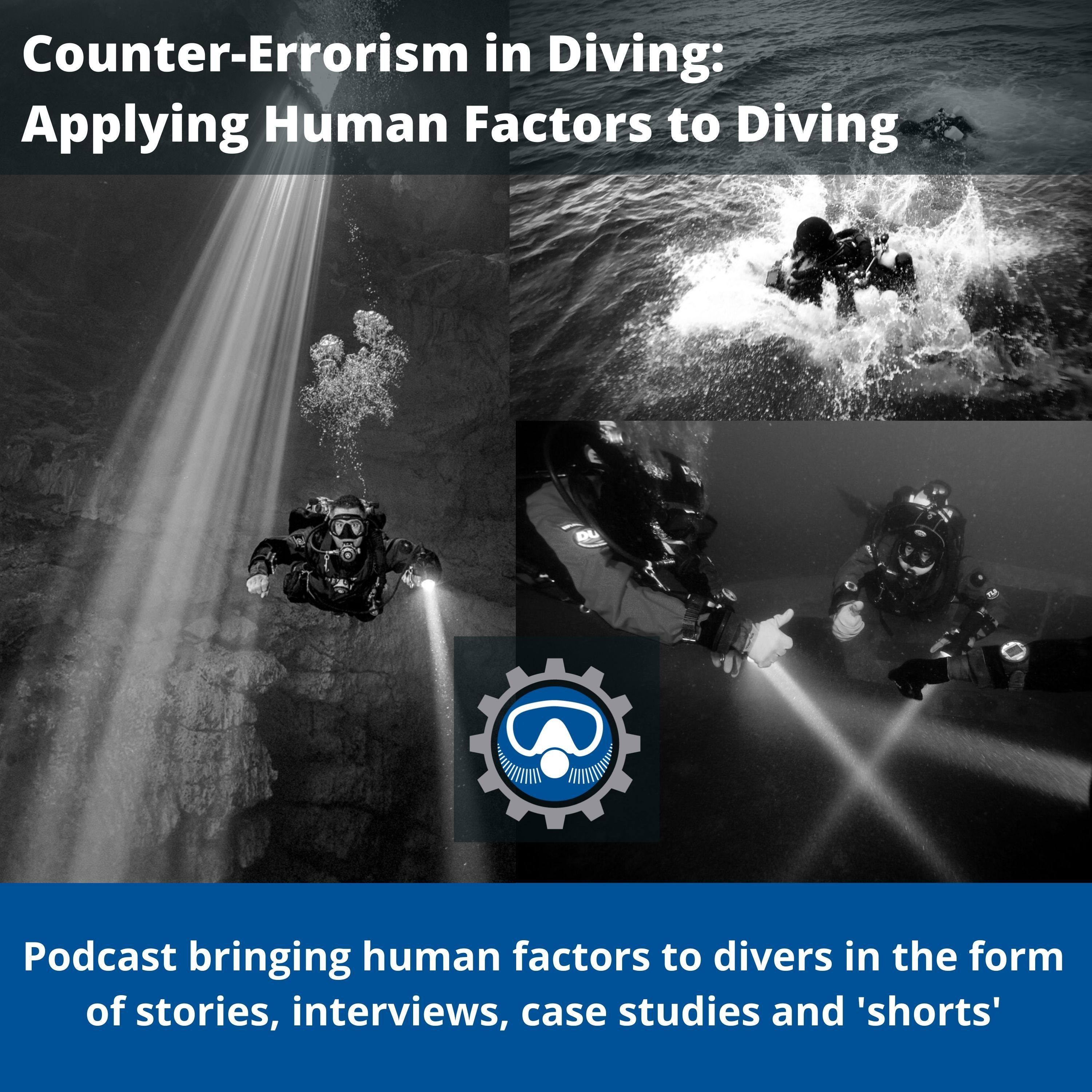
Human factors is a critical topic within the world of SCUBA diving, scientific diving, military diving, and commercial diving. This podcast is a mixture of interviews and 'shorts' which are audio versions of the weekly blog from The Human Diver. Each month we will look to have at least one interview and one case study discussion where we look at an event in detail and how human factors and non-technical skills contributed (or prevented) it from happening in the manner it did.
Author
Gareth Lock at The Human Diver
Category
Podcast website
Latest episode
Jul 11, 2026
Where to listen?
Podcasts in the app Replaio Radio Coming soonPodcasts are coming to the app soon. Install now and be the first to see a whole new take on podcasts
 Install for free
Android 5M+ downloads · 4.8 rating
iOS soon
Install for free
Android 5M+ downloads · 4.8 rating
iOS soon
Episodes
SH170: From an acorn to a two-day global virtual conference in four months! 03.05.2025 19:53
The first-ever Human Factors in Diving Conference, held on September 24-25, 2021, brought together 27 speakers from around the world to explore the application of human factors, non-technical skills, Just Culture, and psychological safety in diving. Spanning nearly 25 hours of content over two days, the event showcased a global virtual conference model using the LexGo Live platform, with a focus o...
SH169: “The root cause of an accident is our imagination” 30.04.2025 11:05
Accidents in diving, and life, rarely stem from a single "root cause" but rather from a complex interplay of factors—technical skills, context, randomness, and non-technical skills like communication and decision-making. This episode explores how cognitive biases, such as the fundamental attribution error, often lead us to blame individuals rather than considering the broader system in which event...
SH168: What is a mistake? What is an error? Words have meanings. 26.04.2025 11:05
In this episode, Gareth Lock delves into the nature of human error, exploring concepts like slips, lapses, mistakes, and violations through the lens of safety research and diving experiences. Drawing on James Reason’s work, Gareth explains how understanding errors and violations—whether unintended or situational—can foster learning, reduce outcome bias, and improve safety systems. By openly discus...
SH167: Only 20% of surgeons would like to use a checklist in their operations… 23.04.2025 7:56
In this episode, Gareth Lock explores the critical role of checklists in enhancing safety and reducing errors in high-risk environments like diving, surgery, and aviation. Drawing insights from Atul Gawande's The Checklist Manifesto , Gareth highlights how properly designed checklists can prevent lapses, improve communication, and establish a culture of accountability. Despite resistance from thos...
SH166: You can’t run before you can walk... 19.04.2025 4:56
In this episode, Bart Den Ouden reflects on the importance of mastering the basics before taking on advanced challenges, using ice diving as a vivid example. During a rare opportunity for ice diving in the Netherlands, Bart observed several instructors rushing into instructor-level ice diving certifications without adequate experience. Drawing parallels with the Dunning-Kruger effect and highlight...
SH165: “You can lead a horse to water, but you can’t make it drink.” Or can you..? 16.04.2025 7:46
In this episode, we explore the critical role of leadership and decision-making in diving safety, using a real-life story about a young instructor, “Jack,” who made a risky dive on a rebreather he wasn’t certified to use. Despite his confidence, Jack’s actions reflect dangerous cognitive biases like overconfidence, outcome bias, and normalization of deviance, shaped by a culture of cutting corners...
SH164: Plan to fail safely – Part 2: Passing the test doesn’t say it all 12.04.2025 10:33
In this episode, we explore how listening to your inner voice can be a lifesaver, both in diving and everyday life. Bart Den Ouden shares his personal journey of uncovering severe heart issues despite passing regular diving medicals, emphasizing the importance of recognizing warning signs and overcoming cognitive biases like denial and confirmation bias. We also discuss a diver’s near-fatal experi...
SH163: Who owns the risk in diving when something goes wrong? 09.04.2025 11:48
In this episode, we delve into risk management and decision-making in diving, exploring the difference between personal and professional responsibilities. Using a case of a divemaster tasked with guiding divers on a challenging wreck dive, we examine the complexities of managing hazards, understanding acceptable risks, and the impact of assumptions and biases. The conversation highlights the impor...
SH162: Plan to fail safely - teaching students/candidates for the real world 05.04.2025 5:43
In this episode, we explore the importance of preparing for failure in diving education, inspired by Hal Watts' quote: “The most dangerous thing about diving is divers themselves.” Using a real-life example from a scuba Instructor Examination, we highlight how training focused solely on passing exams can lead to complacency and poor decision-making in real-life scenarios. Diving instructors and tr...
SH161: ‘One mistake and you are dead’ – isn’t how accidents normally happen 02.04.2025 7:56
In this episode, we explore the dangers of "normalisation of deviance"—the gradual erosion of safety standards through repeated shortcuts—and its impact on rebreather diving and other high-risk activities. Drawing on lessons from aviation and diving, we discuss how human factors, cognitive biases, and systemic drift contribute to accidents, emphasizing that outcomes should not be the sole focus wh...
SH160: Outcomes are so sexy and attractive… 29.03.2025 5:15
This episode dives into the critical role of human factors in safety, using a tragic aviation incident and its parallels in diving to illustrate how distractions, pressures, and systemic issues contribute to accidents. We explore how a Royal Air Force training film, "Distractions," highlighted the cumulative factors behind a hypothetical crash, emphasizing the need for shared responsibility in pre...
SH159: The best is the enemy of the good 26.03.2025 3:29
In this episode, a newly qualified Human Factors in Diving Instructor shares their journey of grappling with impostor syndrome and the challenges of teaching human factors to divers. Despite over a decade of diving instruction experience, they recount feeling inadequate compared to peers and doubting their knowledge, especially when students might view human factors as "common sense." Reflecting o...
SH158: Predictive Profiling & diving: “what deviates, deserves attention!” 22.03.2025 8:38
This episode dives into the critical importance of recognizing deviations from the norm in diving, a concept rooted in situational awareness. Inspired by the 1972 attack at Lod Airport, Bart den Ouden draws parallels between how assumptions can blind us and the role of training and experience in diving. By understanding what “normal” looks like, divers can detect and respond to unexpected changes....
SH157: The Good, the Bad and the Ugly! 19.03.2025 8:12
In this episode, we explore the pitfalls of blindly trusting technology through two cautionary tales—one about a GPS mishap in snowy Quebec and another about divers relying solely on their computers. Automation offers precision and convenience, but over-reliance can dull our awareness and problem-solving skills. We discuss how this applies to diving, where dive computers are invaluable but prone t...
SH156: CCR pre-dive checks and checklists are not always enough to prevent an equipment-based accident! 15.03.2025 10:50
In this episode, we explore how safety in diving is not just about avoiding accidents but about building systems that can fail safely. Drawing on a real-life incident shared by Phil Short, we examine how a small technical issue—debris in a rebreather valve—could have escalated into a life-threatening situation during a cave dive. We highlight the critical role of technical preparation, situational...
SH155: How safe is your diving? 12.03.2025 11:12
In this episode, we dive into the concept of psychological safety and its critical role in diving and team performance. Psychological safety, defined as a shared belief that it's safe to take interpersonal risks, enables people to ask questions, make mistakes, contribute ideas, and challenge the status quo without fear of judgment or reprisal. Drawing on insights from experts like Amy Edmondson an...
SH154: The Importance of Decision Making in Setting Goals: Ensuring “The Juice is worth the Squeeze” 08.03.2025 9:18
In this episode, we explore the double-edged nature of goal setting—how it drives achievement but can also lead to risky decisions when pressure and commitment override safety and judgment. Using examples from mountaineering and advanced diving, including a personal story about a challenging CCR trimix course, we delve into the concept of "destructive goal setting." The discussion highlights how e...
SH153: Why ‘They should have’, ‘...could have’ or ‘I would have..’ do not improve diving safety 05.03.2025 5:55
In this episode, we explore the concept of counterfactual reasoning—our tendency to imagine how incidents could have been avoided by different actions—and why it falls short in improving safety. While this type of hindsight helps us feel better by creating a sense of order, it doesn’t address the real-world conditions or decisions that led to the incident. Instead of asking, "Why didn’t they do Y...
SH152: The Bend is Uninteresting...The Related Decisions Are Much More So 01.03.2025 15:37
In this episode, we explore a personal account of a Gareth’s experience with decompression sickness (DCS) and the critical decision-making process that followed. The story dives into the internal monologue, biases, and stigmas surrounding DCS, highlighting how emotions and uncertainties influence risk-based decisions. We also examine industry practices, the importance of creating a psychologically...
SH151: When the holes line up... 26.02.2025 8:45
In this episode, we explore Professor James Reason's Swiss Cheese Model, which helps explain how incidents occur when multiple safety barriers fail at different levels within a system. We discuss how organizational, supervisory, and individual errors can combine to create accidents, and how the holes in these barriers move and shift over time. Using dynamic models, we highlight that safety is an e...
SH150: Are you a good enough diver? 22.02.2025 12:33
In this episode, we dive into the concept of "good enough" in diving and how it relates to decision-making, risk, and safety. We explore why terms like "safe" and "good" are subjective and often influenced by context, experience, and social pressures, rather than absolutes. Using real-life examples, we discuss how divers weigh trade-offs between efficiency and thoroughness, balancing time, money,...
SH149: 'Choices': Guaranteed small loss or a probable larger loss, injury or fatality? 19.02.2025 9:56
In this episode, we explore how decision-making under uncertainty plays a crucial role in scuba diving, drawing insights from Prospect Theory and real-life scenarios. We discuss how psychological factors, like loss aversion, influence divers to take risks they might otherwise avoid—whether it's diving with faulty gear after weeks of being unable to dive or dealing with pressures during high-profil...
SH148: Risk of diving fatality is 1:200 000. However, you cannot be a fraction of dead…! 15.02.2025 16:00
In this episode, we explore how risk is perceived and managed in diving, where emotions, biases, and mental shortcuts often outweigh logic and statistics. Diving fatalities are statistically rare, but those numbers don’t resonate emotionally—our decisions are more influenced by stories and personal experiences. Through real-life examples, we unpack biases like availability bias, outcome bias, and...
SH147: Dive safety leads to nothingness...and nothingness is unemotive! 12.02.2025 8:53
How do you measure safety in diving? This episode dives into a real story of a dive team that adapted to an emerging safety risk when two divers, certified but inexperienced in drysuits and challenging conditions, showed signs of stress. Through situational awareness, communication, and teamwork, the team adjusted their plan, choosing a safer dive site where the less experienced divers could build...
SH146: Why ‘everyone is responsible for their own risk-based decisions’ isn’t the right approach to take to improve diving safety. 08.02.2025 7:53
In this episode, we explore the decision-making challenges in diving, sharing a personal story of risky dives and lessons learned. A diver reflects on their early diving experiences, from breaking training depth limits to encountering equipment failures at 30m, and how a lack of knowledge and overconfidence contributed to risky choices. We discuss the importance of understanding context when evalu...
Similar podcasts







Listen to the Counter-Errorism in Diving: Applying Human Factors to Diving podcast in Replaio
Radio and podcasts in one app - free, with no sign-up. Install today and do not miss the launch
Replaio is not a podcast publisher; show names, artwork and audio belong to their authors and are distributed through public RSS feeds.