Gareth Lock at The Human Diver
Counter-Errorism in Diving: Applying Human Factors to Diving
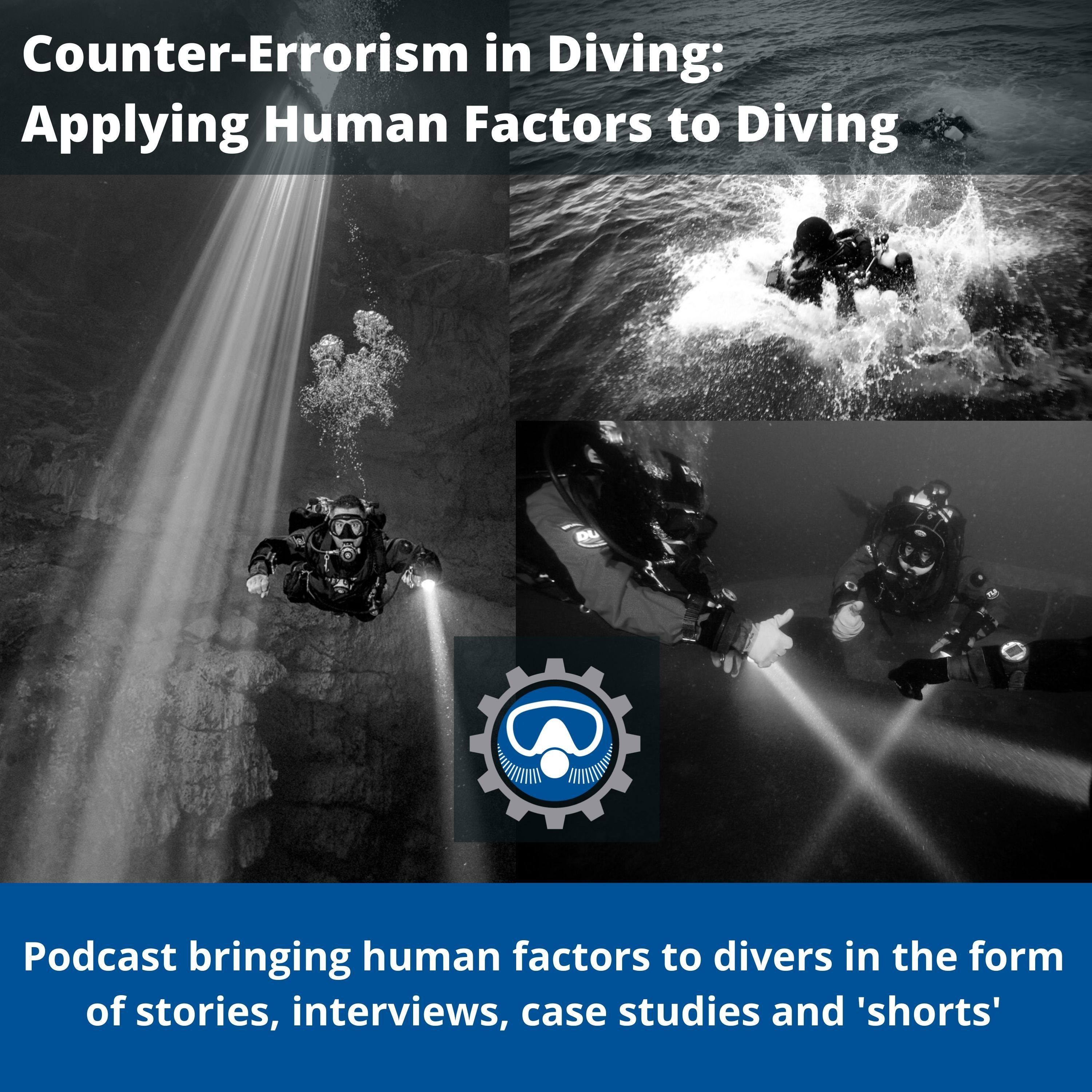
Human factors is a critical topic within the world of SCUBA diving, scientific diving, military diving, and commercial diving. This podcast is a mixture of interviews and 'shorts' which are audio versions of the weekly blog from The Human Diver. Each month we will look to have at least one interview and one case study discussion where we look at an event in detail and how human factors and non-technical skills contributed (or prevented) it from happening in the manner it did.
Author
Gareth Lock at The Human Diver
Category
Podcast website
Latest episode
Jul 11, 2026
Where to listen?
Podcasts in the app Replaio Radio Coming soonPodcasts are coming to the app soon. Install now and be the first to see a whole new take on podcasts
 Install for free
Android 5M+ downloads · 4.8 rating
iOS soon
Install for free
Android 5M+ downloads · 4.8 rating
iOS soon
Episodes
SH120: Why is it so hard to talk about failure? 09.11.2024 6:09
In this episode, we discuss how openly sharing failures can lead to safer, more effective diving practices and team connections. Inspired by a diving forum thread called “I Learned About Diving From That,” we explore how sharing mistakes helps others learn without fear of criticism, creating a “Just Culture.” Embracing failure is vital for growth: it strengthens team bonds, encourages personal lea...
SH119: Local Rationality: Why an old lady vandalised art and how to improve diving safety! 06.11.2024 5:03
In this episode, we explore how understanding "local rationality"—the idea that people make decisions that make sense to them in the moment—can improve diving safety and team performance. Using the story of a 91-year-old woman who "completed" a crossword art piece in a museum, believing it was interactive, we see how context shapes our actions. This concept is critical in diving, where incidents a...
SH118: Being a deviant is normal... 02.11.2024 6:14
In this episode, we delve into "normalization of deviance"—how divers, like workers in many fields, can gradually drift from safe practices due to pressures to be more efficient or productive. Often starting with small rule-bending or shortcuts, this drift can increase over time, as divers operate closer to safety limits without realizing the risk. Drawing on examples from high-reliability organiz...
SH117: Complacency: The Silent Killer... But it's not that Simple! 30.10.2024 10:48
In this episode, we explore complacency in technical diving, using the tragic case of Wes Skiles' 2010 rebreather accident as a springboard. Often labeled as the "silent killer," complacency can emerge when divers become overly reliant on their equipment and fail to actively monitor it, especially automated systems like rebreathers. Diving systems, much like any automated setup, require continuous...
SH116: Incompetent and Unaware: You don't know what you don't know... 26.10.2024 10:41
In this episode, we dive into the Dunning-Kruger effect and how it impacts diver safety. The presentation from TekDiveUSA 2016 emphasizes that humans often overestimate their own knowledge, creating gaps in situational awareness that can lead to dangerous decisions. By understanding cognitive biases, such as outcome and hindsight bias, divers can begin to recognize how easy it is to misjudge risks...
SH115: It's the little things that catch you out... 23.10.2024 6:23
In this episode, we discuss how complacency and cutting corners can lead to serious diving accidents. We explore how the same mental shortcuts that help us operate efficiently can also cause us to miss critical changes in our environment, leading to dangerous situations. Using examples from aviation and diving, we highlight the importance of situational awareness, monitoring equipment, and questio...
SH114: What relevance does Human Factors have to recreational and technical diving? 19.10.2024 7:13
In this episode, we explore why Human Factors are crucial in diving, even if you haven’t experienced an accident. Drawing from high-risk industries like NASA and aviation, we highlight how human errors often lead to major incidents, even when no technical failures are present. We discuss real-life diving examples where poor communication, peer pressure, or lack of planning led to dangerous situati...
SH113: How to help correct the biases which lead to poor decision making 16.10.2024 6:54
In this episode, we explore the concept of "pre-mortem" or prospective hindsight, a technique that helps teams identify potential reasons for failure before a project begins. Research shows that this approach increases the ability to foresee outcomes by 30%. By imagining a scenario where a project has already failed, team members can share their insights and concerns without the fear of being seen...
SH112: Authority Gradient - Why people don't (or can't) speak up. 12.10.2024 4:20
In this episode, we discuss the challenges teams face when speaking up, especially in the presence of authority figures. A German research study found that in 72% of cases, team members chose to remain silent even when verbal intervention was necessary, and only 40% of those who did speak up were assertive. Reasons for silence included deference to authority, lack of confidence, and failure to rec...
SH111: Big Data - Use as a Predictor? Or Not? 09.10.2024 3:28
In this episode, we discuss the potential and challenges of using Big Data to predict safety and performance issues, especially when human behavior is involved. While traditional cause-and-effect thinking works in some cases, complex incidents often involve many small contributing factors that are hard to detect. Big Data could help spot these hidden factors, but it requires detailed context and v...
SH110: Looking in the (Cultural) Mirror... 05.10.2024 5:35
In this episode, we explore cultural awareness and how understanding our own culture is key to improving relationships and performance in diverse environments. After attending a training session at Abbey Communication, I learned that we often judge others based on our own biases without realizing it. The course used the Trompenaars and Hampden-Turner model, which outlines seven dimensions of cultu...
SH109: Anyone could have done that...! 02.10.2024 3:10
In this episode, we discuss the concept of "common sense" and how it's not always as common as we might think. Using the example of Columbus and his "uncommon sense" solution to standing an egg on its end, we explore how knowledge and experience shape our understanding of what seems obvious. Just because something appears simple to one person doesn't mean it's clear to others who haven't had the s...
SH108: How Much Are You Willing to Risk? 28.09.2024 5:28
In this episode, we explore the parallels between decision-making in diving and the concepts from Daniel Kahneman's "Thinking, Fast and Slow." The discussion focuses on how divers often face tough choices when equipment malfunctions, similar to the mixed gambles described in the book. While staying on the boat may seem like the safe choice, the fear of missing a dive can lead to riskier decisions,...
SH107: Summary of RF4 Paper: Human Factors in Rebreather Diving 25.09.2024 14:27
In this episode, we discuss the importance of human factors in rebreather diving, highlighting key themes from the Rebreather Forum 4 conference. Rebreather diving, while offering unique opportunities, is far more complex than traditional scuba due to its intricate systems and hidden failure modes. The talk covers the role of systems thinking in improving safety, the need for a just culture, the v...
SH106: Language Matters: An HF Approach to Reviewing an ‘Accident Analysis’ 21.09.2024 23:27
In this podcast episode, we discuss a recent accident analysis published by RAID, which was framed as a hypothetical event but turned out to be based on a real-life diving incident without full consultation with those involved. The focus is on how we frame learning opportunities in diving and the importance of understanding the decisions made in the moment rather than placing blame after the fact....
SH105: Mistakes are good- learning from mistakes is sometimes better than getting it right 18.09.2024 5:44
In this episode, we discuss why mistakes are a valuable part of the learning process, especially in scuba diving training. While most instructors aim for their students to perform perfectly, making mistakes actually helps students learn more effectively. Mistakes provide opportunities for problem-solving and critical thinking, which can lead to deeper learning. We explore how immediate or delayed...
SH104: Communication- What stops people speaking up? 14.09.2024 6:55
In this episode, we explore the challenges of effective communication and the barriers that often lead to misunderstandings and conflicts. We discuss how stress, language differences, and personal insecurities like the Imposter Syndrome can prevent clear communication, both underwater and on land. We also highlight the importance of creating a psychologically safe environment where everyone feels...
SH103: The Dunning Kruger effect- Incompetent (or Competent?!) and Unaware 11.09.2024 6:13
In this episode, we explore the Dunning-Kruger effect, a cognitive bias where people with limited skills or knowledge in a particular area tend to overestimate their abilities, while those with more expertise may underestimate their competence. This effect explains why some new divers might think they’re better than they are, while more experienced divers might not realize how skilled they’ve beco...
SH102: Decision Making- How do we explain our decisions to others? 07.09.2024 5:35
In this episode, we explore the challenges of explaining decisions to others, especially when they don’t share the same knowledge or experience. Jenny recounts a personal story about deciding not to dive a local canyon system again due to safety concerns, despite it seeming straightforward to others. The incident highlights the importance of situational awareness, good communication, and building...
SH101: Running out of gas- Why does this happen and how can we prevent it? 04.09.2024 6:29
In this episode, we discuss a personal diving incident where I ran out of gas underwater—a situation that could have been fatal but wasn't due to quick thinking and luck. The experience highlights the dangers of complacency and the importance of maintaining situational awareness, even during routine dives. We explore how easily small oversights can lead to critical mistakes and the value of debrie...
SH100: Illusory Truth Effect 31.08.2024 5:07
In this episode, we explore the illusory truth effect, where repeated information, even if false, can become ingrained in our beliefs. This cognitive bias can be reinforced by social media echo chambers, making it difficult to separate fact from fiction. The effect is particularly strong when the information aligns with what we already believe, making us more likely to accept it without question....
SH99: Standards- why do we have them and what can we do if someone breaks them? 28.08.2024 8:30
In this episode, we dive into the issue of diving standards and safety, particularly how some instructors may not follow proper procedures, putting students at risk. Unlike other outdoor sports, the underwater environment makes it difficult to monitor and ensure that standards are upheld. This episode explores why this might be happening, such as the pressure on instructors to certify students qui...
SH98: How do novices know what questions to ask? 24.08.2024 5:57
In this episode, we explore the importance of experience in diving and how it shapes decision-making and problem-solving. Experience helps divers build mental models that guide them in various situations, but beginners often face challenges because they don't know what they don't know. We discuss the value of curiosity in learning, emphasizing the need to ask questions, seek quality information, a...
SH97: Survival instinct: Reaction to stress 21.08.2024 7:49
In this episode, we explore how divers can manage extreme stress in life-threatening situations. While technical skills and knowledge are vital, the ability to stay calm and focused under pressure is crucial. We discuss strategies like controlled breathing, tactical thinking, and continuous training to enhance mental resilience. Techniques such as stress inoculation training and mindfulness can he...
SH96: What do we mean by experience? 17.08.2024 5:58
In this episode, we discuss the concept of experience in diving and how it goes beyond simply logging a certain number of dives. True experience comes from the quality of dives, solving problems, and learning from mistakes in varied environments and conditions. We explore why minimum dive numbers shouldn't be seen as targets and highlight the importance of breadth and depth in diving experiences....
Similar podcasts







Listen to the Counter-Errorism in Diving: Applying Human Factors to Diving podcast in Replaio
Radio and podcasts in one app - free, with no sign-up. Install today and do not miss the launch
Replaio is not a podcast publisher; show names, artwork and audio belong to their authors and are distributed through public RSS feeds.