Gareth Lock at The Human Diver
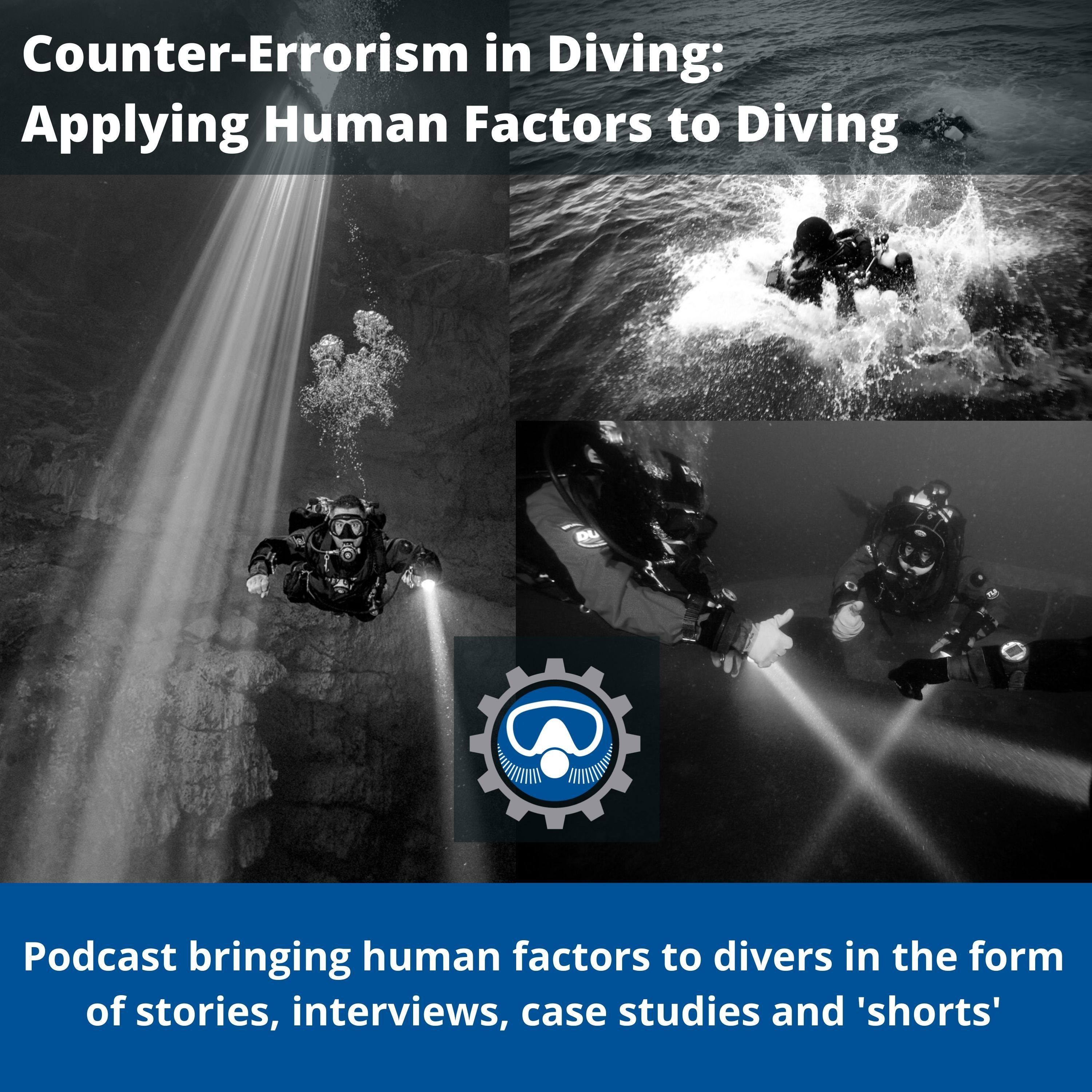
Counter-Errorism in Diving: Applying Human Factors to Diving
Human factors is a critical topic within the world of SCUBA diving, scientific diving, military diving, and commercial diving. This podcast is a mixture of interviews and 'shorts' which are audio versions of the weekly blog from The Human Diver. Each month we will look to have at least one interview and one case study discussion where we look at an event in detail and how human factors and non-technical skills contributed (or prevented) it from happening in the manner it did.
Author
Gareth Lock at The Human Diver
Category
Podcast website
Latest episode
Jul 11, 2026
Where to listen?
Podcasts in the app Replaio Radio Coming soonPodcasts are coming to the app soon. Install now and be the first to see a whole new take on podcasts
 Install for free
Android 5M+ downloads · 4.8 rating
iOS soon
Install for free
Android 5M+ downloads · 4.8 rating
iOS soon
Episodes
SH220: I thought: "WTF did you just say?" I actually said: ....nothing. How to say when it’s not okay 25.10.2025 10:25
Speaking up when something feels off—whether on the dive boat, in a briefing, or underwater—is key to building a safe and inclusive dive culture. In this episode, we explore how small interventions, from a simple pause to a well-placed question, can shift group dynamics and reinforce psychological safety. Using real-world diving scenarios, research-backed strategies, and insights from human factor...
SH219: Why are dive briefings important? How to deliver them effectively 22.10.2025 5:13
Effective dive briefings are key to safe and successful dives, yet many divers overlook their importance. In this episode, we explore how structured briefings help build a shared mental model, reducing misunderstandings and improving team coordination. Using the UNITED-C framework—covering goals, roles, risks, contingencies, and more—we break down how to deliver clear, effective dive briefings tha...
SH218: Being Understood, not just Transmitting 18.10.2025 5:41
Show Notes Summary: In this episode, we dive into the challenges of effective communication, especially in multicultural and high-stakes environments like diving. Using a real-life example from a Human Factors in Diving class, we discuss how cultural misunderstandings and non-verbal cues can lead to confusion and unintended consequences. We explore the importance of tailoring messages to your audi...
SH217: Normalization of Deviance (Risk): How Socially Accepted Drift Can Impact Your Diving 15.10.2025 6:33
Show Notes Summary: In this episode, we explore the concept of normalization of deviance and how it applies to diving. Inspired by a Divemaster's comment about surfacing gas reserves, we discuss how divers can unknowingly drift from safety standards over time, often influenced by social norms or perceived authority. Normalization of deviance, coined by Diane Vaughan, describes how repeated deviati...
SH216: Diving Deep into Diving Safety: The death of Linnea Mills through a lens of HF and System Safety 11.10.2025 16:00
Diving is often seen as a safe and relaxing sport, but true safety goes beyond avoiding accidents—it requires building resilience and learning from mistakes. In this episode, we explore how incidents often stem from systemic pressures and "practical drift," not just individual errors. Through real-world examples from diving and other high-risk industries, we highlight the importance of open debrie...
SH215: Situation Awareness and Mental Models: Making it easier to the do the right thing 08.10.2025 4:46
In this episode, we explore why situational awareness (SA) is the most critical skill for divers, even more so than technical abilities like buoyancy control or propulsion. SA isn’t just about noticing and processing information—it’s about projecting it into the future to anticipate outcomes. Through real-world examples, we highlight how building mental models—scripts based on experience and “what...
SH214: What if Just Culture and Psychological Safety is not enough? 04.10.2025 9:34
In this episode, we explore the challenges and lessons from diving in the Baltic Sea, where high-pressure conditions tested both skill and decision-making. We delve into the concepts of just culture and psychological safety, emphasizing their importance in fostering open communication, learning from mistakes, and creating safer systems. Drawing parallels to regulated industries like aviation, we d...
SH213: The Diving Professional: Leadership is not Optional 01.10.2025 5:16
In this episode, we explore the critical role of leadership in diving, focusing on the responsibilities dive professionals take on as role models. From following standard operating procedures to fostering psychological safety, we discuss how every action, intentional or not, shapes the behavior of students and less experienced divers. We emphasize the importance of admitting mistakes to build trus...
SH212: Stress - A challenge we all face 27.09.2025 5:11
The holiday season often highlights how stress can strain relationships and impact decision-making, both in everyday life and high-stakes activities like scuba diving. Stress narrows our focus, making it easy to miss critical information or react impulsively. Using tools like Viktor Frankl's concept of the space between stimulus and response, or the mantra "Stop, Think, Breathe, Act," we can pause...
SH211: Teams. Buddies. The Difference. 24.09.2025 6:13
In this episode, we dive into what makes an effective team, both above and below the surface. Using insights from a dive centre in Egypt, we explore how teamwork goes beyond buddy pairs, emphasizing shared goals, mutual accountability, and trust. We discuss why planning, adaptability, and understanding each other's roles are key to working interdependently, especially in dynamic environments like...
SH210: Communications - Ask better questions 20.09.2025 5:53
In this episode, we explore how asking the right questions can transform communication, whether during a dive briefing or a post-dive debrief. We discuss the difference between closed questions, which provide quick answers, and open questions, which encourage deeper understanding and learning. Using techniques like TEDS (Tell, Explain, Describe, Show), we can foster better communication, ensure al...
SH209: You're biased, I'm biased, We are all biased! 17.09.2025 5:40
In this episode, we explore how cognitive biases like hindsight bias, severity bias, outcome bias, and confirmation bias impact our ability to learn from accidents and incidents, both in diving and beyond. Using recent Red Sea liveaboard tragedies as a backdrop, we discuss why some events seem “obvious” only in hindsight, how severe outcomes lead to harsher judgments, and the danger of stopping in...
SH208: The Lost Fin: A Lesson in Situation Awareness 13.09.2025 7:49
In this episode, we dive into the story of a diver’s lost fin to explore the challenges of decision-making, task fixation, and situation awareness underwater. Through the lens of a training dive gone awry, we uncover how both students and instructors can fall into cognitive traps, focusing narrowly on immediate tasks while losing sight of broader risks. Highlighting the importance of structured de...
SH207: Change your Language. Change the World 10.09.2025 6:46
This podcast dives into the analysis of a cave diving fatality at Cenote Nariz in Mexico, based on a detailed report by the Creer Line and Safety Committee. The incident highlights critical lessons for divers in all environments, emphasizing the importance of understanding human factors, decision-making, and context in adverse events. While the exact cause of the diver's seizure remains uncertain,...
SH206: Single Diver Fatality in Cenote Nariz, 3 February 2024. CREER Report 06.09.2025 22:02
This podcast dives into the analysis of a cave diving fatality at Cenote Nariz in Mexico, based on a detailed report by the CREER Line and Safety Committee. The incident highlights critical lessons for divers in all environments, emphasizing the importance of understanding human factors, decision-making, and context in adverse events. While the exact cause of the diver's seizure remains uncertain,...
SH205: What one thing... 03.09.2025 10:40
This episode explores the power of small, intentional changes to improve teamwork, leadership, and performance in diving. Drawing from the Human Diver team's experience with a new training platform, we discuss how focusing on key skills like communication, task prioritization, and role clarity can create significant improvements. By embracing curiosity, running effective debriefs, sharing stories,...
SH204: Follow me! Trust me! I am your Leader! 30.08.2025 11:25
Leadership in diving is critical for navigating uncertain situations and achieving successful outcomes, whether you're teaching students, leading a dive project, or running a dive center. Drawing lessons from Ernest Shackleton's legendary leadership and modern theories of influence, this episode explores how effective leaders go beyond authority and management to inspire trust, foster psychologica...
SH203: The Importance of Psychological Safety in Debriefs 27.08.2025 8:54
Debriefs are vital for learning and improvement, but making them effective can be challenging. This episode explores how the DEBrIEF framework, inspired by aviation and human factors experts, provides a structured approach to debriefing that fosters psychological safety. We discuss the importance of vulnerability, showing that even experienced divers make mistakes, and how leading by example encou...
SH202: Accountability? Just another word for blame? 23.08.2025 7:37
In this episode, we explore the meaning of accountability and its role in learning and improvement. Is accountability about assigning blame, or can it be a tool for growth? We discuss the difference between backward-looking accountability, which focuses on punishment, and forward-looking accountability, which emphasizes understanding, empathy, and systemic change. Drawing on lessons from healthcar...
SH201: Knowledge is not enough. We must apply. What can you do to build HF into your training or education? 20.08.2025 9:10
In this episode, we dive into how to integrate human factors and non-technical skills into dive training and businesses. We explore the importance of understanding and applying these concepts in real-world scenarios, from effective communication to structured debriefing. Discover practical tools like blogs, workshops, and the Essentials of Human Factors in Diving course to deepen your knowledge an...
SH200: Why we find it so hard to say no or change...the sunk cost fallacy 16.08.2025 5:54
In this episode, we explore why calling a dive can be so difficult and why safety ultimately allows us to dive more. We discuss how small issues and stressors, combined with the sunk cost fallacy, can lead divers to push boundaries they wouldn’t normally cross. Drawing on personal experiences, we highlight the challenges of making safety-focused decisions and why they’re essential for long-term en...
SH199: Safety is boring... 13.08.2025 3:54
Why is safety often seen as boring in diving? In this episode, we discuss a story of high-current dives, questionable guiding practices, and the stigma of prioritizing safety over thrill. While safety briefings and precautions might seem dull or restrictive, they’re the key to longevity in diving—and life. A safe diver isn’t boring; they’re the one who gets to dive again tomorrow. We explore the v...
SH198: Were you lucky or were you good? 09.08.2025 8:12
What can WWII bombers teach us about diving? The story of Abraham Wald’s counterintuitive armor placement on planes highlights the importance of analyzing what’s not immediately visible—a lesson diving can embrace. Success in diving isn’t just about avoiding accidents but understanding why things go well and whether it’s skill or luck. Reflecting on successes and failures through effective debrief...
SH197: We’ve got an attitude problem! 06.08.2025 4:55
Mistakes are an essential part of learning, but in the highly regulated world of diving, the fear of judgment often stifles open discussion. Unlike other extreme sports where mistakes are embraced as learning opportunities, diving culture tends to focus on blame. This discourages growth and progress within the community. A "Just Culture" encourages sharing mistakes—large or small—without fear, fos...
SH196: They broke the rules! So...? 02.08.2025 14:26
When diving accidents occur, the immediate response often blames rule-breaking, but reality is far more complex. Rules are designed to enhance safety, yet accidents can happen even when rules are followed—and sometimes rules are broken without incident. Diving operations occur within a web of technical, social, and cultural conditions, which can provoke deviations. This highlights the gap between...
Similar podcasts







Listen to the Counter-Errorism in Diving: Applying Human Factors to Diving podcast in Replaio
Radio and podcasts in one app - free, with no sign-up. Install today and do not miss the launch
Replaio is not a podcast publisher; show names, artwork and audio belong to their authors and are distributed through public RSS feeds.