Gareth Lock at The Human Diver
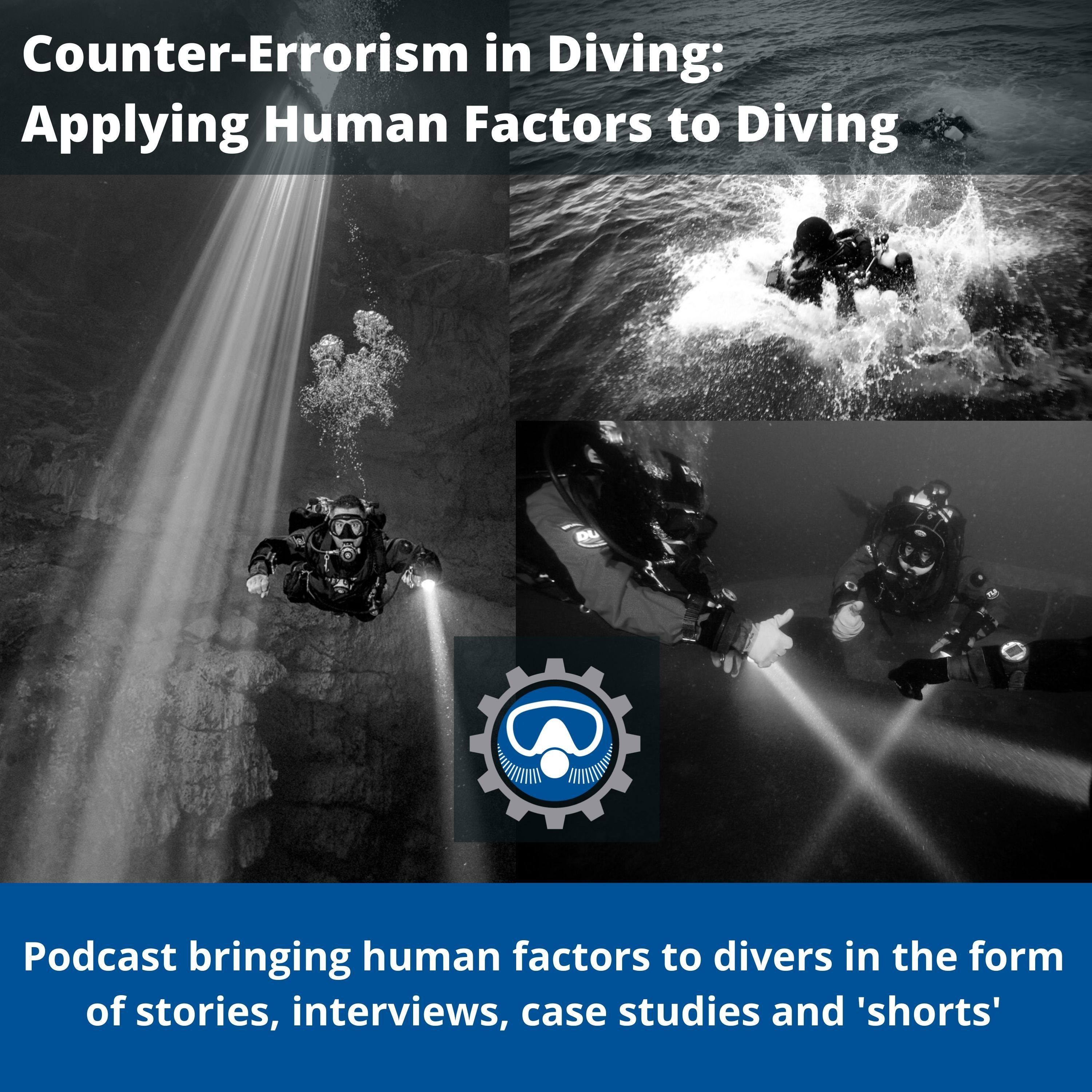
Counter-Errorism in Diving: Applying Human Factors to Diving
Human factors is a critical topic within the world of SCUBA diving, scientific diving, military diving, and commercial diving. This podcast is a mixture of interviews and 'shorts' which are audio versions of the weekly blog from The Human Diver. Each month we will look to have at least one interview and one case study discussion where we look at an event in detail and how human factors and non-technical skills contributed (or prevented) it from happening in the manner it did.
Author
Gareth Lock at The Human Diver
Category
Podcast website
Latest episode
Jul 11, 2026
Where to listen?
Podcasts in the app Replaio Radio Coming soonPodcasts are coming to the app soon. Install now and be the first to see a whole new take on podcasts
 Install for free
Android 5M+ downloads · 4.8 rating
iOS soon
Install for free
Android 5M+ downloads · 4.8 rating
iOS soon
Episodes
SH245: Asking Why. Telling Stories. Owning Accountability 17.01.2026 19:43
This episode explores how the diving community responds when something goes badly wrong and why the choice between blame and learning really matters. Drawing on three university research projects, it explains that after serious incidents people look for meaning through justice, learning, and sometimes punishment, and that visible learning can itself be a form of justice. The episode looks at why d...
SH244: Top Tips for Beginner Divers: Decision Making 14.01.2026 10:06
This episode looks at how many decisions can happen during a single dive and why decision-making is often harder underwater, especially for new divers. Using a real-world wreck dive story, it shows how focus on a goal, strong currents, stress, and missed checks can slowly lead to poor outcomes, even when basic skills are sound. The discussion explains how pressure, mental overload, common thinking...
SH243: Top Tips for Beginner Divers: Situation Awareness 10.01.2026 7:59
In this episode, we explore situation awareness, a key skill that helps divers notice what’s happening around them, understand what it means, and anticipate what might happen next. Using a personal story from a first open water dive, we show how beginners often rely on instructors to manage the “big picture” and don’t realise how much awareness is needed until they dive on their own. The episode e...
SH242: Top Tips for Beginner Divers: Psychological Safety & Just Culture 07.01.2026 6:44
In this episode, we follow Paul, a diver who joins an unfamiliar group and stays silent when he feels unsure, leading to stress, separation from the team, and a risky situation underwater. His story shows how being part of a group doesn’t automatically mean being part of a team, especially when people don’t feel comfortable asking questions or speaking up. We explore the ideas of psychological saf...
SH241: Top Tips for Beginner Divers: Performance Influencing Factors 03.01.2026 8:00
This episode looks at Ellie’s first overseas dive trip, where she discovered that being “ready” on paper doesn’t always mean performing well in real life. Even though she knew her skills, a rushed boat, unexpected changes, stress, and small mistakes left her overwhelmed and unsure underwater. We use her experience to explore why divers don’t always act the way they intend, using the WITH/TWIN mode...
SH240: Top Tips for Beginner Divers Leadership and Followership 31.12.2025 7:36
This episode explores what happened when an inexperienced diver, John, assumed he was “just meant to follow” his far more experienced buddy, Shona- and how a simple sea dive turned stressful when expectations weren’t shared. Their miscommunication shows that good teamwork in diving isn’t automatic: leaders need to notice when teammates are struggling, and followers need to speak up, ask questions,...
SH239: Top Tips for Beginner Divers: Teamwork 27.12.2025 8:10
In this episode, we look at how two new divers learned the hard way that being a true buddy team takes more than just diving side by side. A simple dive on a house reef became stressful when assumptions replaced communication, and neither diver had agreed on roles, pace, or what to do if something went wrong. Their experience shows that teamwork doesn’t happen automatically—it’s built through clea...
SH238: Top tips for Beginner Divers: Communications 24.12.2025 6:38
In this episode, we look at how a simple miscommunication during a fun dive turned into confusion, and why clear planning and shared understanding are essential for safe and enjoyable diving. Because you can’t talk underwater, communication has to start at the surface, and most problems come from assumptions, unclear plans, or people being too nervous to speak up. We break down practical tools to...
SH237: Decision Making: Normalisation of Deviance in Rebreather Cave Diving 20.12.2025 5:29
In this episode, we explore how easy it is for divers to drift into unsafe habits when risky behaviour seems to have no consequences, especially in small or high-performing cave and technical diving teams. A real example from a cave rebreather class shows how a simple shortcut- only a few metres and seemingly low-risk- could have broken a key rule of always maintaining a continuous guideline. Even...
SH236: Reframing The Dirty Dozen - Part 4 17.12.2025 8:03
In this episode, we finish exploring the “Dirty Dozen” human factors that contribute to mistakes in diving by looking at fatigue, lack of assertiveness and norms. These factors influence how divers think and behave, and they can increase risk if they aren’t recognised and managed. Fatigue can reduce focus and reaction time, lack of assertiveness can stop people from speaking up when something feel...
SH235: Reframing The Dirty Dozen - Part 3 13.12.2025 6:43
In this episode, we continue exploring the “Dirty Dozen,” a set of human factors that can lead to mistakes in diving, by looking at pressure, lack of awareness, and lack of knowledge. These factors affect divers of all levels because they shape how we think, act, and make decisions underwater. Pressure—whether from time, money, or other people—can push divers into taking risks or rushing, while la...
SH234: Reframing The Dirty Dozen - Part 2 10.12.2025 9:12
In Part 2 of this blog, we delve into three more of the "Dirty Dozen" human factors—stress, complacency, and lack of teamwork—and explore their impact on diver performance and safety. Stress, whether acute or chronic, can reduce awareness and decision-making ability, while complacency often arises in routine tasks, lowering vigilance. A lack of teamwork, meanwhile, undermines coordination and incr...
SH233: Reframing The Dirty Dozen - Part 1 06.12.2025 10:23
This week’s episode explores the interplay between human factors and system design in diving safety, using the “Dirty Dozen” as a framework to highlight key risks like poor communication, distraction, and lack of resources. While this list simplifies complex issues, it underscores how systemic challenges and individual behaviors intersect to create safety risks. The episode dives into practical co...
SH232: Instructor Toxicity: Why one bad apple really does spoil the bunch 03.12.2025 8:19
This blog by Pedro Paulo Cunha explores the critical role of leadership in dive safety, highlighting how a toxic leader at a dive resort created a culture of fear, harassment, and stress that compromised both staff well-being and guest safety. Through the story of an experienced instructor facing verbal abuse and misconduct, the piece underscores the importance of psychological safety, just cultur...
SH231: What do you mean, the damn box is missing again? 29.11.2025 8:49
Andrzej Gornicki reflects on the challenges of teamwork and organisation in diving operations, sharing lessons from his experience running a dive centre. Through real-life stories, he highlights how logistical oversights and errors—like forgotten equipment or missing supplies—can be mitigated with clear protocols and checklists. However, simply having checklists isn’t enough; they need to be embra...
SH230: What We Get Wrong About Psychological Safety in Diving 26.11.2025 10:28
Psychological safety is more than a buzzword—it's a critical team skill in high-risk environments like diving. Often misunderstood, it's not about being nice or avoiding discomfort, but about fostering an environment where team members feel safe to speak up, question, and learn without fear of judgment. Through real-life examples, including a gas switch error during a dive, this episode explores t...
SH229: Debriefing a Challenging Dive- a real-life experience 22.11.2025 5:50
Join us as we dive into a fascinating debrief from a Human Factors in Diving liveaboard trip, where a challenging dive sparked discussions on team communication, decision-making, and safety. A sandy slope, strong currents, and mixed team responses led to valuable insights during the post-dive debrief, transforming frustrations into learning moments. With psychological safety at the core, participa...
SH228: Designing Checklists that work. Slowing down to get it right. 19.11.2025 4:29
Mike Mason explores how effective decision-making in diving depends on both intuitive (System 1) and analytical (System 2) thinking, highlighting the crucial role of checklists in bridging the gap between these systems. Checklists serve as prompts to prevent errors caused by cognitive shortcuts, ensuring safety-critical steps are not missed. Effective checklists should be simple, logical, and stan...
SH227: Navigating Online Narratives and Learning from Feedback in Diving 17.11.2025 34:51
In this episode of The Human Diver, Mike Mason and I dive into the complexities of online storytelling, the double-edged nature of sharing experiences, and the power of constructive debriefing. We explore how narratives can both create learning opportunities and, at times, lead to misinterpretation, judgment, or defensive responses. You will discover how high-risk industries like aviation use cult...
SH226: 'They Lost Situation Awareness' 15.11.2025 6:35
The phrase "loss of situation awareness" is often misused as a simplistic explanation for diving incidents, focusing on blame rather than understanding the context and contributing factors. Situation awareness involves perceiving the environment, comprehending its significance, and projecting future outcomes to make informed decisions. It can be compromised by factors like fixation, poor communica...
SH225: The Challenge of Psychological Safety 12.11.2025 7:31
Psychological safety is essential for building trust and fostering open communication in diving teams, yet creating it can be a challenge in high-pressure environments like open-water certification weekends. Helene Pellerine explores how leaders, particularly instructors, play a crucial role in setting the tone for a safe and supportive atmosphere where divers feel seen, heard, and free to share c...
SH224: CCR Diver Goes Hypoxic on Surface – What Causal Reasoning Taught Me About Learning from Events 08.11.2025 10:48
In this episode, we examine a near-miss incident involving a CCR diver who narrowly avoided a hypoxic event during a liveaboard dive. Using this real-life scenario, we explore the importance of understanding human factors and causal reasoning in diving, focusing on how fatigue, stress, environmental distractions, and system design can shape performance and decision-making. We discuss the dangers o...
SH223: The Effect of your Environment on your Decision Making: Performance Shaping Factors in Diving 05.11.2025 4:19
In this episode, we dive into the impact of human factors on decision-making in diving, focusing on how environmental elements like fatigue and cold temperatures can shape performance. We explore how jet lag from travel affects cognitive ability and the strategies to mitigate its effects, as well as how cold water impacts dexterity, buoyancy, and mental processing. With insights into the physiolog...
SH222: You can’t risk assess a hazard you don’t know about: DeltaP 01.11.2025 12:23
In this episode, we explore the critical role of understanding hazards in diving and the importance of effective risk management. From the everyday threat of drowning to the more abstract risks like decompression sickness, we discuss how divers rely on equipment, training, and planning to mitigate dangers. The conversation highlights overlooked hazards like differential pressure (DeltaP), which ca...
SH221: The First Human Factors in Diving Liveaboard- Living our values 29.10.2025 6:29
In this episode, we explore how a liveaboard trip in Indonesia integrated Human Factors training to transform the diving experience. Jenny Lord from The Human Diver, Brent Webb from Scuba Adventures in Texas and Mark from Master Liveaboards collaborated to create a unique environment focused on psychological safety, teamwork, and debriefing. Over a week, 19 divers, with varying levels of Human Fac...
Similar podcasts







Listen to the Counter-Errorism in Diving: Applying Human Factors to Diving podcast in Replaio
Radio and podcasts in one app - free, with no sign-up. Install today and do not miss the launch
Replaio is not a podcast publisher; show names, artwork and audio belong to their authors and are distributed through public RSS feeds.