Med School Audio - Medical Knowledge Reimagined & Learning Made Memorable.
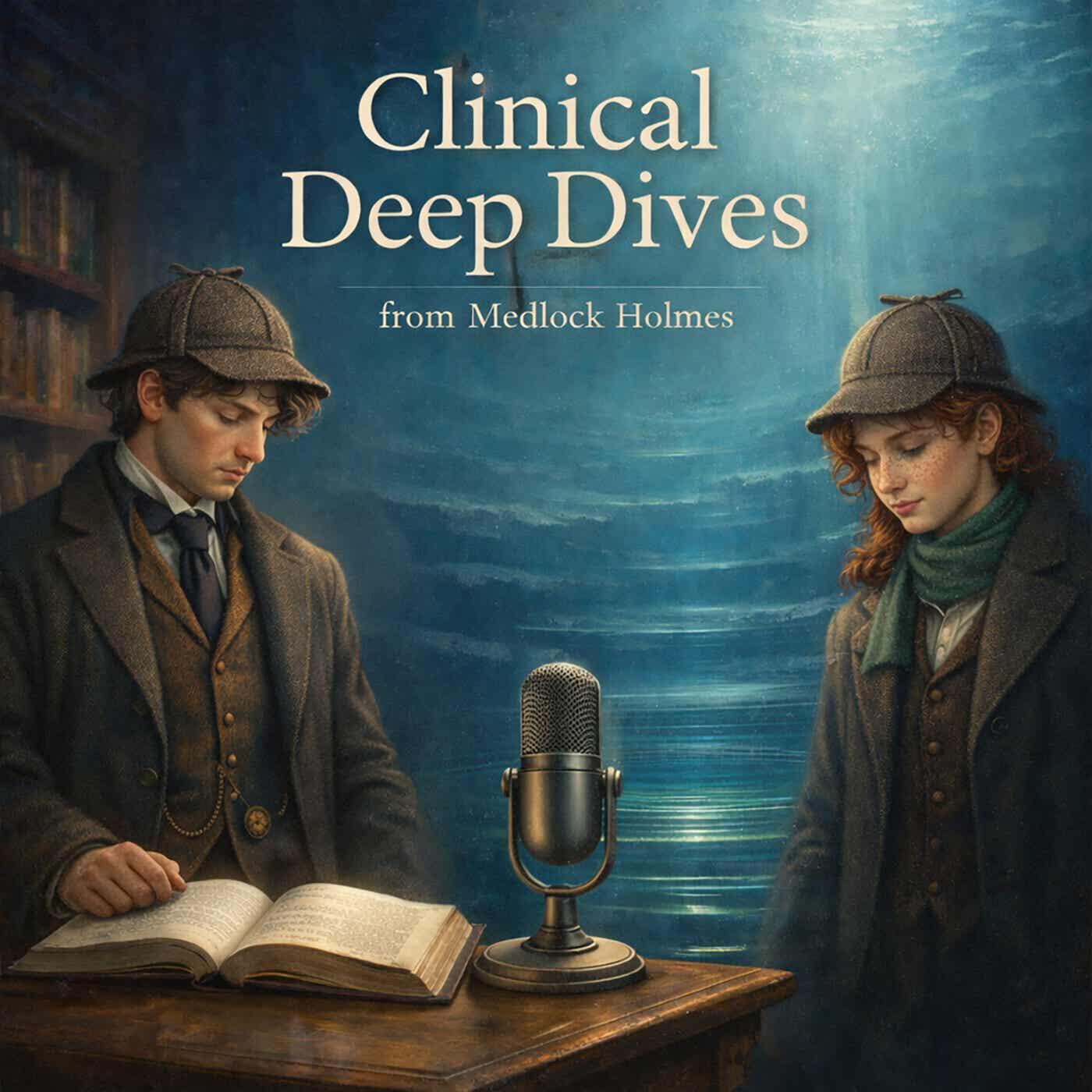
Clinical Deep Dives
Clinical Deep Dives is a Medlock Holmes podcast for clinicians and learners who want understanding, not just information. Using classic medical and surgical texts as a guide and the generative power of AI, each episode explores ideas with curiosity and clarity, designed for learning on the move and knowledge that actually sticks. drmanaankarray.substack.com
Be sure to visit the podcast's website and support the creator: drmanaankarray.substack.com
Author
Med School Audio - Medical Knowledge Reimagined & Learning Made Memorable.
Category
Podcast website
Latest episode
Nov 20, 2026
Where to listen?
Podcasts in the app Replaio Radio Coming soonPodcasts are coming to the app soon. Install now and be the first to see a whole new take on podcasts
 Install for free
Android 10M+ downloads · 4.7+ rating
iOS soon
Episodes
16. Embryology (Nervous System): Wiring the Body 21.01.2026 26:31
The nervous system integrates every other system, and its development reflects that complexity. This episode explores how the brain, spinal cord, and peripheral nerves emerge from simple beginnings into a highly organised network. Langman provides clarity on neural tube differentiation and brain vesicles, IB Singh reinforces spatial and temporal sequencing, and Moore anchors the discussion in neur...
15. Embryology (Musculoskeletal System): Built to Move 21.01.2026 26:41
Movement is not an afterthought in development — it is built into the body from the start. This episode explores how somites, limb buds, cartilage, bone, and muscle form a coordinated system designed for structure and motion. Langman explains segmentation and patterning, IB Singh offers clarity on limb rotations and skeletal timelines, and Moore highlights clinically relevant conditions such as li...
14. Embryology (Cardiovascular System): The First Rhythm 21.01.2026 27:20
Episode description The cardiovascular system is the first to function, and its development sets the tempo for everything that follows. In this episode, we explore how a simple linear tube becomes a four-chambered heart, capable of supporting the growing embryo long before birth. Langman clarifies looping, septation, and signalling pathways; IB Singh provides the essential structural sequencing; a...
13. Embryology (Urogenital System): Paths of Water and Reproduction 21.01.2026 33:05
Few systems illustrate embryology’s layered logic as clearly as the urogenital system. In this episode, we explore how kidneys ascend, ducts repurpose themselves, and reproductive organs differentiate from shared beginnings. Langman helps clarify the transitions from pronephros to mesonephros to metanephros, IB Singh provides a clear structural sequence, and Moore anchors the discussion in clinica...
12. Embryology (Gastrointestinal System): The Long Road Through the Gut 21.01.2026 25:14
The gastrointestinal tract tells one of embryology’s most dramatic stories: rapid growth, temporary displacement, and precise return. In this episode, we follow the gut tube as it lengthens, rotates, herniates, and ultimately settles into its adult configuration. Using Moore’s strong clinical emphasis on malrotation, atresias, and hernias, supported by Langman’s developmental logic and IB Singh’s...
11. Embryology (Respiratory System): Breathing Into Being 21.01.2026 29:39
The respiratory system develops through a simple but powerful idea: branching in response to space and need. This episode traces the journey from a small lung bud to a complex gas-exchanging organ capable of sustaining life at birth. Langman’s explanations of signalling and branching morphogenesis are woven together with IB Singh’s clear staging of lung development and Moore’s clinically focused d...
10. Embryology (Pharyngeal Apparatus): Faces, Arches, and Identity 21.01.2026 29:44
The pharyngeal apparatus is one of the most conceptually dense areas of embryology — and one of the most clinically revealing. In this episode, we explore how arches, pouches, grooves, and membranes collaborate to shape the face, neck, and upper aerodigestive tract. Rather than memorising derivatives in isolation, we trace a single organising idea: repetition with variation . Langman clarifies the...
09. Embryology (Placenta): The Lifeline Between Two Worlds 21.01.2026 30:39
The placenta is often taught as a temporary organ, but its role is anything but minor. This episode explores how the placenta and fetal membranes function as interfaces — exchanging gases, nutrients, hormones, and immune signals while maintaining separation. IB Singh reinforces organisation and placental development timelines, and Moore anchors the discussion in clinical realities such as placenta...
08. Embryology (Foetal Period): Growing Without a Blueprint 21.01.2026 26:26
Once the basic body plan is established, development enters a new phase — one less about formation and more about refinement. This episode focuses on the fetal period, where growth, differentiation, and functional maturation dominate. Using Moore’s trimester-based clinical framing, supported by Langman’s developmental principles and IB Singh’s structured summaries, we explore how organs mature at...
07. Embryology (Body Cavities): Making Room for Life 21.01.2026 25:33
As organs grow, they do not simply appear — they must be given space, orientation, and freedom to move. This episode focuses on the development of the intraembryonic coelom , the formation of the pericardial, pleural, and peritoneal cavities , and the crucial role these spaces play in allowing organs to function. Drawing on Langman’s clear developmental logic, IB Singh’s structured sequencing, and...
06. Embryology (Embryonic Folding): From Flat Disc to Living Form 21.01.2026 29:43
One of the most transformative moments in embryology is when the embryo folds. This episode explores how a flat, layered disc becomes a three-dimensional body with a gut tube, body cavities, and defined axes. Folding is not a single event, but a choreography of growth occurring in multiple directions at once. Drawing on Langman’s spatial explanations, IB Singh’s stepwise clarity, and Moore’s clini...
05. Embryology (Neurulation): Closing the Neural Story 21.01.2026 25:00
Neurulation is where complexity begins to accelerate. In this episode, we explore how a flat sheet of ectoderm transforms into the neural tube and why this process is both elegant and precarious. Rather than memorising days and folds, we focus on the underlying logic: shaping, closure, and timing. Langman’s mechanistic explanations help clarify how neural folds elevate and fuse, while IB Singh’s s...
04. Embryology (Gastrulation): The Point of No Return 21.01.2026 32:34
Gastrulation is the moment when the embryo stops being a collection of cells and becomes a body with direction. In this episode, we explore why the formation of the three germ layers represents a true point of commitment — a developmental crossroads from which there is no return. Using Langman’s explanations of signalling and movement, IB Singh’s clear staging, and Moore’s clinical correlations, w...
03. Embryology (Implantation): Finding a Place to Belong 21.01.2026 27:08
Implantation is often taught as a short, factual step between fertilisation and gastrulation. In reality, it is one of the most delicate negotiations in human development. This episode explores how the early embryo embeds itself within the maternal environment, forming the earliest relationships that will sustain life. We examine the bilaminar disc, amniotic cavity, yolk sac, and early placental s...
02. Embryology (Gametogenesis & Fertilisation): From Cells to Possibility 21.01.2026 23:53
Every human story begins long before fertilisation itself. In this episode, we explore how gametes are formed, shaped, and prepared for the extraordinary moment when two cells become one developing organism. Rather than treating spermatogenesis and oogenesis as lists of stages, we focus on why errors here echo through a lifetime . Using Langman’s mechanistic clarity, IB Singh’s structured sequenci...
01. Embryology (Overview): The Map Before the Journey 21.01.2026 26:39
Embryology can feel overwhelming when approached as a catalogue of stages and structures. This opening episode reframes the discipline as something far more coherent: a study of patterns, timing, and commitment. Before we enter weeks, folds, and systems, we pause to understand what embryology is really trying to teach us . Drawing together perspectives from Langman, Moore, and IB Singh, this episo...
Snell’s Anatomy 12: Head and Neck 20.01.2026 1:36
This is a free preview of a paid episode. To hear more, visit drmanaankarray.substack.com The head and neck contain a remarkable concentration of critical structures within a compact anatomical space. This chapter brings together cranial, cervical, vascular, neural, and visceral anatomy, demonstrating how precise spatial relationships underpin speech, swallowing, breathing, sensation, expression,...
Snell’s Anatomy 11: Lower Limb 20.01.2026 28:11
The lower limb is anatomically dedicated to load-bearing, balance, and locomotion . This chapter explores how stability is prioritised over mobility, and how structural alignment, muscular power, and neurovascular organisation combine to support standing, walking, and running. It also explains why injury and disease in the lower limb so often disrupt independence and quality of life. The chapter b...
Snell’s Anatomy 10: Perineum 20.01.2026 26:19
The perineum is the anatomical region where structure and function intersect most visibly and most frequently in clinical care. This chapter reframes the perineum not as an awkward anatomical afterthought, but as a precisely organised, highly innervated, and clinically decisive space . The chapter begins by defining the boundaries and surface anatomy of the perineum , describing its diamond-shaped...
Snell’s Anatomy 09: Pelvic Cavity 20.01.2026 26:56
The pelvic cavity is a region where anatomy is inseparable from function. This chapter explores how viscera, muscles, fascia, vessels, and nerves coexist in a confined space that must adapt continuously to posture, movement, bladder filling, bowel activity, sexual function, and—in many individuals—pregnancy and childbirth. The chapter opens by defining the boundaries of the pelvic cavity , situati...
Snell’s Anatomy 08: Pelvic Wall 20.01.2026 28:29
The pelvic wall forms the architectural base of the trunk, a region where stability, containment, and neurovascular complexity converge. This chapter reframes the pelvis not as a static basin, but as a load-bearing, force-transmitting structure whose anatomy underpins continence, locomotion, childbirth, and visceral support. The chapter begins by defining the bony pelvis , distinguishing the false...
Snell’s Anatomy 07: Abdominal Cavity 20.01.2026 37:10
The abdominal cavity is a region defined less by rigid boundaries and more by relationships, movement, and suspension . This chapter develops the anatomical understanding required to navigate organs that shift with posture, respiration, and physiological state, while remaining tethered by vessels, mesenteries, and peritoneal reflections. The chapter opens with a detailed account of the peritoneum...
Snell’s Anatomy 06 — Abdominal Wall 20.01.2026 23:32
The abdominal wall is a study in layered engineering. This chapter reveals how muscle, fascia, and connective tissue combine to protect viscera, permit movement, regulate pressure, and create predictable points of weakness. Far from being a passive covering, the abdominal wall is shown as an active, responsive structure central to posture, respiration, and core stability. The chapter begins by def...
Snell’s Anatomy 05: Thoracic Cavity 20.01.2026 25:57
The thoracic cavity is where anatomical relationships become immediately life-critical. This chapter shifts focus from the protective wall to the contents it encloses , revealing how the heart, lungs, great vessels, nerves, and oesophagus coexist within a confined and highly organised space. The chapter begins by defining the boundaries of the thoracic cavity , distinguishing it clearly from the t...
Snell’s Anatomy 04: Thoracic Wall 20.01.2026 29:20
The thoracic wall is often mistaken for a static enclosure, yet this chapter reveals it as a dynamic structure whose design balances protection, movement, and access. Snell’s treatment of the thoracic wall builds the anatomical foundation required to understand respiration, trauma, procedural safety, and referred pain. The chapter opens with the osteology of the thoracic cage , detailing the stern...
Similar podcasts








Listen to the Clinical Deep Dives podcast in Replaio
Radio and podcasts in one app - free, with no sign-up. Install today and do not miss the launch
Replaio is not a podcast publisher; show names, artwork and audio belong to their authors and are distributed through public RSS feeds.