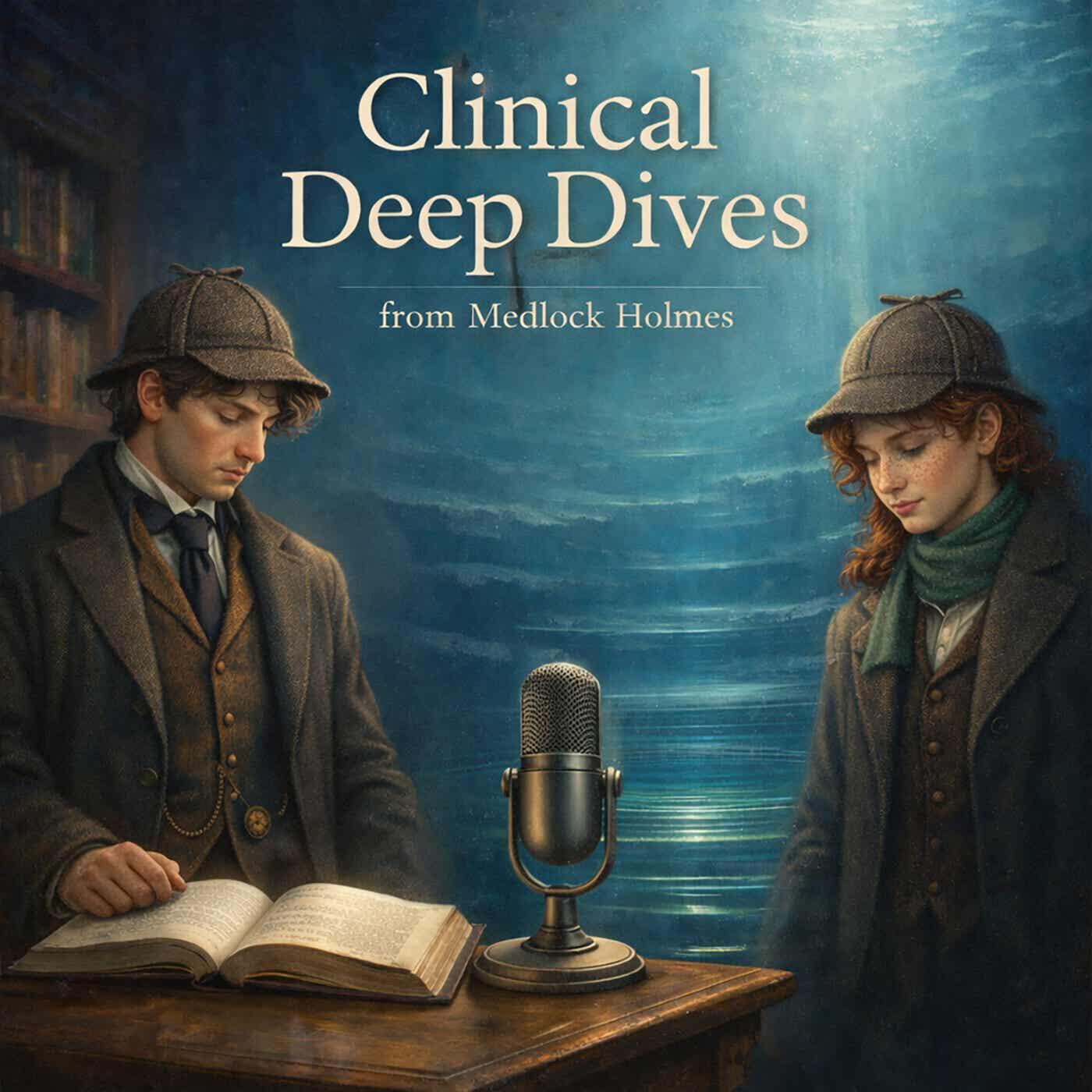
Med School Audio - Medical Knowledge Reimagined & Learning Made Memorable.
Clinical Deep Dives
Clinical Deep Dives is a Medlock Holmes podcast for clinicians and learners who want understanding, not just information. Using classic medical and surgical texts as a guide and the generative power of AI, each episode explores ideas with curiosity and clarity, designed for learning on the move and knowledge that actually sticks. drmanaankarray.substack.com
Be sure to visit the podcast's website and support the creator: drmanaankarray.substack.com
Author
Med School Audio - Medical Knowledge Reimagined & Learning Made Memorable.
Category
Podcast website
Latest episode
Nov 20, 2026
Where to listen?
Podcasts in the app Replaio Radio Coming soonPodcasts are coming to the app soon. Install now and be the first to see a whole new take on podcasts
 Install for free
Android 10M+ downloads · 4.7+ rating
iOS soon
Episodes
Biochem 21: Lipid Biosynthesis 24.01.2026 32:49
Catabolism answers the question of survival. Biosynthesis answers a different one: what do we do with more than we need? In this episode, Medlock Holmes follows carbon not as it is burned, but as it is deliberately redirected into long-term form. Lipid biosynthesis is revealed as an act of confidence — a decision that energy is plentiful enough to be stored, structured, and deferred. We explore ho...
Biochem 20: Photosynthesis 24.01.2026 39:24
Until now, Medlock Holmes has followed energy as it is transferred, transformed, and conserved within living systems. In this episode, he steps back further still — to examine how energy enters the biological world in the first place. Photosynthesis is treated here not as a plant-specific curiosity, but as the foundational act upon which nearly all metabolism depends. Light is captured, separated...
Biochem 19: Oxidative Phosphorylation 24.01.2026 33:59
Episode Description Every pathway so far has been a preparation. In this episode, Medlock Holmes arrives at the place where all prior decisions are settled — oxidative phosphorylation, the final accounting of cellular energy. Here, electrons harvested from carbohydrates, fats, and amino acids are passed along an ordered chain, not to create chaos, but to build potential. The electron transport cha...
Biochem 18: Amino Acid Oxidation and the Production of Urea 24.01.2026 36:08
Carbohydrates burn cleanly. Fats burn patiently. Proteins, however, leave something behind. In this episode, Medlock Holmes turns to amino acids as metabolic fuel and discovers that their oxidation presents a unique problem: nitrogen. While carbon skeletons can be redirected into energy pathways, nitrogen cannot simply accumulate. It must be handled, neutralised, and removed — safely. Drawing on L...
Biochem 17: Fatty Acid Catabolism 24.01.2026 35:05
Not all energy is meant to be spent quickly. In this episode, Medlock Holmes follows fatty acids — dense, efficient stores of energy — as they are released, transported, and broken down with deliberate precision. Fatty acid catabolism is revealed as a process designed for endurance rather than urgency. We explore how fatty acids are mobilised from storage, activated, and transported into mitochond...
Biochem 16: The Citric Acid Cycle 24.01.2026 39:37
Every complex system has a centre — a place where inputs converge, outputs diverge, and meaning is made. In metabolism, that place is the citric acid cycle. In this episode, Medlock Holmes steps into the core of cellular energy metabolism and finds a pathway that is far more than a simple loop. The citric acid cycle is revealed as a meeting point for carbohydrates, fats, and amino acids — a hub wh...
Biochem 15: Glycogen Metabolism 24.01.2026 33:29
Energy availability is rarely constant. In this episode, Medlock Holmes turns his attention to glycogen — the body’s answer to unpredictability. Glycogen metabolism is revealed as a system designed not for abundance, but for transition. We explore how glucose is stored efficiently as a highly branched polymer, how rapid mobilisation is achieved when demand rises, and why liver and muscle glycogen...
Biochem 14: Glycolysis, Gluconeogenesis, and the Pentose Phosphate Pathway 24.01.2026 36:53
Glucose is deceptively simple. In this episode, Medlock Holmes discovers that it is not a fuel with a single purpose, but a crossroads — a molecule whose fate depends entirely on context. We follow glucose as it enters the cell and encounters three competing narratives. In glycolysis, it is broken down rapidly to meet immediate energy demand. In gluconeogenesis, it is patiently rebuilt when supply...
Biochem 13: Introduction to Metabolism 24.01.2026 41:07
Up to this point, Medlock Holmes has examined the pieces of life — their structure, their interactions, their messages. In this episode, he steps back and watches the system in motion. Metabolism is not a list of pathways. It is an economy. Molecules are built, broken, exchanged, and recycled with remarkable coordination. In this opening episode of Bioenergetics & Metabolism , we explore how cells...
Biochem 12: Biochemical Signalling 24.01.2026 31:38
Having traced structure, catalysis, and boundaries, Medlock Holmes now turns to something less tangible but no less decisive: communication. In this episode, we explore how cells detect change, transmit information, and coordinate responses across space and time. Biochemical signalling is revealed not as a single pathway, but as a layered language. Hormones, second messengers, receptors, and casca...
Biochem 11: Biological Membranes and Transport 24.01.2026 34:32
Life depends on separation. Without boundaries, chemistry becomes chaos. In this episode, Medlock Holmes investigates biological membranes not as static walls, but as intelligent interfaces — structures that regulate exchange, maintain gradients, and enable communication. We explore how lipid bilayers form selectively permeable barriers, and how embedded proteins transform these barriers into dyna...
Biochem 10: Lipids 24.01.2026 38:14
Lipids rarely receive the attention they deserve. Often reduced to fats and fuels, they are in fact some of the most versatile and consequential molecules in biology. In this episode, Medlock Holmes investigates lipids as architects of boundaries and modulators of behaviour. We explore their structural diversity — fatty acids, triacylglycerols, phospholipids, sterols — and see how chemical propert...
Biochem 9: DNA-Based Information Technologies 24.01.2026 37:26
Understanding information is one thing. Learning how to access, amplify, edit, and interpret it is another entirely. In this episode, Medlock Holmes examines the tools that allow humans to question the genetic archive directly. DNA, once seen as untouchable record-keeping, becomes a working document — copied, cut, sequenced, and recombined with precision. These technologies do not change the logic...
Biochem 8: Nucleotides and Nucleic Acids 24.01.2026 34:14
Every investigation eventually leads to records: ledgers, archives, instructions left behind. In biology, those records are written in nucleotides. In this episode, Medlock Holmes examines the molecular basis of biological information. We explore how simple nucleotide units assemble into nucleic acids capable of storing, transmitting, and preserving instructions across time. Sugar–phosphate backbo...
Biochem 7: Carbohydrates and Glycobiology 24.01.2026 14:50
Carbohydrates are often introduced as energy sources — quick fuel, stored reserve, metabolic currency. In this episode, Medlock Holmes looks beyond that narrow framing and uncovers a far richer story. Here, carbohydrates emerge as architects of structure and arbiters of recognition. We explore how monosaccharides combine into diverse polymers, how branching patterns encode function, and how glycoc...
Biochem 6: Enzymes 24.01.2026 39:42
If proteins are the workforce of the cell, enzymes are its master craftsmen. They do not merely participate in reactions — they make life feasible by accelerating chemistry that would otherwise take centuries. In this episode, Medlock Holmes turns his attention to enzymes as agents of transformation. We explore how enzymes lower activation energy, stabilise transition states, and impose extraordin...
Biochemistry 5: Protein Function 24.01.2026 42:28
Structure explains how a protein can exist. Function explains why it matters. In this episode, Medlock Holmes follows proteins out of the abstract and into action. Having understood their architecture, we now observe how proteins bind, transport, signal, defend, and regulate. Function is revealed not as a static role, but as a relationship — between protein and ligand, protein and environment, pro...
Biochem 4: The Three-Dimensional Structure of Proteins 24.01.2026 39:04
Knowing the characters is not enough. To understand behaviour, you must understand form . In this episode, Medlock Holmes steps away from linear sequences and into three dimensions, where proteins stop behaving like strings of beads and start behaving like machines. Here, we explore how primary structure folds into secondary motifs, assembles into tertiary forms, and sometimes collaborates into qu...
Biochem 3: Amino Acids, Peptides, and Proteins 24.01.2026 35:06
Every mystery has its characters. In biochemistry, they are not suspects or witnesses, but amino acids — small, deceptively simple molecules whose personalities determine everything that follows. In this episode, Medlock Holmes begins the careful task of identification. We explore amino acids not as a list to memorise, but as a diverse cast with distinct chemical behaviours: charged, polar, hydrop...
Biochem 2: Water — The Solvent of Life 24.01.2026 26:01
At first glance, water seems unremarkable — colourless, tasteless, and everywhere. Yet in biochemistry, nothing happens without it. In this episode, Medlock Holmes turns his attention to the most underestimated participant in life’s molecular drama. Rather than treating water as background scenery, we examine it as an active force : shaping protein structure, driving molecular interactions, buffer...
Biochem 1: Foundations of Biochemistry 24.01.2026 29:49
Every investigation needs a starting point. Before enzymes, pathways, or genes, there is a deeper question: why does life behave the way it does at all? In this opening episode, Medlock Holmes steps back from the bench and the bedside to examine the foundations of biochemistry itself. We explore how chemistry becomes biology, how physical laws shape living systems, and why metabolism, structure, a...
20. Embryology (Teratology): When Development Falters 22.01.2026 26:01
The final episode brings the series full circle, returning to the question of why embryology matters. Here, we explore how timing, exposure, and vulnerability intersect to produce congenital anomalies. Langman provides the conceptual framework of critical periods and signalling disruption, IB Singh reinforces applied clinical patterns, and Moore grounds the discussion in prenatal diagnosis, ultras...
19. Embryology (Endocrine System): Messages Without Wires 21.01.2026 27:33
The endocrine system develops quietly, without ducts or obvious boundaries, yet its influence is global. This episode explores how dispersed endocrine organs arise from multiple embryological origins and come to regulate growth, metabolism, and internal balance across the body. Drawing on IB Singh’s clear sequencing, we trace the embryological origins of key endocrine organs — including the thyroi...
18. Embryology (Integumentary System): Where the Body Meets the World 21.01.2026 27:55
The skin is often taught as a static covering, yet embryologically it is a dynamic, multifunctional organ that mediates the body’s earliest relationship with its environment. This episode explores how the integumentary system develops from surface ectoderm and mesenchyme to form a protective, sensory, and regenerative boundary. Drawing on Langman’s developmental framework, IB Singh’s structured se...
17. Embryology (Eye & Ear): Seeing and Hearing the World 21.01.2026 27:52
Vision and hearing arise from intricate interactions between surface ectoderm, neuroectoderm, and mesenchyme. In this episode, we explore how the eye and ear form through reciprocal induction and precise spatial relationships. Langman explains optic cup formation and otic vesicle development, IB Singh provides structured recall of stages, and Moore links development to congenital blindness, deafne...
Similar podcasts








Listen to the Clinical Deep Dives podcast in Replaio
Radio and podcasts in one app - free, with no sign-up. Install today and do not miss the launch
Replaio is not a podcast publisher; show names, artwork and audio belong to their authors and are distributed through public RSS feeds.