Med School Audio - Medical Knowledge Reimagined & Learning Made Memorable.
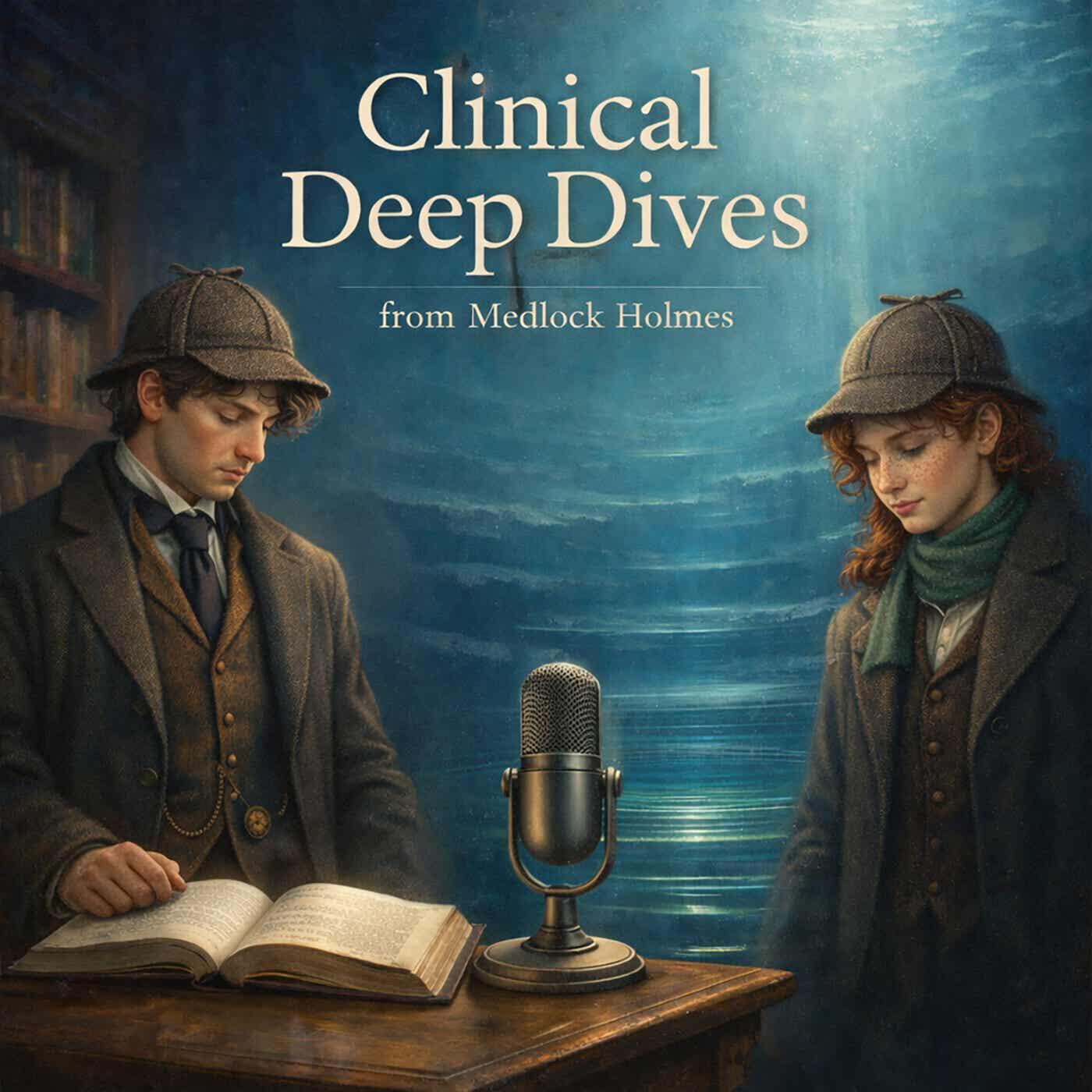
Clinical Deep Dives
Clinical Deep Dives is a Medlock Holmes podcast for clinicians and learners who want understanding, not just information. Using classic medical and surgical texts as a guide and the generative power of AI, each episode explores ideas with curiosity and clarity, designed for learning on the move and knowledge that actually sticks. drmanaankarray.substack.com
Be sure to visit the podcast's website and support the creator: drmanaankarray.substack.com
Author
Med School Audio - Medical Knowledge Reimagined & Learning Made Memorable.
Category
Podcast website
Latest episode
Nov 19, 2026
Where to listen?
Podcasts in the app Replaio Radio Coming soonPodcasts are coming to the app soon. Install now and be the first to see a whole new take on podcasts
 Install for free
Android 10M+ downloads · 4.7+ rating
iOS soon
Episodes
Micro 26: Vibrio and Related Bacteria 18.02.2026 30:04
This episode introduces Vibrio species and related curved Gram-negative rods. Drawing from Murray’s Chapter 26, it begins with ecology: these organisms are intrinsically linked to aquatic environments, particularly brackish and marine waters. The central organism is Vibrio cholerae , whose pathogenesis illustrates the power of toxin-mediated disease. Rather than invading deeply, it adheres to inte...
Micro 25 – Enterobacteriaceae 18.02.2026 38:43
This episode introduces the large and clinically dominant family of Gram-negative rods known as the Enterobacteriaceae . Drawing from Murray’s Chapter 25, it explores organisms that primarily inhabit the gastrointestinal tract but frequently emerge as major pathogens. The narrative frames this family as biologically coherent: facultative anaerobes, oxidase-negative, glucose-fermenting rods possess...
Micro 24: Haemophilus and Related Bacteria 18.02.2026 30:24
Episode Description This episode explores Haemophilus and related fastidious Gram-negative bacteria. Drawing from Murray’s Chapter 24, the focus begins with Haemophilus influenzae , an organism defined not by size but by its growth requirements and virulence potential. The narrative emphasises its need for specific growth factors (X and V), linking laboratory behaviour to biological dependency. Th...
Micro 23: Neisseria and Related Genera 18.02.2026 46:59
This episode introduces the Gram-negative diplococci of the genus Neisseria , organisms defined by their kidney-bean–shaped pairs and strict human host adaptation. Drawing from Murray’s Chapter 23, the focus centres on Neisseria gonorrhoeae and Neisseria meningitidis , two pathogens that share morphology yet diverge dramatically in clinical expression. The narrative begins at the mucosal surface....
Micro 22: Mycobacterium and Related Acid-Fast Bacteria 17.02.2026 32:25
This episode explores the genus Mycobacterium , defined by its distinctive acid-fast cell wall rich in mycolic acids. Drawing from Murray’s chapter, it examines how this lipid-heavy structure confers resistance to desiccation, disinfectants, and many antibiotics - while also shaping immune interaction. The central organism is Mycobacterium tuberculosis , with emphasis on airborne transmission, gra...
Micro 21: Listeria and Related Gram-Positive Bacteria 17.02.2026 44:21
This episode explores Listeria monocytogenes and related aerobic, non–spore-forming Gram-positive bacilli. Drawing from Murray’s chapter, the focus is on Listeria ’s distinctive ability to survive and replicate within host cells. The narrative centres on its pathogenesis: ingestion via contaminated food, intestinal invasion, survival within macrophages, escape from the phagolysosome via listerioly...
Micro 20: Bacillus 17.02.2026 38:39
This episode introduces the Gram-positive, spore-forming rods of the genus Bacillus . Drawing from Murray’s chapter, it explores their defining biological trait: the ability to form endospores that withstand heat, desiccation, radiation, and chemical insult. The episode centres primarily on Bacillus anthracis , the agent of anthrax, examining its capsule, tripartite toxin system (protective antige...
Micro 19: Streptococcus and Enterococcus 16.02.2026 42:45
This episode explores the Gram-positive cocci that grow in chains or pairs - Streptococcus and Enterococcus . Drawing from Murray’s chapter, it introduces their classification by haemolysis patterns and Lancefield grouping, linking laboratory identity with clinical consequence. The narrative moves through the major streptococcal groups: * Streptococcus pyogenes (Group A) and its role in pharyngiti...
Micro 18: Staphylococcus and Related Gram-Positive Cocci 16.02.2026 46:53
This episode introduces Staphylococcus species, beginning with their defining morphology: Gram-positive cocci arranged in clusters. Drawing from Murray’s chapter, it explores the biology, virulence factors, and clinical patterns of Staphylococcus aureus , alongside coagulase-negative staphylococci. The narrative emphasises dual identity. S. aureus may colonise harmlessly in the nares and on skin,...
Micro 17: Antibacterial Agents 16.02.2026 39:16
This episode explores the principles of antibacterial therapy. Drawing from Murray’s chapter, it examines how antibiotics exploit bacterial structure and physiology to achieve selective toxicity - harming microbes while sparing host cells. The episode moves through major drug classes: cell wall synthesis inhibitors, protein synthesis inhibitors, nucleic acid synthesis inhibitors, metabolic antagon...
Micro 16: Laboratory Diagnosis of Bacterial Diseases 16.02.2026 40:26
This episode brings bacteriology into the laboratory. Drawing from Murray’s chapter, it explores the structured process of diagnosing bacterial disease: specimen selection, transport, culture, identification, and susceptibility testing. The episode emphasises that laboratory diagnosis begins before the sample reaches the bench. Appropriate specimen collection, timing, and clinical context determin...
Micro 15: Role of Bacteria in Disease 16.02.2026 41:37
This episode connects bacterial virulence to recognisable clinical disease. Drawing from Murray’s chapter, it examines how bacteria produce distinct patterns of infection depending on entry route, tissue tropism, host factors, and immune response. The episode explores localised infections, systemic spread, bacteraemia, septic shock, and toxin-mediated syndromes. It distinguishes between invasive d...
Micro 14: Mechanisms of Bacterial Pathogenesis 16.02.2026 31:33
This episode examines how bacteria convert structure and genetic capacity into clinical disease. Drawing from Murray’s chapter, it explores the core mechanisms of bacterial pathogenesis: adherence to host tissues, invasion, toxin production, immune evasion, and persistence. Rather than treating virulence as a single trait, the episode presents it as a coordinated sequence of events. Adhesins allow...
Micro 13: Bacterial Metabolism and Genetics 16.02.2026 41:13
This episode enters the bacterial interior. Drawing from Murray’s chapter, it explores how bacteria generate energy, synthesise essential components, and adapt genetically to changing environments. Metabolism is framed not as biochemistry for its own sake, but as a determinant of growth conditions, tissue tropism, and laboratory identification. Aerobic versus anaerobic pathways, fermentation, nutr...
Micro 12: Bacterial Classification, Structure, and Replication 15.02.2026 43:57
This episode marks the formal beginning of bacteriology. Drawing from Murray’s chapter, it introduces bacteria not as clinical labels, but as structured biological systems defined by their morphology, cell wall composition, genetic organisation, and modes of replication. The episode explores Gram-positive and Gram-negative architecture, cell membranes, peptidoglycan layers, outer membranes, endoto...
Micro 11: Antimicrobial Vaccines 15.02.2026 34:03
This episode completes the immunology arc by shifting from natural immune response to deliberate immune preparation. Drawing from Murray’s chapter, it explores how vaccines harness immunologic memory to prevent disease before infection ever establishes itself. The episode examines the principles underlying vaccine design: live-attenuated, inactivated, subunit, conjugate, recombinant, and newer nuc...
Micro 10: Immune Responses to Infectious Agents 15.02.2026 40:12
This episode applies immunologic principles to real pathogens. Drawing from Murray’s chapter, it examines how the immune system tailors its response depending on the nature of the invading organism - extracellular bacteria, intracellular bacteria, viruses, fungi, and parasites each demanding different defensive approaches. The episode emphasises that immunity is not one-size-fits-all. Antibody-med...
Micro 9: Antigen-Specific Immune Responses 15.02.2026 49:44
This episode explores adaptive immunity - the antigen-specific arm of host defence that confers precision, memory, and long-term protection. Drawing from Murray’s chapter, it introduces the cellular and molecular mechanisms that allow the immune system to distinguish self from non-self and mount highly specific responses to distinct pathogens. The episode moves through lymphocyte development, anti...
Micro 8: Innate Host Responses 14.02.2026 46:49
This episode focuses on the innate immune response - the body’s immediate, non-specific defence system that reacts within minutes of microbial invasion. Drawing from Murray’s chapter, it explores how the innate system recognises conserved microbial patterns and initiates protective responses without prior exposure. Pattern recognition receptors, inflammatory mediators, complement activation, phago...
Micro 7: Elements of Host Protective Responses 14.02.2026 41:28
This episode opens the immunology arc by introducing the host as an active participant in infection, not a passive surface upon which microbes act. Drawing from Murray’s chapter, it outlines the fundamental components of host defence that operate continuously, often unnoticed, to prevent infection from taking hold. The episode explores physical barriers, chemical defences, cellular responses, and...
Micro 6: Serologic Diagnosis 14.02.2026 38:48
This episode introduces serologic diagnosis as a fundamentally different way of knowing infection - not by finding the microbe itself, but by interpreting the host’s immune response to it. Drawing from Murray’s chapter, the focus is on antibodies as biological records: signals of exposure, timing, and immune engagement. The episode explores how antigen–antibody interactions are harnessed in diagno...
Micro 5: Molecular Diagnosis 14.02.2026 36:44
This episode moves diagnostic microbiology beyond what can be seen or cultured, into what can be amplified, sequenced, and inferred . Drawing on Murray’s chapter, it introduces molecular diagnosis as a shift in mindset: from growing organisms to detecting their signatures. The episode explores how nucleic acid–based techniques identify pathogens rapidly and with extraordinary sensitivity, often be...
Micro 4: Microscopy and In Vitro Culture 13.02.2026 50:57
This episode marks the listener’s formal entry into the microbiology laboratory. Drawing from Murray’s account, it explores how microorganisms are first detected, visualised, and grown - transforming clinical suspicion into observable evidence. The episode begins with microscopy: light, fluorescence, and electron techniques that convert scale into structure. It then moves into in vitro culture, wh...
Micro 3: Sterilisation, Disinfection, and Antisepsis 13.02.2026 33:58
This episode shifts the series from understanding microbes to controlling them. Building on Murray’s framework, it examines how medicine deliberately interrupts microbial survival through sterilisation, disinfection, and antisepsis - three related but fundamentally different strategies. Rather than treating these as procedural checklists, the episode explores the underlying logic: which microbes a...
Micro 2: Human Microbiome in Health and Disease 13.02.2026 36:00
Episode Description This episode reframes microorganisms from external threats to internal partners. Drawing on Murray’s treatment of the human microbiome, it explores the vast and diverse microbial populations that colonise the skin, gut, respiratory tract, and urogenital system - and how their balance sustains health. Rather than viewing microbes solely through the lens of infection, this chapte...
Similar podcasts








Listen to the Clinical Deep Dives podcast in Replaio
Radio and podcasts in one app - free, with no sign-up. Install today and do not miss the launch
Replaio is not a podcast publisher; show names, artwork and audio belong to their authors and are distributed through public RSS feeds.