Med School Audio - Medical Knowledge Reimagined & Learning Made Memorable.
Clinical Deep Dives
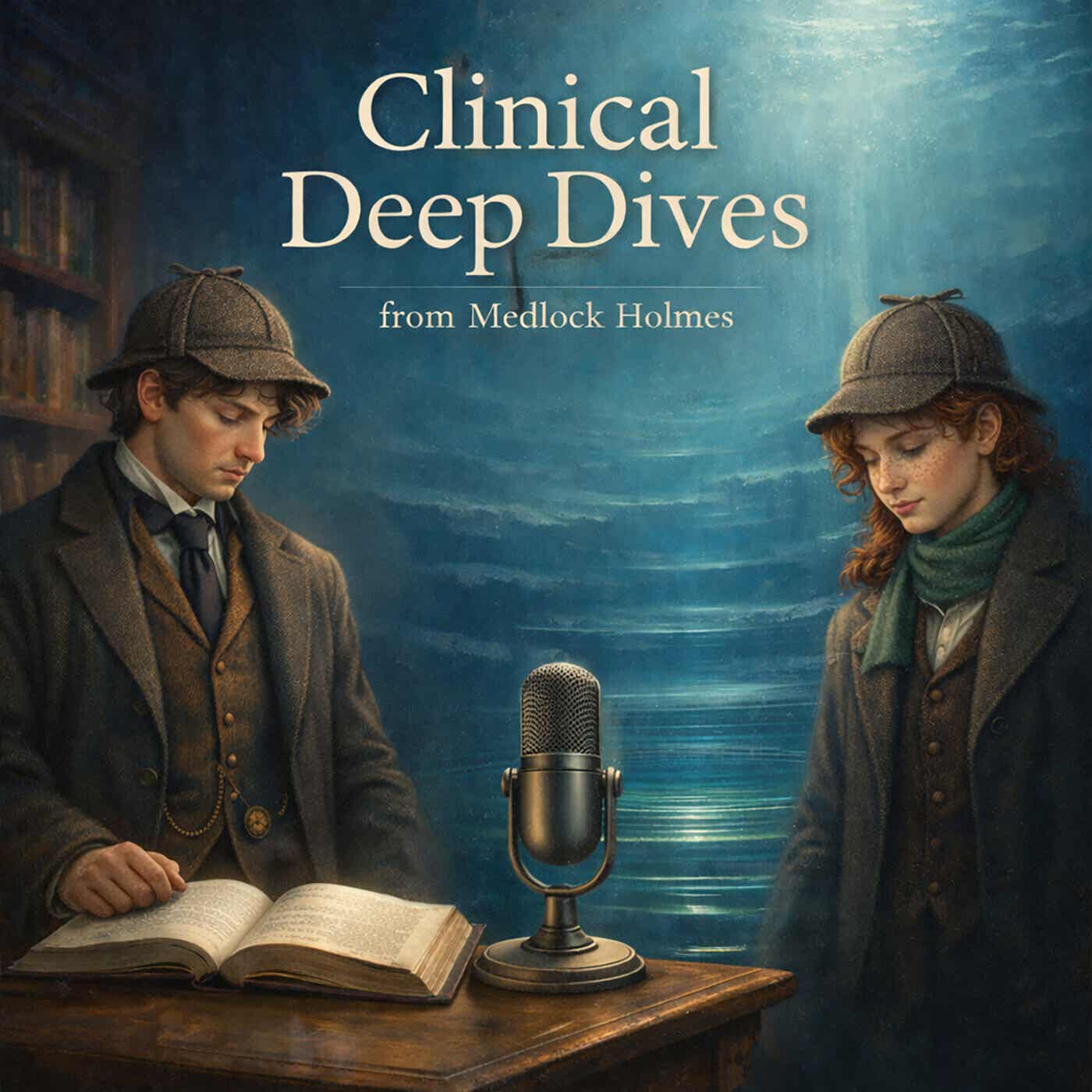
Clinical Deep Dives is a Medlock Holmes podcast for clinicians and learners who want understanding, not just information. Using classic medical and surgical texts as a guide and the generative power of AI, each episode explores ideas with curiosity and clarity, designed for learning on the move and knowledge that actually sticks. drmanaankarray.substack.com
Author
Med School Audio - Medical Knowledge Reimagined & Learning Made Memorable.
Category
Podcast website
Latest episode
Jul 10, 2026
Where to listen?
Podcasts in the app Replaio Radio Coming soonPodcasts are coming to the app soon. Install now and be the first to see a whole new take on podcasts
 Install for free
Android 5M+ downloads · 4.8 rating
iOS soon
Install for free
Android 5M+ downloads · 4.8 rating
iOS soon
Episodes
Pharma 19: Hypnotics and Sedatives - Calming the Overactive Brain 02.02.2026 39:02
This episode explores hypnotics and sedatives as agents that lower arousal thresholds rather than induce unconsciousness. We examine how these drugs interact with inhibitory systems—particularly GABAergic signalling—to quiet hyperactive networks, facilitate sleep, and reduce anxiety. Framed this way, their benefits and risks become predictable: sedation, amnesia, tolerance, and dependence all foll...
Pharma 18: Neurodegeneration - Slowing the Unravelling 01.02.2026 42:50
This episode examines drugs used in central nervous system degenerative disorders through a lens of preservation rather than reversal. Conditions such as Parkinson’s disease, Alzheimer’s disease, and related syndromes reflect progressive loss of neurons and network integrity. Pharmacology here is about buying time, restoring functional balance, and reducing downstream harm. We focus on why benefit...
Pharma 17: Epilepsy - Containing the Electrical Storm 01.02.2026 38:21
Episode description (with key takeaways) This episode explores antiseizure pharmacology as the art of stabilising excitable networks. Seizures arise when synchronous firing overwhelms inhibitory control; treatment therefore focuses on shifting thresholds, damping propagation, and restoring balance between excitation and inhibition. We move beyond drug lists to a small set of governing principles t...
Pharma 16: Psychosis and Mania - Reality, Regulation, and Restraint 01.02.2026 42:18
This episode examines the pharmacological treatment of psychosis and mania as an exercise in regulation rather than suppression. Antipsychotics and mood stabilisers act on systems that assign meaning, importance, and momentum to thoughts and experiences. We move beyond dopamine reduction as a slogan to understand why these drugs work, why they take time, and why adverse effects often mirror the sy...
Pharma 15: Treating Depression and Anxiety - Restoring Emotional Balance 01.02.2026 38:54
This episode examines the pharmacological treatment of depression and anxiety through the lens of adaptation and balance. Rather than viewing these conditions as simple chemical deficits, we explore how sustained modulation of neurotransmitter systems gradually recalibrates circuits involved in mood, threat perception, sleep, and cognition. The delayed onset of benefit, the prominence of side-effe...
Pharma 14: Neurotransmission in the Central Nervous System 01.02.2026 36:00
This episode widens the lens from individual synapses to whole neural networks. Central nervous system neurotransmission is less about linear pathways and more about integration—multiple signals converging, diverging, and being reshaped in real time. We explore how excitation and inhibition are balanced, how plasticity changes responses over time, and why drugs acting in the CNS often have broad,...
Pharma 13: Serotonin and Dopamine - Mood, Motion, and Meaning 01.02.2026 38:03
Episode description (with key takeaways) This episode explores serotonin and dopamine as systems of context rather than single functions. Together, they influence mood, motivation, reward, perception, and movement. We move past simplistic labels (“happy chemical”, “pleasure pathway”) to understand distributed circuits, receptor diversity, and downstream consequences. This framework explains why dr...
Pharma 11: Nicotinic Signalling - Junctions, Gates, and Thresholds 31.01.2026 36:36
This episode examines nicotinic receptor pharmacology at two critical crossroads: autonomic ganglia and the neuromuscular junction. Here, signalling is rapid, decisive, and threshold-dependent—very different from the modulatory tone of muscarinic systems. We explore how drugs that act at nicotinic receptors can stimulate, block, or exhaust transmission, and why small shifts at these junctions can...
Pharma 10: Anticholinesterase Agents - Prolonging the Signal 31.01.2026 32:43
This episode focuses on anticholinesterase agents as a distinctive pharmacological strategy: rather than stimulating receptors directly, these drugs extend the life of an endogenous signal. By inhibiting acetylcholinesterase, they increase acetylcholine availability at synapses and neuromuscular junctions, sharpening or overwhelming physiological effects depending on dose and context. We explore h...
Pharma 09: Muscarinic Signalling - Turning Up and Turning Down 31.01.2026 37:17
This episode explores muscarinic receptor pharmacology as a lesson in nuance. Acetylcholine acting at muscarinic receptors governs secretion, smooth muscle tone, heart rate, and central signalling. We move beyond lists of agonists and antagonists to understand muscarinic effects as context-dependent responses shaped by receptor subtype, tissue distribution, and baseline autonomic tone. This framin...
Pharma 08: Neurotransmission - Wiring the Nervous System 31.01.2026 37:25
This episode lays the physiological foundation for all of neuropharmacology by exploring how neurons communicate with each other and with effector organs. Rather than starting with drug classes, we begin with the architecture of signalling itself: synapses, neurotransmitters, receptors, and termination mechanisms. Autonomic and somatic systems are contrasted to show how pharmacology exploits norma...
Pharma 07: Pharmacogenetics — Why One Dose Never Fits All 31.01.2026 34:16
This episode explores how genetics influences the way individuals handle and respond to medicines. Pharmacogenetics is framed not as a futuristic add-on, but as an extension of everyday pharmacology—explaining why standard doses fail some patients, harm others, and work beautifully for a few. We focus on principles that clinicians can recognise and apply, even when formal genetic testing is unavai...
Pharma 06: Drug Metabolism - Transformation and Consequence 31.01.2026 35:23
This episode looks at what happens when a drug meets the body’s chemical processing plants. Drug metabolism is framed not as simple breakdown, but as biotransformation —a set of enzymatic decisions that can inactivate drugs, activate pro-drugs, generate toxic intermediates, or change duration of action. We explore why metabolism is central to variability, interactions, and organ-specific risk, and...
Pharma 05: Membrane Transporters and Drug Response 31.01.2026 38:14
This episode explores a layer of pharmacology that quietly shapes almost every therapeutic decision but is often overlooked: membrane transporters. These proteins act as biological customs officers, controlling drug entry, distribution, and elimination at the cellular level. We examine how transporters influence variability in drug response, underpin many drug–drug interactions, and explain why tw...
Pharma 04: Drug Toxicity and Poisoning 31.01.2026 41:38
This episode examines the shadow side of pharmacology—how drugs cause harm, why toxicity is often dose- and context-dependent, and how clinicians reason through poisoned states. Rather than treating toxicity as an exception, we frame it as an extension of pharmacology itself: the same principles of kinetics and dynamics, pushed beyond safe margins or distorted by vulnerability. The goal is not fea...
Pharma 03: Pharmacodynamics - How Drugs Create Effects 31.01.2026 37:13
This episode shifts the lens from movement to mechanism . Pharmacodynamics explores how drugs interact with biological targets to produce effects—therapeutic and adverse. Rather than memorising receptor lists, we build a conceptual framework for understanding why drugs behave the way they do, and how small molecular differences translate into large clinical consequences. Pharmacodynamics becomes t...
Pharma 02: Pharmacokinetics - From Dose to Destination 31.01.2026 36:38
This episode follows a drug’s journey after it enters the body, focusing on the forces that determine how much , how fast , and for how long a medicine exerts its effect. Pharmacokinetics is presented as a story of movement and timing—where absorption, distribution, metabolism, and elimination together shape exposure, response, and safety. We connect equations to clinical judgement, showing how PK...
Pharma 01: Drug Invention and the Pharmaceutical Industry 31.01.2026 39:27
In this opening episode, we set the stage for the whole series by tracing the life-cycle of a drug: why it is pursued, how it is discovered, how it is tested, and what it takes to make it safely and ethically available to the public. We treat pharmacology as both a science and a social contract—where benefit must be proven, harm anticipated, and uncertainty handled with humility. Key takeaways you...
Physio 39: Acidification of the Urine & Bicarbonate Excretion 30.01.2026 36:44
Every metabolic reaction produces acid. Without precise correction, this chemical drift would quietly disrupt enzymes, membranes, and electrical signalling. The kidneys provide the final safeguard—adjusting what the lungs cannot. In this concluding episode, Medlock Holmes examines how the kidneys regulate acid–base balance through hydrogen ion secretion, bicarbonate reabsorption and generation, an...
Physio 38: Regulation of Extracellular Fluid Composition & Volume 30.01.2026 37:46
Cells do not experience the body directly. They experience the extracellular fluid that bathes them. Its volume and composition determine whether enzymes function, membranes fire, and metabolism proceeds normally. In this episode, Medlock Holmes explores how extracellular fluid (ECF) composition and volume are regulated through renal function, hormonal control, and osmoregulation. We examine sodiu...
Physio 37: Renal Function & Micturition 30.01.2026 40:30
Every minute, the kidneys receive a vast volume of blood—and return most of it carefully adjusted. Their task is not simply excretion, but precision editing of the internal environment. In this episode, Medlock Holmes explores renal function and micturition, focusing on glomerular filtration, tubular reabsorption and secretion, urine concentration, and the coordinated control of bladder storage an...
Physio 36: Regulation of Respiration 30.01.2026 29:28
Respiration must respond instantly to changing metabolic demands—exercise, sleep, emotion, illness—while remaining stable enough to sustain gas exchange and pH balance. In this episode, Medlock Holmes explores how respiration is regulated through central and peripheral control systems. We examine medullary respiratory centres, chemoreceptors, reflex inputs, and higher cortical influences, focusing...
Physio 35: Gas Transport & pH 30.01.2026 36:35
Ventilation brings oxygen into the lungs, but survival depends on how gases are carried, released, and buffered once they enter the blood. Oxygen delivery and carbon dioxide removal are inseparable from the regulation of pH—the chemical environment in which all cells function. In this episode, Medlock Holmes examines how gases are transported in blood and how acid–base balance is maintained. We ex...
Physio 34: Introduction to Pulmonary Structure & Mechanics 30.01.2026 43:11
Breathing feels effortless—until it isn’t. Behind each quiet breath lies a finely balanced mechanical system, where structure, pressure, and elasticity cooperate to move air efficiently while protecting delicate exchange surfaces. In this episode, Medlock Holmes introduces pulmonary structure and mechanics, focusing on lung architecture, compliance, airway resistance, surfactant, and the mechanics...
Physio 33: Circulation Through Special Regions 30.01.2026 40:29
Blood does not flow evenly everywhere—and it shouldn’t. Different organs demand different patterns of perfusion depending on function, timing, and physiological state. In this episode, Medlock Holmes explores circulation through special regions including the brain, heart, skeletal muscle, skin, kidneys, and lungs. We examine how autoregulation, metabolic demand, temperature control, filtration, an...
Similar podcasts



Listen to the Clinical Deep Dives podcast in Replaio
Radio and podcasts in one app - free, with no sign-up. Install today and do not miss the launch
Replaio is not a podcast publisher; show names, artwork and audio belong to their authors and are distributed through public RSS feeds.