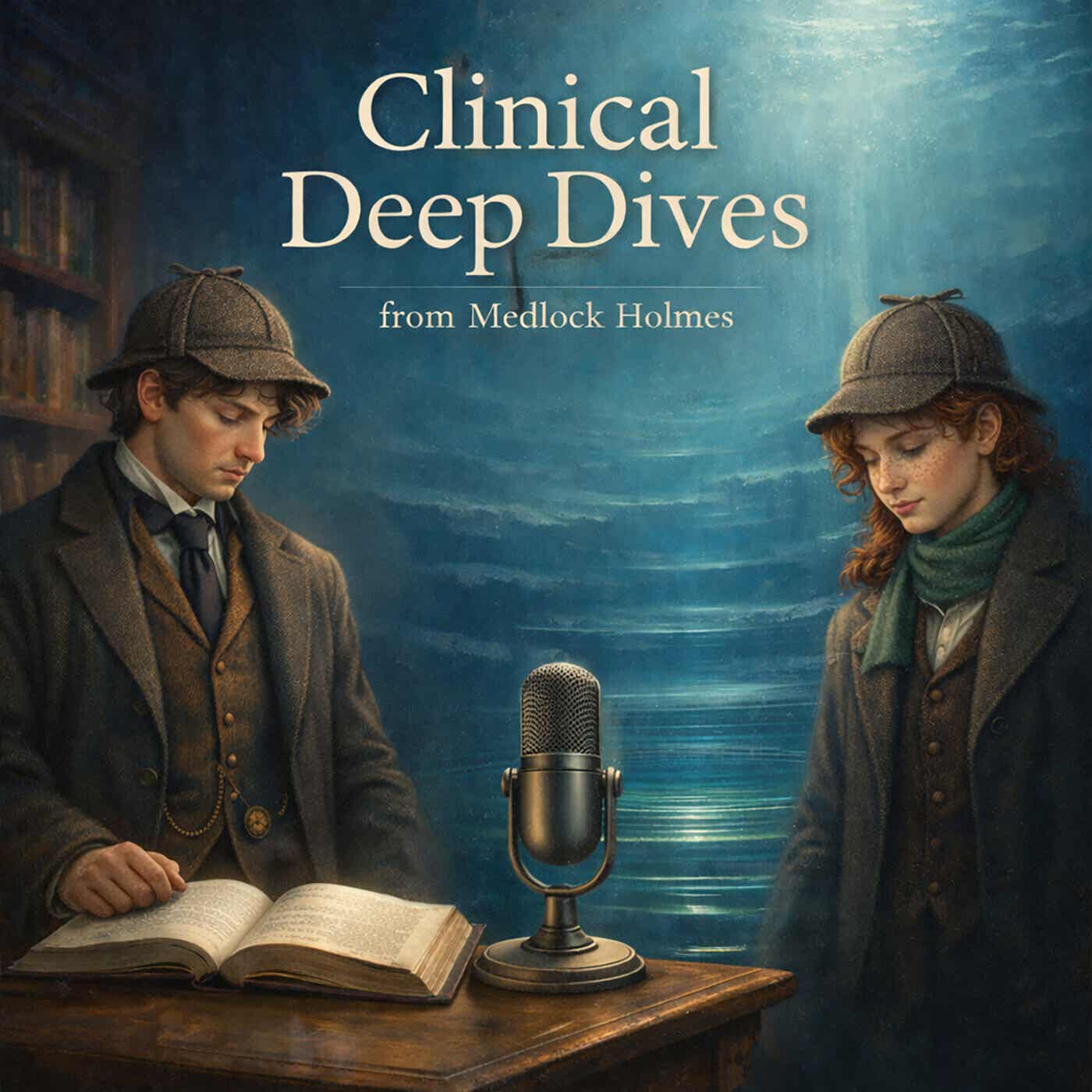
Med School Audio - Medical Knowledge Reimagined & Learning Made Memorable.
Clinical Deep Dives
Clinical Deep Dives is a Medlock Holmes podcast for clinicians and learners who want understanding, not just information. Using classic medical and surgical texts as a guide and the generative power of AI, each episode explores ideas with curiosity and clarity, designed for learning on the move and knowledge that actually sticks. drmanaankarray.substack.com
Be sure to visit the podcast's website and support the creator: drmanaankarray.substack.com
Author
Med School Audio - Medical Knowledge Reimagined & Learning Made Memorable.
Category
Podcast website
Latest episode
Jul 10, 2026
Where to listen?
Podcasts in the app Replaio Radio Coming soonPodcasts are coming to the app soon. Install now and be the first to see a whole new take on podcasts
 Install for free
Android almost 10M downloads · 4.8 rating
iOS soon
Install for free
Android almost 10M downloads · 4.8 rating
iOS soon
Episodes
Micro 42: Adenoviruses 23.02.2026 41:20
This episode explores adenoviruses , medium-sized, non-enveloped double-stranded DNA viruses known for environmental resilience and broad tissue tropism. Drawing from Murray’s Chapter 42, it examines how structural stability supports widespread transmission. The narrative begins with viral architecture: icosahedral symmetry with distinctive fibre projections that mediate cellular attachment. Their...
Micro 41: Papillomaviruses and Polyomaviruses 22.02.2026 31:15
This episode begins the virus-family–specific chapters with two groups of small, non-enveloped DNA viruses: papillomaviruses and polyomaviruses . Drawing from Murray’s Chapter 41, it explores their structural simplicity and profound clinical consequences. The narrative centres first on Human Papillomavirus (HPV) . These viruses infect stratified squamous epithelium, producing benign warts or, in h...
Micro 40: Antiviral Agents and Infection Control 22.02.2026 46:02
This episode explores antiviral therapy and infection control principles. Drawing from Murray’s Chapter 40, it examines how antiviral agents differ fundamentally from antibacterial drugs - because viruses replicate within host cells and rely on host machinery. The narrative organises antivirals by replication step: * Entry inhibitors * Uncoating inhibitors * Polymerase inhibitors * Reverse transcr...
Micro 39: Laboratory Diagnosis of Viral Diseases 22.02.2026 32:54
This episode brings virology back to the laboratory. Drawing from Murray’s Chapter 39, it explores how viral diagnosis differs fundamentally from bacterial methods - because viruses cannot grow independently in standard culture systems. The narrative begins with specimen timing and selection, emphasising that viral detection often depends on capturing infection during active replication. It then m...
Micro 38 – Role of Viruses in Disease 22.02.2026 48:51
This episode translates viral mechanisms into recognisable clinical syndromes. Drawing from Murray’s Chapter 38, it explores how viruses produce disease patterns across organ systems - respiratory, gastrointestinal, neurologic, hepatic, cutaneous, and systemic. The narrative emphasises tropism: viruses infect specific tissues based on receptor availability and replication compatibility. Respirator...
Micro 37 – Mechanisms of Viral Pathogenesis 21.02.2026 32:43
This episode explores how viral replication translates into tissue injury and clinical illness. Drawing from Murray’s Chapter 37, it examines the mechanisms through which viruses cause damage - directly and indirectly. The narrative begins with cytopathic effects: viral replication disrupting cellular function, inducing apoptosis, forming syncytia, or triggering lytic destruction. Yet not all vira...
Micro 36: Viral Classification, Structure, and Replication 21.02.2026 34:54
This episode opens the virology section by redefining what it means to be a pathogen. Drawing from Murray’s Chapter 36, it introduces viruses as obligate intracellular agents composed of nucleic acid wrapped in protein - sometimes cloaked in a lipid envelope - entirely dependent on host cellular machinery. The narrative begins with viral structure: capsid symmetry (icosahedral, helical), enveloped...
Micro 35: Chlamydia 21.02.2026 40:01
This episode explores Chlamydia , obligate intracellular bacteria distinguished by a unique biphasic developmental cycle. Drawing from Murray’s Chapter 35, it focuses on how structural simplicity and intracellular dependence shape both diagnosis and disease. The narrative centres on Chlamydia trachomatis , which alternates between an infectious elementary body and a replicative reticulate body wit...
Micro 34: Rickettsia, Ehrlichia, and Related Bacteria 21.02.2026 33:34
This episode explores obligate intracellular Gram-negative bacteria transmitted by arthropod vectors. Drawing from Murray’s Chapter 34, it centres on Rickettsia , Ehrlichia , and related genera whose pathogenicity depends on intracellular replication within host cells. The narrative begins with Rickettsia rickettsii , the cause of Rocky Mountain spotted fever, where infection of endothelial cells...
Micro 33: Mycoplasma 21.02.2026 34:46
This episode explores Mycoplasma , the smallest free-living bacteria and uniquely defined by the absence of a cell wall. Drawing from Murray’s Chapter 33, it examines how structural minimalism reshapes both pathogenesis and therapy. Without peptidoglycan, Mycoplasma species are intrinsically resistant to beta-lactam antibiotics and exhibit pleomorphic morphology. Their sterol-rich cell membranes p...
Micro 32: Treponema, Borrelia, and Leptospira 20.02.2026 43:28
This episode introduces the spirochetes - slender, helically coiled bacteria distinguished by axial filaments that permit corkscrew motility. Drawing from Murray’s Chapter 32, it explores how this unique structure enables deep tissue penetration and systemic dissemination. The narrative begins with Treponema pallidum , the agent of syphilis. Its pathogenesis is defined by immune evasion, slow repl...
Micro 31: Non–Spore-Forming Anaerobic Bacteria 20.02.2026 48:06
This episode explores the clinically significant anaerobic bacteria that do not form spores. Drawing from Murray’s Chapter 31, it focuses on organisms that are normal residents of mucosal surfaces yet become pathogenic when anatomical barriers are breached. Key genera include Bacteroides , Prevotella , Fusobacterium , and anaerobic Gram-positive cocci. These organisms thrive in low-oxygen environm...
Micro 30: Clostridium 20.02.2026 44:57
This episode explores the Gram-positive, spore-forming anaerobic rods of the genus Clostridium . Drawing from Murray’s Chapter 30, it centres on organisms whose pathogenicity is defined less by invasion and more by potent exotoxin production. The narrative moves through the major clinical species: * Clostridium tetani - neurotoxin-mediated inhibition of inhibitory neurotransmission, producing musc...
Micro 29: Miscellaneous Gram-Negative Rods 20.02.2026 42:12
This episode gathers a diverse group of Gram-negative rods that do not fit neatly into the larger families already covered. Drawing from Murray’s Chapter 29, it examines organisms whose clinical importance outweighs their taxonomic simplicity. Included here are pathogens such as Yersinia pestis , Pasteurella multocida , Legionella pneumophila , Bartonella species, and other less frequently encount...
Micro 28: Campylobacter and Helicobacter 20.02.2026 40:43
This episode explores two genera of curved Gram-negative rods that occupy distinct niches within the gastrointestinal tract. Drawing from Murray’s Chapter 28, it contrasts Campylobacter - a common cause of inflammatory diarrhoea - with Helicobacter pylori , a master of chronic gastric colonisation. The narrative begins with Campylobacter jejuni , typically acquired through undercooked poultry or c...
Micro 27: Pseudomonas and Related Bacteria 19.02.2026 39:16
This episode examines Pseudomonas and related non-fermenting Gram-negative rods. Drawing from Murray’s Chapter 27, it focuses primarily on Pseudomonas aeruginosa , a metabolically versatile organism defined by environmental resilience and intrinsic antibiotic resistance. The narrative begins with ecology: P. aeruginosa thrives in moist environments - soil, water, sinks, ventilator tubing - and exp...
Micro 26: Vibrio and Related Bacteria 18.02.2026 30:04
This episode introduces Vibrio species and related curved Gram-negative rods. Drawing from Murray’s Chapter 26, it begins with ecology: these organisms are intrinsically linked to aquatic environments, particularly brackish and marine waters. The central organism is Vibrio cholerae , whose pathogenesis illustrates the power of toxin-mediated disease. Rather than invading deeply, it adheres to inte...
Micro 25 – Enterobacteriaceae 18.02.2026 38:43
This episode introduces the large and clinically dominant family of Gram-negative rods known as the Enterobacteriaceae . Drawing from Murray’s Chapter 25, it explores organisms that primarily inhabit the gastrointestinal tract but frequently emerge as major pathogens. The narrative frames this family as biologically coherent: facultative anaerobes, oxidase-negative, glucose-fermenting rods possess...
Micro 24: Haemophilus and Related Bacteria 18.02.2026 30:24
Episode Description This episode explores Haemophilus and related fastidious Gram-negative bacteria. Drawing from Murray’s Chapter 24, the focus begins with Haemophilus influenzae , an organism defined not by size but by its growth requirements and virulence potential. The narrative emphasises its need for specific growth factors (X and V), linking laboratory behaviour to biological dependency. Th...
Micro 23: Neisseria and Related Genera 18.02.2026 46:59
This episode introduces the Gram-negative diplococci of the genus Neisseria , organisms defined by their kidney-bean–shaped pairs and strict human host adaptation. Drawing from Murray’s Chapter 23, the focus centres on Neisseria gonorrhoeae and Neisseria meningitidis , two pathogens that share morphology yet diverge dramatically in clinical expression. The narrative begins at the mucosal surface....
Micro 22: Mycobacterium and Related Acid-Fast Bacteria 17.02.2026 32:25
This episode explores the genus Mycobacterium , defined by its distinctive acid-fast cell wall rich in mycolic acids. Drawing from Murray’s chapter, it examines how this lipid-heavy structure confers resistance to desiccation, disinfectants, and many antibiotics - while also shaping immune interaction. The central organism is Mycobacterium tuberculosis , with emphasis on airborne transmission, gra...
Micro 21: Listeria and Related Gram-Positive Bacteria 17.02.2026 44:21
This episode explores Listeria monocytogenes and related aerobic, non–spore-forming Gram-positive bacilli. Drawing from Murray’s chapter, the focus is on Listeria ’s distinctive ability to survive and replicate within host cells. The narrative centres on its pathogenesis: ingestion via contaminated food, intestinal invasion, survival within macrophages, escape from the phagolysosome via listerioly...
Micro 20: Bacillus 17.02.2026 38:39
This episode introduces the Gram-positive, spore-forming rods of the genus Bacillus . Drawing from Murray’s chapter, it explores their defining biological trait: the ability to form endospores that withstand heat, desiccation, radiation, and chemical insult. The episode centres primarily on Bacillus anthracis , the agent of anthrax, examining its capsule, tripartite toxin system (protective antige...
Micro 19: Streptococcus and Enterococcus 16.02.2026 42:45
This episode explores the Gram-positive cocci that grow in chains or pairs - Streptococcus and Enterococcus . Drawing from Murray’s chapter, it introduces their classification by haemolysis patterns and Lancefield grouping, linking laboratory identity with clinical consequence. The narrative moves through the major streptococcal groups: * Streptococcus pyogenes (Group A) and its role in pharyngiti...
Micro 18: Staphylococcus and Related Gram-Positive Cocci 16.02.2026 46:53
This episode introduces Staphylococcus species, beginning with their defining morphology: Gram-positive cocci arranged in clusters. Drawing from Murray’s chapter, it explores the biology, virulence factors, and clinical patterns of Staphylococcus aureus , alongside coagulase-negative staphylococci. The narrative emphasises dual identity. S. aureus may colonise harmlessly in the nares and on skin,...
Similar podcasts







Listen to the Clinical Deep Dives podcast in Replaio
Radio and podcasts in one app - free, with no sign-up. Install today and do not miss the launch
Replaio is not a podcast publisher; show names, artwork and audio belong to their authors and are distributed through public RSS feeds.