Med School Audio - Medical Knowledge Reimagined & Learning Made Memorable.
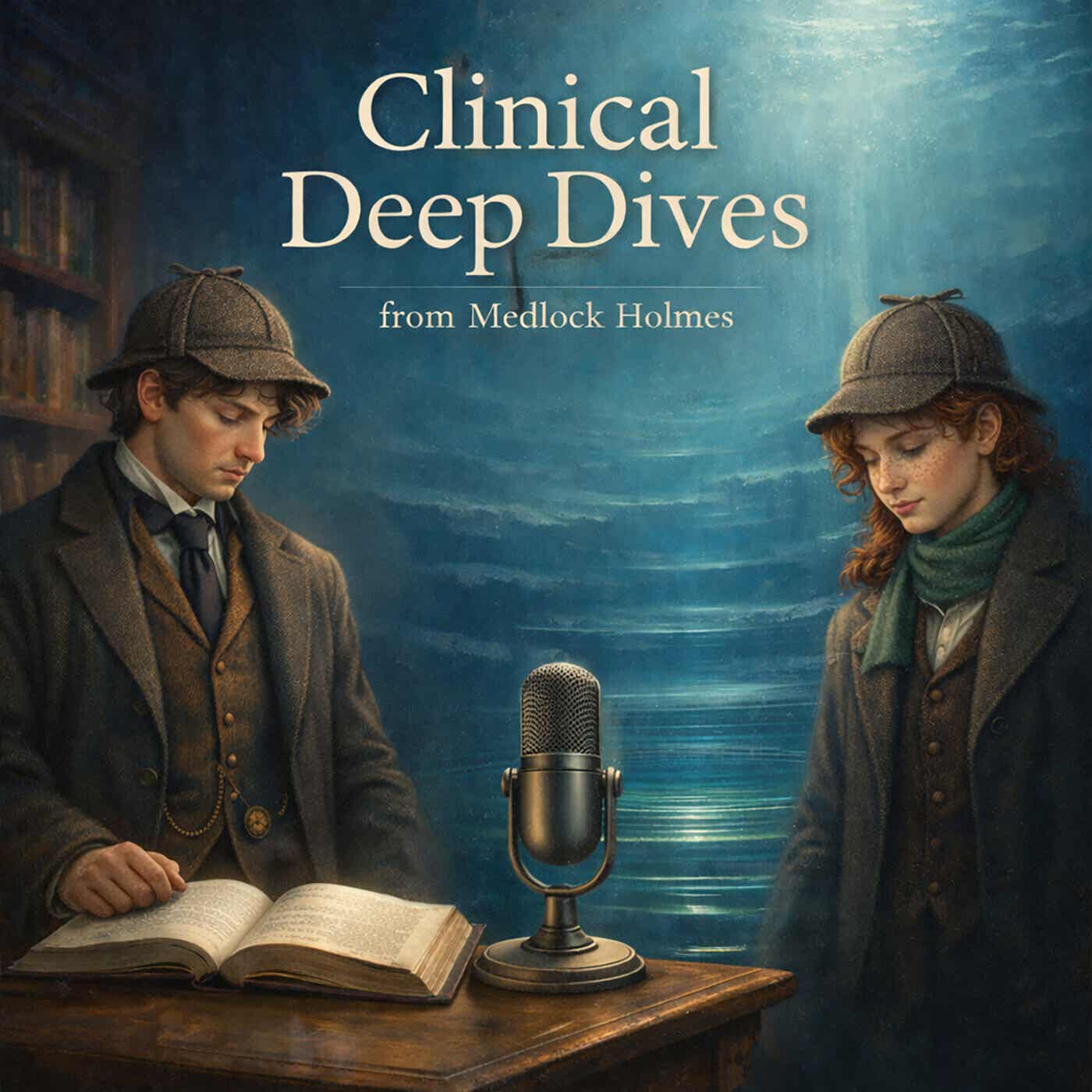
Clinical Deep Dives
Clinical Deep Dives is a Medlock Holmes podcast for clinicians and learners who want understanding, not just information. Using classic medical and surgical texts as a guide and the generative power of AI, each episode explores ideas with curiosity and clarity, designed for learning on the move and knowledge that actually sticks. drmanaankarray.substack.com
Be sure to visit the podcast's website and support the creator: drmanaankarray.substack.com
Author
Med School Audio - Medical Knowledge Reimagined & Learning Made Memorable.
Category
Podcast website
Latest episode
Jul 10, 2026
Where to listen?
Podcasts in the app Replaio Radio Coming soonPodcasts are coming to the app soon. Install now and be the first to see a whole new take on podcasts
 Install for free
Android almost 10M downloads · 4.8 rating
iOS soon
Install for free
Android almost 10M downloads · 4.8 rating
iOS soon
Episodes
Micro 67: Parasitic Classification, Structure, and Replication 01.03.2026 28:47
This episode introduces parasitology as the study of multicellular and unicellular eukaryotic organisms that derive sustenance from human hosts. Drawing from Murray’s Chapter 67, it establishes the major taxonomic groupings and life cycle strategies that underpin parasitic disease. Parasites are broadly divided into: * Protozoa - unicellular organisms (intestinal, blood, tissue parasites) * Helmin...
Micro 66: Fungal and Fungal-Like Infections of Unusual or Uncertain Etiology 01.03.2026 34:18
This episode concludes the mycology section by examining rare and atypical fungal or fungal-like pathogens. Drawing from Murray’s Chapter 66, it explores organisms that blur traditional classification or present unique diagnostic challenges. The chapter includes: * Pneumocystis jirovecii - once classified as a protozoan, now recognised as a fungus; a major cause of pneumonia in immunocompromised p...
Micro 65: Opportunistic Mycoses 01.03.2026 44:09
This episode examines fungal infections that emerge primarily in immunocompromised individuals. Drawing from Murray’s Chapter 65, it explores how normally contained environmental or commensal fungi become invasive pathogens when host defences falter. The principal organisms include: * Candida species - from mucocutaneous disease to candidemia * Aspergillus species - inhaled spores causing invasive...
Micro 64: Systemic Mycoses Caused by Dimorphic Fungi 01.03.2026 32:21
This episode explores systemic infections caused by dimorphic fungi , organisms that exist as moulds in the environment and transform into yeast forms within host tissue. Drawing from Murray’s Chapter 64, it examines how inhalation initiates pulmonary infection with potential dissemination. The major pathogens include: * Histoplasma capsulatum * Blastomyces dermatitidis * Coccidioides species * Pa...
Micro 63: Subcutaneous Mycoses 01.03.2026 34:29
This episode examines fungal infections that extend beyond the epidermis into subcutaneous tissue. Drawing from Murray’s Chapter 63, it explores how environmental fungi enter through traumatic implantation rather than inhalation. Unlike superficial mycoses, subcutaneous infections often follow penetrating injury - thorns, splinters, soil contamination. Organisms such as Sporothrix schenckii and ag...
Micro 62: Superficial and Cutaneous Mycoses 01.03.2026 55:37
This episode focuses on fungal infections confined primarily to the outer layers of skin, hair, and nails. Drawing from Murray’s Chapter 62, it examines how dermatophytes and superficial yeasts exploit keratinised tissues. The narrative begins with dermatophytes - fungi such as Trichophyton , Microsporum , and Epidermophyton - which produce keratinases that allow them to colonise the stratum corne...
Micro 61: Antifungal Agents 28.02.2026 38:32
This episode explores antifungal pharmacology within the structural complexity of eukaryotic pathogens. Drawing from Murray’s Chapter 61, it examines how therapeutic strategy is shaped by the similarities between fungal and human cells. Because fungi are eukaryotic, drug selectivity must target features unique to fungal biology. The episode organises antifungal agents by mechanism: * Polyenes (e.g...
Micro 60: Laboratory Diagnosis of Fungal Disease 27.02.2026 45:51
This episode returns to the laboratory, focusing on diagnostic strategies specific to fungi. Drawing from Murray’s Chapter 60, it explores how identification relies heavily on morphology, growth characteristics, and targeted antigen detection. Unlike many viral diagnoses, fungal identification frequently begins with direct microscopy : * Potassium hydroxide (KOH) preparations * Calcofluor white st...
Micro 59: Role of Fungi in Disease 27.02.2026 1:02:16
This episode translates fungal mechanisms into clinical syndromes. Drawing from Murray’s Chapter 59, it examines how fungi produce disease across a spectrum - from superficial colonisation to invasive systemic infection. The narrative is structured by depth of involvement: * Superficial and cutaneous infections - dermatophytes, Candida, Malassezia * Subcutaneous infections - following traumatic im...
Micro 58: Pathogenesis of Fungal Disease 27.02.2026 36:55
This episode explores how fungi transition from environmental organisms to human pathogens. Drawing from Murray’s Chapter 58, it focuses on host–pathogen interaction and the central role of immunity. Unlike many bacteria and viruses, fungi are often opportunistic pathogens . Disease frequently arises when host defences are impaired - whether through neutropenia, corticosteroid use, HIV infection,...
Micro 57: Fungal Classification, Structure, and Replication 26.02.2026 50:50
This episode introduces the fungal world. Drawing from Murray’s Chapter 57, it establishes fungi as eukaryotic organisms distinct from bacteria and viruses in structure, replication, and treatment response. The narrative begins with structural fundamentals: * Eukaryotic cells with true nuclei * Cell walls composed of chitin and glucans * Ergosterol-containing cell membranes * Larger size relative...
Micro 56: Prion Diseases 26.02.2026 36:55
This episode concludes the virology section with an agent that defies traditional classification: the prion . Drawing from Murray’s Chapter 56, it explores infectious disease caused not by bacteria or viruses, but by misfolded protein. Prions lack nucleic acid. Instead, a normal cellular protein (PrPᶜ) undergoes conformational change into a pathogenic isoform (PrPˢᶜ). This altered structure induce...
Micro 55: Hepatitis Viruses 26.02.2026 34:03
This episode examines the hepatitis viruses , a group of unrelated viruses unified by their shared target: the liver. Drawing from Murray’s Chapter 55, it explores how different genomic strategies converge on hepatocellular injury. The episode is organised by virus: * Hepatitis A virus (HAV) - non-enveloped RNA virus, faecal–oral transmission, acute self-limited disease * Hepatitis B virus (HBV) -...
Micro 54: Retroviruses 26.02.2026 36:41
This episode examines retroviruses , enveloped positive-sense RNA viruses that replicate through reverse transcription and genomic integration. Drawing from Murray’s Chapter 54, it explores how this unique replication strategy reshapes host biology. The defining feature is the enzyme reverse transcriptase , which converts viral RNA into complementary DNA. This DNA is transported into the nucleus a...
Micro 53: Bunyaviridae and Arenaviridae 25.02.2026 34:18
This episode explores two families of enveloped negative-sense RNA viruses often associated with zoonotic transmission and severe systemic disease. Drawing from Murray’s Chapter 53, it examines ecological reservoirs and genomic structure as determinants of epidemiology. The Bunyaviridae family (now taxonomically expanded but conceptually preserved in Murray) includes viruses transmitted by mosquit...
Micro 52: Togaviruses and Flaviviruses 25.02.2026 42:29
This episode explores two important families of enveloped positive-sense RNA viruses frequently transmitted by arthropod vectors. Drawing from Murray’s Chapter 52, it examines how ecological cycles shape viral epidemiology. The togaviruses include rubella virus and various alphaviruses. Rubella produces mild disease in children but poses serious risk during pregnancy, leading to congenital rubella...
Micro 51: Reoviruses 25.02.2026 39:47
This episode explores the reoviruses , a family of non-enveloped double-stranded RNA viruses with segmented genomes. Drawing from Murray’s Chapter 51, it focuses primarily on rotavirus , a leading cause of severe gastroenteritis in infants and young children. Reoviruses are structurally distinctive: they possess multiple protein layers forming a double capsid shell that protects the segmented RNA...
Micro 50: Rhabdoviruses, Filoviruses, and Bornaviruses 25.02.2026 34:13
Episode Description This episode examines three morphologically distinctive families of enveloped negative-sense RNA viruses. Drawing from Murray’s Chapter 50, it explores how structure and tropism define clinical severity. The first focus is rhabdoviruses , particularly rabies virus , characterised by its bullet-shaped virion. Rabies uniquely travels along peripheral nerves to the central nervous...
Micro 49: Orthomyxoviruses 24.02.2026 46:19
This episode explores the orthomyxoviruses , the viral family that includes influenza viruses. Drawing from Murray’s Chapter 49, it examines how genome segmentation enables evolutionary change and periodic global outbreaks. Orthomyxoviruses are enveloped negative-sense single-stranded RNA viruses with segmented genomes . This segmentation permits reassortment when multiple strains infect the same...
Micro 48: Paramyxoviruses 24.02.2026 36:01
This episode explores the paramyxoviruses , enveloped negative-sense single-stranded RNA viruses known for their ability to induce cell fusion. Drawing from Murray’s Chapter 48, it examines how viral surface proteins drive respiratory infection and characteristic cytopathic changes. The family includes: * Respiratory syncytial virus (RSV) * Parainfluenza viruses * Measles virus * Mumps virus The d...
Micro 47: Coronaviruses and Noroviruses 24.02.2026 52:35
This episode examines two clinically distinct but epidemiologically powerful viral groups: coronaviruses and noroviruses . Drawing from Murray’s Chapter 47, it explores how structural features drive transmission patterns. The first half focuses on coronaviruses , enveloped positive-sense RNA viruses characterised by crown-like spike glycoproteins. These spikes mediate attachment to host receptors...
Micro 46: Picornaviruses 24.02.2026 33:48
This episode explores the picornaviruses , a large family of small, non-enveloped, positive-sense single-stranded RNA viruses. Drawing from Murray’s Chapter 46, it examines how genomic efficiency enables extensive clinical diversity. The family includes: * Enteroviruses (poliovirus, coxsackieviruses, echoviruses) * Rhinoviruses * Hepatitis A virus The replication strategy is direct and efficient:...
Micro 45: Parvoviruses 23.02.2026 40:00
Episode Description This episode examines parvoviruses , the smallest human DNA viruses. Drawing from Murray’s Chapter 45, it focuses on how structural simplicity results in highly selective cellular targeting. Parvoviruses are non-enveloped, single-stranded DNA viruses that require actively dividing cells for replication. Their dependence on host DNA polymerase confines them to tissues with high...
Micro 44: Poxviruses 23.02.2026 33:32
This episode explores poxviruses , the largest and most structurally complex DNA viruses infecting humans. Drawing from Murray’s Chapter 44, it examines how these enveloped double-stranded DNA viruses uniquely replicate in the cytoplasm rather than the nucleus. The narrative begins with structure: brick-shaped virions containing their own transcriptional machinery. Because they do not rely on host...
Micro 43: Human Herpesviruses 23.02.2026 41:50
This episode explores the human herpesvirus family , a group of enveloped double-stranded DNA viruses defined by their ability to establish lifelong latency. Drawing from Murray’s Chapter 43, it examines how acute infection transitions into persistent genomic silence with episodic reactivation. The narrative is structured around the major human herpesviruses: * HSV-1 and HSV-2 - mucocutaneous dise...
Similar podcasts







Listen to the Clinical Deep Dives podcast in Replaio
Radio and podcasts in one app - free, with no sign-up. Install today and do not miss the launch
Replaio is not a podcast publisher; show names, artwork and audio belong to their authors and are distributed through public RSS feeds.