Jason Edwards
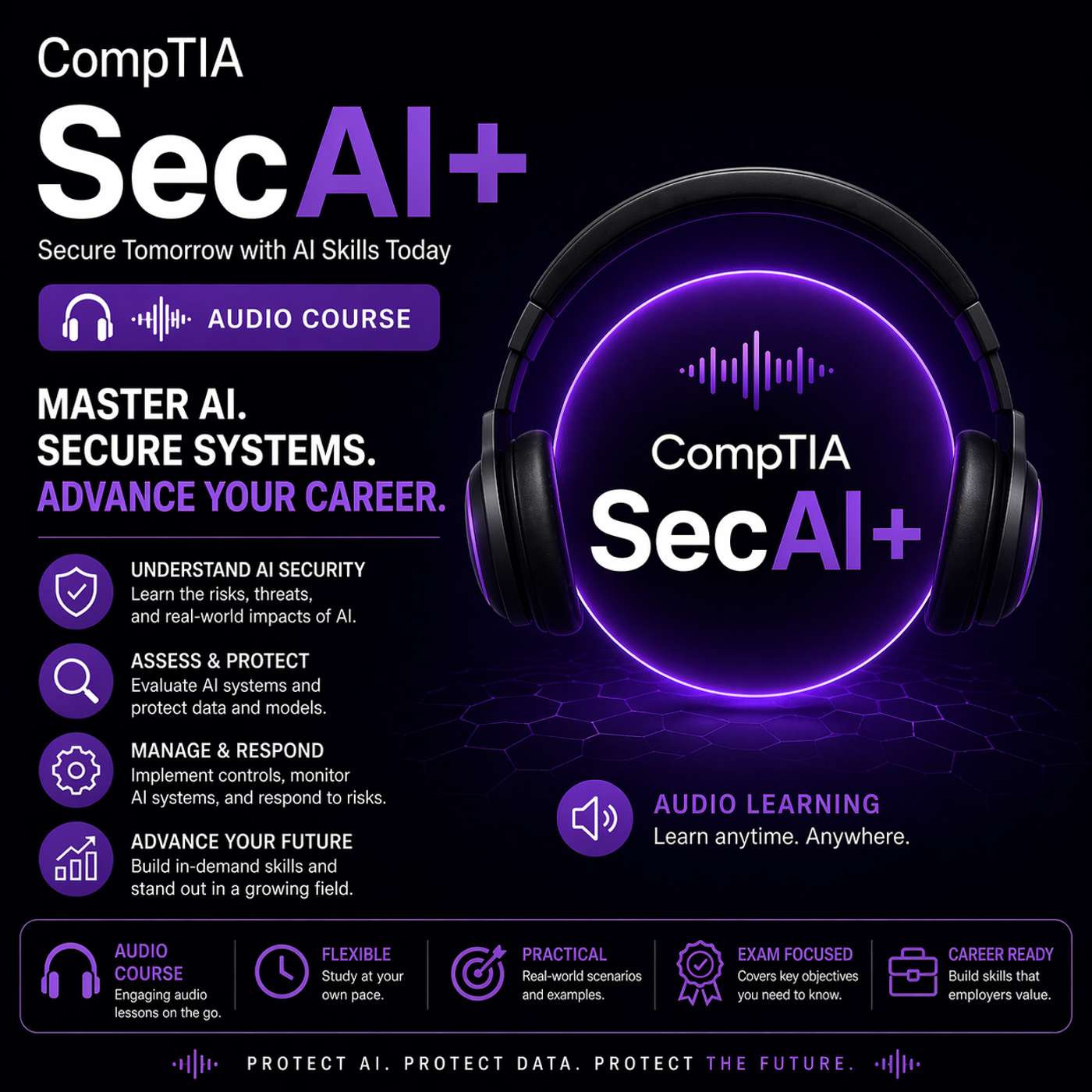
Certified: The CompTIA SecAI+ Audio Course
Certified: The CompTIA SecAI Certification Audio Course is an audio-first training program built for busy IT and security professionals who want to understand how AI changes cybersecurity work—and how security changes when AI is part of the environment. It’s designed for early- to mid-career practitioners, analysts, administrators, and technically curious managers who need a practical foundation without wading through research papers or hype. If you already speak basic security—identity, logging, vulnerability management, incident response—this course helps you connect those skills to modern A...
Where to listen?
Podcasts in the app Replaio Radio Coming soonPodcasts are coming to the app soon. Install now and be the first to see a whole new take on podcasts
 Install for free
Android 5M+ downloads · 4.8 rating
iOS soon
Install for free
Android 5M+ downloads · 4.8 rating
iOS soon
Episodes
Episode 40 — Translate Requirements into Controls: Security, Privacy, and Reliability Criteria 23.02.2026 11:23
This episode teaches the requirement-to-control translation that SecAI+ expects you to perform in scenario questions, because strong programs do not start with tools, they start with clear criteria for security, privacy, and reliability that can be implemented, tested, and audited. You will learn how to take high-level requirements like confidentiality, integrity, availability, and lawful process...
Episode 39 — Anchor AI Security to Business Objectives: Use-Case Scope and Risk Appetite 23.02.2026 10:50
This episode focuses on aligning AI security controls to business objectives, because SecAI+ often tests whether you can choose security requirements that fit the use case, rather than applying generic controls that are either too weak or unnecessarily restrictive. You will learn how to define use-case scope in concrete terms, including the intended users, decisions the system can influence, data...
Episode 38 — Enforce Data Access Boundaries: RBAC, ABAC, and Purpose-Based Controls 23.02.2026 10:35
This episode teaches access boundaries for AI data as a key exam topic, because SecAI+ expects you to prevent unauthorized use of sensitive data across teams, tools, and pipelines, especially when AI systems make it easy to reuse data for new purposes without re-approval. You will learn how role-based access control supports clear job-function permissions, how attribute-based access control suppor...
Episode 37 — Manage Data Retention: Deletion, Forgetting Limits, and Compliance-Driven Policies 23.02.2026 11:43
This episode explains retention as both a legal requirement and an AI security requirement, because SecAI+ scenarios often involve data being kept “just in case” and later becoming the source of leakage, breach impact, or regulatory trouble. You will learn how retention policies translate into operational controls like time-based deletion, tiered storage, and restricted archives, and why those con...
Episode 36 — Encrypt AI Data Correctly: In Transit, At Rest, and In Use 23.02.2026 11:24
This episode focuses on encryption as a foundational control that SecAI+ expects you to apply with precision, because AI pipelines often move data across ingestion services, storage layers, training infrastructure, and inference endpoints, and every handoff is an exposure opportunity. You will learn what “in transit” means in practical terms, how to ensure strong transport protections between int...
Episode 35 — Protect Sensitive Data With Masking, Redaction, and Practical De-Identification 23.02.2026 11:53
This episode teaches sensitive data protection as a hands-on discipline across the AI lifecycle, because SecAI+ will test whether you can reduce exposure without destroying utility, especially when working with logs, tickets, documents, and conversational text that frequently contain personal data or secrets. You will learn the differences between masking, redaction, and de-identification, why ea...
Episode 34 — Understand Watermarking Basics: Goals, Limits, and Validation Use Cases 23.02.2026 11:36
This episode explains watermarking as a technique with specific goals and very real limits, because SecAI+ expects you to understand when watermarking supports security and governance and when it should not be treated as a magic proof of origin. You will learn the basic idea of watermarking for generated content, what it tries to signal about provenance, and how validation might be performed under...
Episode 33 — Preserve Integrity End-to-End: Hashing, Signing, and Controlled Transformations 23.02.2026 11:34
This episode focuses on integrity controls that keep AI pipelines trustworthy, because SecAI+ scenarios often involve tampering risks that occur between “we collected good data” and “we trained a safe model,” and integrity gaps are exactly where poisoning and silent corruption thrive. You will learn how hashing supports tamper detection for datasets and artifacts, how digital signatures support a...
Episode 32 — Build Lineage and Traceability: From Raw Sources to Model Artifacts 23.02.2026 13:22
This episode teaches lineage and traceability as core AI security controls, because SecAI+ will test whether you can prove what went into a model, what changed over time, and how to investigate an issue when outputs become questionable. You will learn what lineage should cover, including raw source identifiers, collection methods, permissions, transformations, labeling actions, training configurat...
Episode 31 — Apply Data Augmentation Responsibly Without Introducing Backdoors or Skew 23.02.2026 12:01
This episode explains data augmentation as a double-edged technique in SecAI+ terms, because it can improve robustness and coverage, but it can also introduce bias, distort operational reality, or open the door to subtle backdoor behaviors if it is not governed carefully. You will learn what augmentation actually means across data types, such as text, images, and structured event records, and why...
Episode 30 — Use Labeling Safely: Quality Controls, Annotation Bias, and Poisoning Exposure 23.02.2026 9:52
This episode focuses on labeling as both a quality risk and a security risk, because SecAI+ expects you to understand how labels shape model behavior and how attackers or process failures can corrupt labels to produce dangerous outcomes. You will learn why label definitions must be precise, how inconsistent annotator guidance creates noise that looks like “model weakness,” and how annotation bias...
Episode 29 — Apply Data Minimization: Collect Less, Store Less, and Expose Far Less 23.02.2026 9:55
This episode explains data minimization as a practical security strategy, because SecAI+ scenarios often involve unnecessary data collection that expands breach impact, complicates compliance, and increases the chance of model leakage. You will learn how to define the minimum data needed for a given objective, how to avoid “maybe we’ll need it later” collection habits, and how to design features a...
Episode 28 — Handle Structured, Semi-Structured, and Unstructured Data With Safe Controls 23.02.2026 10:54
This episode teaches safe handling across data types, because SecAI+ expects you to apply appropriate controls whether you are dealing with clean tables, messy logs, documents, images, or mixed-format records that carry hidden risk. You will learn what distinguishes structured, semi-structured, and unstructured data, and how each type affects validation, sanitization, and access control design. We...
Episode 27 — Prevent Training Data Leakage: Secrets, PII, and Tokenization Side Effects 23.02.2026 11:12
This episode focuses on preventing training data leakage, because SecAI+ will test whether you can recognize how secrets and personal data can enter pipelines and later reappear through memorization, regeneration, or logs. You will learn the most common leakage paths, including raw data dumps, chat transcripts, support tickets, code repositories, and telemetry that contains tokens, credentials, or...
Episode 26 — Clean and Normalize Data Without Losing Security-Relevant Signal and Context 23.02.2026 12:02
This episode teaches data cleaning as a careful tradeoff, because SecAI+ expects you to preserve security-relevant signals while still producing datasets that models can learn from reliably. You will learn why aggressive normalization can erase indicators like rare command-line patterns, unusual user agents, or subtle timing artifacts that matter in detection and fraud contexts. We will cover prac...
Episode 25 — Secure Data Intake: Authenticity Checks, Source Trust, and Provenance Tracking 23.02.2026 11:59
This episode covers data intake as the start of the AI security chain, because SecAI+ often frames failures that begin with untrusted sources, weak authenticity checks, and missing provenance that later makes incidents impossible to investigate. You will learn how to assess source trust, validate authenticity through signatures, checksums, secure transport, and controlled collection methods, and...
Episode 24 — Manage Model Output Formats: Schemas, Parsing, and Safe Downstream Handling 23.02.2026 12:05
This episode explains why output formatting is a security issue, not just a developer convenience, because SecAI+ expects you to prevent failures where loosely structured AI text breaks automation, triggers unsafe actions, or causes data exposure in downstream systems. You will learn how schemas constrain output shape, how strict parsing reduces ambiguity, and why “best effort” extraction can be...
Episode 23 — Calibrate Confidence Carefully: When to Trust Outputs and When to Escalate 23.02.2026 12:30
This episode teaches confidence calibration as a safety control, because SecAI+ scenarios frequently require you to decide when an AI output is “good enough,” when it needs validation, and when it must be escalated to a human or a trusted system. You will learn the difference between fluency and correctness, why models can sound certain while being wrong, and how to design workflows that treat mo...
Episode 22 — Reduce Hallucinations Practically: Grounding, Constraints, and Verification Patterns 23.02.2026 13:20
This episode focuses on reducing hallucinations as an operational discipline, because SecAI+ tests whether you can select controls that improve reliability without pretending models are perfectly factual. You will learn why hallucinations appear when context is thin, ambiguous, or conflicting, and how grounding patterns such as retrieval, structured context packaging, and limited-scope knowledge b...
Episode 21 — Separate System, Developer, and User Instructions to Prevent Confused Authority 23.02.2026 13:49
This episode explains instruction hierarchy as a security control, because SecAI+ scenarios often involve an AI system receiving competing directions from system prompts, developer prompts, user prompts, and untrusted content, and the exam expects you to prevent “confused authority” failures. You will learn what each instruction layer is intended to do, how higher-priority instructions constrain l...
Episode 20 — Control Tool Use in Agents: Permissions, Scope, and Safe Action Boundaries 23.02.2026 17:01
This episode teaches tool-using agents as a high-impact risk area, because SecAI+ will test whether you understand that once an AI system can take actions, the primary question becomes what it is allowed to do, under what constraints, and with what verification. You will learn how agent tool use typically works, including selecting tools, forming tool arguments, receiving results, and chaining act...
Episode 19 — Write Prompt Templates That Reduce Variance and Prevent Risky Behaviors 23.02.2026 18:25
This episode focuses on prompt templates as a standardization control, because SecAI+ expects you to think like an operator who needs consistent outputs, predictable safety behavior, and auditable change management across teams. You will learn how templates define stable sections for role framing, task instructions, inputs, constraints, and output schemas, and why consistency makes both security r...
Episode 18 — Use Zero-Shot, One-Shot, and Few-Shot Prompting With Clear Guardrails 23.02.2026 16:29
This episode teaches when and how to use zero-shot, one-shot, and few-shot prompting in ways that improve reliability without creating new security problems, because SecAI+ questions often ask you to pick the safest and most effective prompting approach for a given use case. You will learn what each approach implies about model guidance, why examples can shape output style and decision boundaries,...
Episode 17 — Build Prompt Foundations: Roles, Instructions, Context, and Output Constraints 23.02.2026 17:23
This episode establishes prompt fundamentals the way SecAI+ tests them, treating prompts as a control surface that can reduce variance and risk when they are structured intentionally. You will learn how role-style framing influences behavior, how to write instructions that are explicit about task scope and prohibited actions, and how to provide context that supports accuracy without leaking unnece...
Episode 16 — Choose Vector Stores Wisely: Indexing, Latency, Recall, and Access Controls 23.02.2026 18:16
This episode focuses on selecting and operating vector stores with a security-first mindset, because SecAI+ expects you to balance performance goals like low latency and high recall with controls that prevent unauthorized retrieval and data exposure. You will learn the basics of vector indexing approaches, how approximate nearest neighbor search trades accuracy for speed, and why configuration cho...
Similar podcasts







Listen to the Certified: The CompTIA SecAI+ Audio Course podcast in Replaio
Radio and podcasts in one app - free, with no sign-up. Install today and do not miss the launch
Replaio is not a podcast publisher; show names, artwork and audio belong to their authors and are distributed through public RSS feeds.