Jason Edwards
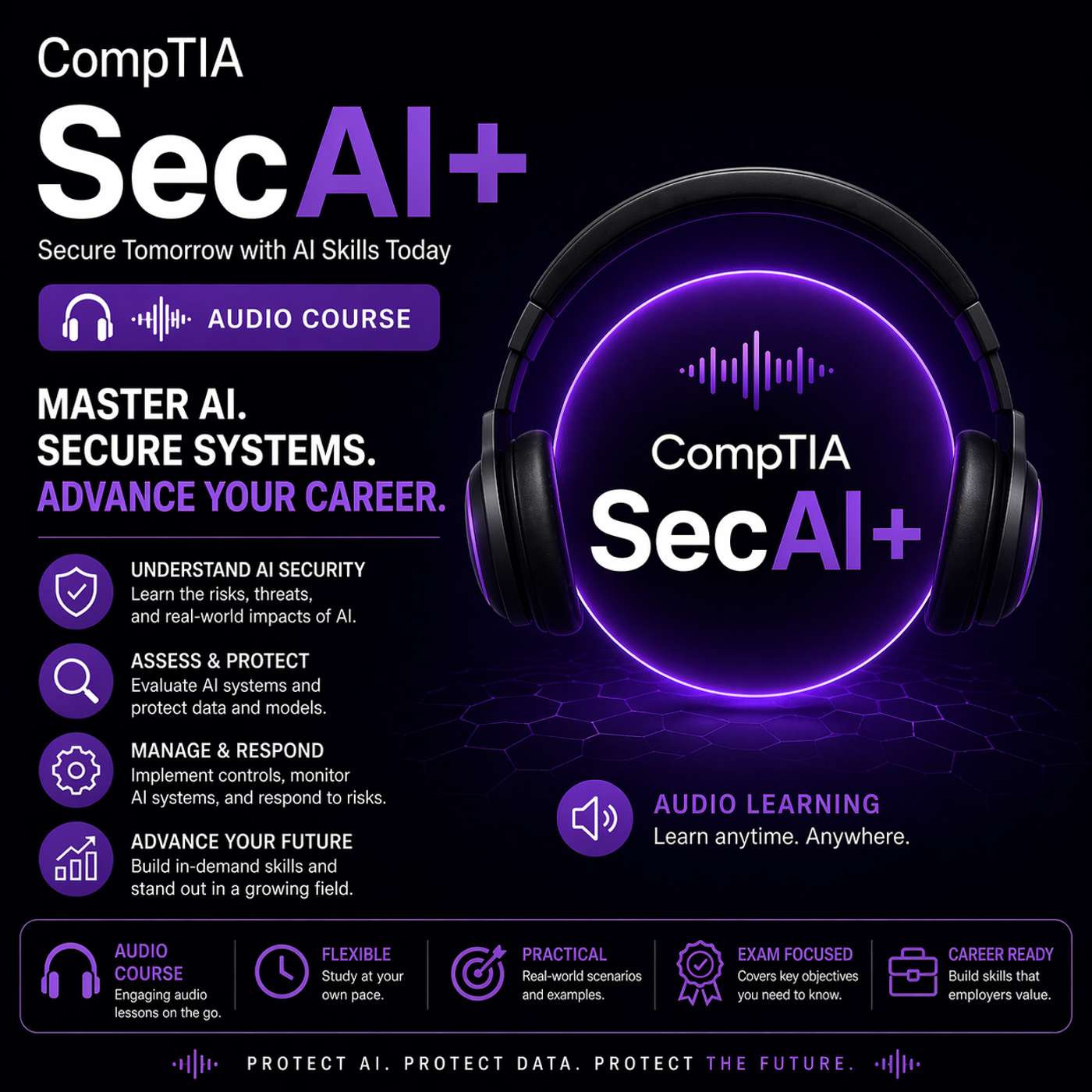
Certified: The CompTIA SecAI+ Audio Course
Certified: The CompTIA SecAI Certification Audio Course is an audio-first training program built for busy IT and security professionals who want to understand how AI changes cybersecurity work—and how security changes when AI is part of the environment. It’s designed for early- to mid-career practitioners, analysts, administrators, and technically curious managers who need a practical foundation without wading through research papers or hype. If you already speak basic security—identity, logging, vulnerability management, incident response—this course helps you connect those skills to modern A...
¿Dónde escuchar?
Podcasts en la app Replaio Radio Muy prontoLos podcasts llegarán muy pronto a la app. Instálala ahora y sé el primero en descubrir una forma totalmente nueva de vivir los podcasts
 Instálala gratis
Android 5 M+ de descargas · valoración de 4,8
iOS muy pronto
Instálala gratis
Android 5 M+ de descargas · valoración de 4,8
iOS muy pronto
Episodios
Episode 90 — Prevent Shadow AI: Sanctioned Tools, Usage Rules, and Enforcement Patterns 23.02.2026 10:31
This episode focuses on preventing shadow AI as a governance and data protection requirement, because SecAI+ expects you to control unapproved tools that employees adopt for convenience, often without understanding how prompts, files, and proprietary data may be retained, reused, or exposed. You will learn why shadow AI emerges, including friction in approved tooling, unclear policies, and rapid...
Episode 89 — Apply Responsible AI Principles: Fairness, Transparency, and Explainability Choices 23.02.2026 11:42
This episode teaches responsible AI principles in an exam-ready, security-relevant way, because SecAI+ expects you to translate fairness, transparency, and explainability into practical choices that reduce harm, improve trust, and support governance rather than treating them as abstract ideals. You will learn how fairness concerns arise from biased data, uneven error rates across groups, and feed...
Episode 88 — Define AI Security Responsibilities: Owners, Approvers, Builders, and Auditors 23.02.2026 11:12
This episode focuses on defining responsibilities clearly, because SecAI+ scenarios often reveal failures caused by vague ownership, where everyone assumes someone else handled security review, data permissions, or monitoring, and the exam expects you to fix that with explicit accountability. You will learn how to separate responsibilities across owners who define outcomes and accept risk, approve...
Episode 87 — Build AI Governance Structures: Policies, Roles, and a Working Operating Model 23.02.2026 10:38
This episode explains AI governance as an operating model that makes security and compliance achievable at scale, because SecAI+ expects you to choose governance structures that produce consistent decisions instead of one-off exceptions and informal approvals. You will learn what governance must cover, including approved use cases, data classification and access rules, model and vendor evaluation...
Episode 86 — Manage CI/CD With AI Assistants: Secure Pipelines, Tests, and Change Control 23.02.2026 11:18
This episode teaches how AI assistants fit into CI/CD without weakening security, because SecAI+ scenarios often involve AI-generated code, AI-suggested pipeline changes, or automated remediation that must still obey testing discipline and change control. You will learn where AI can help, such as drafting build steps, proposing tests, summarizing failures, and generating documentation, while emph...
Episode 85 — Apply Safe Automation: Low-Code Workflows With Guardrails and Auditability 23.02.2026 11:40
This episode focuses on safe automation using low-code workflows, because SecAI+ expects you to recognize that automation reduces toil but can also amplify errors and create new abuse paths when guardrails and auditability are weak. You will learn how low-code automations typically connect triggers, data sources, transformations, and actions, and why each step needs validation, authorization, and...
Episode 84 — Recognize AI-Assisted Malware Evolution: Obfuscation, Mutation, and Detection Gaps 23.02.2026 11:56
This episode teaches how AI can accelerate malware evolution by supporting rapid variation, improved obfuscation, and faster iteration on what evades detection, which is a key SecAI+ theme when scenarios ask you to respond to changing attacker capabilities without assuming perfect prevention. You will learn what mutation means in operational terms, including frequent changes to strings, structure,...
Episode 83 — Track AI-Accelerated Recon: Target Discovery, Enumeration, and Defensive Signals 23.02.2026 12:31
This episode focuses on how AI accelerates reconnaissance by reducing attacker effort in discovering targets, mapping organizations, and enumerating exposed systems, and how SecAI+ expects you to translate that reality into defensive monitoring and hardening choices. You will learn what recon looks like in practice, including automated collection of public-facing assets, rapid analysis of job pos...
Episode 82 — Counter AI-Scaled Social Engineering: Phishing, Vishing, and Pretext Detection 23.02.2026 13:30
This episode teaches how AI scales social engineering by making messages more convincing, more personalized, and easier to generate at volume, which is exactly why SecAI+ includes scenarios that test your ability to spot and disrupt pretexts rather than simply telling users to “be careful.” You will connect AI-scaled phishing and vishing to practical indicators like timing, unusual requests, urge...
Episode 81 — Understand AI-Driven Deepfakes: Impersonation Risk and Verification Countermeasures 23.02.2026 14:17
This episode explains why AI-driven deepfakes are a security problem, not just a media curiosity, and how SecAI+ expects you to analyze impersonation risk in realistic organizational workflows. You will define deepfakes across audio, video, and synthetic identity artifacts, then connect them to attack paths like executive impersonation for wire fraud, fake candidate interviews, synthetic support...
Episode 80 — Use AI for Threat Intel: Entity Extraction, Clustering, and Confidence Handling 23.02.2026 13:31
This episode teaches practical uses of AI in threat intelligence, because SecAI+ expects you to apply AI to messy text and indicator data while still handling uncertainty, provenance, and bias responsibly. You will learn how AI can extract entities such as malware names, CVEs, infrastructure, and actor references from reports, cluster similar narratives to identify campaigns, and summarize key tak...
Episode 79 — Use AI for Incident Triage: Summaries, Prioritization, and Evidence Integrity 23.02.2026 13:23
This episode focuses on using AI for incident triage without compromising evidence integrity, because SecAI+ expects you to accelerate understanding while still preserving the chain of custody and avoiding premature conclusions driven by fluent summaries. You will learn how AI can summarize alerts, cluster related events, extract key entities like hosts and accounts, and propose prioritization bas...
Episode 78 — Use AI for Detection Engineering: Rules, Correlation, and Noise Reduction 23.02.2026 14:06
This episode teaches AI-assisted detection engineering in a way that matches SecAI+ expectations, because exam scenarios often involve improving detection coverage and quality while controlling false positives, preserving evidence, and avoiding overfitting detections to yesterday’s attacks. You will learn how AI can help draft detection rules, suggest correlations across logs, and propose enrichme...
Episode 77 — Use AI for Code Review: Linting, SAST Triage, and False-Positive Control 23.02.2026 13:58
This episode focuses on using AI to improve code review efficiency without weakening security rigor, because SecAI+ expects you to balance speed gains against the risk of missed findings, noisy recommendations, and overconfident summaries that hide uncertainty. You will learn how AI can assist with linting and style consistency, explain SAST findings in clearer language, and help triage false posi...
Episode 76 — Use AI in Secure Coding: Generating Code Without Injecting Vulnerabilities 23.02.2026 13:47
This episode teaches how to use AI for code generation without turning your SDLC into a vulnerability factory, because SecAI+ expects you to recognize that AI can accelerate delivery while also increasing risk if outputs are trusted blindly. You will learn common failure modes in generated code, such as insecure defaults, weak input validation, unsafe deserialization, improper authentication and a...
Episode 75 — Reduce Overreliance Risk: Human Verification Loops and Safe Escalation Rules 23.02.2026 13:25
This episode focuses on overreliance as a real operational hazard, because SecAI+ expects you to design workflows that keep humans in control of high-impact decisions even when AI outputs are fluent, fast, and usually correct. You will learn why overreliance happens, including automation bias, time pressure, and unclear accountability, and how it leads to failures like approving unsafe changes, mi...
Episode 74 — Secure Integrations and Plug-Ins: Trust Boundaries, Validation, and Least Privilege 23.02.2026 14:11
This episode teaches integration security for AI systems, because SecAI+ scenarios often involve plug-ins, connectors, and third-party services that expand capability while also expanding attack surface and data exposure pathways. You will learn how to define trust boundaries between the model, the orchestration layer, external plug-ins, and internal systems of record, and why untrusted integratio...
Episode 73 — Handle Denial-of-Service Risks: Model DoS, Cost Bombs, and Resilience 23.02.2026 14:18
This episode focuses on denial-of-service in AI systems, because SecAI+ expects you to defend not only availability, but also cost stability and operational continuity when models can be abused with oversized prompts, pathological inputs, or tool chains that amplify resource use. You will learn how model DoS differs from traditional API DoS, including token-based cost bombs, long-context payloads...
Episode 72 — Prevent Model Theft: Extraction Risks, Query Limits, and Watermark Strategies 23.02.2026 14:10
This episode teaches model theft as an access and abuse problem, because SecAI+ scenarios often involve attackers trying to replicate a model’s behavior by querying it repeatedly, capturing outputs, and building a substitute that steals value and may later be used for harmful activity. You will learn how extraction attempts typically present, including high-volume, systematically varied prompts, p...
Episode 71 — Analyze Membership Inference Risks: Privacy Exposure and Defensive Techniques 23.02.2026 15:04
This episode focuses on membership inference as a practical privacy risk, because SecAI+ expects you to recognize when attackers can probe a model to determine whether a specific record was part of its training data and why that matters for confidentiality and compliance. You will learn how membership inference typically works, including repeated querying, confidence score analysis, and comparison...
Episode 70 — Analyze Model Inversion Risks: What Can Leak and How to Reduce It 23.02.2026 13:19
This episode focuses on model inversion risk as a privacy and confidentiality concern, because SecAI+ expects you to understand how attackers may try to infer sensitive training information or reconstruct aspects of private data by interacting with a model and analyzing its responses. You will learn what model inversion attempts look like in practice, including probing for likely attributes, using...
Episode 69 — Investigate Model Poisoning: Artifact Integrity, Supply Chain, and Remediation 23.02.2026 13:06
This episode teaches model poisoning as an artifact and supply chain problem, because SecAI+ scenarios often involve compromised checkpoints, tampered weights, malicious updates, or untrusted third-party models that introduce backdoors or unsafe behavior. You will learn how to assess artifact integrity using hashes, signatures, and controlled build and promotion pipelines, and how to detect suspi...
Episode 68 — Investigate Data Poisoning: Detection Clues, Impact Analysis, and Recovery Steps 23.02.2026 13:21
This episode focuses on data poisoning investigations, because SecAI+ expects you to recognize how poisoned inputs can degrade performance, embed attacker goals, or create selective failures that only appear under specific conditions. You will learn detection clues such as sudden shifts in feature distributions, unexpected label patterns, anomalous clusters in embeddings, performance changes tied...
Episode 67 — Defend Against Jailbreaking: Common Tactics and Practical Mitigations 23.02.2026 15:04
This episode teaches jailbreak defense as a layered control strategy, because SecAI+ expects you to recognize that jailbreaks are not just “bad prompts,” they are systematic attempts to bypass policies, exploit inconsistent refusals, and manipulate context boundaries until the model behaves unsafely. You will learn common tactics such as roleplay framing, instruction laundering through translation...
Episode 66 — Detect Prompt Injection Attempts: Indicators, Triage, and Containment Options 23.02.2026 14:15
This episode focuses on detecting prompt injection as an active defense capability, because SecAI+ scenarios frequently involve untrusted inputs that try to override instructions, exfiltrate data, or push an agent into unsafe tool usage. You will learn common indicators, such as content that mimics system directives, attempts to redefine roles and priorities, coercive language that demands policy...
Podcasts similares







Escucha el podcast Certified: The CompTIA SecAI+ Audio Course en Replaio
Radio y podcasts en una sola app - gratis y sin registro. Instálala hoy y no te pierdas el estreno
Replaio no es editor de podcasts; los nombres de los programas, las portadas y el audio pertenecen a sus autores y se distribuyen a través de canales RSS públicos