Jason Edwards
Certified: The CompTIA SecAI+ Audio Course
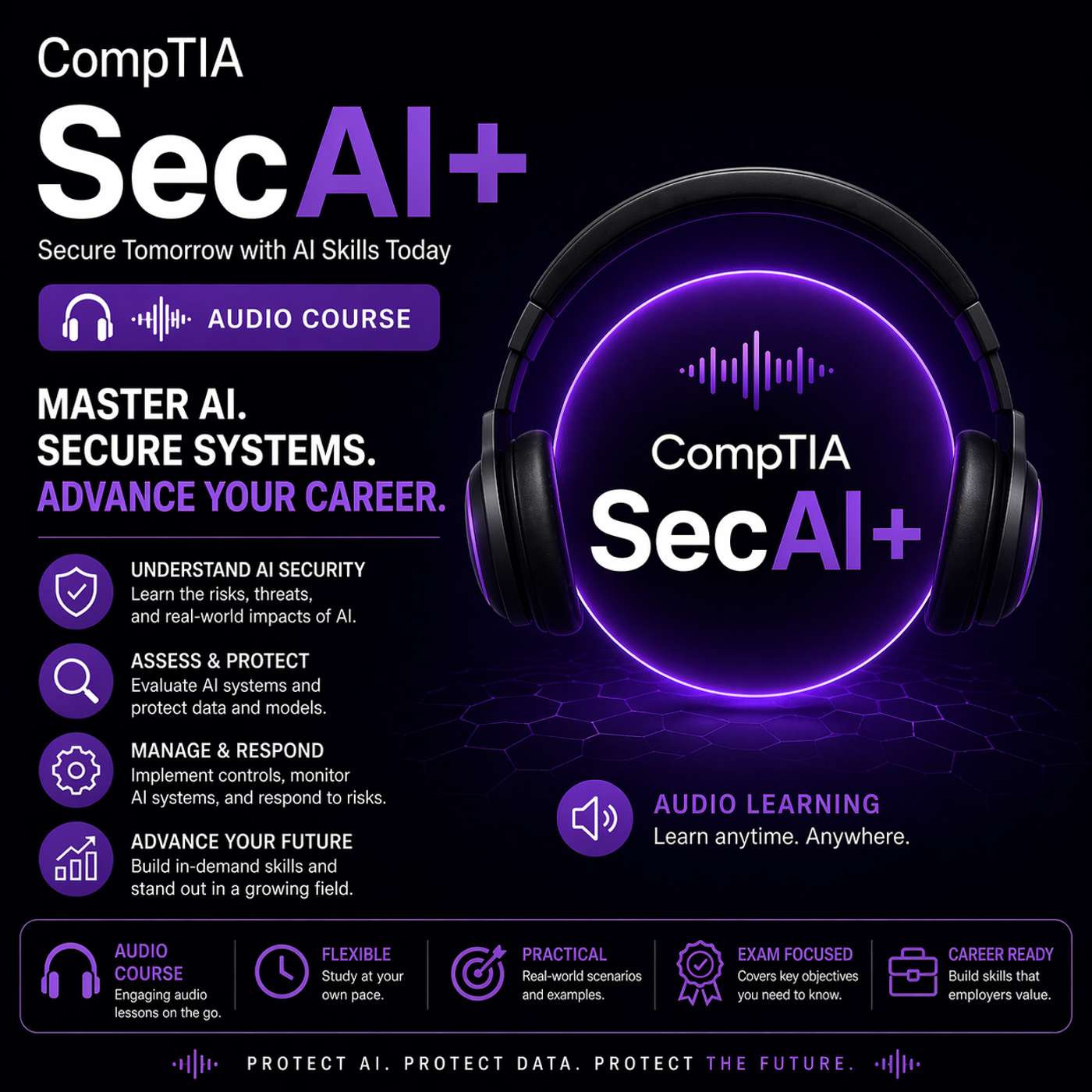
Certified: The CompTIA SecAI Certification Audio Course is an audio-first training program built for busy IT and security professionals who want to understand how AI changes cybersecurity work—and how security changes when AI is part of the environment. It’s designed for early- to mid-career practitioners, analysts, administrators, and technically curious managers who need a practical foundation without wading through research papers or hype. If you already speak basic security—identity, logging, vulnerability management, incident response—this course helps you connect those skills to modern A...
Where to listen?
Podcasts in the app Replaio Radio Coming soonPodcasts are coming to the app soon. Install now and be the first to see a whole new take on podcasts
 Install for free
Android 5M+ downloads · 4.8 rating
iOS soon
Install for free
Android 5M+ downloads · 4.8 rating
iOS soon
Episodes
Episode 15 — Design Retrieval-Augmented Generation That Resists Abuse and Data Spillover 23.02.2026 19:12
This episode teaches retrieval-augmented generation as a security architecture pattern, because SecAI+ frequently frames scenarios where an LLM is connected to enterprise knowledge and the primary risk becomes what the system retrieves, what it trusts, and what it reveals. You will learn how RAG pipelines typically work, including query formation, vector or hybrid retrieval, ranking, context assem...
Episode 14 — Understand Embeddings Deeply: Similarity Search, Semantic Space, and Leakage Risks 23.02.2026 17:44
This episode explains embeddings in a way that makes similarity search and semantic retrieval feel concrete, because SecAI+ will test your ability to reason about how embeddings enable powerful workflows and how they can also introduce unique leakage and access-control problems. You will learn what an embedding represents as a numerical mapping of content into a semantic space, why distance metric...
Episode 13 — Apply Pruning and Quantization Without Breaking Security Expectations and Accuracy 23.02.2026 17:49
This episode covers pruning and quantization from a security-aware perspective, because SecAI+ scenarios often involve performance constraints, edge deployment, or cost reduction, and the exam expects you to anticipate how optimization choices can change risk. You will learn what pruning does when it removes parameters or connections to reduce model size, and what quantization does when it reduce...
Episode 12 — Fine-Tune Safely: Epochs, Learning Rates, and Catastrophic Forgetting Risks 23.02.2026 16:48
This episode teaches fine-tuning as a controlled engineering activity with security consequences, not a casual “make it better” step, because SecAI+ expects you to understand how tuning choices can change behavior, expose data, and increase risk. You will learn what epochs and learning rates mean operationally, how they influence convergence and overfitting, and why a tuning run that is too aggres...
Episode 11 — Explain Model Lifecycle States: Training, Tuning, Serving, and Retirement Criteria 23.02.2026 19:02
This episode explains the full model lifecycle in a way that maps directly to SecAI+ governance, risk, and operational control questions, because exam scenarios often hinge on where a model is in its lifecycle and what controls are appropriate at that moment. You will define the major states, including initial training, iterative tuning, validation and approval gates, production serving, monitorin...
Episode 10 — Validate Models Like a Defender: Cross-Validation, Holdouts, and Drift Awareness 23.02.2026 12:57
This episode teaches validation as a defensive discipline, not a checkbox, because SecAI+ expects you to understand how evaluation methods relate to trustworthy deployment in changing environments. You will learn the purpose of holdout sets, why cross-validation improves confidence when data is limited, and how to avoid common mistakes like random splits that leak time-dependent patterns or dupli...
Episode 9 — Spot Overfitting Early: Bias-Variance Tradeoffs and Generalization Failure 23.02.2026 13:41
Signals Overfitting is a classic exam topic because it creates false confidence, and in security that can translate directly into missed detections or unpredictable behavior, so this episode teaches you how to recognize and prevent it early. You will learn the bias-variance tradeoff in plain language, how training performance can improve while real-world performance collapses, and why complex mode...
Episode 8 — Translate Model Metrics into Risk: Precision, Recall, F1, ROC, and Cost 23.02.2026 13:07
Metrics are easy to memorize and still easy to misuse, so this episode focuses on turning precision, recall, F1, ROC curves, and cost tradeoffs into security decisions that make sense. You will learn what each metric actually measures, how thresholds shift outcomes, and why high accuracy can be meaningless when the event rate is low, which is common in intrusion detection and fraud. We will walk t...
Episode 7 — Compare Supervised, Unsupervised, and Reinforcement Learning for Security Use Cases 23.02.2026 13:43
SecAI+ expects you to match learning approaches to security problems and to anticipate where each approach can fail, so this episode builds a comparison you can use on exam day and at work. You will learn when supervised learning is appropriate, what labeled data really costs, and how label noise can quietly degrade model decisions in fraud, malware classification, or phishing detection. We will e...
Episode 6 — Understand Transformers Clearly: Attention, Tokens, Context Windows, and Limits 23.02.2026 13:44
Transformers are foundational to modern LLMs, and SecAI+ tests whether you understand their operational constraints well enough to reason about security outcomes, so this episode explains the essentials without hand-waving. You will learn what tokens are and why tokenization can create surprising edge cases for secrets, identifiers, and “near matches,” plus how attention mechanisms influence what...
Episode 5 — Explain Statistical Learning Foundations Security Pros Actually Use on the Job 23.02.2026 14:03
This episode covers the statistical learning concepts that show up repeatedly in SecAI+ questions because they influence model reliability, detection quality, and risk decisions. You will learn how distributions, sampling, correlation versus causation, and uncertainty affect what you can safely infer from data, especially when building or evaluating security analytics. We will connect concepts lik...
Episode 4 — Map the AI Landscape for Security: ML, Deep Learning, and Generative Systems 23.02.2026 13:58
SecAI+ expects you to speak clearly about AI system types and where security risk shows up, so this episode builds a practical map of machine learning, deep learning, and generative systems from a defender’s point of view. You will learn how ML pipelines differ from traditional software pipelines, why deep learning shifts risk toward data quality and model behavior rather than deterministic logic,...
Episode 3 — Lock In Exam-Day Tactics: Time, Stress, and Scenario Decision Patterns 23.02.2026 13:06
Exam performance often fails on execution, not knowledge, so this episode focuses on exam-day tactics that help you manage time, control stress, and make consistent decisions in scenario-heavy questions. You will learn a repeatable pacing model for the full session, when to flag and move on without panic, and how to prevent a single confusing item from draining minutes you need later. We will prac...
Episode 2 — Build a Spoken Study Plan That Fits SecAI+ Objectives and Your Calendar 23.02.2026 12:00
This episode teaches you how to build a realistic, exam-aligned study plan that works for busy schedules by converting SecAI+ objectives into weekly learning blocks you can execute without constantly re-planning. You will learn how to size each objective into “learn, apply, review” passes, how to sequence topics so prerequisites like metrics, validation, and data handling show up before advanced...
Episode 1 — Decode the SecAI+ Exam Blueprint, Scoring Rules, and Question Mechanics 23.02.2026 14:21
Fast SecAI+ is less about memorizing buzzwords and more about recognizing what the exam writers are actually testing, so this episode focuses on translating the blueprint into a practical map of what to study and how to think under time pressure. You will learn how domain weighting typically shapes your return on study time, how to interpret task verbs so you do not overbuild an answer, and why so...
Welcome to Certified: The CompTIA SecAI+ Audio Course 23.02.2026 0:57
Certified: The CompTIA SecAI Certification Audio Course is an audio-first training program built for busy IT and security professionals who want to understand how AI changes cybersecurity work—and how security changes when AI is part of the environment. It’s designed for early- to mid-career practitioners, analysts, administrators, and technically curious managers who need a practical foundation w...
Similar podcasts







Listen to the Certified: The CompTIA SecAI+ Audio Course podcast in Replaio
Radio and podcasts in one app - free, with no sign-up. Install today and do not miss the launch
Replaio is not a podcast publisher; show names, artwork and audio belong to their authors and are distributed through public RSS feeds.