Jason Edwards
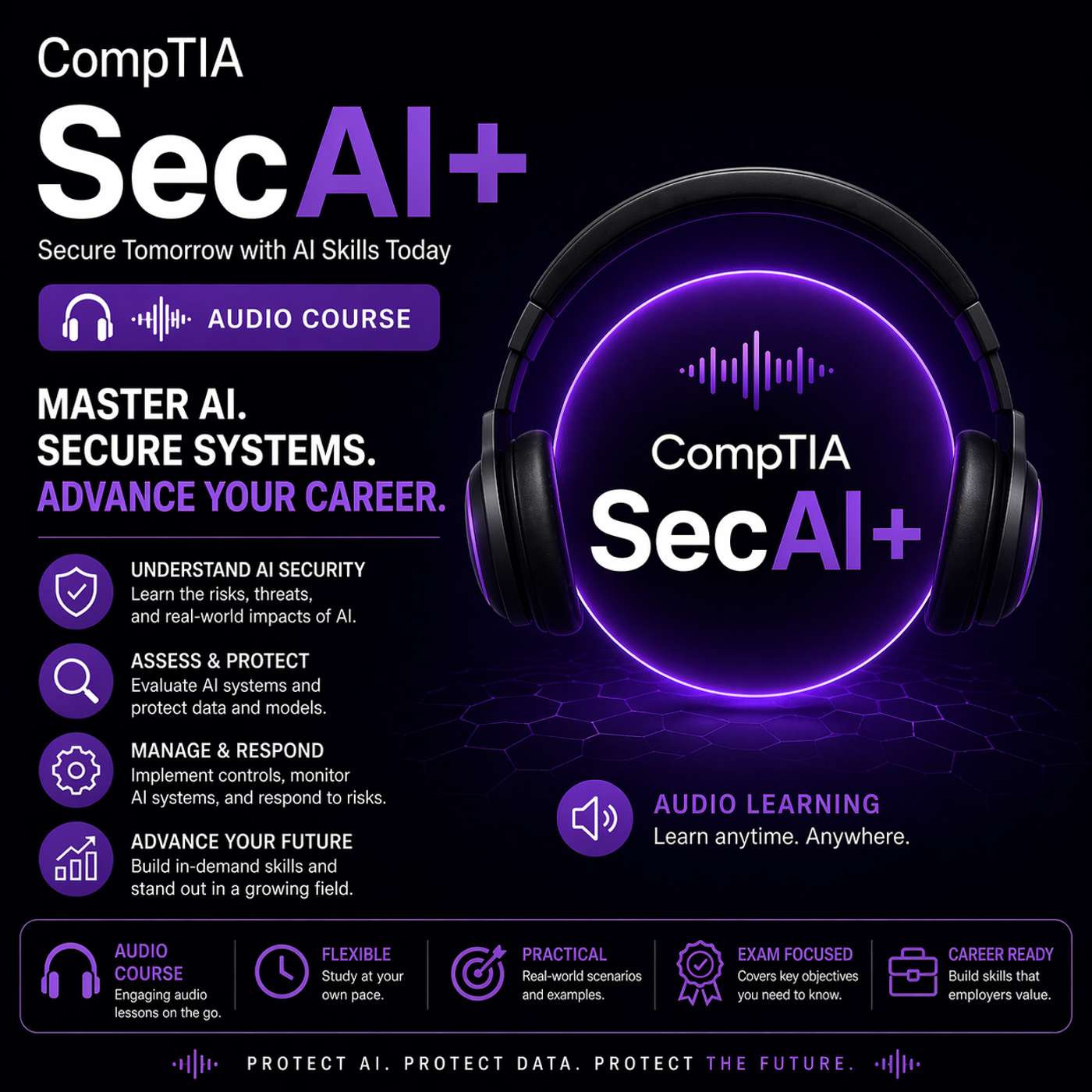
Certified: The CompTIA SecAI+ Audio Course
Certified: The CompTIA SecAI Certification Audio Course is an audio-first training program built for busy IT and security professionals who want to understand how AI changes cybersecurity work—and how security changes when AI is part of the environment. It’s designed for early- to mid-career practitioners, analysts, administrators, and technically curious managers who need a practical foundation without wading through research papers or hype. If you already speak basic security—identity, logging, vulnerability management, incident response—this course helps you connect those skills to modern A...
Where to listen?
Podcasts in the app Replaio Radio Coming soonPodcasts are coming to the app soon. Install now and be the first to see a whole new take on podcasts
 Install for free
Android 5M+ downloads · 4.8 rating
iOS soon
Install for free
Android 5M+ downloads · 4.8 rating
iOS soon
Episodes
Episode 65 — Interpret Confidence Signals: Limits, Miscalibration, and Operational Risk 23.02.2026 14:01
This episode teaches confidence as a risk signal that must be handled carefully, because SecAI+ expects you to understand that model confidence can be miscalibrated, can vary by topic and data distribution, and can create unsafe automation when teams treat it as a guarantee. You will learn what confidence signals typically represent in different systems, why a high score can still be wrong in edge...
Episode 64 — Audit AI Use at Scale: Who Asked What, When, and With What Data 23.02.2026 13:58
This episode focuses on auditing AI usage as a governance and security requirement, because SecAI+ expects you to prove accountability across prompts, retrieval, tools, and outputs when the organization is challenged by incidents, regulators, or internal oversight. You will learn what “who asked what, when, and with what data” means operationally, including identity attribution, request context, t...
Episode 63 — Log AI Interactions Safely: Sanitization, Redaction, and Tamper-Resistance 23.02.2026 14:45
This episode teaches secure logging for AI interactions, because SecAI+ scenarios regularly involve logs that accidentally become a secondary data breach, especially when prompts include secrets, personal data, proprietary documents, or tool outputs that were never meant to persist. You will learn how to sanitize and redact logs so they preserve operational value while removing high-risk fields, a...
Episode 62 — Monitor Prompts as Telemetry: Signals, Patterns, and Threat-Hunting Hooks 23.02.2026 15:01
This episode explains how prompts and context assembly can be treated as security telemetry, because SecAI+ expects you to detect emerging abuse, injection attempts, and data-seeking behavior by analyzing how users interact with an AI system over time. You will learn what signals matter, such as repeated attempts to override instruction hierarchy, unusually high iteration rates, aggressive probing...
Episode 61 — Apply Key Management Right: Rotation, Storage, and Separation of Duties 23.02.2026 18:25
This episode focuses on key management as a foundational control for AI systems, because SecAI+ scenarios often involve encrypted datasets, protected model artifacts, secure API calls, and secrets used by retrieval or agent tools, and weak key practices can erase the benefits of otherwise strong designs. You will learn how to store keys and secrets safely using centralized services rather than app...
Episode 60 — Apply Access Controls Across Layers: Data, Models, Tools, and Agents 23.02.2026 13:36
This episode ties access control together across the entire AI ecosystem, because SecAI+ scenarios often fail when organizations secure one layer, like the model endpoint, but leave other layers, like data stores or tool permissions, effectively wide open. You will learn how to design consistent access boundaries for raw data, derived artifacts such as embeddings and feature stores, model manageme...
Episode 59 — Lock Down Endpoints: Network Controls, Segmentation, and Service Hardening 23.02.2026 11:53
This episode teaches endpoint security for AI services as a familiar discipline applied to a new workload, because SecAI+ expects you to defend inference endpoints, retrieval services, and orchestration layers the same way you defend any critical API surface, with extra attention to abuse patterns and data exposure. You will learn how network controls like private connectivity, firewall rules, an...
Episode 58 — Secure Agent Toolchains: Least Privilege, Scoped Credentials, and Audit Trails 23.02.2026 12:04
This episode focuses on agent toolchains as a high-risk area, because SecAI+ scenarios often involve agents that can call APIs, query internal systems, create tickets, or modify resources, and the exam expects you to prevent an AI assistant from becoming a privilege escalation pathway. You will learn how least privilege applies to agent tools, including limiting the tool set, narrowing action sco...
Episode 57 — Control Outputs Safely: Dangerous Content Filters and Secure Output Encoding 23.02.2026 12:50
This episode teaches safe output handling as a concrete security requirement, because SecAI+ expects you to prevent situations where AI outputs create harm through unsafe instructions, embedded payloads, or downstream injection into systems that render or execute content. You will learn how dangerous content filters work conceptually, what they can and cannot reliably catch, and why filtering must...
Episode 56 — Validate Inputs Rigorously: File Types, Length Limits, and Content Sanitization 23.02.2026 12:40
This episode focuses on input validation as a first-line defense for AI systems, because SecAI+ scenarios frequently involve attackers using oversized payloads, malicious files, or carefully crafted content to cause failures, bypass guardrails, or inject instructions into the model’s context. You will learn how to validate file types, enforce safe parsing paths, and set length limits that protect...
Episode 55 — Set Rate Limits and Quotas: Token Caps, Cost Controls, and Abuse Prevention 23.02.2026 11:05
This episode explains rate limiting and quotas as both a security control and a reliability control, because SecAI+ expects you to mitigate abuse patterns that include brute-force probing, model extraction attempts, denial-of-wallet attacks, and operational instability caused by uncontrolled usage. You will learn how token caps and request quotas shape exposure, why limits should differ by user t...
Episode 54 — Build Prompt Firewalls: Filtering, Classification, and Instruction Boundary Checks 23.02.2026 11:45
This episode teaches prompt firewalls as a practical defense pattern, because SecAI+ scenarios often involve untrusted user input, untrusted documents, and integrated retrieval where malicious strings can be introduced deliberately or accidentally. You will learn what a prompt firewall is intended to do, including filtering high-risk content, classifying intent, and enforcing instruction boundari...
Episode 53 — Implement Guardrails That Hold: Policy Rules, Validators, and Refusal Logic 23.02.2026 12:24
This episode focuses on guardrails as enforceable controls, because SecAI+ expects you to design guardrails that still work when inputs are messy, users are persistent, and systems are integrated with tools and data. You will learn how policy rules define what is allowed, what is prohibited, and what requires escalation, and why rules must be expressed in operational terms that can be tested and a...
Episode 52 — Model the Attack Surface: Data, Model, Agent, Tooling, and Integrations 23.02.2026 12:59
This episode builds an AI-specific attack surface map you can apply quickly on the SecAI+ exam, because many scenario questions are really asking which layer is being attacked and what control reduces risk most directly. You will learn to break the system into attackable components, including data sources and pipelines, model artifacts and inference endpoints, agents and tool permissions, orchestr...
Episode 51 — Track AI Vulnerabilities: CVE Workflows, Advisories, and Exposure Management 23.02.2026 16:39
This episode teaches vulnerability management for AI and adjacent components in a way that matches SecAI+ scenario questions, where the right answer is often a disciplined process rather than a clever technical trick. You will learn how CVE workflows apply to the real AI stack, including inference servers, orchestration services, vector databases, web gateways, dependency libraries, and even mode...
Episode 50 — Use MITRE ATLAS Concepts for AI Threat Modeling and Adversary Behavior 23.02.2026 12:08
This episode introduces MITRE ATLAS concepts as a structured way to think about adversary behavior against AI systems, because SecAI+ expects you to threat model AI like any other critical capability, with clear tactics, techniques, and mitigations that map to real controls. You will learn how AI threat modeling differs from traditional application threat modeling by including unique assets like t...
Episode 49 — Apply OWASP Guidance to ML Risks: Abuse Patterns and Defensive Responses 23.02.2026 16:07
This episode focuses on machine learning risks beyond LLMs, because SecAI+ includes scenarios where traditional ML models support detection, classification, or decisioning, and the exam expects you to recognize abuse patterns and apply defenses that preserve integrity and reliability. You will learn common ML abuse patterns such as data poisoning, evasion through adversarial inputs, model extract...
Episode 48 — Apply OWASP Guidance to LLM Risks: Top Threats and Key Controls 23.02.2026 10:47
This episode translates OWASP guidance into SecAI+ exam-ready thinking, because you are expected to recognize common LLM threat patterns and choose practical controls that match the scenario rather than reacting with generic advice. You will learn how typical LLM risks show up in real environments, including prompt injection through untrusted content, insecure output handling that causes downstre...
Episode 47 — Operate Feedback Loops Safely: User Inputs, Reinforcement, and Toxic Drift 23.02.2026 11:27
This episode teaches feedback loops as a risk area, because SecAI+ will test whether you understand how user feedback, retraining signals, and reinforcement mechanisms can improve a system or slowly degrade it into unsafe behavior if they are not governed. You will learn how feedback enters systems through ratings, edits, follow-up prompts, support tickets, and implicit signals like click-through,...
Episode 46 — Build Human Oversight That Works: Reviews, Approvals, and Accountability Points 23.02.2026 10:25
This episode focuses on human oversight as an operational control, because SecAI+ expects you to design workflows where people are placed at the right decision points, with clear accountability, rather than relying on vague “humans will review it” promises. You will learn how to decide where reviews belong, such as high-impact outputs, policy interpretations, security actions, or customer-facing c...
Episode 45 — Plan Secure Maintenance: Patch Strategy, Versioning, and Rollback Discipline 23.02.2026 11:18
This episode teaches maintenance as a disciplined security process, because SecAI+ scenarios often include model updates, dependency changes, or vendor refreshes that introduce behavior shifts, new vulnerabilities, or compliance surprises if they are not controlled. You will learn how patch strategy applies to the full stack, including inference services, libraries, vector stores, orchestration to...
Episode 44 — Control Model Exposure: Endpoints, APIs, Authentication, and Authorization Choices 23.02.2026 11:50
This episode explains why exposing a model through endpoints and APIs is a high-impact attack surface, because SecAI+ will test whether you can select authentication, authorization, and traffic controls that prevent misuse, data leakage, and unintended access. You will learn the practical differences between internal-only endpoints, partner-facing APIs, and public interfaces, and how exposure lev...
Episode 43 — Design Secure Deployment Paths: Environments, Isolation, and Integration Boundaries 23.02.2026 12:35
This episode covers deployment architecture as a security control, because SecAI+ expects you to reason about where AI components run, what they can reach, and how environment design either contains risk or lets it spread. You will learn how to separate development, testing, and production environments so prompts, logs, and datasets do not leak across boundaries, and why controlled promotion matt...
Episode 42 — Evaluate Models for Abuse: Misuse Paths, Safety Gaps, and Overreach Risks 23.02.2026 13:22
This episode teaches abuse evaluation as a core SecAI+ skill, because exam questions frequently ask what to test and what to mitigate when a model could be used to generate harmful content, enable unsafe actions, or provide confident guidance in areas where it should refuse or escalate. You will learn how to identify misuse paths such as social engineering assistance, data exfiltration through cle...
Episode 41 — Select Models Securely: Capability Fit, Failure Modes, and Vendor Transparency 23.02.2026 13:48
This episode focuses on choosing an AI model as a security decision, because SecAI+ scenarios often hinge on whether the selected model fits the intended use case without introducing hidden risks that the organization cannot see, test, or control. You will learn how to evaluate capability fit by mapping the model’s strengths and limits to the required task, then identifying likely failure modes su...
Similar podcasts







Listen to the Certified: The CompTIA SecAI+ Audio Course podcast in Replaio
Radio and podcasts in one app - free, with no sign-up. Install today and do not miss the launch
Replaio is not a podcast publisher; show names, artwork and audio belong to their authors and are distributed through public RSS feeds.