Dr. Jason Edwards
Certified: The CompTIA DataX Audio Course
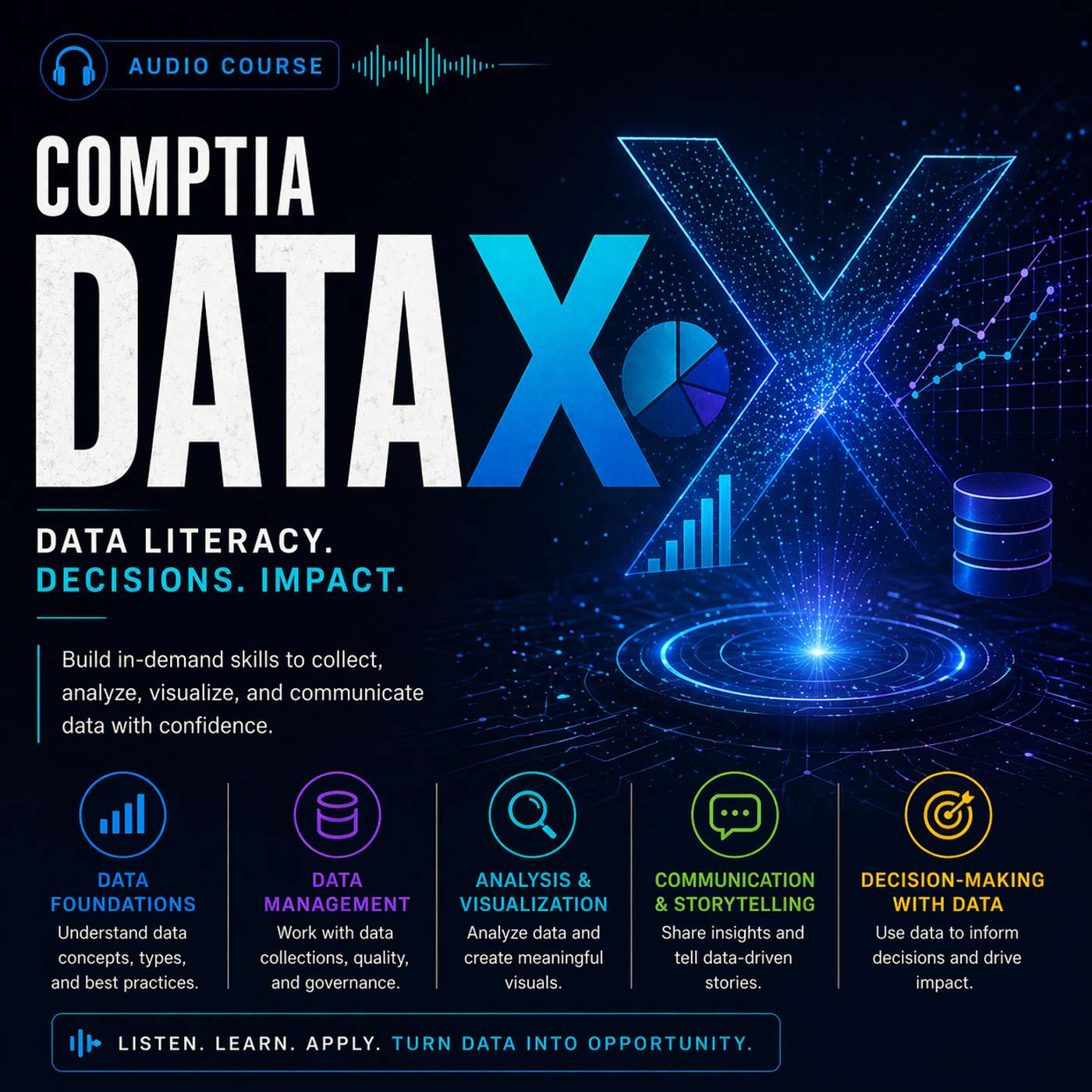
This DataX DY0-001 PrepCast is an exam-focused, audio-first course designed to train analytical judgment rather than rote memorization, guiding you through the full scope of the CompTIA DataX exam exactly the way the test expects you to think. The course builds from statistical and mathematical foundations into exploratory analysis, feature design, modeling, machine learning, and business integration, with each episode reinforcing how to interpret scenarios, recognize constraints, select defensible methods, and avoid common traps such as leakage, metric misuse, and misaligned objectives. Conce...
Where to listen?
Podcasts in the app Replaio Radio Coming soonPodcasts are coming to the app soon. Install now and be the first to see a whole new take on podcasts
 Install for free
Android 5M+ downloads · 4.8 rating
iOS soon
Install for free
Android 5M+ downloads · 4.8 rating
iOS soon
Episodes
Episode 45 — Domain 1 Mixed Review: Statistics and Math Decision Drills 24.01.2026 15:51
This episode is a mixed review designed to convert Domain 1 knowledge into fast, reliable decisions, because the DataX exam rewards candidates who can select the right concept under pressure and avoid traps that sound statistically sophisticated but don’t match the scenario. You will practice rapid identification of what the prompt is actually testing: sampling versus inference, hypothesis testing...
Episode 44 — A/B Tests and RCTs: Treatment Effects, Validity, and Common Pitfalls 24.01.2026 18:02
This episode covers randomized experiments as the gold standard for causal inference, focusing on what A/B tests and randomized controlled trials estimate, what makes them valid, and what can go wrong in both exam scenarios and real deployments. You will define an A/B test as random assignment to different variants and an RCT as the broader concept of randomized treatment assignment, then connect...
Episode 43 — Difference-in-Differences: Detecting Change When You Can’t Randomize 24.01.2026 15:52
This episode explains difference-in-differences as a quasi-experimental method for estimating effects when randomization is not feasible, which is a realistic business constraint that DataX scenarios may include. You will define DiD as comparing the change over time in a treated group to the change over time in a similar control group, with the key intuition that the control group approximates wha...
Episode 42 — Causal Tools: DAGs as a Way to Explain “What Drives What” 24.01.2026 15:21
This episode introduces directed acyclic graphs as a practical tool for expressing causal assumptions, clarifying variable relationships, and communicating “what drives what” in a way that improves both analysis design and exam performance. You will define a DAG as a graph where nodes represent variables and directed edges represent assumed causal influence, with the key property that the graph ha...
Episode 41 — Causal Thinking: Correlation vs Causation and Why the Exam Cares 24.01.2026 16:13
This episode builds causal reasoning as a disciplined mindset, because DataX questions often test whether you can tell the difference between patterns in data and claims about what drives outcomes, especially when decisions and interventions are involved. You will define correlation as a relationship observed in data and causation as a claim that changing one factor would change another, then conn...
Episode 40 — Parametric vs Non-Parametric Survival: When Assumptions Help or Hurt 24.01.2026 20:34
This episode contrasts parametric and non-parametric survival approaches, focusing on assumption tradeoffs that the DataX exam may probe in scenario-based questions. You will define parametric survival models as assuming a specific distribution for event times, which can improve efficiency and interpretability when assumptions are reasonable. Non-parametric approaches will be defined as making min...
Episode 39 — Survival Analysis Concepts: What “Time to Event” Modeling Solves 24.01.2026 20:30
This episode introduces survival analysis as a framework for modeling time until an event occurs, which DataX scenarios may reference in contexts like churn, failure, or duration analysis. You will define survival analysis as focusing on time-to-event outcomes while properly handling censoring, where the event has not yet occurred for some observations. We’ll explain why standard regression is ina...
Episode 38 — Differencing and Lag Features: Fixing Non-Stationarity Without Overfitting 24.01.2026 19:35
This episode teaches practical techniques for addressing non-stationarity, focusing on differencing and lag features as controlled ways to make temporal patterns learnable without memorizing history. You will define differencing as modeling changes rather than levels, and you’ll learn how it can remove trends and stabilize mean behavior. Lag features will be explained as explicitly representing pa...
Episode 37 — AR, MA, and ARIMA: Choosing the Right Time Series Family 24.01.2026 18:55
This episode explains autoregressive and moving-average models as tools for capturing temporal dependence, focusing on when each family is appropriate rather than on equations. You will define AR models as using past values to predict future values and MA models as using past errors to correct predictions, then connect these ideas to intuition about momentum and shock correction. ARIMA will be int...
Episode 36 — Time Series Basics: Trend, Seasonality, Noise, and Stationarity 24.01.2026 19:32
This episode introduces time series concepts as patterns over time that require different reasoning than cross-sectional data, which is a frequent distinction in DataX scenarios. You will define trend as long-term directional movement, seasonality as repeating patterns tied to calendar or cycle, noise as random fluctuation, and stationarity as stability of statistical properties over time. We’ll e...
Episode 35 — Logs and Exponentials: Why They Show Up in Models and Transformations 24.01.2026 19:56
This episode explains logarithms and exponentials as tools for managing scale, growth, and multiplicative effects, which frequently appear in DataX scenarios involving modeling, feature engineering, and interpretation. You will define logarithms as transformations that compress large ranges and turn multiplicative relationships into additive ones, making patterns easier to model and interpret. We’...
Episode 34 — Calculus for ML: Derivatives as “Slope,” Partial Derivatives, and the Chain Rule 24.01.2026 19:29
This episode introduces calculus concepts as intuitive tools for understanding learning and optimization, focusing on meaning rather than computation, which aligns with how DataX frames these ideas. You will define a derivative as a measure of how output changes when an input changes, and you’ll connect this to the idea of “slope” on a loss surface that tells an algorithm which direction reduces e...
Episode 33 — Distance and Similarity Metrics: Euclidean, Manhattan, Cosine, and When to Use 24.01.2026 20:31
This episode teaches distance and similarity metrics as modeling choices that shape how algorithms perceive “closeness,” which is a subtle but important concept in DataX scenarios involving clustering, nearest neighbors, and embeddings. You will define Euclidean distance as straight-line distance in feature space, emphasizing its sensitivity to scale and its assumption that dimensions are comparab...
Episode 32 — Eigenvalues and Eigenvectors: The Intuition Behind “Important Directions” 24.01.2026 19:28
This episode explains eigenvalues and eigenvectors as a way to understand dominant patterns in data, which is a concept DataX may test indirectly through dimensionality reduction, variance explanation, and stability discussions. You will define an eigenvector as a direction that remains aligned after a transformation and an eigenvalue as a measure of how strongly that direction is scaled, then con...
Episode 31 — Matrix Operations You Must Understand: Multiply, Transpose, Invert, Decompose 24.01.2026 20:20
This episode builds practical intuition for core matrix operations that DataX expects you to recognize conceptually, even if you never compute them by hand, because these operations describe how data and models are transformed. You will define matrix multiplication as combining information across dimensions, such as applying model weights to feature vectors or composing transformations in a pipeli...
Episode 30 — Math for Modeling: Vectors, Matrices, and What Linear Algebra Enables 24.01.2026 18:53
This episode introduces the linear algebra vocabulary that underpins many DataX modeling concepts, focusing on how vectors and matrices represent data and transformations, and why this matters for understanding algorithms even when you are not writing code. You will define a vector as an ordered list of numbers that can represent a single observation’s features, a set of model parameters, or a dir...
Episode 29 — Sampling Strategies: Stratification, Oversampling, and Class Balance 24.01.2026 20:07
This episode teaches sampling strategies as tools to make analysis and modeling more reliable, especially when data is imbalanced or when subpopulations must be represented, which are recurring themes in DataX scenarios. You will define stratified sampling as selecting samples in a way that preserves or enforces representation of key groups, then connect it to reduced variance in estimates and mor...
Episode 28 — Missing Data Types: MCAR vs MAR vs NMAR and Correct Responses 24.01.2026 19:33
This episode teaches missing data mechanisms as a decision framework, because DataX scenarios often ask what kind of missingness you are facing and what response is defensible without introducing bias or false confidence. You will define MCAR as missing completely at random, where missingness is unrelated to observed or unobserved data, MAR as missing at random conditional on observed data, and NM...
Episode 27 — Resampling Methods: Bootstrapping for Confidence Without New Data 24.01.2026 16:42
This episode teaches bootstrapping as a resampling approach for estimating uncertainty when you cannot assume a convenient parametric form or when the analytic confidence interval is unclear, which is a decision you may need to recognize in DataX questions. You will define bootstrapping as repeatedly sampling with replacement from the observed dataset to create many “pseudo-samples,” then computin...
Episode 26 — Simulation Thinking: Monte Carlo for Uncertainty and Risk 24.01.2026 19:33
This episode explains Monte Carlo simulation as a general-purpose way to reason about uncertainty when analytic solutions are hard or when you need to propagate multiple uncertain inputs through a decision model, which is a practical skill DataX scenarios can probe. You will define Monte Carlo as repeatedly sampling from input distributions to generate a distribution of outcomes, then interpreting...
Episode 25 — PDF, PMF, and CDF: The Three Views of Probability You Must Recognize 24.01.2026 19:36
This episode teaches you to recognize three core probability representations—PMF, PDF, and CDF—because DataX questions often test whether you understand what kind of variable you are dealing with and what the probability statement actually means. You will define a probability mass function as describing probabilities for discrete outcomes, where you can meaningfully talk about the probability of a...
Episode 24 — Variance Behavior: Homoskedasticity vs Heteroskedasticity and Why It Matters 24.01.2026 19:33
This episode explains variance behavior as an assumption that quietly affects regression validity, confidence in estimates, and the reliability of predictions across different ranges of input, which is why the DataX exam cares about homoskedasticity and heteroskedasticity in applied scenarios. You will define homoskedasticity as roughly constant variance of errors across levels of predictors and h...
Episode 23 — Shape Descriptors: Skewness and Kurtosis as “Data Personality” 24.01.2026 20:15
This episode teaches skewness and kurtosis as practical descriptors of distribution shape, helping you communicate “data personality” and choose appropriate modeling and preprocessing responses in DataX scenarios. You will define skewness as a measure of asymmetry and learn how positive skew often indicates many small values with occasional large spikes, while negative skew indicates the reverse,...
Episode 22 — Real-World Distributions: Skew, Heavy Tails, and Power Laws 24.01.2026 19:54
This episode focuses on distribution behavior that breaks “textbook normal” assumptions, because DataX frequently tests whether you can reason correctly when data is skewed, heavy-tailed, or driven by rare extremes that dominate risk. You will define skew as asymmetry in the distribution, where most observations cluster on one side with a long tail on the other, and you’ll learn how skew affects a...
Episode 21 — Distribution Families: Normal, Uniform, Binomial, Poisson, and t-Distribution 24.01.2026 19:37
This episode teaches you to recognize common distribution families in DataX scenarios and to choose appropriate assumptions and methods based on how the data is generated, not just how it “looks,” because many exam questions reward matching distribution to process. You will define the normal distribution as a symmetric, bell-shaped model often used for aggregated effects and measurement noise, and...
Similar podcasts







Listen to the Certified: The CompTIA DataX Audio Course podcast in Replaio
Radio and podcasts in one app - free, with no sign-up. Install today and do not miss the launch
Replaio is not a podcast publisher; show names, artwork and audio belong to their authors and are distributed through public RSS feeds.