Dr. Jason Edwards
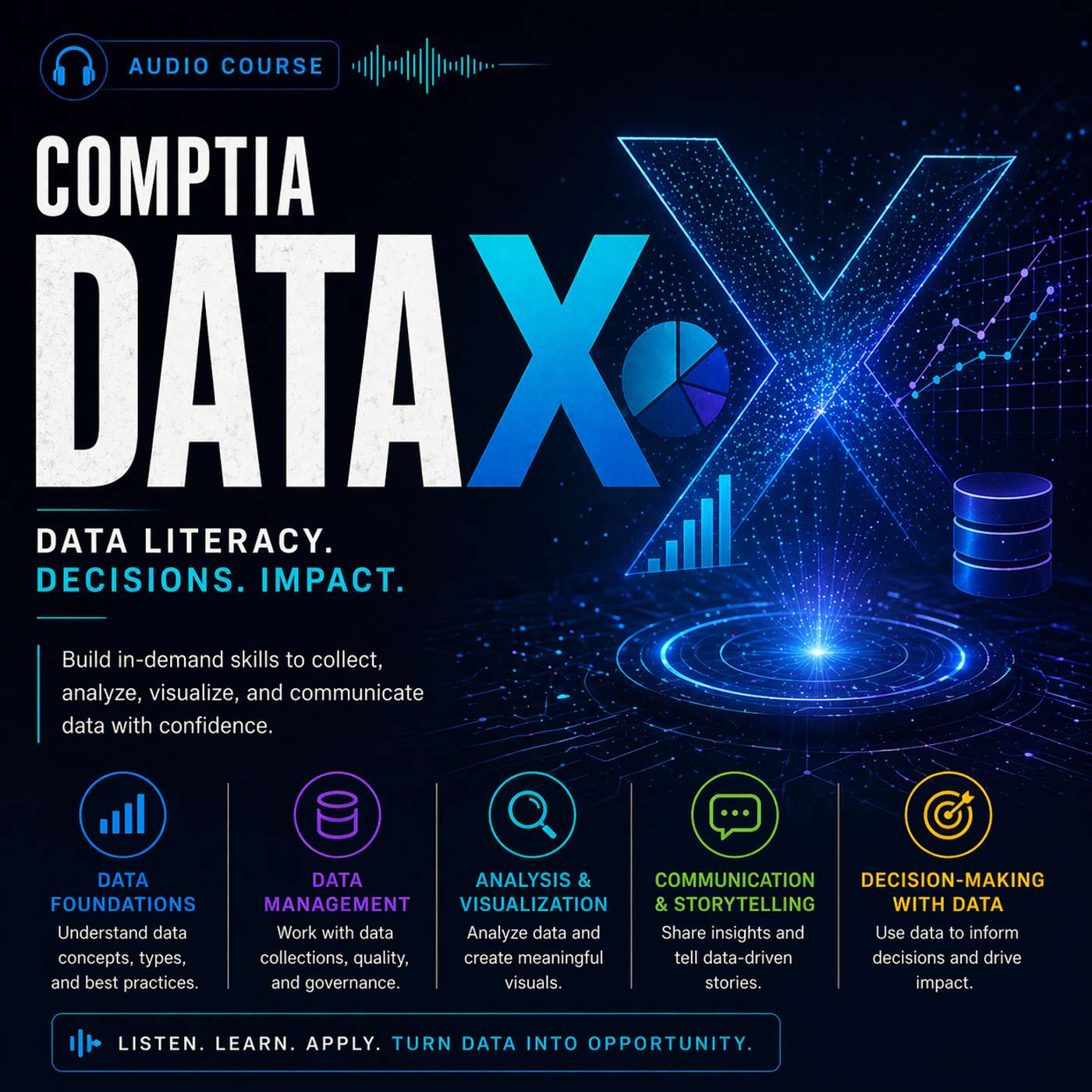
Certified: The CompTIA DataX Audio Course
This DataX DY0-001 PrepCast is an exam-focused, audio-first course designed to train analytical judgment rather than rote memorization, guiding you through the full scope of the CompTIA DataX exam exactly the way the test expects you to think. The course builds from statistical and mathematical foundations into exploratory analysis, feature design, modeling, machine learning, and business integration, with each episode reinforcing how to interpret scenarios, recognize constraints, select defensible methods, and avoid common traps such as leakage, metric misuse, and misaligned objectives. Conce...
Where to listen?
Podcasts in the app Replaio Radio Coming soonPodcasts are coming to the app soon. Install now and be the first to see a whole new take on podcasts
 Install for free
Android 5M+ downloads · 4.8 rating
iOS soon
Install for free
Android 5M+ downloads · 4.8 rating
iOS soon
Episodes
Episode 70 — Iteration Loops: From Constraints to Experiments to Better Outcomes 24.01.2026 18:51
This episode frames iteration as the core workflow of applied data science: you start with constraints, translate them into testable hypotheses, run controlled experiments, and converge toward better outcomes without losing validity, which is exactly the kind of systematic thinking DataX rewards. You will learn to treat each iteration as a loop with explicit inputs and outputs: define success metr...
Episode 69 — Designing the First Model: Baselines, Assumptions, and Quick Wins 24.01.2026 17:59
This episode teaches first-model design as a disciplined baseline process, because DataX scenarios often test whether you start with a defensible reference point and build complexity only when the baseline reveals a clear gap. You will define a baseline model as the simplest meaningful approach that establishes expected performance, such as a naive predictor, a simple linear model, or a straightfo...
Episode 68 — Synthetic Data: Why It’s Used, How It’s Sampled, and Where It Misleads 24.01.2026 19:41
This episode covers synthetic data as a tool for augmentation, privacy, and testing, while highlighting where it can mislead, because DataX scenarios may ask you to weigh benefits against risks like distribution shift, bias amplification, and false confidence. You will define synthetic data as artificially generated records designed to resemble real data, either through sampling from estimated dis...
Episode 67 — Geocoding as Enrichment: Location Features With Realistic Expectations 24.01.2026 19:46
This episode explains geocoding as an enrichment strategy that can add useful location context, while also teaching the realistic expectations and governance constraints that DataX scenarios may test, especially around quality, privacy, and operational feasibility. You will learn what geocoding provides conceptually: converting addresses or place identifiers into structured location features such...
Episode 66 — Feature Reshaping: Ratios, Aggregations, and Pivoting Concepts 24.01.2026 18:24
This episode teaches feature reshaping as a way to convert raw operational data into variables that reflect meaningful behavior, because DataX scenarios often imply that the predictive signal exists but is only visible after you compute ratios, aggregate over time, or reshape event data into a model-ready structure. You will learn to think of ratios as normalization tools that control for scale, s...
Episode 65 — Discretization Choices: Binning for Interpretability and Model Stability 24.01.2026 18:17
This episode covers discretization as an intentional tradeoff: converting continuous values into bins can improve interpretability and sometimes stability, but it can also destroy predictive nuance, so DataX scenarios may test whether you can choose binning for the right reasons. You will define discretization as grouping numeric values into intervals, then connect it to common motivations like re...
Episode 64 — Scaling Choices: Normalization vs Standardization vs Robust Scaling 24.01.2026 15:00
This episode explains scaling as a prerequisite for many models and a common source of subtle errors, because DataX scenarios often test whether you know which scaling method matches the model family and the data’s outlier behavior. You will define normalization as rescaling values to a fixed range, standardization as centering and scaling to unit variance, and robust scaling as using statistics l...
Episode 63 — Box-Cox and Friends: Transformations for Shape and Variance Control 24.01.2026 18:18
This episode teaches transformation families like Box-Cox as systematic tools for addressing skewness and heteroskedasticity, which DataX may test through scenario language about non-normality, unstable variance, or the need to improve linear model assumptions. You will learn the purpose of these transformations: to make distributions more symmetric, stabilize variance, and improve the fit and rel...
Episode 62 — Linearization Tactics: Log, Exp, and Interpreting the New Scale 24.01.2026 17:37
This episode focuses on linearization as a pragmatic strategy: transforming variables so relationships become closer to linear and variance becomes more stable, which can make simpler models viable and interpretations clearer in DataX scenarios. You will learn how log transforms can turn multiplicative relationships into additive ones, reduce the impact of extreme values, and convert percent-chang...
Episode 61 — Interaction Features: Cross-Terms and When They Actually Help 24.01.2026 18:04
This episode teaches interaction features as a targeted way to represent conditional relationships, because DataX scenarios often involve effects that change by segment, context, or level of another variable, and the exam rewards candidates who know when cross-terms add real value versus noise. You will define an interaction feature as a constructed variable that captures how two predictors combin...
Episode 60 — Encoding Categorical Data: One-Hot vs Label Encoding Tradeoffs 24.01.2026 17:48
This episode explains categorical encoding as a modeling compatibility and meaning-preservation decision, because DataX commonly tests whether you understand how encoding choices change what a model can learn and how it behaves in production. You will define one-hot encoding as representing each category with its own indicator, preserving the lack of inherent order while increasing dimensionality,...
Episode 59 — Enrichment Strategy: New Sources vs Better Features vs Better Labels 24.01.2026 18:35
This episode teaches enrichment as a strategic decision, because DataX scenarios often present performance or reliability issues where the best improvement comes not from algorithm changes but from choosing the right type of enrichment: new sources, better features, or better labels. You will define source enrichment as adding new data streams that capture drivers currently missing, feature enrich...
Episode 58 — Outliers in Context: Univariate vs Multivariate and Why They Break Assumptions 24.01.2026 18:54
This episode covers outliers as context-dependent phenomena, emphasizing the difference between univariate extremes and multivariate anomalies, because DataX scenarios often test whether you understand why outliers can break assumptions and how to handle them without destroying important signal. You will define univariate outliers as extreme values on a single variable and multivariate outliers as...
Episode 57 — Weak Features and Insufficient Signal: When Better Modeling Won’t Save You 24.01.2026 17:54
This episode teaches you to recognize when the limiting factor is signal quality rather than algorithm choice, because DataX often frames scenarios where candidates are tempted to “upgrade the model” instead of diagnosing weak features and insufficient information. You will define weak features as predictors with low relationship to the target, whether because the true drivers are unmeasured, the...
Episode 56 — Multicollinearity: How to Spot It and What to Do About It 24.01.2026 17:23
This episode explains multicollinearity as a structural feature problem that can destabilize estimates, distort interpretation, and confuse feature importance, which is why DataX scenarios test whether you can recognize it and respond appropriately. You will define multicollinearity as strong correlation among predictors, meaning multiple features carry overlapping information about the same under...
Episode 55 — Seasonality and Granularity: Fixing “Wrong Time Scale” Analysis 24.01.2026 17:31
This episode teaches seasonality and granularity as time-related framing choices that can make an analysis correct or useless, because DataX scenarios often include “wrong time scale” traps where candidates model patterns that are artifacts of aggregation. You will define seasonality as repeating temporal structure and granularity as the time resolution at which data is collected or summarized, th...
Episode 54 — Non-Stationarity Beyond Time Series: Drifting Patterns in Real Systems 24.01.2026 17:06
This episode expands non-stationarity beyond classic time series by explaining drift as a real-world property of systems, users, and environments, which DataX scenarios frequently test through deployment and monitoring themes. You will define non-stationarity as changes in the underlying data distribution or relationships over time, not necessarily in a periodic or trend-like way, and you’ll learn...
Episode 53 — Nonlinearity in Data: Detecting It and Knowing When Linear Models Fail 24.01.2026 17:28
This episode teaches you to detect nonlinearity conceptually and to know when linear models are likely to underfit, because DataX questions often probe whether you can recognize relationship structure from scenario descriptions and select an appropriate response. You will define nonlinearity as relationships where the effect of a variable is not constant across its range, such as saturation, thres...
Episode 52 — Sparse Data and High Dimensionality: Symptoms and Mitigations 24.01.2026 18:05
This episode explains sparse data and high dimensionality as structural challenges that affect similarity, generalization, and stability, because DataX scenarios often include “wide” datasets, sparse signals, or text-like features that require specific mitigations. You will define sparsity as most entries being zero or absent, common in one-hot encodings, event logs, and bag-of-words representatio...
Episode 51 — Data Quality Problems: Missingness, Noise, Duplicates, and Inconsistency 24.01.2026 18:30
This episode covers core data quality failure modes and the correct responses the DataX exam expects you to prioritize, because many scenario questions are designed to test whether you can diagnose the root data issue rather than applying more modeling complexity. You will define missingness as absent values that require mechanism-aware handling, noise as random or systematic measurement variation...
Episode 50 — Chart Literacy Without Charts: What Patterns Sound Like in Words 24.01.2026 18:00
This episode trains “chart literacy without charts,” a skill that supports audio learning and also maps directly to the DataX exam’s underlying requirement: recognizing patterns and diagnosing issues even when you are not shown a visualization. You will learn to translate common plot insights into verbal cues, such as describing a histogram as “most values cluster near X with a long right tail,” d...
Episode 49 — Multivariate Analysis Narration: Relationships, Interactions, and Confounding 24.01.2026 18:43
This episode teaches you to reason about multivariate relationships in spoken form, focusing on interactions and confounding because DataX questions often require you to explain why a relationship changes once other variables are considered. You will define multivariate analysis as examining how multiple variables relate to each other and to the outcome, and you’ll learn to describe patterns such...
Episode 48 — Univariate Analysis Narration: Distributions, Outliers, and “Typical” Behavior 24.01.2026 18:05
This episode teaches you to narrate univariate analysis clearly without visuals, because DataX scenarios may require you to reason about distribution shape, outliers, and central tendency in words and to choose appropriate actions based on what a single variable reveals. You will learn to describe distributions using practical language: where most values cluster, whether there is skew, how wide th...
Episode 47 — Feature Types: Categorical, Ordinal, Continuous, Binary, and Why Choices Change 24.01.2026 18:08
This episode teaches feature types as decision drivers, because many DataX questions hinge on whether you correctly identify variable type and choose preprocessing, modeling, and evaluation approaches that respect what the data represents. You will define categorical features as labels without intrinsic order, ordinal features as ordered categories with uneven or undefined spacing, continuous feat...
Episode 46 — EDA Mindset: What You Look For Before You Model Anything 24.01.2026 17:08
This episode establishes the exploratory data analysis mindset as a structured diagnostic phase, because DataX scenarios often test whether you know what to confirm before modeling so you don’t build confidence on broken inputs. You will define EDA as the process of understanding data meaning, structure, quality, and relationships prior to selecting algorithms, and you’ll learn why the exam reward...
Similar podcasts







Listen to the Certified: The CompTIA DataX Audio Course podcast in Replaio
Radio and podcasts in one app - free, with no sign-up. Install today and do not miss the launch
Replaio is not a podcast publisher; show names, artwork and audio belong to their authors and are distributed through public RSS feeds.