Dr. Jason Edwards
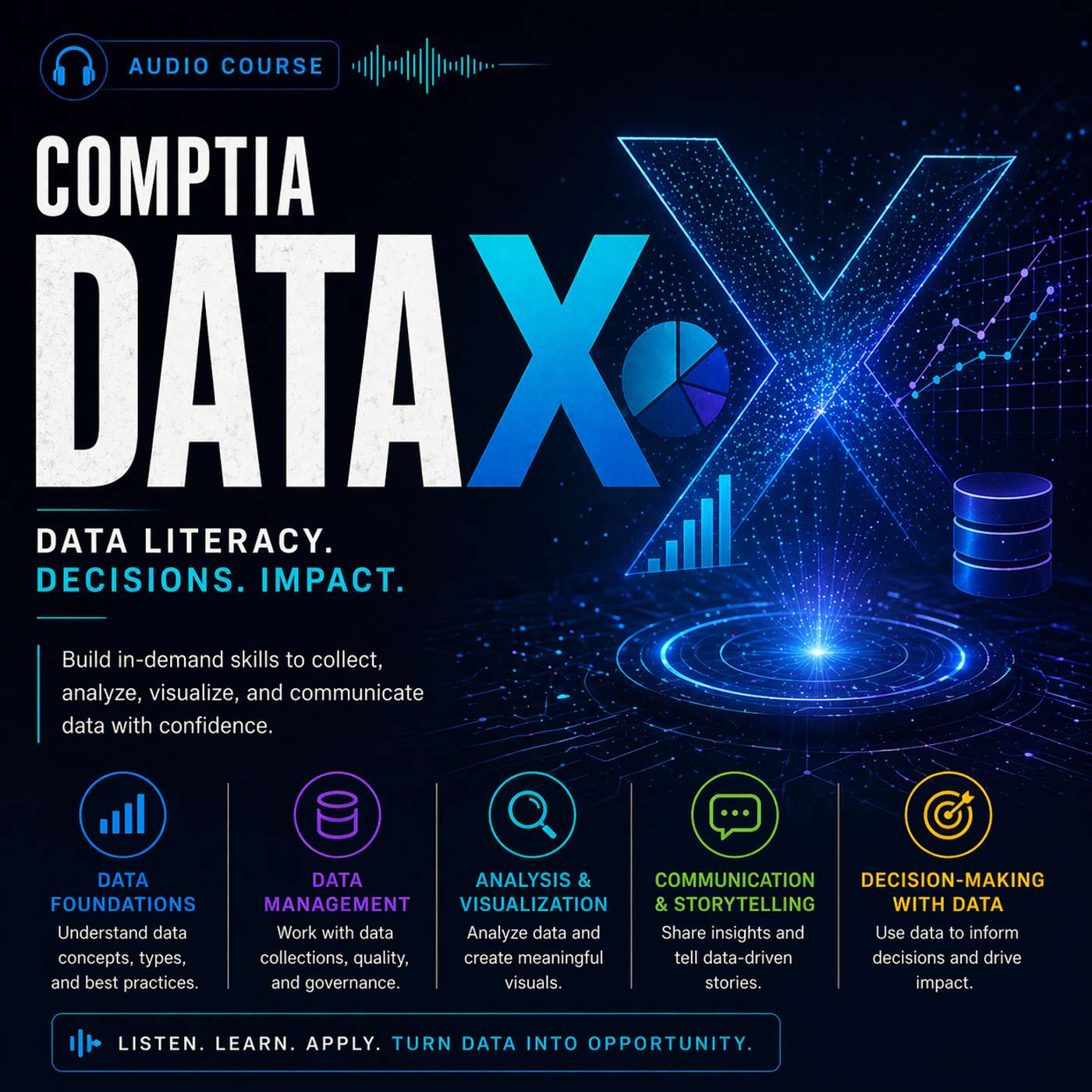
Certified: The CompTIA DataX Audio Course
This DataX DY0-001 PrepCast is an exam-focused, audio-first course designed to train analytical judgment rather than rote memorization, guiding you through the full scope of the CompTIA DataX exam exactly the way the test expects you to think. The course builds from statistical and mathematical foundations into exploratory analysis, feature design, modeling, machine learning, and business integration, with each episode reinforcing how to interpret scenarios, recognize constraints, select defensible methods, and avoid common traps such as leakage, metric misuse, and misaligned objectives. Conce...
Where to listen?
Podcasts in the app Replaio Radio Coming soonPodcasts are coming to the app soon. Install now and be the first to see a whole new take on podcasts
 Install for free
Android 5M+ downloads · 4.8 rating
iOS soon
Install for free
Android 5M+ downloads · 4.8 rating
iOS soon
Episodes
Episode 120 — Ingestion and Storage: Formats, Structured vs Unstructured, and Pipeline Choices 24.01.2026 20:46
This episode teaches ingestion and storage as foundational pipeline design decisions, because DataX scenarios often test whether you can choose formats and storage approaches that match data structure, performance needs, governance constraints, and downstream modeling requirements. You will learn to distinguish structured data with explicit schemas from unstructured data like text, images, and log...
Episode 119 — External and Commercial Data: Availability, Licensing, and Restrictions 24.01.2026 19:07
This episode covers external and commercial data as enrichment options with governance constraints, because DataX scenarios may ask you to evaluate whether third-party data is worth using and whether it can legally and operationally be integrated into a production pipeline. You will learn to assess availability in practical terms: coverage for your population, update frequency aligned to decision...
Episode 118 — Data Acquisition: Surveys, Sensors, Transactions, Experiments, and DGP Thinking 24.01.2026 20:11
This episode teaches data acquisition as a source-driven decision, because DataX scenarios often require you to choose the right data collection approach and to reason about the data-generating process, since the DGP determines what conclusions and models are valid. You will learn the core acquisition modes: surveys that capture self-reported perceptions but carry response bias, sensors that provi...
Episode 117 — Compliance and Privacy: PII, Proprietary Data, and Risk-Aware Handling 24.01.2026 20:45
This episode covers compliance and privacy as design constraints that shape the entire data lifecycle, because DataX scenarios frequently test whether you can identify PII and proprietary data, apply risk-aware handling, and avoid solutions that violate policy even if they improve model performance. You will learn to classify sensitive data types in practical terms: direct identifiers, quasi-ident...
Episode 116 — Business Alignment: Requirements, KPIs, and “Need vs Want” Tradeoffs 24.01.2026 19:25
This episode teaches business alignment as the first constraint layer in DataX scenarios, because many questions are designed to test whether you can translate stakeholder language into measurable requirements, choose the right KPIs, and make “need versus want” tradeoffs that keep a solution feasible. You will learn to separate business goals from implementation ideas by converting vague aims like...
Episode 115 — Domain 3 Mixed Review: Model Selection and ML Scenario Drills 24.01.2026 20:08
This episode is a mixed review designed to convert Domain 3 model-selection knowledge into fast scenario decisions, because DataX questions often present multiple plausible algorithms and reward the candidate who matches model choice to data shape, constraints, and operational needs. You will practice identifying whether the task is supervised or unsupervised, classification or regression, ranking...
Episode 114 — Recommenders: Similarity, Collaborative Filtering, and ALS in Plain Terms 24.01.2026 20:49
This episode explains recommender systems as methods for predicting preference or relevance, focusing on similarity-based approaches, collaborative filtering intuition, and ALS in plain terms, because DataX scenarios may test whether you can choose a recommender approach based on data availability and cold-start constraints. You will learn similarity-based recommenders as using item-to-item or use...
Episode 113 — SVD and Nearest Neighbors: Where They Appear in DataX Scenarios 24.01.2026 19:12
This episode teaches SVD and nearest neighbors as foundational tools that appear across recommendation, dimensionality reduction, similarity search, and clustering, because DataX scenarios may reference them directly or indirectly through “latent factors” and “similar items” language. You will learn SVD as decomposing a matrix into components that reveal latent structure, enabling compression and...
Episode 112 — Nonlinear Reduction: t-SNE and UMAP for Structure, Not “Truth” 24.01.2026 19:23
This episode covers t-SNE and UMAP as nonlinear dimensionality reduction methods, emphasizing how to interpret their outputs correctly, because DataX scenarios may test whether you understand that these methods reveal structure for exploration but do not guarantee faithful global geometry or causal meaning. You will learn the core idea: both methods attempt to preserve local neighborhood relations...
Episode 111 — Dimensionality Reduction: PCA Intuition and What Components Represent 24.01.2026 18:47
This episode teaches PCA as a linear dimensionality reduction technique, focusing on intuition and component meaning, because DataX scenarios often test whether you can explain what components represent and how PCA should be used safely in pipelines. You will learn PCA as finding directions in feature space that capture the most variance, then projecting data onto a smaller number of those directi...
Episode 110 — Cluster Validation: Elbow, Silhouette, and “Does This Grouping Matter” 24.01.2026 18:07
This episode teaches cluster validation as a reality check, because DataX scenarios may ask you how to pick k, how to evaluate whether clusters are meaningful, and how to avoid convincing yourself that any grouping is useful just because an algorithm produced it. You will learn the elbow method as a heuristic for k-means-like objectives: plot within-cluster dispersion versus k and look for the poi...
Episode 109 — Clustering: k-Means, Hierarchical, DBSCAN and Choosing the Right One 24.01.2026 19:33
This episode teaches clustering as an unsupervised grouping task and trains you to choose among k-means, hierarchical clustering, and DBSCAN based on data geometry, scale, and the meaning of “cluster” in the scenario, because DataX questions often test method fit more than algorithm trivia. You will define clustering as grouping observations so members of the same group are more similar to each ot...
Episode 108 — AutoML and Few-Shot Concepts: Where Automation Fits and Where It Fails 24.01.2026 18:36
This episode teaches AutoML and few-shot concepts as automation tools with clear boundaries, because DataX scenarios may ask you to choose when automation accelerates delivery and when it creates governance, interpretability, or data-leakage risks that outweigh benefits. You will define AutoML as systems that automate parts of the modeling workflow—feature processing, model selection, hyperparamet...
Episode 107 — Transfer Learning and Embeddings: Reuse, Fine-Tune, and Cold Start 24.01.2026 19:31
This episode explains transfer learning and embeddings as strategies for reusing learned representations, because DataX scenarios may test whether you can recognize when leveraging prior learning is the most practical path to strong performance under data, time, or compute constraints. You will define an embedding as a dense vector representation that captures similarity and structure, allowing it...
Episode 106 — Deep Model Families: CNN, RNN, LSTM, Autoencoders, GANs, Transformers 24.01.2026 19:32
This episode introduces major deep model families at the conceptual level, focusing on what each family is designed to capture and how to recognize their appropriate use cases in DataX scenarios without turning the discussion into architecture trivia. You will learn CNNs as models that exploit local spatial patterns and weight sharing, which makes them effective for images and other grid-like data...
Episode 105 — Regularizing Deep Models: Dropout, Batch Norm, Early Stopping, Schedulers 24.01.2026 18:38
This episode teaches deep model regularization as a toolkit for controlling overfitting and stabilizing training, because DataX scenarios may test whether you can choose among dropout, batch normalization, early stopping, and learning rate scheduling based on observed training behavior. You will learn dropout as randomly disabling units during training, which reduces co-adaptation and encourages t...
Episode 104 — Optimizers: SGD, Momentum, Adam, RMSprop and Practical Differences 24.01.2026 19:00
This episode explains optimizers as the rules that turn gradients into parameter updates, because DataX scenarios may ask you to recognize why different optimizers behave differently in practice and how that affects convergence speed and stability. You will define stochastic gradient descent as updating parameters using gradients computed from batches of data, which introduces noise that can help...
Episode 103 — Training Mechanics: Backpropagation as Error Correction 24.01.2026 17:56
This episode explains backpropagation as the mechanism neural networks use to adjust parameters, focusing on the intuitive idea of error correction rather than math details, because DataX questions typically test conceptual understanding of how training updates occur. You will learn that backpropagation computes how changes in each weight would change the loss, then uses those gradients to update...
Episode 102 — Activation Functions: ReLU, Sigmoid, Tanh, Softmax and Output Behavior 24.01.2026 18:14
This episode teaches activation functions as the mechanism that gives neural networks nonlinearity and shapes output behavior, because DataX scenarios may ask you to recognize which activation fits which layer role and what that implies about predictions. You will define an activation function as transforming a neuron’s pre-activation score into an output that is passed forward, enabling the netwo...
Episode 101 — Neural Network Basics: Neurons, Layers, and What “Representation” Means 24.01.2026 16:33
This episode introduces neural networks as function approximators that learn internal representations of data, because DataX scenarios may test whether you understand the vocabulary—neurons, layers, activations—and what these components do conceptually without requiring deep math. You will define a neuron as a unit that computes a weighted combination of inputs and passes it through a nonlinearity...
Episode 100 — Ensemble Thinking: When Combining Models Helps and When It Confuses 24.01.2026 18:05
This episode teaches ensemble thinking as a decision framework: combining models can improve accuracy and robustness, but it can also create operational and interpretability confusion if done without a clear purpose, which is exactly the tradeoff DataX scenarios may test. You will learn the main reasons ensembles help: they reduce variance by averaging unstable models, reduce bias by combining com...
Episode 99 — Boosting: Gradient Boosting and Why XGBoost Often Wins 24.01.2026 18:19
This episode explains boosting as a sequential ensemble method that builds strong predictors by combining many weak learners, emphasizing gradient boosting intuition and why implementations like XGBoost are often strong in tabular competitions and practical modeling, which DataX may reference conceptually. You will define boosting as training models one after another, where each new model focuses...
Episode 98 — Random Forests: Bagging Intuition and Variance Reduction 24.01.2026 17:07
This episode teaches random forests as an ensemble strategy for improving stability and generalization, because DataX scenarios often test whether you understand bagging intuition and why forests reduce variance compared to single decision trees. You will define bagging as training many models on different bootstrap samples of the data and averaging their predictions, which smooths out the idiosyn...
Episode 97 — Decision Trees: Splits, Depth, Pruning, and Interpretability Tradeoffs 24.01.2026 17:24
This episode explains decision trees as a rule-like model family, focusing on how splits create decision boundaries, how depth controls complexity, and how pruning supports generalization, because DataX scenarios often ask you to balance interpretability with performance. You will learn to think of a split as choosing a feature and a threshold or category that best separates outcomes according to...
Episode 96 — Association Rules: Support, Confidence, Lift, and Practical Meaning 24.01.2026 17:14
This episode teaches association rules as pattern-mining outputs that describe co-occurrence relationships, because DataX scenarios may test whether you can interpret support, confidence, and lift correctly and avoid treating association as causation. You will define an association rule in plain terms as “if X occurs, Y tends to occur,” then connect that statement to the metrics that quantify how...
Similar podcasts







Listen to the Certified: The CompTIA DataX Audio Course podcast in Replaio
Radio and podcasts in one app - free, with no sign-up. Install today and do not miss the launch
Replaio is not a podcast publisher; show names, artwork and audio belong to their authors and are distributed through public RSS feeds.