Dr. Jason Edwards
Certified: The CompTIA DataX Audio Course
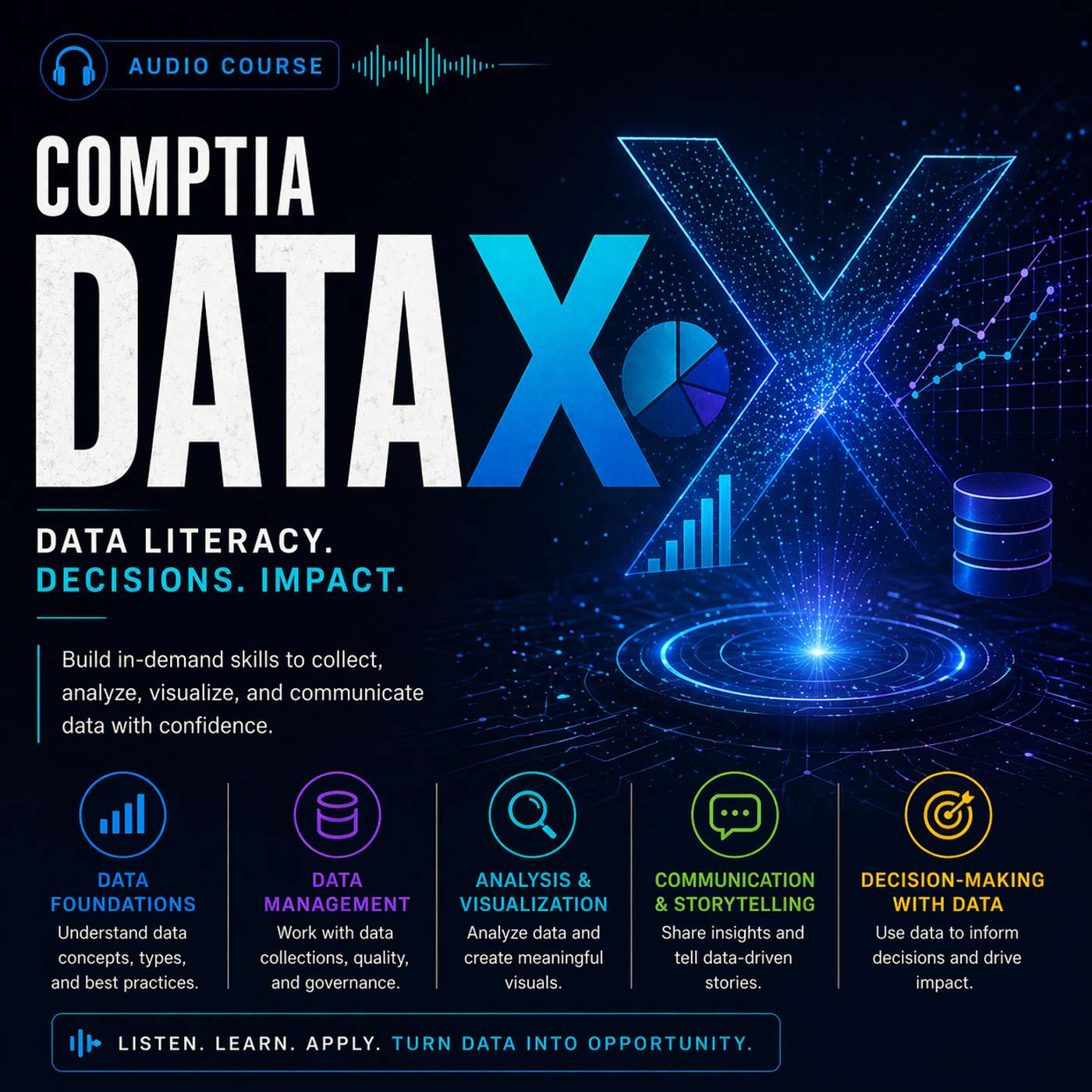
This DataX DY0-001 PrepCast is an exam-focused, audio-first course designed to train analytical judgment rather than rote memorization, guiding you through the full scope of the CompTIA DataX exam exactly the way the test expects you to think. The course builds from statistical and mathematical foundations into exploratory analysis, feature design, modeling, machine learning, and business integration, with each episode reinforcing how to interpret scenarios, recognize constraints, select defensible methods, and avoid common traps such as leakage, metric misuse, and misaligned objectives. Conce...
Where to listen?
Podcasts in the app Replaio Radio Coming soonPodcasts are coming to the app soon. Install now and be the first to see a whole new take on podcasts
 Install for free
Android 5M+ downloads · 4.8 rating
iOS soon
Install for free
Android 5M+ downloads · 4.8 rating
iOS soon
Episodes
Episode 20 — Bayes’ Rule in Plain English: Updating Beliefs With Evidence 24.01.2026 19:36
This episode explains Bayes’ Rule as a practical updating framework, focusing on the plain-English meaning that DataX scenarios typically test: how new evidence should change your belief about a hypothesis, especially when base rates are not intuitive. You will define prior probability as what you believe before seeing new evidence, likelihood as how compatible the evidence is with each hypothesis...
Episode 19 — Probability Essentials: Events, Conditional Probability, and Independence 24.01.2026 19:42
This episode builds the probability fundamentals you need for DataX, emphasizing how to translate scenario language into event logic, how to reason about conditional probability, and how to recognize when independence is a safe assumption versus a dangerous shortcut. You will define an event as an outcome or set of outcomes and learn to interpret common operations like “and,” “or,” and “not” as in...
Episode 18 — Law of Large Numbers: Stability, Variance, and Practical Implications 24.01.2026 19:39
This episode clarifies the Law of Large Numbers as a convergence principle that supports many data science practices, and it equips you to recognize when “more data” helps and when it does not solve the underlying problem, which is a subtle but testable DataX idea. You will define the LLN as the tendency for sample averages to converge toward the expected value as the number of observations increa...
Episode 17 — Central Limit Theorem: Why Averages Behave and When They Don’t 24.01.2026 19:20
This episode teaches the Central Limit Theorem as a practical intuition you will use for interpreting estimates, confidence intervals, and hypothesis tests across DataX scenarios, especially when the underlying data is messy. You will define the CLT in applied terms: when you take sufficiently large random samples, the distribution of the sample mean tends to look approximately normal, even if the...
Episode 16 — Model Comparison Criteria: AIC, BIC, and Parsimony Without Hand-Waving 24.01.2026 20:20
This episode explains model comparison through information criteria, focusing on how AIC and BIC operationalize the idea that a model should fit well without being needlessly complex, which is a decision pattern the DataX exam frequently tests. You will define parsimony as preferring the simplest model that adequately explains the data, then connect that to the risk of overfitting, inflated confid...
Episode 15 — Thresholding and Tradeoffs: ROC Curves, AUC, and Operating Points 24.01.2026 19:18
This episode teaches thresholding as a control mechanism for classification systems, which is a recurring DataX theme because many scenarios are really asking you to pick an operating point that aligns model behavior to business outcomes. You will learn to distinguish between a model’s ranking ability and a specific decision threshold, and you’ll define ROC thinking as comparing true positive rate...
Episode 14 — Precision, Recall, F1, and When Accuracy Lies 24.01.2026 19:10
This episode deepens classification metric selection by focusing on precision, recall, and F1, and by explaining when accuracy becomes a deceptive summary that leads to the wrong decision. You will define precision as the fraction of predicted positives that are truly positive and recall as the fraction of true positives that the model successfully captures, then connect each to different operatio...
Episode 13 — Classification Evaluation: Confusion Matrix Thinking Under Pressure 24.01.2026 20:08
This episode builds your ability to reason through classification evaluation using the confusion matrix as the mental model, because DataX commonly tests whether you can connect business risk to the right metric and threshold behavior. You will define the four outcomes—true positives, false positives, true negatives, and false negatives—and practice mapping them to scenario language such as “misse...
Episode 12 — Regression Evaluation: R², Adjusted R², RMSE, and Residual Intuition 24.01.2026 19:56
This episode teaches how the exam expects you to evaluate regression models: not by memorizing metric names, but by understanding what each metric emphasizes and how to detect problems using residual thinking. You will define R² as the fraction of variance explained by the model in the observed data and explain why it can be misleading when you add features, when the relationship is nonlinear, or...
Episode 11 — Correlation and Association: Pearson vs Spearman vs “No Relationship” 24.01.2026 19:03
This episode explains correlation and association in a way that helps you avoid common exam mistakes, especially confusing correlation strength with causation, and choosing the wrong correlation measure for the data. You will define correlation as a measure of relationship between two variables, then separate linear correlation from monotonic association, which is the key distinction behind Pearso...
Episode 10 — Selecting Tests: t-Test vs Chi-Squared vs ANOVA in Scenarios 24.01.2026 19:15
This episode gives you a scenario-driven method for choosing among common statistical tests the exam expects you to recognize, focusing on what each test answers and what data conditions make it appropriate. You will learn to classify questions by outcome type and comparison structure: means versus proportions, two groups versus multiple groups, independent samples versus paired measurements, and...
Episode 9 — Confidence Intervals: Interpretation, Width, and Common Traps 24.01.2026 18:15
This episode teaches confidence intervals as an estimation tool, emphasizing interpretation and decision use rather than formula memorization, because DataX questions often test whether you understand what intervals do and do not claim. You will define a confidence interval as a range of plausible values for an unknown parameter based on sample data and a chosen confidence level, and you’ll learn...
Episode 8 — Type I vs Type II Errors and Why Power Matters in Decisions 24.01.2026 18:59
This episode explains error types and statistical power as decision tradeoffs, which is exactly how the DataX exam tends to frame them: not as memorized definitions, but as consequences you must manage in a scenario. You will define a Type I error as rejecting a true null hypothesis, often framed as a false positive, and a Type II error as failing to reject a false null, often framed as a false ne...
Episode 7 — Hypothesis Testing Basics: Null, Alternative, and What p-Values Really Mean 24.01.2026 18:20
This episode builds the hypothesis testing vocabulary and decision logic that appears repeatedly in DataX questions, especially when you must justify whether an observed effect is likely to be real or just sampling noise. You will define the null hypothesis as the default claim of no effect or no difference, and the alternative hypothesis as the claim you are evaluating evidence for, then you’ll c...
Episode 6 — Statistical Foundations: Populations, Samples, Parameters, and Estimates 24.01.2026 17:19
This episode refreshes the statistical foundation that DataX scenarios assume you can use fluently: the distinction between populations and samples, what parameters represent, and how estimates are constructed and interpreted under uncertainty. You will define a population as the full target set you care about and a sample as the subset you actually observe, then connect that gap to why inference...
Episode 5 — The Data Science Lifecycle at Exam Level: From Problem to Production 24.01.2026 18:07
This episode covers the data science lifecycle as the exam expects you to understand it: an end-to-end sequence from defining the problem through deployment and ongoing monitoring, with clear responsibilities and failure points at each stage. You will define the lifecycle phases in practical terms—requirements and success criteria, data acquisition and understanding, exploratory analysis, feature...
Episode 4 — Performance-Based Questions in Audio: How to Think Without a Keyboard 24.01.2026 16:41
This episode prepares you for performance-based questions by teaching an internal, stepwise problem-solving method that works without typing, tooling, or visual aids. You will learn to treat PBQs as structured tasks that test process: identify inputs, determine the transformation or decision needed, anticipate the output, and validate that the result meets constraints such as correctness, robustne...
Episode 3 — Reading the Prompt Like an Analyst: Keywords, Constraints, and “Best Next Step” 24.01.2026 18:05
This episode builds the analyst mindset for reading DataX prompts: extracting decision-driving keywords, honoring constraints, and selecting the best next step rather than the most impressive technique. You will define what counts as a constraint in exam terms—limited labels, incomplete history, high false-negative cost, latency requirements, privacy restrictions, shifting distributions, or the ne...
Episode 2 — How CompTIA DataX Questions Are Built and What They Reward 24.01.2026 16:03
This episode explains the mechanics behind CompTIA DataX question design so you can target what the exam actually rewards: disciplined interpretation, defensible tradeoffs, and correct method selection under constraints. You will learn to spot the parts of a prompt that carry scoring weight—business goal, data conditions, operational limitations, and the evaluation metric being implied—so you don’...
Episode 1 — Welcome to DataX DY0-001 and How This Audio Course Works 24.01.2026 16:22
This episode orients you to the DataX DY0-001 exam and sets the operational approach for learning complex analytics and machine learning concepts through audio only. You will define what “exam readiness” means in this context: recognizing vocabulary precisely, mapping scenarios to the right technique, and defending choices using constraints the question provides rather than personal preference. We...
Welcome to the DataX Audio Course 24.01.2026 1:08
If you are preparing for the CompTIA DataX DY0-001 exam, welcome to the DataX PrepCast, an audio first course built to train how the exam actually thinks by teaching you to read prompts like an analyst, spot keywords and constraints quickly, eliminate distractors, and choose the best next step with confidence; across the series we cover the full DataX scope including statistics and probability, ED...
Similar podcasts







Listen to the Certified: The CompTIA DataX Audio Course podcast in Replaio
Radio and podcasts in one app - free, with no sign-up. Install today and do not miss the launch
Replaio is not a podcast publisher; show names, artwork and audio belong to their authors and are distributed through public RSS feeds.