Oliver Ashford
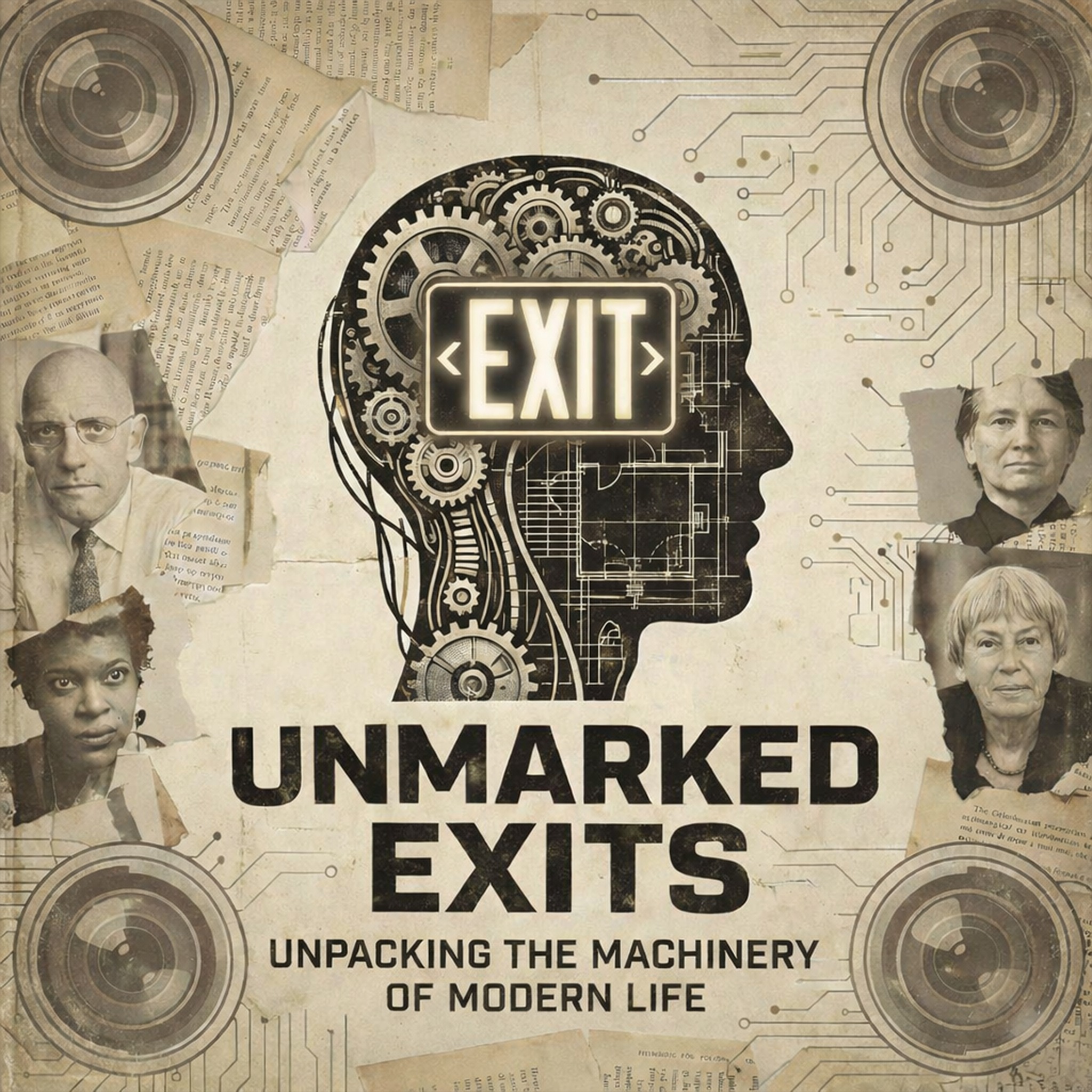
Unmarked Exits
The ideas that shape how you think, work, and consume weren't accidents. They were designed. Each episode unpacks one essential text from critical theory, philosophy, fiction, and media studies that reveals how power really operates. No jargon. No academic gatekeeping. Just genuine inquiry into the forces shaping modern life. We're exploring thinkers like Guy Debord, Michel Foucault, Naomi Klein, and Mark Fisher alongside fiction from Ursula K. Le Guin, Kurt Vonnegut, and Octavia Butler. Some of these works are decades old. All of them feel uncomfortably relevant. This isn't about telling you...
Koniecznie odwiedź stronę podcastu i wesprzyj twórcę: redcircle.com
Gdzie słuchać?
Podcasty w aplikacji Replaio Radio Już wkrótcePodcasty trafią do aplikacji już wkrótce. Zainstaluj teraz i jako pierwszy zobacz nowe podejście do podcastów
 Zainstaluj za darmo
Android prawie 10 mln pobrań · ocena 4,8
iOS niedługo
Zainstaluj za darmo
Android prawie 10 mln pobrań · ocena 4,8
iOS niedługo
Odcinki
S03 E39: Eichmann in Jerusalem: Bureaucracy and the Banality of Evil 28.09.2026 44:48
Adolf Eichmann helped orchestrate the Holocaust. When he was finally captured and tried in Jerusalem, he seemed… ordinary. Boring. A bureaucrat who spoke in clichés. In this episode, we explore Hannah Arendt’s controversial report on the trial and her concept of “the banality of evil.” Eichmann wasn’t a monster or a fanatic. He was a careerist who didn’t think about what he was doing. The evil he...
S03 E38: Obedience to Authority: The Experiment That Revealed Our Capacity for Harm 21.09.2026 53:05
How many people would deliver painful electric shocks to a stranger just because an authority figure told them to? In this episode, we explore Stanley Milgram’s famous, and controversial, experiments on obedience. Participants were instructed to administer escalating shocks to a learner who gave wrong answers. The shocks weren’t real. But the participants didn’t know that, and most delivered what...
S03 E37: The Power of the Powerless: Living in Truth Under Post-Totalitarianism 14.09.2026 50:13
A greengrocer puts a sign in his window: “Workers of the world, unite!” He doesn’t believe it. Nobody believes it. Everybody knows nobody believes it. But the sign stays up. Why? In this episode, we explore Havel’s essay on how totalitarian systems maintain themselves not through true believers but through ritual compliance. The greengrocer isn’t expressing conviction. He’s signalling that he will...
S03 E36: Player Piano: Automation, Dignity, and the Horror of Uselessness 07.09.2026 43:05
What happens when machines can do everything better than humans? Not unemployment exactly. There will always be make-work. But something worse: the knowledge that you’re not needed. In this episode, we explore Vonnegut’s first novel, published in 1952 but describing our future. A society where engineers and managers live in comfort while everyone else is assigned to the army or public works. Not b...
S03 E35: Escape from Freedom: The Psychological Appeal of Authoritarianism 31.08.2026 49:57
Freedom should feel good. So why do so many people run from it into the arms of authoritarianism? In this episode, we explore Erich Fromm’s psychological study of fascism, written in 1941, trying to understand how Germany happened. His answer: modern life gives us freedom but also isolation, anxiety, powerlessness. Faced with the burden of self-determination, many people would rather surrender to...
S03 E34: The Technological Society: Technique as Autonomous Force 24.08.2026 49:37
Technology isn’t just machines. It’s a way of thinking: the relentless pursuit of the most efficient means. And this way of thinking, Ellul argues, has become autonomous. It no longer serves human ends. We serve it. In this episode, we explore Ellul’s prophetic 1954 work on technique: his term for the totality of methods rationally arrived at for efficiency in every field of human activity. Techni...
S03 E33: Discipline and Punish: The Panopticon and the Production of Docile Bodies 17.08.2026 37:57
Prisons seem obvious: you do something wrong, you get locked up. But prisons as we know them are only about 200 years old. Before that, punishment was public spectacle: torture, execution, branding. What changed? In this episode, we explore Foucault’s history of how modern society learned to produce “docile bodies.” The prison isn’t just a building. It’s a model. The same principles of surveillanc...
S03 E32: Technological Rationality and the Mechanics of Social Conformity 10.08.2026 41:53
We think of technology as neutral. Just tools we choose to use. But what if the logic of efficiency and standardisation has quietly reshaped how we think, work, and obey? In this episode, we explore Herbert Marcuse’s argument that modern society has traded critical thinking for compliance. Once, rationality meant questioning authority. Now it means fitting seamlessly into the machine. From the fac...
S02 E31: Four Arguments for the Elimination of Television: The Case Against the Medium Itself 27.07.2026 42:52
Most media criticism assumes television could be better. What if television, as a technology, is inherently destructive? What if the only solution is elimination? In this episode, we explore Jerry Mander's radical argument: four interconnected cases against the medium itself. Not bad programmes, but the medium. He argues that television colonizes experience, replaces reality with images, centr...
S02 E30: How to Do Nothing: Resisting the Attention Economy 20.07.2026 48:12
Your attention is the product. Every app, every platform, every notification is designed to capture and extract it. So what would it mean to do nothing? In this episode, we explore Jenny Odell's meditation on attention, place, and resistance. Doing nothing isn't passivity. It's refusal. It's looking at the bird instead of the phone. It's insisting on a self that can't be op...
S02 E29: The Circle: Transparency, Connection, and the New Totalitarianism 14.07.2026 41:04
What if surveillance wasn't imposed on you? What if you demanded it? What if total transparency felt like freedom? In this episode, we explore Eggers' novel about a young woman who joins a tech company that combines the worst aspects of Google, Facebook, and a cult. The Circle's motto: "Secrets are lies. Sharing is caring. Privacy is theft." The horror of The Circle isn't t...
S02 E28: White Noise: Death, Consumerism, and the Background Hum of Modern Life 06.07.2026 41:29
The white noise is always there: the hum of appliances, the murmur of television, the constant low-frequency buzz of modern life. What if that noise is the sound of contemporary existence itself? In this episode, we explore DeLillo's novel about a professor of Hitler studies, his blended family, and an "airborne toxic event" that forces them to confront mortality. Except mortality is i...
S02 E27: Eight O'Clock in the Morning: Obey, Consume, Sleep 29.06.2026 35:59
A man wakes up and discovers that the world is run by aliens. They're everywhere: politicians, police, executives. They control humanity through subliminal messages in advertisements: OBEY. CONSUME. SLEEP. In this episode, we explore Ray Nelson's 1963 short story that John Carpenter later adapted into the cult film They Live. It's pulp science fiction with a sharp political edge. The a...
S02 E26: Network: The Prophecy of News as Entertainment 22.06.2026 51:18
"I'm mad as hell, and I'm not going to take it anymore!" In this episode, we explore Paddy Chayefsky's screenplay for Network: a satire about a news anchor who has a breakdown on air and is transformed into an entertainment phenomenon. The network doesn't cancel him. They exploit him. Made in 1976, it was dismissed as over-the-top. Now it looks like understatement. Reality...
S02 E25: The Image: Pseudo-Events and the Menace of Unreality 15.06.2026 52:26
What's the difference between a news event and a pseudo-event? A news event happens. A pseudo-event is staged to be reported. In this episode, we explore Boorstin's 1962 study of how American life became increasingly dominated by manufactured reality. Press conferences, celebrity culture, tourist attractions, political campaigns: all designed not to be experiences but to be images of exper...
S02 E24: Mythologies: Decoding the Hidden Meanings of Everyday Life 08.06.2026 45:18
A wrestling match is fake, and everyone knows it. So why do people watch? Because it's not about athletic competition. It's about the spectacle of justice, performed in exaggerated bodies. In this episode, we explore Barthes' collection of short essays decoding French popular culture: wrestling, steak and chips, soap advertisements, plastic, the face of Greta Garbo. Each essay peels ba...
S02 E23: No Logo: Brands, Sweatshops, and the Colonization of Public Space 01.06.2026 49:24
There was a time when companies made products. Then they discovered it was more profitable to make brands. Products can be manufactured anywhere. Brands are pure image. In this episode, we explore Naomi Klein's landmark study of how corporations colonized public space, culture, and identity itself. Nike doesn't sell shoes. It sells the idea of athletic transcendence. Starbucks doesn't...
S02 E22: The Work of Art in the Age of Mechanical Reproduction: Aura and Its Dissolution 25.05.2026 42:12
What makes an original artwork special? Something Benjamin called "aura": its unique presence in time and space, its unrepeatable existence. But what happens when perfect copies become possible? In this episode, we explore Benjamin's famous essay on how photography and film changed art forever. Reproduction destroys aura, but it also democratizes access. Art leaves the realm of ritua...
S02 E21: Amusing Ourselves to Death: Public Discourse in the Age of Show Business 18.05.2026 57:46
Orwell feared the banning of books. Huxley feared there would be no reason to ban them. Postman argues Huxley was right. In this episode, we explore how television changed not just what we think about, but how we think. Postman's argument isn't that TV shows bad content. It's that television as a medium is structurally incapable of supporting serious discourse. Everything becomes enter...
S02 E21: Amusing Ourselves to Death: Public Discourse in the Age of Show Business 18.05.2026 57:46
Orwell feared the banning of books. Huxley feared there would be no reason to ban them. Postman argues Huxley was right. In this episode, we explore how television changed not just what we think about, but how we think. Postman's argument isn't that TV shows bad content. It's that television as a medium is structurally incapable of supporting serious discourse. Everything becomes enter...
S02 E20: Understanding Media: The Extensions of Man and the Reshaping of Thought 11.05.2026 45:36
"The medium is the message." You've heard the phrase. But what does it actually mean? In this episode, we explore McLuhan's provocative, chaotic, often contradictory masterwork. His argument: we focus too much on what media contain and miss how they reshape us. Television didn't just broadcast new content. It rewired how people think, feel, and relate. McLuhan saw the internet...
S02 E19: Ways of Seeing: The Politics of the Visual and the Male Gaze 04.05.2026 52:13
Before you can critique what images show, you have to understand how seeing works. And seeing is never neutral. In this episode, we explore John Berger's revolutionary series of essays, originally a BBC programme, that changed how we think about art, advertising, and visual culture. Berger shows how oil painting served property relations, how publicity images manipulate our sense of lack, and...
S02 E18: The Era of Simulacra and the Hyperreal Order 27.04.2026 55:29
What if there is no reality behind the images? What if the copy has replaced the original so completely that asking what's "real" has become meaningless? In this episode, we explore Baudrillard's most famous work: the book Neo carries in The Matrix, hollowed out to hide contraband. Appropriate, since Baudrillard argues we're all living in something like the Matrix, except there...
S02 E17: The Society of the Spectacle: Life Reduced to Representation 20.04.2026 52:14
"All that once was directly lived has become mere representation." Debord wrote that in 1967. Every year since, it has become more true. In this episode, we explore The Society of the Spectacle: a book that predicted Instagram, reality television, and political theatre decades before they existed. Debord argues that modern society has replaced lived experience with its representation. We d...
S02 E16: The Culture Industry: Enlightenment as Mass Deception 13.04.2026 41:16
Welcome to season two of Unmarked Exits: The Image World. This season, we're exploring spectacle, media, and the construction of reality itself. You think you're relaxing when you watch a film, listen to music, or scroll through content. But what if entertainment is work: the work of adjusting you to the system? In this episode, we explore Adorno and Horkheimer's devastating critique o...
Podobne podcasty



Słuchaj podcastu Unmarked Exits w Replaio
Radio i podcasty w jednej aplikacji - za darmo, bez zakładania konta. Zainstaluj już dziś i nie przegap premiery
Replaio nie jest wydawcą podcastów; nazwy audycji, okładki i audio należą do ich autorów i są rozpowszechniane przez publiczne kanały RSS