Oliver Ashford
Unmarked Exits
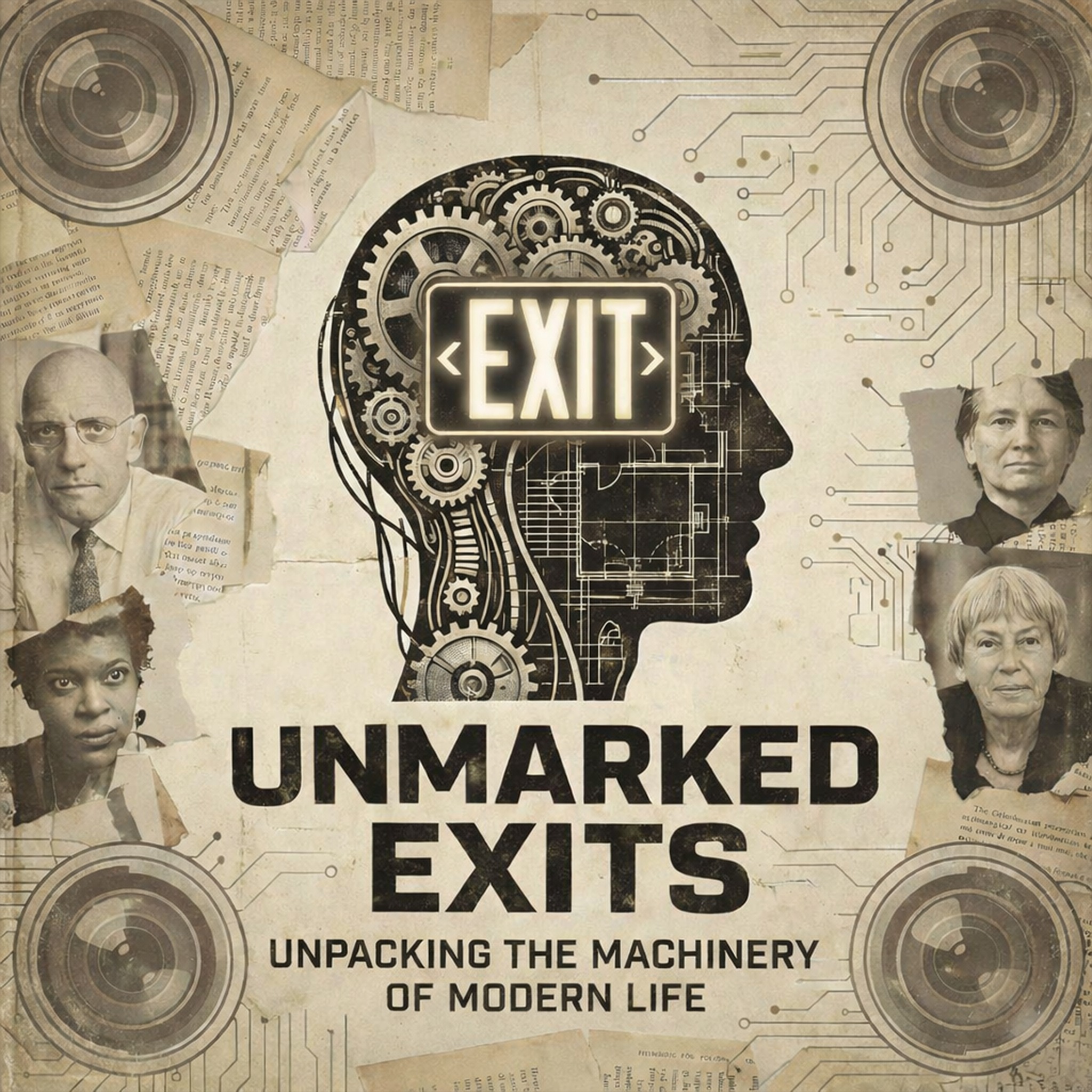
The ideas that shape how you think, work, and consume weren't accidents. They were designed. Each episode unpacks one essential text from critical theory, philosophy, fiction, and media studies that reveals how power really operates. No jargon. No academic gatekeeping. Just genuine inquiry into the forces shaping modern life. We're exploring thinkers like Guy Debord, Michel Foucault, Naomi Klein, and Mark Fisher alongside fiction from Ursula K. Le Guin, Kurt Vonnegut, and Octavia Butler. Some of these works are decades old. All of them feel uncomfortably relevant. This isn't about telling you...
Be sure to visit the podcast's website and support the creator: redcircle.com
Where to listen?
Podcasts in the app Replaio Radio Coming soonPodcasts are coming to the app soon. Install now and be the first to see a whole new take on podcasts
 Install for free
Android almost 10M downloads · 4.8 rating
iOS soon
Install for free
Android almost 10M downloads · 4.8 rating
iOS soon
Episodes
S02 E28: White Noise: Death, Consumerism, and the Background Hum of Modern Life 06.07.2026 41:29
The white noise is always there: the hum of appliances, the murmur of television, the constant low-frequency buzz of modern life. What if that noise is the sound of contemporary existence itself? In this episode, we explore DeLillo's novel about a professor of Hitler studies, his blended family, and an "airborne toxic event" that forces them to confront mortality. Except mortality is i...
S02 E27: Eight O'Clock in the Morning: Obey, Consume, Sleep 29.06.2026 35:59
A man wakes up and discovers that the world is run by aliens. They're everywhere: politicians, police, executives. They control humanity through subliminal messages in advertisements: OBEY. CONSUME. SLEEP. In this episode, we explore Ray Nelson's 1963 short story that John Carpenter later adapted into the cult film They Live. It's pulp science fiction with a sharp political edge. The a...
S02 E26: Network: The Prophecy of News as Entertainment 22.06.2026 51:18
"I'm mad as hell, and I'm not going to take it anymore!" In this episode, we explore Paddy Chayefsky's screenplay for Network: a satire about a news anchor who has a breakdown on air and is transformed into an entertainment phenomenon. The network doesn't cancel him. They exploit him. Made in 1976, it was dismissed as over-the-top. Now it looks like understatement. Reality...
S02 E25: The Image: Pseudo-Events and the Menace of Unreality 15.06.2026 52:26
What's the difference between a news event and a pseudo-event? A news event happens. A pseudo-event is staged to be reported. In this episode, we explore Boorstin's 1962 study of how American life became increasingly dominated by manufactured reality. Press conferences, celebrity culture, tourist attractions, political campaigns: all designed not to be experiences but to be images of exper...
S02 E24: Mythologies: Decoding the Hidden Meanings of Everyday Life 08.06.2026 45:18
A wrestling match is fake, and everyone knows it. So why do people watch? Because it's not about athletic competition. It's about the spectacle of justice, performed in exaggerated bodies. In this episode, we explore Barthes' collection of short essays decoding French popular culture: wrestling, steak and chips, soap advertisements, plastic, the face of Greta Garbo. Each essay peels ba...
S02 E23: No Logo: Brands, Sweatshops, and the Colonization of Public Space 01.06.2026 49:24
There was a time when companies made products. Then they discovered it was more profitable to make brands. Products can be manufactured anywhere. Brands are pure image. In this episode, we explore Naomi Klein's landmark study of how corporations colonized public space, culture, and identity itself. Nike doesn't sell shoes. It sells the idea of athletic transcendence. Starbucks doesn't...
S02 E22: The Work of Art in the Age of Mechanical Reproduction: Aura and Its Dissolution 25.05.2026 42:12
What makes an original artwork special? Something Benjamin called "aura": its unique presence in time and space, its unrepeatable existence. But what happens when perfect copies become possible? In this episode, we explore Benjamin's famous essay on how photography and film changed art forever. Reproduction destroys aura, but it also democratizes access. Art leaves the realm of ritua...
S02 E21: Amusing Ourselves to Death: Public Discourse in the Age of Show Business 18.05.2026 57:46
Orwell feared the banning of books. Huxley feared there would be no reason to ban them. Postman argues Huxley was right. In this episode, we explore how television changed not just what we think about, but how we think. Postman's argument isn't that TV shows bad content. It's that television as a medium is structurally incapable of supporting serious discourse. Everything becomes enter...
S02 E21: Amusing Ourselves to Death: Public Discourse in the Age of Show Business 18.05.2026 57:46
Orwell feared the banning of books. Huxley feared there would be no reason to ban them. Postman argues Huxley was right. In this episode, we explore how television changed not just what we think about, but how we think. Postman's argument isn't that TV shows bad content. It's that television as a medium is structurally incapable of supporting serious discourse. Everything becomes enter...
S02 E20: Understanding Media: The Extensions of Man and the Reshaping of Thought 11.05.2026 45:36
"The medium is the message." You've heard the phrase. But what does it actually mean? In this episode, we explore McLuhan's provocative, chaotic, often contradictory masterwork. His argument: we focus too much on what media contain and miss how they reshape us. Television didn't just broadcast new content. It rewired how people think, feel, and relate. McLuhan saw the internet...
S02 E19: Ways of Seeing: The Politics of the Visual and the Male Gaze 04.05.2026 52:13
Before you can critique what images show, you have to understand how seeing works. And seeing is never neutral. In this episode, we explore John Berger's revolutionary series of essays, originally a BBC programme, that changed how we think about art, advertising, and visual culture. Berger shows how oil painting served property relations, how publicity images manipulate our sense of lack, and...
S02 E18: The Era of Simulacra and the Hyperreal Order 27.04.2026 55:29
What if there is no reality behind the images? What if the copy has replaced the original so completely that asking what's "real" has become meaningless? In this episode, we explore Baudrillard's most famous work: the book Neo carries in The Matrix, hollowed out to hide contraband. Appropriate, since Baudrillard argues we're all living in something like the Matrix, except there...
S02 E17: The Society of the Spectacle: Life Reduced to Representation 20.04.2026 52:14
"All that once was directly lived has become mere representation." Debord wrote that in 1967. Every year since, it has become more true. In this episode, we explore The Society of the Spectacle: a book that predicted Instagram, reality television, and political theatre decades before they existed. Debord argues that modern society has replaced lived experience with its representation. We d...
S02 E16: The Culture Industry: Enlightenment as Mass Deception 13.04.2026 41:16
Welcome to season two of Unmarked Exits: The Image World. This season, we're exploring spectacle, media, and the construction of reality itself. You think you're relaxing when you watch a film, listen to music, or scroll through content. But what if entertainment is work: the work of adjusting you to the system? In this episode, we explore Adorno and Horkheimer's devastating critique o...
S01 E15: The Power of Nightmares: Politics in the Age of Fear 06.04.2026 58:10
What happens when politicians can no longer promise a better future? They promise to protect you from a terrifying one. In this episode, we explore Adam Curtis's documentary series: a history of how fear became the dominant currency of politics in both the West and the Middle East. How neoconservatives and radical Islamists, despite opposing each other, both rose to power by abandoning positiv...
S01 E14: It Can't Happen Here: American Fascism and the Comfort of Denial 30.03.2026 34:16
"When fascism comes to America, it will be wrapped in the flag and carrying a cross." Lewis probably never said exactly that, but he wrote an entire novel exploring the idea. In this episode, we explore It Can't Happen Here: a 1935 novel about a populist demagogue who wins the American presidency on a platform of traditional values and promises to make the country great again. What fol...
S01 E13: Flat Earth News: Churnalism and the Collapse of Verification 23.03.2026 57:09
What if most of what you read in newspapers was never checked by journalists at all? In this episode, we explore Nick Davies' investigative study of modern British media: a system he calls "churnalism." Understaffed newsrooms, wire copy published as original reporting, PR firms feeding stories directly to papers. Journalism without journalism. Davies isn't making a political argume...
S01 E12: Media Control: The Necessary Illusions of Democratic Society 16.03.2026 52:42
Democratic societies face a problem: you can't control people by force, so you have to control them by opinion. And it turns out democratic propaganda is more sophisticated than anything a dictator could devise. In this episode, we explore Chomsky's short, accessible overview of how public relations, media management, and political spectacle work together to manufacture consent. From Woodr...
S01 E11: The True Believer: Mass Movements and the Escape from the Self 09.03.2026 28:03
Who joins mass movements? Not the successful, not the satisfied, not those with a stake in the present. The true believer is someone who has lost faith in themselves. In this episode, we explore Eric Hoffer's study of fanaticism, written by a longshoreman who watched the rise of fascism and communism with equal alarm. Hoffer argues that the content of a movement matters less than its form. Wha...
S01 E10: Inventing Reality: The Politics of the Mass Media 02.03.2026 34:15
If the news told you the truth about power, would power allow it to continue? In this episode, we explore Michael Parenti's systematic analysis of American media: how it frames issues, which voices it includes, and more importantly, which questions it never thinks to ask. Parenti isn't interested in individual bias. He's interested in structural bias: the ownership patterns, the advert...
S01 E09: Brave New World: Oppression Perfected Through Pleasure 23.02.2026 26:26
Orwell warned of a boot stamping on a human face forever. Huxley warned of something more unsettling: what if people came to love their oppression? In this episode, we explore Brave New World: a society where control operates through pleasure, not pain. Genetic engineering, conditioning, endless entertainment, and a drug called soma that makes unhappiness optional. There are no rebels because ther...
S01 E08: Newspeak, Doublethink, and the Politics of Language 16.02.2026 32:40
If you can corrupt language, you can corrupt thought. If you can corrupt thought, you can make people accept anything. In this episode, we pair Orwell's famous essay on political language with selections from Nineteen Eighty-Four. Not the surveillance state everyone remembers, but the linguistic project beneath it: Newspeak. A language designed to make dissent literally unspeakable. Orwell'...
S01 E07: Capitalist Realism: The Colonization of the Horizon 09.02.2026 39:00
It's easier to imagine the end of the world than the end of capitalism. That sentence captures something true about our moment. Not that people love the current system. But that alternatives feel unthinkable. In this episode, we explore Mark Fisher's short, sharp diagnosis of our ideological condition. Capitalist realism isn't enthusiasm for capitalism. It's the sense that there...
S01 E06: Public Opinion: The Pictures in Our Heads and Who Draws Them 02.02.2026 48:25
You've never been to most of the places you have opinions about. You've never met the politicians you vote for or against. Almost everything you think you know about the world, you know secondhand. In this episode, we explore Walter Lippmann's 1922 classic: an argument that democracy has a problem at its core. Citizens are supposed to make informed decisions, but the world is too big a...
S01 E05: Intellectuals, Hegemony, and the Italian State 26.01.2026 35:06
Force is expensive. You need soldiers, police, surveillance. But what if you could rule by making your worldview feel like common sense? What if the oppressed would police themselves? In this episode, we explore Antonio Gramsci's concept of hegemony, written in a fascist prison in the 1930s, smuggled out in fragments. Gramsci asked why revolution hadn't come to the West as Marx predicted....
Similar podcasts








Listen to the Unmarked Exits podcast in Replaio
Radio and podcasts in one app - free, with no sign-up. Install today and do not miss the launch
Replaio is not a podcast publisher; show names, artwork and audio belong to their authors and are distributed through public RSS feeds.