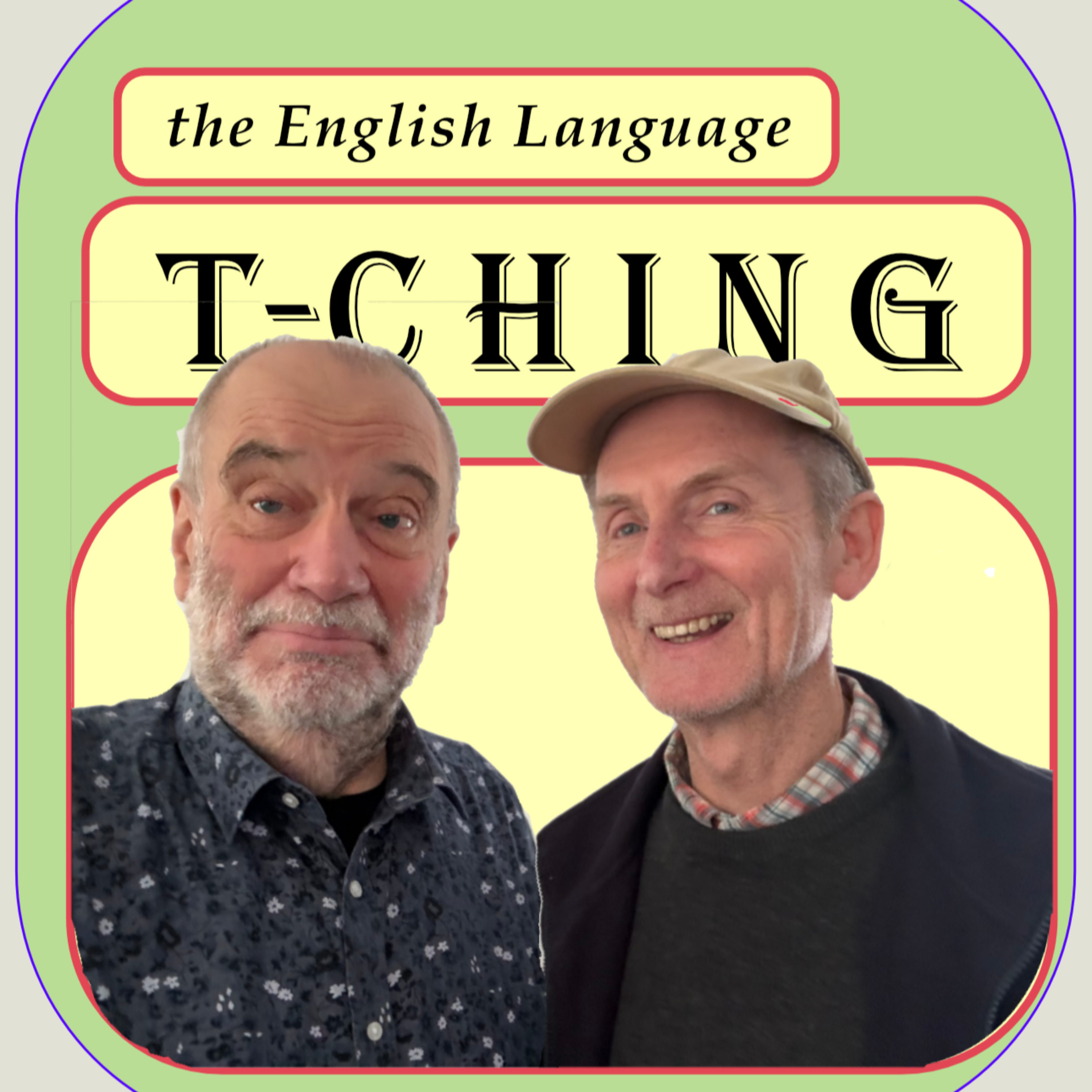
Adrian Underhill and Jim Scrivener
The English Language T-Ching
No lesson-plans. No aims. No exams. Just short lively chats about education, English language teaching, life, values … and any sideroads we discover along the way. Two teachers looking back and wondering what they may have learnt over the years? … or completely failed to learn …Adrian Underhill wrote Sound Foundations and created the Phonemic Chart. He's a past President of IATEFL. Jim Scrivener wrote Learning Teaching, Classroom Management Techniques, Teaching English Grammar and many other ELT books....We'd love your questions and comments: adrianandjimpodcast@gmail.com
Koniecznie odwiedź stronę podcastu i wesprzyj twórcę: podcasters.spotify.com
Autor
Adrian Underhill and Jim Scrivener
Kategoria
Strona podcastu
Ostatni odcinek
25 sie 2026
Gdzie słuchać?
Podcasty w aplikacji Replaio Radio Już wkrótcePodcasty trafią do aplikacji już wkrótce. Zainstaluj teraz i jako pierwszy zobacz nowe podejście do podcastów
 Zainstaluj za darmo
Android prawie 10 mln pobrań · ocena 4,8
iOS niedługo
Zainstaluj za darmo
Android prawie 10 mln pobrań · ocena 4,8
iOS niedługo
Odcinki
018 "Any Questions?" 25.08.2026 7:12
Adrian wonders if asking "Any Questions?" at the end of a stage or of the lesson is any use.
017 Learning the Teacher 11.08.2026 10:00
"There is more to be learned from any good teacherthan the subject taught.” Jim found this quote in a sci-fi novel (The Litany of theLong Sun by Gene Wolfe) and wonders what Adrian thinks of it. We discuss good (and bad) teachers we have known and wonder whether the main thing most children learn in a lesson is … the teacher.
016 Learner centred or LEARNING centred? 28.07.2026 10:30
Jim talks about some of the issues he raised in his IATEFL2026 talk, focussing on how “learner-centred” has been misunderstood and the potential for more “learning-centred” teaching. He also discusses how “upgrade” is a more powerful concept than “correct”. Jim gets over enthusiastic and Adrian hardly gets a word in!
015 Handwriting (not Keyboards) and Walking (not Sitting) 14.07.2026 8:42
Some recent research suggests that physical movement (e.g. writing by hand or walking around) actively helps us to learn and be more creative. We consider what the implications might be for our language classrooms. Should we be discouraging keyboard use? How can we “take a conversation for a walk”? Find out more about the walking research by googling: “Marily Oppezzo walking” Find out more about t...
014 Decline of the staffroom photocopier 30.06.2026 7:09
Should we mourn the lost age of ELT photocopying (and the even more ancient Roneo Gestetners)? Has the era of handout-driven teaching come to an end? Is “heads up” to an IWB better than “heads down” to a handout? Plus ... there’s a bit of nostalgia for the creativity of DIY handouts
013 "Pay attention, boy!" 16.06.2026 10:48
What do teachers think will happen when they say "Pay attention" to a learner? What does the learner have to do in order to "pay attention"? And what is attention anyway? How does it connect to "engagement" and "presence? If you have a question, suggestion or comment we'd love to hear from you. Write to: adrianandjimpodcast@gmail.com
012 Why don't chimps ask questions? Why don't students ask more? 02.06.2026 10:15
Recent interesting research about whale and chimp language starts us wondering about question asking and communication in the language classroom. Can whales have a conversation? What stops chimps asking questions? Does repetition still have a role to play?
011 Karate ... and the Politics of the Language Classroom 21.05.2026 9:37
What makes karate classes so different from language teaching lessons? What does this suggest about the value of learner-centredness, choice, decision-making and self-discipline? Should we approach different types of classroom subject in different ways? Who has the power in a classroom? Who decides the goals and the route? If you have a question, suggestion or comment we'd love to hear from yo...
010 Praise, Encouragement, Feedback and Power 11.05.2026 11:39
Adrian worries about whether he should have praised his four-and-a-half year old grandson's map-reading skills. He relates this to his own attitude to praise, encouragement and feedback in the classroom. Should we praise in class? Or does praising reduce the learner's ability to recognise and value their own achievements? If you have a question, suggestion or comment we'd love to hear...
009 Slow Learning 26.03.2026 8:47
What do we miss when we speed through our coursebook pages? Does a “fast lesson” reduce the quality of experience for teachers and learners? Is there time in our busy classrooms for “slow learning”? Could going slow actually be pacier and less boring than going fast? The article Adrian refers to is at: Slow learning - by Alexandra Mihai - The Educationalist If you have a question, suggestion or c...
008 Movement in ELT 09.03.2026 11:27
This episode we're following a suggestion from one of our listeners - Thanks, Elvira! We're looking at how much movement and physicality play a role in the ELT classroom. If you have a question, suggestion or comment we'd love to hear from you. Write to: adrianandjimpodcast@gmail.com
007 Intuition ... Morphic Resonance and a Supposition 28.01.2026 8:56
What is intuition? How can a student access it? Does intuition come from our store of previous experiences or might it be something more esoteric? Could intuition be tapping into some universal field? Might it be similar to Rupert Sheldrake's idea of Morphic Resonance? Even if these ideas are nuts, what would happen if we went into class as if they were true?
006 Consciousness ... Is language a "field"? 25.11.2025 10:04
Might consciousness be "non-local"? Why do some people seem to learn languages so easily? Could language be a "field" like gravity or magnetism?
005 Tidal Locking ... Helping students feel pronunciation ... Stress and unstress 11.11.2025 10:33
So why does the Moon always keep the same side to us? What didn't Adrian's French teacher do? How can you help learners sound much more like fluent speakers?
004 Planets ... Holding a space 28.10.2025 11:04
Can a day be longer than a year? What does Adrian mean by "holding a space" in lessons? How can learners and teacher be "busy together"?
003 Busyness ... Facilitation and Classroom Management 13.10.2025 10:58
Am I too "busy" in class? Does my "busyness" get in the way of learning? Is "facilitation" the same thing as "classroom management"?
002 Car Journeys ... Wholes, Bits and Practice 08.10.2025 13:11
Should we be teaching the language "bits" so that learners can put them together to express themselves or encourage them to express themselves and assist with the "bits" along the way? Can Adrian's car journey metaphor possible make it to the end of the podcast?
001 Shells ... Speaking from the heart 30.09.2025 9:32
Why has Adrian got a bag full of shells? How can a language learner express themselves in their new language? How does that fit in with all our coursebooks and exercises? ... We'd love to hear your questions and comments. Write to: adrianandjimpodcast@gmail.com
Podobne podcasty







Słuchaj podcastu The English Language T-Ching w Replaio
Radio i podcasty w jednej aplikacji - za darmo, bez zakładania konta. Zainstaluj już dziś i nie przegap premiery
Replaio nie jest wydawcą podcastów; nazwy audycji, okładki i audio należą do ich autorów i są rozpowszechniane przez publiczne kanały RSS