Financial Times
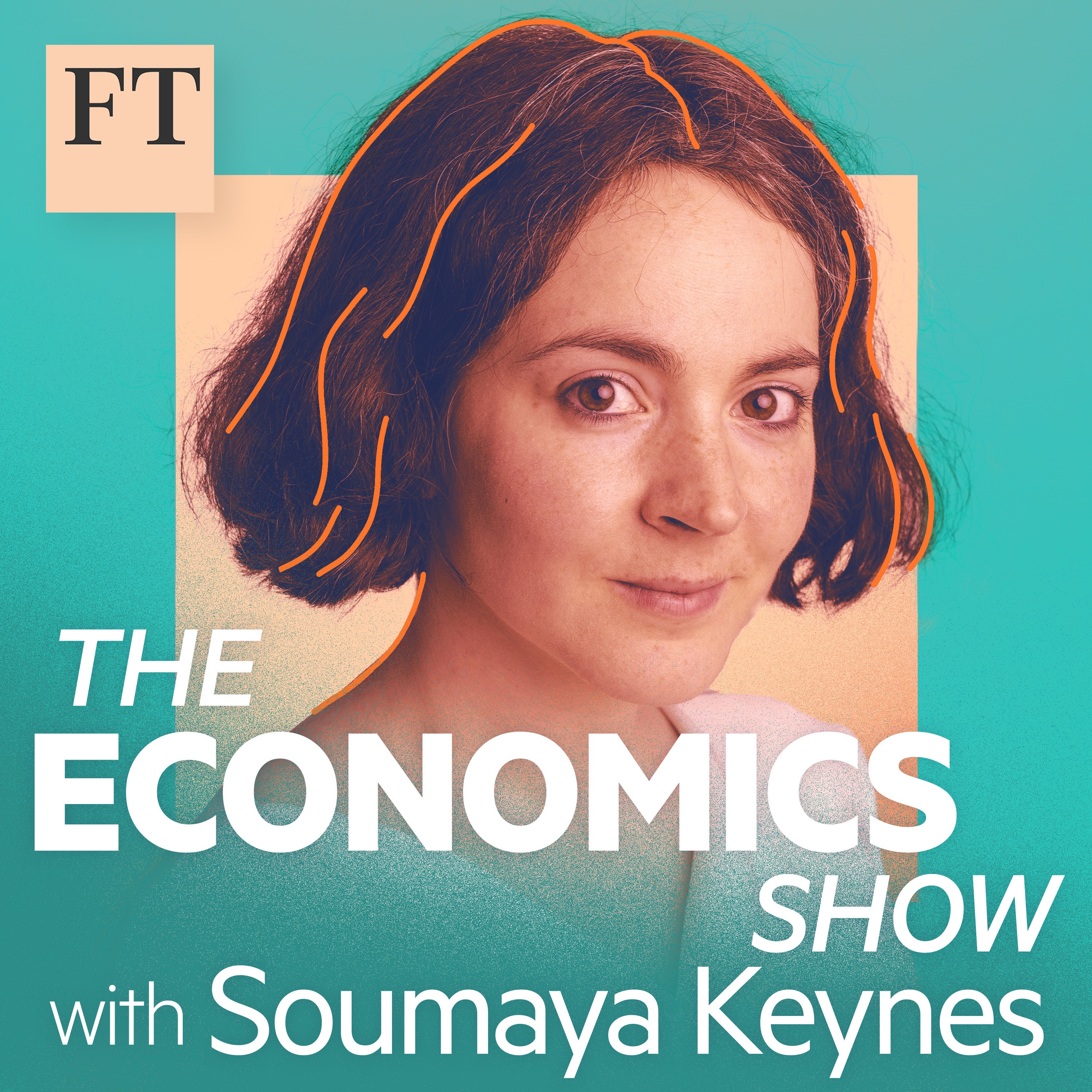
The Economics Show
The Economics Show with Soumaya Keynes is a new weekly podcast from the Financial Times packed full of smart, digestible analysis and incisive conversation. Soumaya Keynes digs deep into the hottest topics in economics along with a cast of FT colleagues and special guests. Come for the big ideas, stay for the nerdery. Soumaya Keynes is an economics columnist for the Financial Times. Prior to joining the FT she worked at The Economist for eight years as a staff writer, where as well as covering trade, the US economy and the UK economy she co-hosted the Money Talks podcast. She also co-founded t...
Koniecznie odwiedź stronę podcastu i wesprzyj twórcę: shows.acast.com
Autor
Financial Times
Kategoria
Strona podcastu
Ostatni odcinek
13 lis 2026
Gdzie słuchać?
Podcasty w aplikacji Replaio Radio Już wkrótcePodcasty trafią do aplikacji już wkrótce. Zainstaluj teraz i jako pierwszy zobacz nowe podejście do podcastów
 Zainstaluj za darmo
Android prawie 10 mln pobrań · ocena 4,7+
iOS niedługo
Odcinki
Europe’s AI story. With Philip Lane 13.11.2026 25:24
Europe is nowhere to be found in the AI story. As the US builds new models and crunches through chips, China provides competition and other Asian nations churn out hardware, Europe is often portrayed as a passive spectator. But is that right? Philip Lane, chief economist at the European Central Bank, joins host Soumaya Keynes to discuss. He tells us where the technology is already showing up in th...
Can economics fight fascism? With Isabella Weber 06.11.2026 34:50
Economist Isabella Weber grew up in Nuremberg, the German city where Adolf Hitler staged his vast Nazi rallies. Growing up in the shadow of that history helped shape her thinking about the relationship between economics and democracy. Now, with the cost of living dominating US politics and fuelling protests across Europe, Weber argues governments must do more to guarantee life's essentials rat...
The right way to tax the rich. With Owen Zidar 30.10.2026 33:27
What does it really take to get rich in America? Straight As at an elite university or entrepreneurial parents? And as America holds midterm elections and California votes on whether to tax billionaires on their wealth, what does it mean for the rich to be paying their fair share? Host Soumaya Keynes speaks to economist Owen Zidar, co-author of Everywhere Millionaire , Who Is Really Rich in Americ...
Why oil hasn’t ruined the global economy. With Rory Johnston 23.10.2026 29:14
Eight months ago, when the Iran war began, analysts worried that oil could go up to $200 per barrel. That’s a huge jump compared with about $70 before the conflict, and there were fears it would cause a huge shock to the global economy. Luckily, that hasn’t happened. But oil prices have been climbing again since July. Commentator and analyst Rory Johnston joins host Soumaya Keynes to talk through...
Lessons in communication for Kevin Warsh. With Chris Giles 16.10.2026 27:05
It is not a calm time in the markets. Investors are losing their cool while bond yields rise along with inflation. So where are central bankers? Offering words of calm? Or adding to the anxiety? The Fed’s Kevin Warsh has been telling people they need to look to the data, not to him. But is it that simple? The FT’s Chris Giles joins host Soumaya Keynes to talk through what makes for good central ba...
The EU vs China: it’s complicated. With Bernd Lange 09.10.2026 22:48
Europe has a China problem. Every single day, Europe buys a billion euros’ worth more stuff from China than it sells back. And the EU wants to stand up to Beijing over surging exports, which are challenging European industry. But China is also a vital market for European businesses and a crucial supplier of goods and raw materials. So how do you pick a trade fight with a country you depend on? Hos...
Why Big Tech wants more economists 02.10.2026 31:00
Tech companies are hiring economists to study how AI is reshaping work and society. But what happens when the companies building the technology also produce the research into its effects? Host Soumaya Keynes talks to Ara Kharazian, chief economist at Ramp and Peter McCrory chief economist at Anthropic, alongside FT data journalist John Burn-Murdoch, about why economists are in such demand, what pr...
How to be a middle power in a superpower world. With Jenny Bates 25.09.2026 31:15
The global economy is becoming increasingly hostile with tariffs, export controls and industrial policy being used as geopolitical weapons, while the world’s biggest powers compete for economic advantage. So where does that leave a middle power like Britain? Host Soumaya Keynes speaks to UK senior civil servant Jenny Bates, who’s just completed the Heywood Fellowship at Oxford university, where sh...
Can you spreadsheet your way to equal parenting? With Corinne Low 18.09.2026 27:25
Dads today are doing more childcare than previous generations, so why hasn’t the parenting gap between mothers and fathers disappeared? One reason: mums are doing more too. Host Soumaya Keynes talks to Corinne Low, associate professor at the University of Pennsylvania's Wharton School and author of 'Femonomics’ (titled ‘Having it all’ in the US), about what the data tells us about how couples divi...
Will US debt burst the AI bubble? With Ruchir Sharma 11.09.2026 27:21
Building data centres and running the US government have something in common: they cost a lot of money. Tech companies are borrowing heavily to fund the AI build out, just as Washington is borrowing vast sums to fund the US government, and those two borrowing binges may be on a collision course. Investors are already worried about America’s mounting debt burden and about whether the AI boom has be...
Memory chip mania isn’t going away, with Dan Kim 04.09.2026 32:16
In recent months, part of the chip market has been going bananas. Prices for memory chips – which AI data centres use in droves – have rocketed, as US tech companies lock in massive orders. That’s bad news for consumers facing more expensive electronic devices. But what are the broader consequences of misalignment in this market? How will the chip squeeze end? And, as memory chips become a strateg...
Kevin Warsh spoke — what did we learn? With Torsten Slok 29.08.2026 19:03
Federal Reserve chair Kevin Warsh took to the stage at Jackson Hole under pressure. Inflation is sticky, bond markets have been wobbling and his insistence on minimal Fed communication has been seen by some to make matters worse . Soumaya speaks to Torsten Slok, chief economist at Apollo Global Management, to discuss what Warsh did (and didn’t say), the changing relationship between the Fed and th...
From "The Story of Money": How a stock market crash gave birth to modern antisemitism 21.08.2026 50:21
The 1873 Gründerkrach, the spectacular stock market crash that followed Germany’s unification, is one of history’s great financial maelstroms. But its most enduring legacy isn’t about money. Host Robin Wigglesworth speaks to Pulitzer Prize-winning author Liaquat Ahamed about how the resulting economic malaise fuelled social division and transformed old prejudices into antisemitic conspiracy. It ga...
From "Trumponomics": Can the US Actually Tax Billionaires? 14.08.2026 24:12
As wealth becomes increasingly concentrated — and artificial intelligence threatens to shift even more income from workers to investors — has the US tax system become outdated? Stephanie Flanders speaks with Harvard professor Jason Furman, a former economic adviser to President Barack Obama, and Bloomberg reporter Caitlin Reilly about wealth taxes, capital gains, inheritance and whether taxing Ame...
How to break China’s chokehold on rare earths 07.08.2026 31:00
In the midst of the US-China trade conflict last year, Beijing unsheathed its fiercest weapon. By ramping up restrictions on exports of rare earth metals – crucial elements for high-tech manufacturing – China forced the US to climb down. That show of strength was a wake up call for the US. It has since spent huge sums backing mining companies, penned eye-catching deals and moved to collaborat...
Will AI solve the productivity puzzle? With Nick Bloom 31.07.2026 29:43
Productivity has been a problem for the past 15 years. In developed countries, weak demand, a lack of competition and a paucity of new ideas have all been blamed. Could AI finally reverse that trend? Soumaya speaks to Stanford economics professor Nick Bloom about why CFOs and CEOs expect AI to supercharge their businesses; how concentrated (or otherwise) the gains might be; and why working from ho...
Is China catching up with the US in AI? With Kyle Chan 24.07.2026 30:08
The US has long been the world’s undisputed leader in AI. Now, that lead looks under threat. Cutting-edge Chinese models such as Kimi K3 are proving almost as capable as leading American models; meanwhile, companies in the US and Europe are turning to cheap, efficient Chinese software from companies including DeepSeek and Z.ai in an attempt to curb high usage costs. As China takes strides – and Be...
The US-Iran war has not triggered a food crisis — yet. With Adam Hanieh and Susannah Savage 17.07.2026 27:13
When the US and Israel started bombing Iran earlier this year, market watchers eyed the oil markets nervously. But as the price of crude oil climbed, so did the price of another key commodity produced in the Gulf: fertiliser. Five months later, the world’s food system is looking better than feared, but as Adam Hanieh, director of the Middle East Institute at the School of Oriental and African Stud...
The economics of weight loss, with Rebecca Diamond and Claer Barrett 10.07.2026 29:18
In the western world, richer people tend to be thinner – especially women. But does wealth make people thin, or does being thin make them wealthy? And could the rise of weight-loss drugs such as Mounjaro and Wegovy give people – especially women – greater control over their economic outcomes? Soumaya speaks to Harvard professor Rebecca Diamond, the author of a new working paper that finds female u...
Why didn’t the Iran war cause a recession? With Tyler Goodspeed 03.07.2026 32:22
When Iran closed the Strait of Hormuz, economists were panicked. Several warned that a prolonged closure of the chokepoint could trigger a recession. After all, that’s what oil shocks do. But no recession came – even after oil prices jumped to almost twice their pre-war level. Why didn’t the global economy tumble into a recession – and are we out of the woods? Soumaya speaks to Tyler Goodspeed, au...
How to win at AI (if you’re not the US or China), with AI minister Kanishka Narayan 26.06.2026 39:37
When the US government banned a top AI lab from exporting its newest models, the world took notice. Export controls forbidding foreign access to Anthropic’s Mythos and Fable systems locked most of the world out of using this cutting-edge technology. As AI becomes more embedded in our daily lives, countries want to secure access to frontier models. But unless you’re the US or China, your country do...
China wanted western tech. Now, the tables have turned. With John Minnich 19.06.2026 42:47
For decades, China accelerated its industrial development through a straightforward bargain: foreign firms invested in China, often through joint ventures, gaining access to the enormous Chinese market, while Chinese companies absorbed western tech and knowhow. Today, that dynamic is changing. China's high-tech industries are now world-leading, and western governments are looking on enviously. So...
Brexit at 10: What comes next? With Anand Menon 12.06.2026 29:47
Just before the UK voted to leave the EU in June 2016, the Treasury (and others) warned the consequences would be catastrophic. GDP would fall and unemployment would rise, Sterling would dip and government borrowing would climb. The shock of Brexit would plunge the UK into a recession. Ten years later, it’s clear some of those predictions were wide of the mark. But Brexit has made the UK’s economy...
The US-China decoupling fantasy, with Jessica Chen Weiss 05.06.2026 32:21
Everything looks to be going China’s way: Beijing has a stranglehold on the world’s critical minerals, and its high-tech manufacturing has rapidly become world-leading. Its massive trade surplus is undermining vital industries in the rest of the world. Is this part of a Chinese masterplan for world domination? The truth is a little more nuanced than that. Soumaya Keynes speaks to Jessica Chen Weis...
How to win a trade war, with Paul Krugman and Chad Bown 29.05.2026 30:51
In a reversal of roles, Nobel prize-winning economist Paul Krugman steps into host Soumaya Keynes shoes to quiz her and co-author Chad Bown about their new book "How to Win a Trade War", and the lessons it contains for surviving a global world order where traditional trade rules are being abandoned. They discuss the fragile domestic politics of a trade war, what the rest of the world can learn fro...
Podobne podcasty








Słuchaj podcastu The Economics Show w Replaio
Radio i podcasty w jednej aplikacji - za darmo, bez zakładania konta. Zainstaluj już dziś i nie przegap premiery
Replaio nie jest wydawcą podcastów; nazwy audycji, okładki i audio należą do ich autorów i są rozpowszechniane przez publiczne kanały RSS