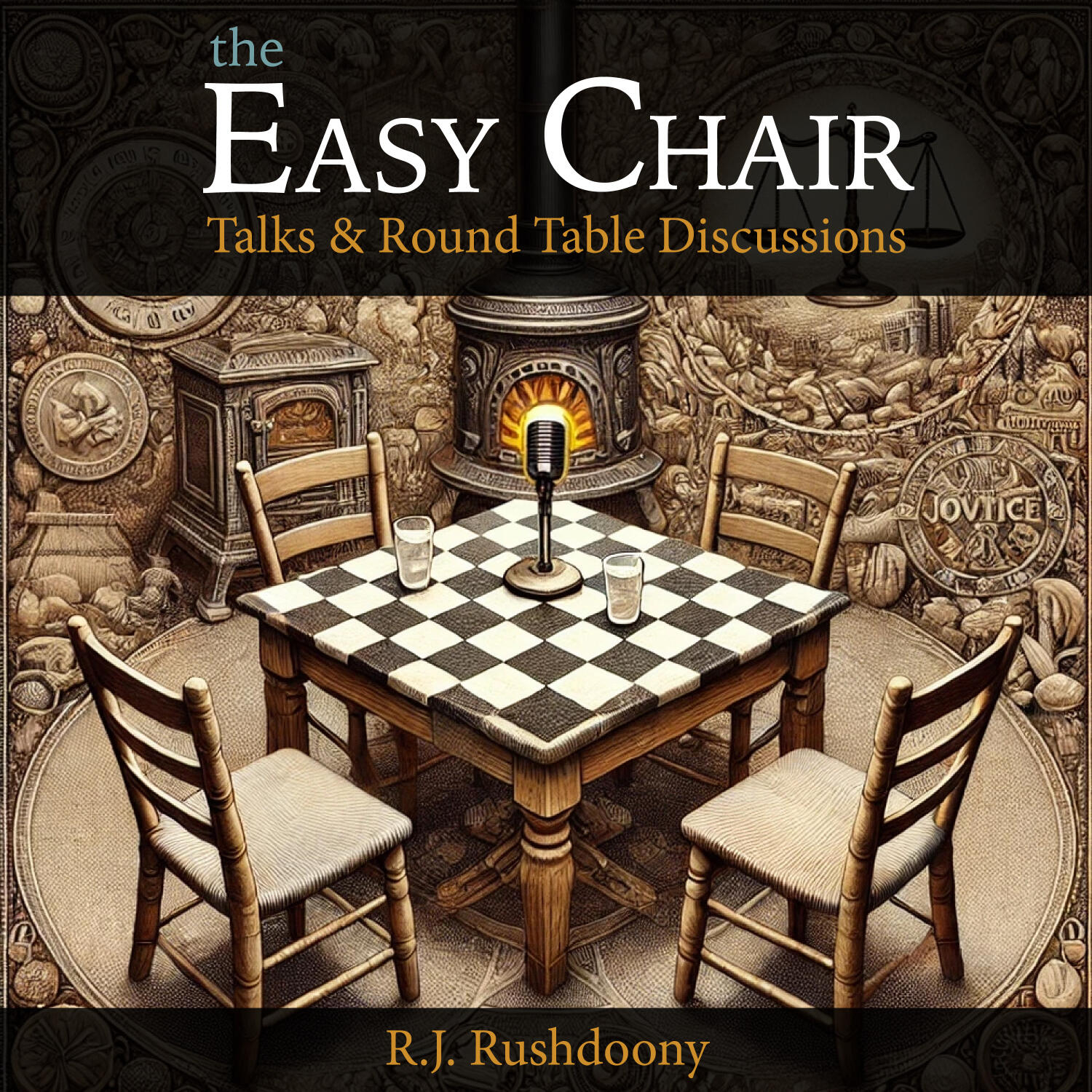
R. J. Rushdoony
The Easy Chair
Round table discussions on a variety of subjects from a Christian perspective.
Koniecznie odwiedź stronę podcastu i wesprzyj twórcę: cr101radio.com
Gdzie słuchać?
Podcasty w aplikacji Replaio Radio Już wkrótcePodcasty trafią do aplikacji już wkrótce. Zainstaluj teraz i jako pierwszy zobacz nowe podejście do podcastów
 Zainstaluj za darmo
Android prawie 10 mln pobrań · ocena 4,8
iOS niedługo
Zainstaluj za darmo
Android prawie 10 mln pobrań · ocena 4,8
iOS niedługo
Odcinki
Easy Chair No. 165, March 10, 1988 - Pragmatism 10.10.2026 1:00:45
Rushdoony and Scott examine pragmatism, the American form of existentialism, which defines truth by what “works” rather than by God or eternal standards. Pragmatism dominates education, politics, business, law, and even religion, leading to consumer-oriented, self-centered thinking, situation ethics, and the erosion of merit, permanence, and moral restraint. It fosters a society focused on immedia...
Easy Chair No. 164, February 11, 1988 - The New Paganism 03.10.2026 1:01:11
R.J. Rushdoony and Otto Scott examine Darwin and the cultural impact of evolution, highlighting Michael Denton’s Evolution: A Theory in Crisis, which critiques Darwinian theory from a molecular biology standpoint, concluding that evolution lacks conclusive evidence and serves as a foundational myth for 20th-century secularism. They trace Darwin’s influence as removing purpose and God from natural...
Easy Chair No. 163, February 11, 1988 - Inflation in the U.S. 26.09.2026 1:02:07
R.J. Rushdoony and Otto Scott discuss persistent inflation in the U.S., explaining it as an increase in the money supply that benefits debtors at the expense of creditors. Citing Freeman Tilden, they note inflation succeeds when fueled by larceny in the hearts of participants. They trace inflation from Roosevelt’s era to the late 20th century, highlighting how excessive credit, foreign loans, and...
Easy Chair No. 162, January 15, 1988 - Cultural Impact of Evolution 19.09.2026 1:00:23
R.J. Rushdoony and Otto Scott examine Darwin and the cultural impact of evolution, highlighting Michael Denton’s Evolution: A Theory in Crisis, which critiques Darwinian theory from a molecular biology standpoint, concluding that evolution lacks conclusive evidence and serves as a foundational myth for 20th-century secularism. They trace Darwin’s influence as removing purpose and God from natural...
Easy Chair No. 161, January 15, 1988 12.09.2026 59:22
R.J. Rushdoony and Otto Scott discuss communism, tracing its history from the 5th-century Mazdakite movement in Persia to modern Marxism in the Soviet Union, Red China, and beyond. They note communism’s appeal to intellectuals, elites, and opportunists who are drawn to power, influence, and social control rather than ideology, and its reliance on propaganda, education, and media to shape minds. Ea...
Easy Chair No. 160, December 9, 1987 - Money and Debt 05.09.2026 1:02:20
R.J. Rushdoony and Otto Scott discuss money and debt, emphasizing that the Bible views money as hard money (gold and silver) and limits long-term debt. They contrast historical practices of short-term debt and thrift with modern inflationary policies, paper money, and mounting personal and national debt. This shift, they argue, erodes financial independence, encourages reckless spending, and threa...
Easy Chair No. 159, December 9, 1987 - Preaching – Q&A (Evangelism and Preaching) 29.08.2026 1:03:31
This wide-ranging and provocative Q&A session brings together R.J. Rushdoony and Marshall Foster to address pressing questions about Christian responsibility in a broken world covering issues of global poverty, missions, liberation theology, political involvement, education, law and grace, civil religion, and cultural transformation. With candor and conviction, they challenge sentimental chari...
Easy Chair No. 158, November 4, 1987 - Fear & Denial of Death in Modern Society 22.08.2026 59:31
R.J. Rushdoony and Otto Scott discuss modern society’s fear and denial of death, describing it as a cultural “pornography” and taboo. They contrast this with the Christian perspective, where death is accepted as part of life and a transition to eternal life, emphasizing the profound dignity and peace possible for believers even in dying. They explore contemporary issues such as suicide, abortion,...
Easy Chair No. 157, November 4, 1987 - Burdens and Dangers of Modern Taxation in the U.S. 15.08.2026 59:41
He emphasizes that morality and life are inseparable: without faith and a commitment to God, ethical principles erode, leaving society vulnerable. Only a vigorous, pro-life Christian faith, grounded in action and obedience to God, can restore vitality and counter the pervasive cultural drift toward death, immorality, and decay.
Easy Chair No. 156, October 20, 1987 - The Rise of Anti-Christian Influences in Modern America 08.08.2026 58:45
Finally, they stress that modern society has lost independence, self-reliance, and a moral grounding in God. Scott and Rushdoony warn that relying on politics, economics, or rationalistic theories without ethical and spiritual foundation has led to diminished freedom, societal decline, and economic vulnerability. They conclude that reassessing assumptions and restoring moral, cultural, and practic...
Easy Chair No. 155, October 7, 1987 - Debt Dependency of the Modern Economy 01.08.2026 58:42
They critique the modern economy’s dependence on debt, foreign aid, and overleveraged international systems, noting the hidden costs of inflation, declining domestic production, and reliance on other nations for resources. Both discuss Japan’s protectionist policies, the U.S. trade deficit, and the vulnerability created by foreign dependency, emphasizing that economic mismanagement and political i...
Easy Chair No. 154, September 11, 1987 - The Pitfalls of Free Trade 25.07.2026 1:01:35
R.J. Rushdoony and Otto Scott examine the pitfalls of free trade, protectionism, and modern economic policies. Rushdoony notes that free trade presupposes a rational and moral world, ignoring cultural, political, and ethical realities, and argues that no economic system can succeed if the people are corrupt or morally deficient. Scott emphasizes that historical context matters: nations like the U....
Easy Chair No. 153, September 4, 1987 - The Contemporary Influence of the Transcendentalists 18.07.2026 1:02:24
Dr. Rushdoony and Otto Scott analyze modernism as a cultural and intellectual force rooted in the Transcendentalists, particularly Emerson and Frothingham, which rejects God and biblical authority in favor of the spirit of the age. Modernism elevates human impulses, experience, and cultural trends above objective moral standards, affecting education, art, literature, and politics. Scott emphasizes...
Easy Chair No. 152, August 5, 1987 - Gary Mose Behind the Iron Curtain 11.07.2026 59:15
Gary Mose recounts his two trips behind the Iron Curtain, particularly to Romania, to support persecuted Christians and observe the reality of life under Communist rule. He describes Romania as devastated—materially, spiritually, and socially—with extreme poverty, shortages of basic goods, oppressive surveillance, and a stark divide between the ruling elite and ordinary citizens. Despite these har...
Easy Chair No. 151, July 17, 1987 - Laurie Eck & the Christian Conciliation Service 04.07.2026 1:01:32
Laurie Eck discusses the Christian Conciliation Service, a ministry designed to resolve disputes among Christians according to biblical principles rather than secular courts. Inspired by his own marital and professional struggles, Eck emphasizes reconciliation, restoration of relationships, and applying God’s law to conflicts. The service trains local church members—often elders or spiritually mat...
Easy Chair No. 150, July 14, 1987 Sweden: The “New Totalitarianism” of Comfort and Conformity 27.06.2026 59:29
In Easy Chair 150 (July 14, 1987), R.J. Rushdoony and Otto Scott interview Gary and Carlinda Mose about two years in Sweden, portraying a society that looks peaceful and prosperous yet functions as a “new totalitarianism” built not on terror but on education, conformity, and cradle‑to‑grave dependency. The Moses describe a nation where the state effectively replaces God, families are weakened by h...
Easy Chair No. 149, July the 9th, 1987 — Money and Debt: Paper Wealth, Real Slavery 20.06.2026 1:04:07
In *Easy Chair 149* (July 9, 1987), R.J. Rushdoony and Otto Scott warn that money and debt are not merely “economic” topics but **religious and moral realities**—because a culture’s view of money reveals where its faith rests. Scott argues the modern world has entered an unprecedented situation: *“money”* as true wealth has largely disappeared, replaced by **paper claims backed by nothing—worse th...
Easy Chair No. 148, June 4, 1987 — The French Revolution: The Revolution That Never Ended 13.06.2026 1:01:07
In *Easy Chair 148* (June 4, 1987), R.J. Rushdoony and Otto Scott argue that the French Revolution didn’t merely “happen” in history—it **still shapes the modern world**, and its errors keep replaying wherever elites try to seize man’s destiny. They trace the revolution’s logic back to Enlightenment assumptions (especially Locke’s belief in morally “neutral” man who can be remade by education), pr...
Easy Chair No. 147, May 26, 1987 - The Tree of Hate, Dr. Philip Wayne Powell 06.06.2026 58:59
In Easy Chair No. 147, R.J. Rushdoony and Otto Scott host Dr. Philip Wayne Powell to discuss his book The Tree of Hate, which exposes the historical myths and prejudices surrounding the Hispanic world, especially the Spanish Empire and Latin America. Powell explains how Northern European propaganda, dating from the 15th and 16th centuries, fostered widespread misconceptions about Spain’s colonizat...
Easy Chair No. 146, May 14, 1987 — Book Reviews: Roots, Vision, and the Future Under God 30.05.2026 1:00:09
In Easy Chair 146 (May 14, 1987), R.J. Rushdoony argues that a culture survives only when it honors both past and future: despising the past makes a people rootless, while losing a God-given vision for the future leaves only nostalgia—relics without meaning and prosperity without purpose. He warns that this same past-orientation infects churchmen who cling to “security” instead of obeying Scriptur...
Easy Chair No. 145, May 6, 1987 23.05.2026 59:57
In Easy Chair No. 145, R.J. Rushdoony and Joseph McAuliffe examine the state of Christian fundraising, highlighting widespread concern over unethical practices, misuse of funds, and the public’s declining trust in TV ministries. McAuliffe cites polls showing that both Christians and non-Christians view many fundraising methods as manipulative, commercialized, and spiritually dishonest. He contrast...
Easy Chair No. 144, April 16, 1987 16.05.2026 1:03:59
In this broadcast, R.J. Rushdoony, Otto Scott, and R.E. McMaster discuss the moral and religious collapse of the Western world and its profound impact on economics, politics, and society. McMaster emphasizes that government and economics are extensions of religious ethics, noting stark contrasts between Protestant-influenced North America and Catholic/Latin cultures, particularly in terms of produ...
Easy Chair No. 143, April 10, 1987 09.05.2026 59:40
R.J. Rushdoony reviews books illustrating moral, cultural, and societal trends. He highlights John Morgan’s Prince of Crime on Catholic dominance in urban politics and crime, A. Craig Copetas’ Metal Men on large-scale corporate corruption, and Major Henry Darley’s Slaves and Ivory on Africa’s moral and social challenges. He also notes cultural degeneration in 19th-century France, historical insigh...
Easy Chair No. 142, March 18, 1987 02.05.2026 59:38
R.J. Rushdoony and Otto Scott discuss Christian Reconstruction as the biblical mandate to establish God’s justice and righteousness in every sphere of society. They emphasize that the Early Church became influential far beyond its numbers by helping one another, serving the community, resolving disputes, and creating a moral, functional order amid a corrupt world. Christianity historically transfo...
Easy Chair No. 141, March 16, 1987 - The Meaning of History 25.04.2026 58:31
R.J. Rushdoony and Otto Scott discuss history, its meaning, and how it is recorded, emphasizing that true history reflects God’s hand, not merely human actions. They critique modern historiography, which often interprets events naturalistically, humanistically, or through myths, ignoring divine providence and the unpredictable factors that shape outcomes, such as weather, disease, or unexpected de...
Podobne podcasty





Słuchaj podcastu The Easy Chair w Replaio
Radio i podcasty w jednej aplikacji - za darmo, bez zakładania konta. Zainstaluj już dziś i nie przegap premiery
Replaio nie jest wydawcą podcastów; nazwy audycji, okładki i audio należą do ich autorów i są rozpowszechniane przez publiczne kanały RSS