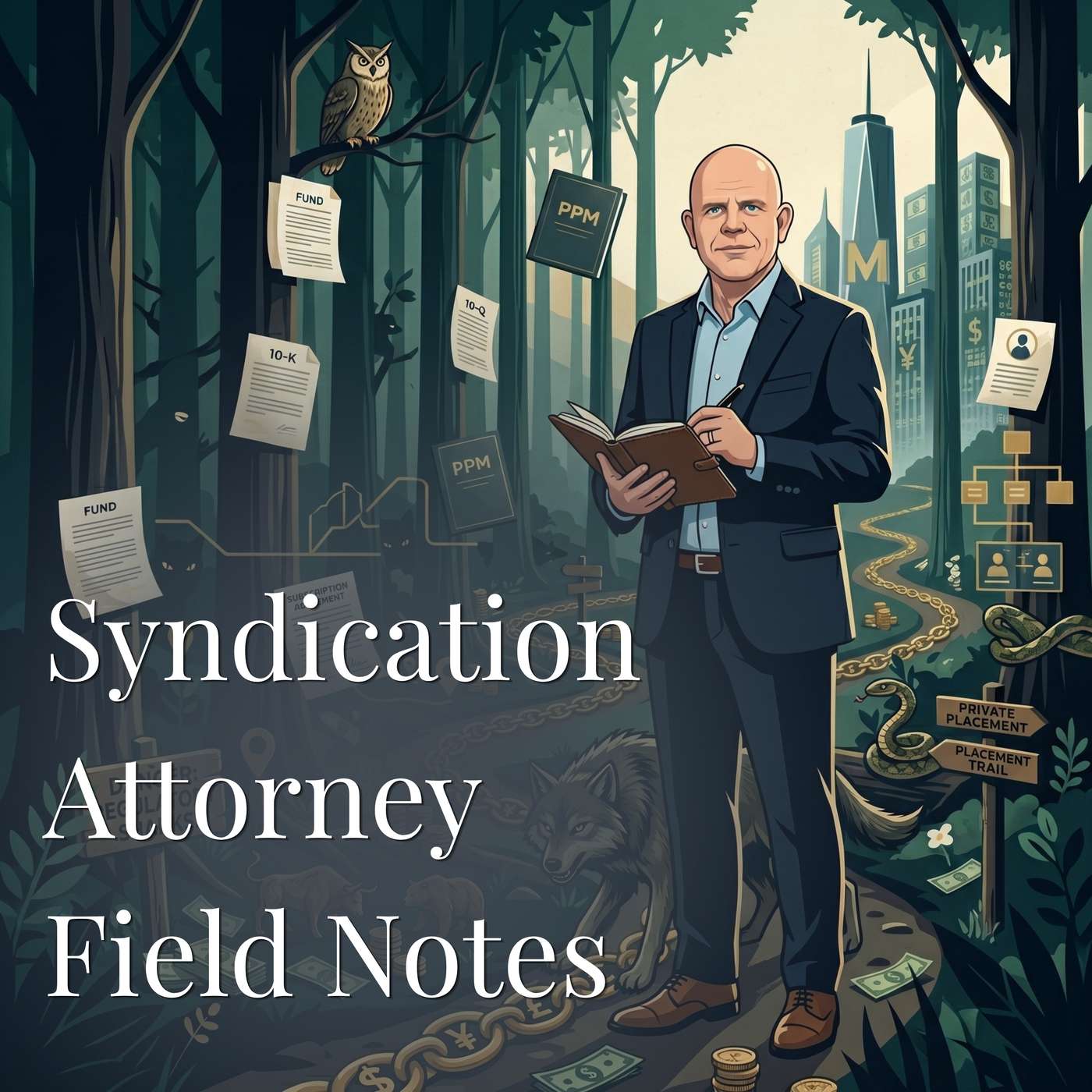
Tilden Moschetti
Syndication Attorney Field Notes with Tilden Moschetti
Syndication Attorney Field Notes is a short-form educational podcast from Tilden Moschetti for sponsors, real estate syndicators, fund managers, and business owners raising capital through Regulation D offerings, private placements, syndications, and investment funds. Each episode breaks down one issue from the legal notebook: finder’s fees, broker-dealer registration, Rule 506(b), Rule 506(c), investor verification, private placement memorandums, subscription agreements, Form D, Blue Sky filings, fund structure, and the mistakes that show up before the documents are drafted. Plain-English fie...
Koniecznie odwiedź stronę podcastu i wesprzyj twórcę: www.moschettilaw.com
Autor
Tilden Moschetti
Kategoria
Strona podcastu
Ostatni odcinek
11 lis 2026
Gdzie słuchać?
Podcasty w aplikacji Replaio Radio Już wkrótcePodcasty trafią do aplikacji już wkrótce. Zainstaluj teraz i jako pierwszy zobacz nowe podejście do podcastów
 Zainstaluj za darmo
Android prawie 10 mln pobrań · ocena 4,7+
iOS niedługo
Odcinki
The 30-Day Safe Harbor Myth in Rule 506(b) 11.11.2026 5:49
Building a pre-existing substantive relationship under Rule 506(b) can create operational questions for sponsors. A common assumption is that waiting thirty days after meeting an investor automatically satisfies the SEC’s relationship requirements. In this episode of Syndication Attorney Field Notes, Tilden Moschetti addresses the 30-day safe harbor myth. We explore the distinct meanings behind 'p...
Qualifying Trusts, LLCs, and Family Offices as Accredited Investors 10.11.2026 6:45
Qualifying Trusts, LLCs, and Family Offices as accredited investors under Regulation D requires a different approach than qualifying individuals. Sponsors often assume that a wealthy person signing on behalf of a new LLC automatically makes the entity accredited. However, the SEC tests for human beings do not map onto entities. In this field note, syndication attorney Tilden Moschetti breaks down...
The 1031 Exchange Problem in Real Estate Syndications 09.11.2026 7:34
Accommodating 1031 exchange proceeds in a real estate syndication can create structural and control complications for sponsors. Because investors cannot execute a 1031 exchange directly into a partnership interest, sponsors must use a Tenant-in-Common (TIC) structure to make the tax deferral work. In this episode, syndication attorney Tilden Moschetti examines how placing an investor directly on t...
Intercreditor Controls in the Development Capital Stack 06.11.2026 6:06
In this episode of Syndication Attorney Field Notes, Tilden Moschetti breaks down how layers of development capital actually interact regarding priority and project control. Sponsors often assume that inserting preferred equity into the capital stack merely changes the blended interest rate. However, a capital stack is a hierarchy of control, not just a repayment order. Using a $20 million develop...
The Legal Difference Between a Target and a Guarantee 03.11.2026 5:49
Sponsors in a Regulation D syndication often blend the terms target return, preferred return, and guaranteed return in their marketing materials. Legally, however, these three concepts describe completely different realities. In this episode, we unpack why relying on a Private Placement Memorandum to fix enthusiastic marketing language can create unintended payment obligations. We examine a practi...
Annualized vs. Total Return Disclosures in the PPM 02.11.2026 6:11
Presenting annualized returns on a pitch deck without clear definitions can lead investors to expect yearly cash distributions that won't materialize. In this episode of Syndication Attorney Field Notes, Tilden Moschetti addresses the core confusion between annualized, total, and cash-on-cash returns. When the metrics promised in your marketing materials don't align with the legal frameworks in yo...
PPM Disclosures: Single-Asset Deals vs. Blind Pool Funds 27.10.2026 6:52
Sponsors transitioning from single-asset deals to blind pool funds often assume they can just recycle their old Private Placement Memorandum by broadening the language. However, the disclosure burden structurally shifts from the physical property to the manager's judgment. In this field note, Tilden Moschetti walks through how a fund PPM differs mechanically from a single-asset document. You will...
Why You Don't Need a Prospectus for a Reg D Deal 27.10.2026 6:33
In a Regulation D syndication, terms like prospectus, offering memorandum, and PPM are often thrown around as if they mean the exact same thing. In this episode, syndication attorney Tilden Moschetti unpacks the core confusion surrounding these disclosure documents. You will learn why a prospectus is reserved for public SEC-registered deals, how a broker's offering memorandum is simply a marketing...
How Redemption Rights Actually Work in Open-End Funds 07.10.2026 6:17
Handling redemption rights in an open-end private fund can create operational challenges if sponsors equate 'open-end' with 'liquid.' In this episode, syndication attorney Tilden Moschetti walks through the realities of the redemption process when dealing with illiquid assets. From notice periods and valuation dates to protective gates and queues, this field note breaks down how to structure redem...
When a Junior Partner Blocks the GP Buyout: Drag-Along Rights 02.10.2026 6:43
In this episode of Syndication Attorney Field Notes, Tilden Moschetti addresses a structural oversight that can derail a profitable exit for deal sponsors. While most syndicators focus entirely on investor-facing documents, their own Sponsor LLC operating agreements are often neglected. Tilden explains the core tension: without a drag-along right, a 10% minority partner can block a 100% buyout off...
Rolling Funds, Subscription Cycles, and Equalization 30.09.2026 6:05
Many sponsors view rolling funds as a convenient way to accept investor capital on a continuous basis, but unstructured admissions can inadvertently dilute your earliest investors. As a syndication attorney, Tilden Moschetti often sees the administrative and mechanical realities of rolling capital get overlooked during the marketing phase. This episode breaks down the concept of a rolling fund, de...
The Reg D Fund-of-Funds Structure 28.09.2026 7:06
Sponsors often view a Regulation D fund of funds as the lazy version of running a fund—no assets to operate, no midnight phone calls. But trading away operational friction means picking up structural and compliance friction instead. In this episode, syndication attorney Tilden Moschetti whiteboards the fund-of-funds model, mapping the flow of capital from your investor to the underlying sponsor. W...
Why Your Blind-Pool Mandate Isn't Just Marketing 23.09.2026 5:58
When launching a blind-pool fund, the investment mandate is often written to sell a vision to potential investors. But once that language is in your Private Placement Memorandum and Operating Agreement, it becomes a strict legal boundary. In this episode of Field Notes, syndication attorney Tilden Moschetti breaks down the tension between drafting a mandate that is too narrow—which can cause you t...
The Shortfall Problem: Cumulative vs. Non-Cumulative Preferred Returns 21.09.2026 6:14
What happens to an investor's preferred return when a fund has a lean year? In this episode, syndication attorney Tilden Moschetti clears up the pervasive confusion surrounding cumulative and non-cumulative preferred returns. Sponsors often assume cumulative structures act as dangerous compounding debt, while non-cumulative structures offer complete payment discretion. Both assumptions miss the ma...
Calculating Preferred Returns: Contributed vs. Unreturned Capital 18.09.2026 6:27
When syndicators return capital to investors after a refinance, many assume their ongoing preferred return payments will drop automatically. This episode explores why that assumption can create an unexpected cash flow mismatch, and how to prevent it. Key Takeaways: - The crucial difference between calculating returns on "contributed capital" versus "unreturned capital." - How a mismatch between a...
Preferred Equity vs. Mezzanine Debt: Reading the Remedies 16.09.2026 7:09
When filling a multi-million dollar gap in a syndication capital stack, sponsors often assume that preferred equity is inherently safer than mezzanine debt because it acts as a partnership interest rather than a loan. However, relying on the label at the top of the term sheet can create unforeseen vulnerabilities. In this episode, we unpack the functional similarities between these two financing i...
When a Hard Money Lender Becomes a Debt Fund 14.09.2026 6:36
When a hard money lender starts taking outside capital to fund deals, they cross an invisible line from being just a lender to becoming a securities issuer. In this episode of Syndication Attorney Field Notes, Tilden Moschetti explains the core structural shift between lending your own money and managing a debt fund under Regulation D. We discuss why using your existing balance-sheet LLC for poole...
What a PPM Sample Actually Tells You 11.09.2026 5:42
First-time sponsors naturally want to review a sample Private Placement Memorandum (PPM) to understand what they are handing to investors under Regulation D. While reviewing samples is a great way to learn the structure of an offering document, assuming a downloaded sample is a fill-in-the-blank form can create serious disclosure issues. In this episode, we cover the legitimate educational uses of...
Why 'Managing Partner' Isn't a Real LLC Title 09.09.2026 5:37
Using the title 'Managing Partner' on a pitch deck is a common habit for real estate sponsors, but dropping that title into an LLC structure can create unexpected friction at the closing table. In this episode of Syndication Attorney Field Notes, Tilden Moschetti unpacks the confusion between entity types and explains where your legal authority actually comes from. We break down the functional dif...
The Fund Launch Sequence: From Economics to First Close 07.09.2026 6:16
The practical sequence for launching a private fund under Regulation D is frequently misunderstood. Sponsors often assume the process begins with forming an LLC and filing a Form D to secure SEC permission. In this field note, we unpack why that assumption can create unnecessary administrative burdens. We walk through the proper fund launch sequence, starting with core economic decisions, moving t...
Debt vs. Equity Securities: Priority, Control, and Cash Flow 04.09.2026 6:27
Choosing between debt and equity in a private capital raise is often driven by what sounds easiest to pitch. Sponsors frequently issue promissory notes just because investors like the sound of guaranteed interest. In this field note, we break down the practical differences between offering debt and offering equity, focusing on priority, control, and what happens to your deal during a slow month. W...
The Admin Trap of Setting Your Minimum Investment 04.09.2026 6:44
Setting the minimum investment for a private fund or syndication is often treated as a marketing strategy. Many sponsors assume a lower barrier to entry means a faster capital raise. In reality, lowering your minimum can create a heavy, long-term back-office burden. In this episode of Syndication Attorney Field Notes, Tilden Moschetti breaks down the administrative trap of low minimums, comparing...
The Promissory Note Trap in Capital Raises 31.08.2026 5:45
Sponsors often assume that structuring a capital raise as debt rather than equity bypasses securities laws. If it's a promissory note, it's just a loan, right? In this episode, syndication attorney Tilden Moschetti examines the core tension between what a document is called and its actual economic reality. We break down the differences between ordinary commercial borrowing and investment debt, ill...
The Sequence from Soft Commitment to Funded Capital 28.08.2026 6:01
When gathering soft commitments for a Regulation D syndication, sponsors often look at an email or a verbal pledge and assume the capital is secure. But building rigid funds around soft numbers can create significant operational hurdles when some of those pledges inevitably fall away. In this episode, syndication attorney Tilden Moschetti breaks down the four distinct phases of investor commitment...
Why a Blind Pool Fund Isn't Just a Syndication Without an Address 27.08.2026 8:22
Sponsors often assume a blind pool fund is just a normal syndication with a 'to be determined' property address. This episode explores why you can't simply take an old Private Placement Memorandum and hit delete on the location. When there is no specific asset to underwrite, investors are underwriting your judgment. We walk through how to build an investment mandate that balances operational flexi...
Podobne podcasty






Słuchaj podcastu Syndication Attorney Field Notes with Tilden Moschetti w Replaio
Radio i podcasty w jednej aplikacji - za darmo, bez zakładania konta. Zainstaluj już dziś i nie przegap premiery
Replaio nie jest wydawcą podcastów; nazwy audycji, okładki i audio należą do ich autorów i są rozpowszechniane przez publiczne kanały RSS