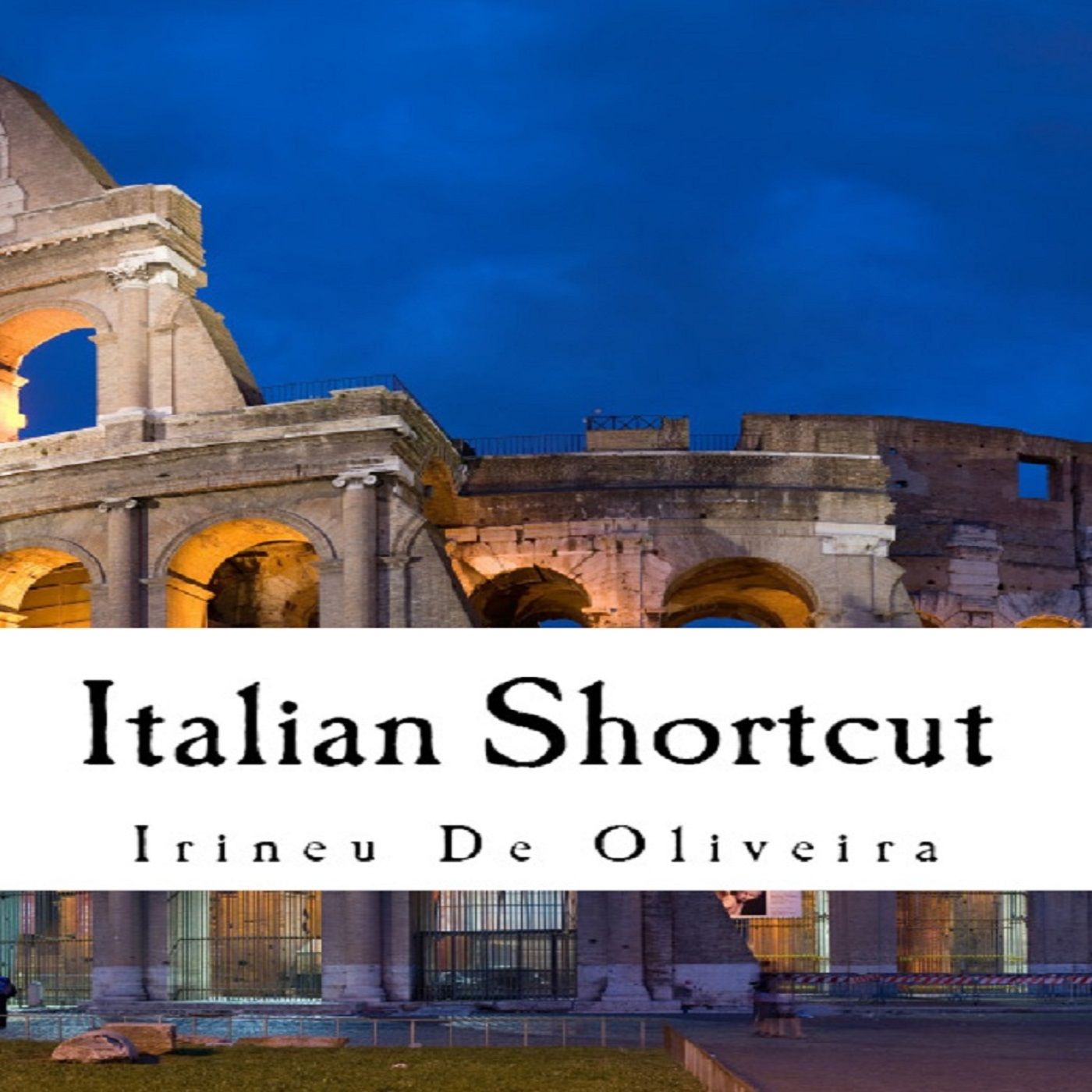
Irineu De Oliveira Jnr
Italian Shortcut
Introducing the groundbreaking audio version of "Italian Shortcut" course, a revolutionary method designed to make learning Italian effortless. Say goodbye to complicated grammar books and embrace this smarter, more efficient way to learn Italian. Crafted by renowned language teacher and translator Irineu De Oliveira Jnr, this method simplifies the learning process by focusing on easy-to-apply patterns that enable instant Italian speaking. By learning to translate your thoughts from English to Italian, rather than memorizing pre-set phrases or grappling with intricate grammar rules, you can ga...
Koniecznie odwiedź stronę podcastu i wesprzyj twórcę: www.spreaker.com
Autor
Irineu De Oliveira Jnr
Kategoria
Strona podcastu
Ostatni odcinek
22 paź 2023
Gdzie słuchać?
Podcasty w aplikacji Replaio Radio Już wkrótcePodcasty trafią do aplikacji już wkrótce. Zainstaluj teraz i jako pierwszy zobacz nowe podejście do podcastów
 Zainstaluj za darmo
Android prawie 10 mln pobrań · ocena 4,8
iOS niedługo
Zainstaluj za darmo
Android prawie 10 mln pobrań · ocena 4,8
iOS niedługo
Odcinki
Italian-English Verb Shortcut 22.10.2023 16:41
Dive into this chapter to discover key verb shortcuts that will propel your journey towards Italian fluency. These shortcuts are not just about simplifying the process, but about recognizing patterns and connections in the language. Below is a list of Italian verbs. Try translating them into English and see how you fare. Diventa un supporter di questo podcast: https://www.spreaker.com/podcast/ital...
Italian words by topic 21.10.2023 44:01
his chapter deviates from the previous structure. Instead of direct translations, Italian words are categorized by topic. The objective? To astonish you with how much Italian you can comprehend simply by associating words with their respective topics. Should any word stump you, consult your Italian/English dictionary. Diventa un supporter di questo podcast: https://www.spreaker.com/podcast/italian...
-TO 20.10.2023 1:15
In the realm of English-Italian translations, words in English ending in "T" often shift to have a "TO" ending in Italian. Here's a brief exercise to test this understanding. Try translating the provided English words into Italian, and then listen to the correct Italian pronunciations to check if they match your expectations or if they sound familiar. 1. alphabet 2. amulet 3. ballet 4. banquet 5....
-TRO 19.10.2023 4:28
A linguistic transformation can be observed between English and Italian where words in English ending in "TER" often evolve into Italian with a "TRO" ending. Listen to the correct Italian pronunciations to gauge if they resonate with your understanding or sound familiar. Diventa un supporter di questo podcast: https://www.spreaker.com/podcast/italian-shortcut--5829505/support .
-ARE part 2 25.05.2023 4:40
To achieve fluency in Italian, it's important to grasp the pattern of words ending in "-ar" in English transforming into "-are" in Italian. This straightforward conversion allows for a smooth transition while retaining the fundamental meaning of the word. To further enhance your language skills, practicing proper pronunciation is crucial. One effective method is to listen to audio recordings of na...
-INA 23.05.2023 3:20
When translating English words to Italian, a consistent pattern can be observed for words ending in "-in" or "-ine" in English. In Italian, these words typically undergo a transformation by adopting the ending "-ina." This pattern allows for a seamless transition of meaning and concept from one language to another while adjusting the word ending accordingly. For example: - Feminine (English) ->...
-IA 22.05.2023 3:08
When it comes to English words ending in "-ia," there is often a striking resemblance to their Italian counterparts, with only minor spelling changes. This linguistic connection stems from the shared historical roots and influences between the two languages, particularly their common Latin heritage. Words such as "acacia," "amnesia," "anemia," and "enciclopedia" maintain their essence when transit...
-ANO 21.05.2023 3:07
When it comes to translating English words to Italian, a noteworthy pattern involves words ending in "-an" in English, which typically become "-ano" in Italian. This conversion allows for a smooth transition of the concept or meaning from one language to another while adjusting the ending accordingly. For example: - American (English) -> Americano (Italian) By substituting the "-an" ending with...
-CLO/-COLO 20.05.2023 1:47
When translating English words ending in "-cle" to Italian, there is no direct and consistent pattern of transforming them into "-clo" or "-colo" in Italian. The translation of these words into Italian will depend on the specific word and its etymology. For example: - Circle (English) -> Cerchio (Italian) - Miracle (English) -> Miracolo (Italian) - Vehicle (English) -> Veicolo (Italian) A...
-EA 18.05.2023 1:26
When learning Italian, English speakers can find solace in the fact that many English words ending in "-ea" have close counterparts in Italian. Although there may be minor spelling differences, the underlying similarities in sound and meaning remain evident. This linguistic resemblance is rooted in the historical ties and shared influences between the two languages, particularly from Latin and oth...
-FIA 17.05.2023 3:15
In the realm of language learning, shortcuts and patterns can be incredibly useful for English speakers delving into the world of Italian. One such shortcut lies in the transformation of words ending in "-phy" in English, where they take on the ending "-fia" in Italian. This pattern opens up an exciting avenue for English speakers to rapidly expand their Italian vocabulary. By recognizing this pat...
-ENZA/-ENZIA 16.05.2023 5:27
Words ending in "-ency" in English, such as "agency," "fluency," and "efficiency," undergo a transformation when translated to Italian. In Italian, these words can be rendered as either "-enza" or "-enzia" to convey a similar meaning. This pattern of substituting "-ency" with "-enza" or "-enzia" is a common feature of the Italian language. The choice between "-enza" and "-enzia" depends on factors...
-TUDINE 15.05.2023 0:49
Words ending in "-tude" in English, such as "attitude," "gratitude," and "solitude," typically undergo a transformation when translated to Italian. In Italian, these words are rendered as "-tudine" to convey a similar meaning. This pattern of substituting "-tude" with "-tudine" is a characteristic feature of the Italian language. This transformation can be attributed to the influence of Latin on b...
-URA 14.05.2023 3:49
Words ending in -ure in English become -ura in Italian. English (-ure) -> Italian (-ura)For example: Adventure -> Avventura Culture -> Cultura Future -> Futuro However, it's important to note that this pattern is not applicable to all English words ending in "-ure." There are exceptions where the corresponding Italian word may have a different ending or structure. It's always advisable...
-IO 13.05.2023 4:38
In Italian, there is a pattern observed when translating English words that end with the letters "-ium." In many cases, when such words are rendered into Italian, the ending changes to "-io" to align with the phonetics and word formation rules of the Italian language. For instance, the English word "medium" becomes "medio" in Italian, "odium" becomes "odio," and "curriculum" becomes "curricolo." B...
-EMA 10.05.2023 0:39
In Italian, the suffix "-ema" is not commonly used to form nouns. However, there are some exceptions. For example, "cinema" refers to the art of film-making, while "poema" refers to a poem. Additionally, there are some words borrowed from Greek that use the "-ema" suffix, such as "problema" (problem) and "sistema" (system). Understanding the use of "-ema" in Italian can help learners of the langua...
-GRAMMA 09.05.2023 1:57
The "-gramma" suffix is commonly used in Italian to form nouns related to written or recorded information. For example, "programma" (program) refers to a schedule of events, while "anagramma" (anagram) refers to a word formed by rearranging the letters of another word. Additionally, "-gramma" can be used to form nouns that indicate a written or recorded document or message, such as "telegramma" (t...
-AGGIO 08.05.2023 1:16
The suffix "-aggio" in Italian is often used to form nouns that denote a result, action, or process related to the root word. For example, the word "viaggio" refers to a trip or journey, while "lavaggio" refers to the process of washing. Additionally, "-aggio" can be used to form nouns that indicate possession or ownership, such as "pedaggio" (toll) or "diritto di passaggio" (right of way). Unders...
-ISM 07.05.2023 7:42
In relation to Italian language, the suffix "-ismo" is often used in Italian to form words that denote a particular ideology, belief system, or movement, similar to how "-ism" is used in English. For example, the word "fascismo" refers to the political ideology of fascism, while "comunismo" refers to the political theory of communism. Additionally, in Italian, "-ismo" can also be used to describe...
-OSO 07.05.2023 6:21
In English, words that end in "-ous" can often be translated into Italian with the ending "-oso." For example, Nervous (English) - Nervoso (Italian) Similarly, in Italian, words that end in "-oso" often have the same meaning as English words that end in "-ous." For example, the Italian word "curioso" translates to "curious" in English. Understanding this pattern can help learners of Italian to rec...
-ANZA 03.05.2023 1:51
When translating English words that end in "-ance" to Italian, the corresponding ending in Italian is "-anza." This language rule is frequently observed in Italian and applies to many words, such as "importance" (importanza) and "ambulance" (ambulanza). Understanding this pattern is important for learners of Italian who want to expand their vocabulary and improve their understanding of the languag...
-IZZARE 02.05.2023 4:52
In Italian language, words that end in "-ize" in English are typically translated to "-izzare" in Italian. This language rule is frequently observed in Italian and applies to a variety of words, such as "capitalize" (capitalizzare) and "modernize" (modernizzare).For learners of Italian, it is important to understand this language pattern to expand their vocabulary and improve their grasp of Italia...
-IDO 01.05.2023 1:12
In Italian, words that end in "-id" in English are typically translated to "-ido" in Italian. This language rule is commonly observed in Italian and applies to a variety of words, such as "acid" (acido) and "intrepid" (intrepido).For learners of Italian, it is important to understand this language pattern to expand their vocabulary and improve their grasp of Italian grammar and structure. Addition...
-ORIO 30.04.2023 1:23
In Italian, words that end in "-ory" in English are typically translated to "-orio" in Italian. This language rule is commonly observed in Italian and applies to a variety of words, such as "history" (storia) and "territory" (territorio).For learners of Italian, it is important to understand this language pattern to expand their vocabulary and improve their grasp of Italian grammar and structure....
-GIA 29.04.2023 7:23
In Italian, words that end in "-gy" in English are typically translated to "-gia" in Italian. This language rule is frequently observed in Italian and applies to a variety of words, such as "biology" (biologia) and "strategy" (strategia).For learners of Italian, it is important to understand this language pattern to expand their vocabulary and improve their grasp of Italian grammar and structure....
Podobne podcasty







Słuchaj podcastu Italian Shortcut w Replaio
Radio i podcasty w jednej aplikacji - za darmo, bez zakładania konta. Zainstaluj już dziś i nie przegap premiery
Replaio nie jest wydawcą podcastów; nazwy audycji, okładki i audio należą do ich autorów i są rozpowszechniane przez publiczne kanały RSS