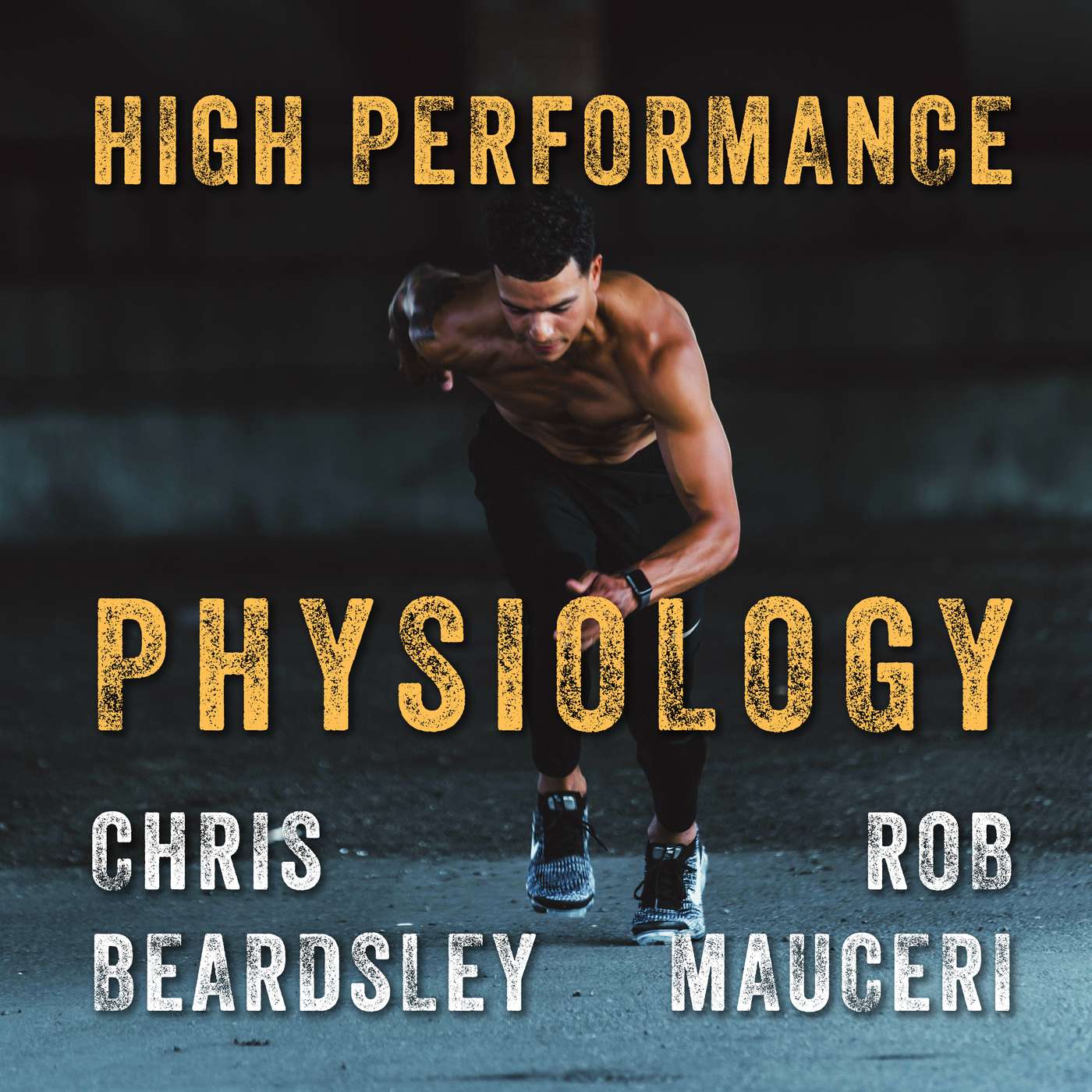
Chris Beardsley and Rob Mauceri
High Performance Physiology
The High Performance Physiology Podcast is co-hosted by Chris Beardsley and Rob Mauceri. Each episode showcases an example of how muscle physiology and biomechanics can be used to identify the best ways to train for athletic performance.
Gdzie słuchać?
Podcasty w aplikacji Replaio Radio Już wkrótcePodcasty trafią do aplikacji już wkrótce. Zainstaluj teraz i jako pierwszy zobacz nowe podejście do podcastów
 Zainstaluj za darmo
Android prawie 10 mln pobrań · ocena 4,8
iOS niedługo
Zainstaluj za darmo
Android prawie 10 mln pobrań · ocena 4,8
iOS niedługo
Odcinki
014 Transfer of training 06.02.2026 33:15
How do strength training programs transfer to sporting movements? What is the role of different exercises? Chris and Rob unpack the physiology and then go on to provide both positive and negative examples from existing training programs.
013 Rate of force development 30.01.2026 35:11
Chris and Rob explain the definitions of rate of force development and explosiveness in sporting contexts before going on to talk about how to develop these qualities in strength training programs.
012 Periodization 23.01.2026 40:06
In this long-awaited episode, Chris and Rob talk about periodization. While periodization itself is somewhat overrated, there are some benefits associated with aspects of it that can be replicated in other ways.
011 Deloads and tapers 16.01.2026 33:42
After a short break for the holidays, Chris and Rob are back for their first episode of 2026 talking about deloads. There are two scenarios in which deloads are taken: planned and unplanned. Planned deloads are written into a training program when fatigue is expected to accumulate. Unplanned deloads are taken when fatigue accidentally accumulates.
010 One arm chin ups 02.01.2026 37:36
Chris and Rob change the format for this episode. Rather than covering physiology and biomechanics and then talking about how that information guides strength training programs for athletic performance, they talk about their own experiences in training for a one arm chin up.
009 Sprinting 19.12.2025 46:10
Continuing on from the previous episodes discussing vertical jumping and throwing, Chris and Rob break down the way in which we can support the sprinting movement through targeted strength training.
008 Throwing and punching 10.12.2025 38:16
Building once again on previous episodes in which they talked about strength, speed, and power, the proximal to distal sequence, and vertical jumping, Chris and Rob now tackle how throwing and punching work, and discuss how to train to improve performance in those activities.
007 Vertical jumping 03.12.2025 37:52
In this episode, Chris and Rob build on previous podcast discussions about strength, speed, and power as well as on the proximal to distal sequence to explain [1] how vertical jumping works, and [2] how we can structure training programs to improve vertical jump height.
006 Eccentric training 27.11.2025 40:07
In this episode, Chris and Rob introduce eccentric training, starting with the underlying physiological adaptations and then going on to provide some commentary on practical programming. Contrary to what you will likely hear elsewhere, the important (transferable) adaptations caused by eccentric training are peripheral and not neural.
005 Stretch-shortening cycle 19.11.2025 36:47
In this episode, Chris and Rob introduce the stretch-shortening cycle and its underlying mechanisms, focusing on how it works in fast movements. This builds on previous episodes in which they talked about speed, power, strength, and the proximal to distal sequence. Learn more about how tendons work to store and release elastic energy in fast movements.
004 Proximal to distal sequencing 13.11.2025 37:19
After covering the basics of strength, speed, and power, Chris and Rob now address how the proximal to distal sequence works. This is a key feature of human movement and has been observed in running, jumping, and throwing, as well as more complex activities. Understanding how it works is essential for interpreting the transfer of training to sporting performance.
003 Maximum speed 05.11.2025 42:03
Building on the previous episodes, Chris and Rob tackle the adaptations that contribute to increasing maximum speed in the context of athletic training. As always, Chris explains the physiology and Rob provides examples of how to implement that knowledge from the training programs that he is currently writing for his clients.
002 Maximum strength 29.10.2025 41:29
Chris and Rob walk through the major physiological adaptations that contribute to increases in maximum strength and give examples of how these adaptations can be stimulated by specific elements within a strength training program. Since maximum strength is an externally-measured outcome, it cannot be stimulated to increase directly. We must instead create a range of specific underlying adaptations,...
001 Strength, speed, and power 24.10.2025 32:54
What are strength, speed, and power? We call them athletic qualities but how are they actually improved? In this episode, Chris and Rob explain how strength and speed are each outcomes underpinned by specific, unique adaptations, while power is a second order outcome underpinned by strength and speed.
Podobne podcasty







Słuchaj podcastu High Performance Physiology w Replaio
Radio i podcasty w jednej aplikacji - za darmo, bez zakładania konta. Zainstaluj już dziś i nie przegap premiery
Replaio nie jest wydawcą podcastów; nazwy audycji, okładki i audio należą do ich autorów i są rozpowszechniane przez publiczne kanały RSS