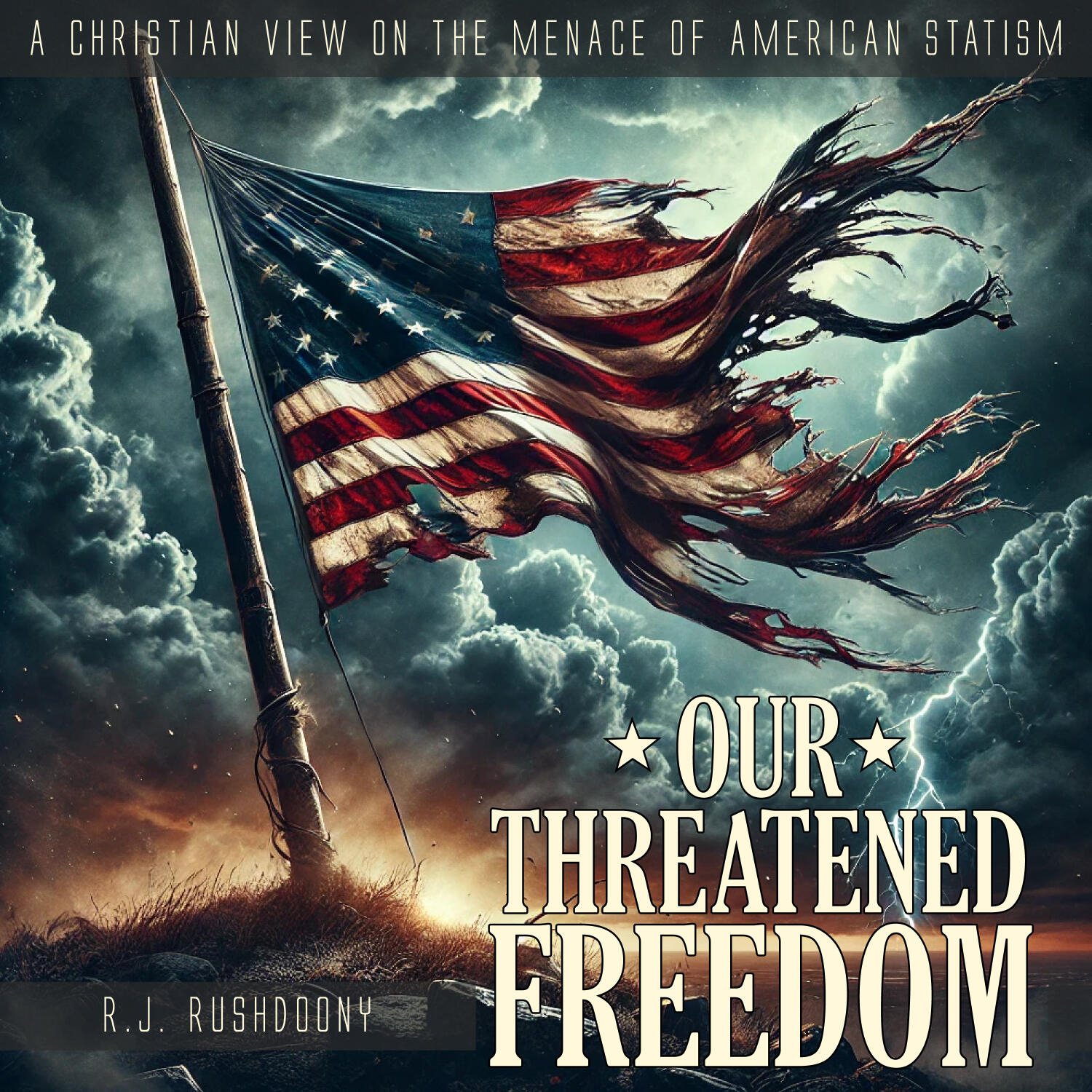
R.J. Rushdoony
Our Threatened Freedom
A Christian View on the Menace of American Statism with R.J. Rushdoony
No dejes de visitar la web del podcast y apoyar a su creador: cr101radio.com
Autor
R.J. Rushdoony
Categoría
Web del podcast
Último episodio
7 de oct. de 2026
¿Dónde escuchar?
Podcasts en la app Replaio Radio Muy prontoLos podcasts llegarán muy pronto a la app. Instálala ahora y sé el primero en descubrir una forma totalmente nueva de vivir los podcasts
 Instálala gratis
Android casi 10 M de descargas · valoración de 4,8
iOS muy pronto
Instálala gratis
Android casi 10 M de descargas · valoración de 4,8
iOS muy pronto
Episodios
Is Federal Aid Destroying America? 15.04.2026 3:11
This passage describes a common problem with federally funded local projects: well-meaning federal grants can incentivize unnecessary construction, often at the expense of local residents. The anecdote of the hill-country homeowner illustrates how a simple bridge-widening need was expanded into a full road-widening project, costing land, money, and public resources unnecessarily. The author argues...
Do We Have a New Kind of Prejudice? 08.04.2026 2:57
This passage critiques the U.S. Court of Appeals for the Second Circuit granting the Communist Party special privileges in campaign reporting, exempting it from the disclosure rules required of Republicans and Democrats. The author questions the rationale, arguing that donors to the Communist Party rarely face persecution, while donors to mainstream causes like United Way sometimes do. He frames t...
Are We Regulating Ourselves into Tyranny? 01.04.2026 3:10
This passage warns that excessive regulation even over seemingly minor matters like lawn maintenance can erode personal freedom and lead society toward tyranny. Using the example of a proposed 16-page building code in University Park, Texas, the author highlights how fines for weeds, cracks, or unsound chimneys, combined with inspectors’ authority to enter homes at will, could pave the way for eve...
Are We Using Language to Confuse Ourselves? 25.03.2026 3:10
Are We Using Language To Confuse Ourselves? https://cr101radio.com/podcast/are-we-using-language-to-confuse-ourselves-2 In “Are We Using Language to Confuse Ourselves?” Rushdoony warns that statist categories—especially the IRS distinction between “profit” and “nonprofit”—have subtly reshaped Christian and cultural thinking, causing people to mistake tax classifications for reality itself. He argu...
Do You Want a Vegetarian World? 18.03.2026 3:26
This piece critiques the modern animal rights movement and its push toward vegetarianism as a social imperative. While acknowledging the right of vegetarians and animal rights advocates to promote their beliefs, the author warns against coercive tactics that could impose dietary choices on the broader public. Representative Ronald Mottl’s proposed bill to study animal rights is cited as an example...
Are We Robbing Widows? 11.03.2026 3:26
This piece highlights the harsh realities widows face under federal and state property and tax laws. A Missouri widow, unable to operate her late husband’s farm machinery during harvest because it was tied up in his estate, was forced to hire help at additional expense. Laws and regulations, including estate and inheritance taxes, often treat widows as secondary to bureaucratic process, ignoring t...
When is R-pe Not R-pe? 04.03.2026 3:37
A shocking case in New York exposed the failure of justice when a young bank teller was held at knifepoint, her face covered, and raped, yet the judge asked only whether she had seen penetration. When she said no, the criminal was acquitted of first-degree rape and violent robbery, convicted instead of lighter charges of nonviolent robbery and sexual abuse, highlighting a dangerous precedent that...
Does Crime Pay? 25.02.2026 3:46
In California, a con man who stole $9 million through a Ponzi scheme served only three years of a nine-year sentence, essentially paying a year for every $3 million stolen, while his victims lost everything their savings and homes. His incarceration at Boron was described as a “country club” with tennis courts, swimming pools, and dorm-style housing, showing that prisons often fail as a deterrent....
Are We Becoming a Postage Stamp Republic? 18.02.2026 3:31
The U.S. is showing signs of becoming a “postage stamp republic,” a term I first learned as a boy from my stamp collection. Historically, “postage stamp republics” were weak, unstable nations, issuing new stamps frequently to raise money and signaling constant inflation through fluctuating postal rates. Today, the U.S. mirrors that pattern: new stamps appear constantly, often sold more to collecto...
Are We Running Low on Ideas to Spend our Money? 11.02.2026 3:35
Sometimes it seems Washington’s planners compete to find the most absurd ways to spend our money. Take Baltimore’s “Block” of strip joints and adult shops: $338,000 is being spent to make the area more accessible with tree plantings and wheelchair cuts apparently ensuring the physically disabled can comfortably visit porno shops! While satire aside, one wonders if resources couldn’t go toward more...
Do You Like Taxation? 04.02.2026 4:04
A Christian View on the Menace of American StatismTaxation touches every aspect of our lives, from income and property to gasoline, entertainment, and even our estates, and yet the burden often feels arbitrary and excessive. While some taxes may be necessary, the scope of modern levies from birth to death reveals a system where the citizen is constantly treated as a revenue source rather than a fr...
Are We Over-Licensed and Over-Ticketed? 28.01.2026 3:47
Over-licensing and over-ticketing have become a modern assault on American initiative and freedom. A young entrepreneur with a camera and a pony, providing a wholesome service, faces fines and potential jail simply because he cannot secure 82 separate municipal licenses—licenses that serve the cities’ revenue more than the public good. Meanwhile, real criminals often receive lighter consequences t...
How Much of You does the Federal Government Own? 21.01.2026 3:22
A striking reality in the U.S. is the vast land and wealth controlled by the federal government: Alaska 90%, Nevada 87%, Utah 65%, and so on, supposedly in trust for the people, yet private groups often manage these lands more effectively. Beyond land, civil governments claim 40–60% of our income through taxes, effectively owning a significant portion of our labor—modern slavery in all but name. W...
Is Law Enforcement Always Good? 14.01.2026 4:25
Not all law enforcement agencies serve the public good. The Law Enforcement Assistance Administration, created in 1968 and defunded in 1982, spent nearly $8 billion on projects with little practical impact, like wristwatches to monitor officers’ vitals or studies on why convicts escape or people leave high-crime neighborhoods. Such programs highlight bureaucratic inefficiency and the ease with whi...
Who Is Congress Working For? 07.01.2026 4:22
Congress is supposed to serve the people, but in 1982 it voted itself enormous tax benefits and perks—including deductions for housing, food, servants, and utilities—while ordinary Americans faced rising unemployment and stagnant wages. These special privileges allowed members to shield tens of thousands of dollars from taxation, essentially giving themselves a hidden pay raise while discussing hi...
Will Wishing or Legislating Make It So? 31.12.2025 4:43
In this episode, R.J. Rushdoony critiques the modern obsession with wishful thinking and state control. From workshops that promise wealth through “positive wishing” to bloated licensing agencies that regulate everything but common sense, Rushdoony asks: Can foolishness be outlawed—or must freedom include the right to fail? Tune in to hear why real growth requires liberty, not legislation, and why...
Are Criminals Afraid of the Law? 31.12.2025 3:58
A Christian View on the Menace of American Statism
Is Education For or Against Barbarism? 24.12.2025 4:32
A Christian View on the Menace of American Statism
Does the Supreme Court Know Best? 17.12.2025 4:37
This article questions whether the U.S. Supreme Court truly serves justice, using its unanimous ruling against the Old Order Amish—forcing them to pay Social Security taxes despite religious objections—as a focal point. The author compares the Court’s logic to that of the Soviet Union, arguing that if Social Security were truly a “common good,” people wouldn’t need to be coerced into it. Highlight...
Is Freedom Dangerous? 10.12.2025 4:28
A Christian View on the Menace of American Statism
How Much are Federal Regulations Costing Us? 03.12.2025 4:38
A Christian View on the Menace of American Statism
Will Our Courts Defend Orphans? 26.11.2025 4:19
A Christian View on the Menace of American Statism
What is a Monopoly? 19.11.2025 4:37
A Christian View on the Menace of American Statism
How Big are the Big Corporations? 12.11.2025 4:47
A Christian View on the Menace of American Statism
How Sensitive are You to Vampires? 05.11.2025 4:20
A Christian View on the Menace of American Statism
Podcasts similares






Escucha el podcast Our Threatened Freedom en Replaio
Radio y podcasts en una sola app - gratis y sin registro. Instálala hoy y no te pierdas el estreno
Replaio no es editor de podcasts; los nombres de los programas, las portadas y el audio pertenecen a sus autores y se distribuyen a través de canales RSS públicos