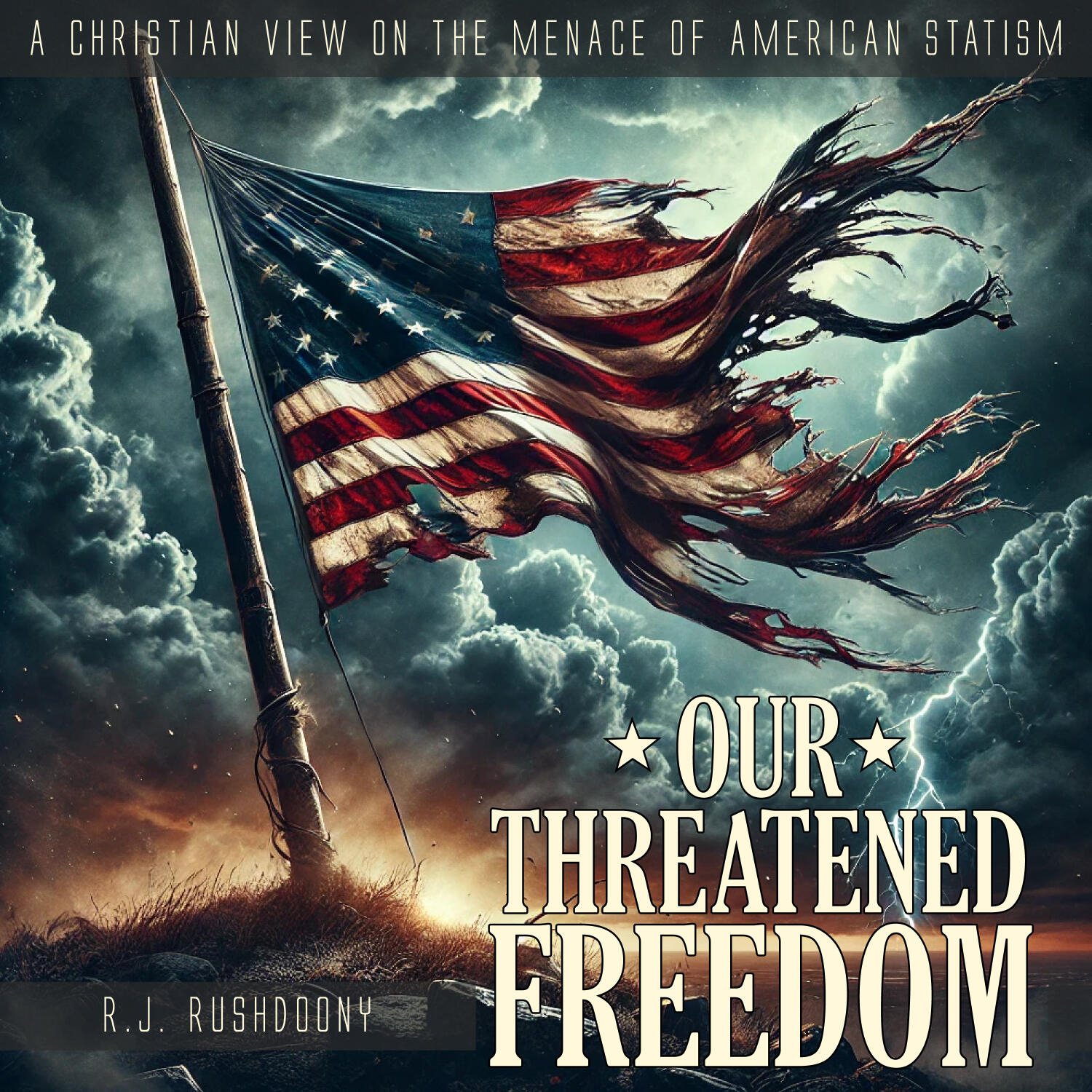
R.J. Rushdoony
Our Threatened Freedom
A Christian View on the Menace of American Statism with R.J. Rushdoony
Be sure to visit the podcast's website and support the creator: cr101radio.com
Where to listen?
Podcasts in the app Replaio Radio Coming soonPodcasts are coming to the app soon. Install now and be the first to see a whole new take on podcasts
 Install for free
Android almost 10M downloads · 4.8 rating
iOS soon
Install for free
Android almost 10M downloads · 4.8 rating
iOS soon
Episodes
Who Are the Debtors of America? 07.10.2026 3:39
In America, the poor carry the least debt because they are generally considered bad credit risks, the middle class holds moderate debt primarily for homes, farms, and small businesses, while the rich borrow most easily and carry the highest proportion of personal debt; corporations are actually the largest debtors outside the government, funding expansions, acquisitions, and operations, and on top...
Are We Misjudging our Prison Convicts? 30.09.2026 3:39
Our prisons have become breeding grounds for violence and extortion, as illustrated by a young man murdered for refusing to pay $5 a week to a gang in Los Angeles Men’s Central Jail, highlighting that the humanistic assumption that prisoners are “good at heart” blinds us to their evil nature; misjudging criminals as unfortunate or reformable only endangers society, and true safety requires recogni...
Should Universities Get Grants from Pentagon Funds for Research? 23.09.2026 4:01
Universities receiving Pentagon research funds can divert focus from their core mission of education, as such grants though tiny compared to industry contracts ($852 million to universities vs. $116.7 billion to industry in 1982) often prioritize research over teaching, benefit professors financially, and may reward politically connected alumni rather than serve practical scientific advancement; w...
Are We In a Banking Crisis? 16.09.2026 3:34
Too often, we let fear of words charges of racism or bigotry paralyze us while taxpayers fund groups that fail obligations yet sue the government and receive federal support, highlighting how timidity in confronting abuses undermines both freedom and fiscal responsibility. #FreedomOfSpeech #TaxpayerBurden #StopAbuse #NameCalling #ProtectLiberty
Are We Afraid of Words? 09.09.2026 3:33
There is evidence of a real return to faith in the United States, particularly within evangelical churches, which have grown significantly from 1972 to 1982 while modernistic denominations have declined; this growth is accompanied by an increase in Christian schools, agencies addressing social problems from a Biblical perspective, and efforts to influence politics and economics according to faith,...
Are You a Patron of the Arts? 02.09.2026 3:23
Through our taxes, we are unwitting patrons of the arts, funding millions for projects many consider frivolous or objectionable erotic shows, feminist journals, or ex-convict art programs while contributing to a growing national deficit that threatens economic stability and, ultimately, freedom. #ArtsFunding #TaxpayerBurden #FiscalResponsibility #StopWastefulSpending #ProtectFreedom
Are We a Suicidal People? 26.08.2026 3:44
U.S. foreign aid and loans often fund oppressive regimes, military projects, and even human-rights abuses abroad, effectively financing tyranny, slavery, and the enemies of freedom, while lacking proper oversight, making our generosity a tool for global harm rather than good. #StopFinancingTyranny #ForeignAidReform #ProtectFreedom #AccountabilityMatters #NoAidForOppression
Who Makes History? 19.08.2026 3:18
History is made by people, not abstract “social forces”; men and women of faith and action shape events, drive progress, and give purpose to civilizations, while the modern notion that vague forces dictate outcomes undermines human responsibility, freedom, and the Biblical understanding of man as God’s active creation. #HistoryMakers #FaithAndAction #HumanResponsibility #BiblicalWorldview #Freedom...
Are We a Nation of Book Burners? 12.08.2026 3:05
Concerns about “book banning” in U.S. schools are often misrepresented; parents may object to certain books for moral or educational reasons, while libraries promote works aligned with humanistic perspectives, but true censorship prohibiting publication altogether does not exist here; freedom means the right to choose, and defending that choice requires respecting others’ freedom to make their own...
Should Life be Better at the Top? 05.08.2026 3:31
Those in positions of responsibility deserve fair compensation, but when civil officials use taxpayer money for extravagant personal benefits like $85,000 office remodels they cross from just reward into exploitation, creating a growing gap between leaders and citizens, eroding trust, and undermining freedom; life should be better at the top only in proportion to responsibility and service, not lu...
Who Gets Hurt by Trade Controls? 29.07.2026 3:22
The passage argues that trade controls and protectionism ultimately harm consumers more than they help producers. While some domestic industries may complain about cheap foreign imports whether Japanese or American the real effect of tariffs and trade restrictions is to raise prices for the majority of consumers, who are paying more for goods that could otherwise be purchased more cheaply. Free tr...
What is Wrong with Deficit Spending? 22.07.2026 3:22
The passage argues that deficit spending is both economically and morally harmful. Economically, running annual deficits accumulates national debt, threatens programs like Social Security, and risks eventual bankruptcy. Deficit spending fuels inflation, which undermines the purchasing power of citizens and destabilizes the economy. Morally, debt living is seen as a symptom of poor discipline and p...
Do We Have a Dynasty of Wealth in the United States? 15.07.2026 2:51
This passage argues that the United States does not have a permanent dynasty of wealth. While some inherited fortunes exist, the majority of the richest Americans earned their wealth independently, and new industries such as microelectronics and emerging energy technologies continuously create fresh fortunes. Economic change ensures that wealth shifts over time, discouraging stagnation. Historical...
Who is Taking Care of the Poor? 08.07.2026 2:58
This passage emphasizes that the primary caregivers for the poor in the U.S. are not government agencies, but private and voluntary institutions. The family remains the most effective welfare system, providing for sick members, elderly parents, and children’s education from kindergarten through college. Churches, both Protestant and Catholic, supplement this care by aiding the homeless and transie...
How Bad is Pollution? 01.07.2026 2:54
This passage emphasizes that historical urban pollution was far worse than what we typically imagine today. In the era of horse-drawn vehicles, cities in the U.S. and London were covered with tons of horse manure, creating unsanitary conditions and difficult foot traffic. Noise pollution from horseshoes and buggy wheels added to the chaos. Going back further, in 1783, many cities lacked sewers, an...
Are We Over-Polluted and Over-Populated? 24.06.2026 3:01
This passage argues that fears of overpopulation and overpollution are largely myths. Citing Dr. Julian L. Simon’s The Ultimate Resource, it emphasizes that food production, farmland availability, and natural resources are increasing, not diminishing. Pollution has been declining, population density does not inherently create social or biological problems, and immigration contributes positively to...
Who Gets Hurt by Budget Cuts? 17.06.2026 2:59
This passage argues that the public is often misled about budget cuts. Media and politicians claim that cuts primarily harm the poor and elderly, but in reality, budgets are frequently still increasing, and cuts usually apply only to proposed increases. Meanwhile, overgrown bureaucracies and legislators’ own expenditures remain untouched. Ordinary citizens, facing rising taxes and aggressive colle...
Are We Suffering From a New Bigotry? 10.06.2026 2:57
This passage argues that a new form of bigotry is emerging in the foster-care system, where devout Christians though responsible and moral are being rejected as foster parents. The author cites a tragic case in Pomona, California, where a child was sexually abused and killed in foster care, suggesting that prejudice against Christian foster parents may contribute to such failures. The broader conc...
Are the Courts an Enemy to Justice? 03.06.2026 3:15
This passage argues that the courts, rather than serving justice, have increasingly become instruments of relativism and majority rule, often harming victims more than criminals. It highlights Oliver Wendell Holmes Jr.’s philosophy that the law is a game to be played according to its rules rather than a pursuit of justice, suggesting that justice is no longer viewed as absolute but as subject to h...
Does Bionic Man Have a Future? 27.05.2026 3:13
This passage critiques the uncritical glorification of science and technological enhancements, using the “bionic man” as a symbol of this trend. The author argues that while medical devices pacemakers, glasses, crutches are helpful, they are no replacement for God’s original design and natural human faculties. Scientific interventions, including test-tube babies, are portrayed as risky, morally co...
Done Any Nagging Lately? 20.05.2026 3:02
This passage explores the origin and meaning of the word nag, tracing it from its Scandinavian roots meaning “to gnaw, bite, or burrow” to its modern sense of persistent, irritating talk or complaint. The imagery comes from rats gnawing in thatched-roof houses during the Middle Ages, producing an unending, unwelcome noise hence the connection to human nagging. Solomon recognized the difficulty of...
Is Mexicos Problem Americas Problem Too? 13.05.2026 3:12
This passage argues that Mexico’s debt crisis in 1982 is not just Mexico’s problem but a global and particularly American one. The United States and other nations, through international loans and private banking, have tied themselves to the fate of unstable economies. Mexico’s $80 billion debt, coupled with economic collapse and inflation, threatens U.S. banks, credit availability, and the broader...
Who Gets the Benefits These Days? 06.05.2026 3:07
This passage examines how well-intentioned social and labor programs can be exploited, often favoring the wrong parties. The “Burglar Cops of Hollywood” case illustrates law enforcement officers who committed theft while on duty yet received overtime pay during interrogation and even claims for disability due to the stress of being caught. Similarly, in a sex-discrimination lawsuit, the plaintiff...
Are Technicalities Destroying Justice? 29.04.2026 3:33
This passage critiques the modern legal system’s focus on technicalities over substantive justice. Minor procedural errors, once considered irrelevant, now frequently overturn convictions, regardless of overwhelming evidence of guilt. Charles Peters cites cases in New York where a convicted burglar and a guilty dentist were freed due to procedural quirks, despite strong evidence against them. The...
Can Crime Stopping Be Dangerous? 22.04.2026 3:10
This passage warns against the dangers of predictive crime prevention. Richard Conniff’s article in Science Digest highlights research aimed at identifying potential future criminals before they commit any crime, with proposals even suggesting preemptive jailing or execution. Critics, including ACLU lawyer David Landau, point out both constitutional and scientific flaws future criminality cannot b...
Similar podcasts






Listen to the Our Threatened Freedom podcast in Replaio
Radio and podcasts in one app - free, with no sign-up. Install today and do not miss the launch
Replaio is not a podcast publisher; show names, artwork and audio belong to their authors and are distributed through public RSS feeds.