Marshall Madow
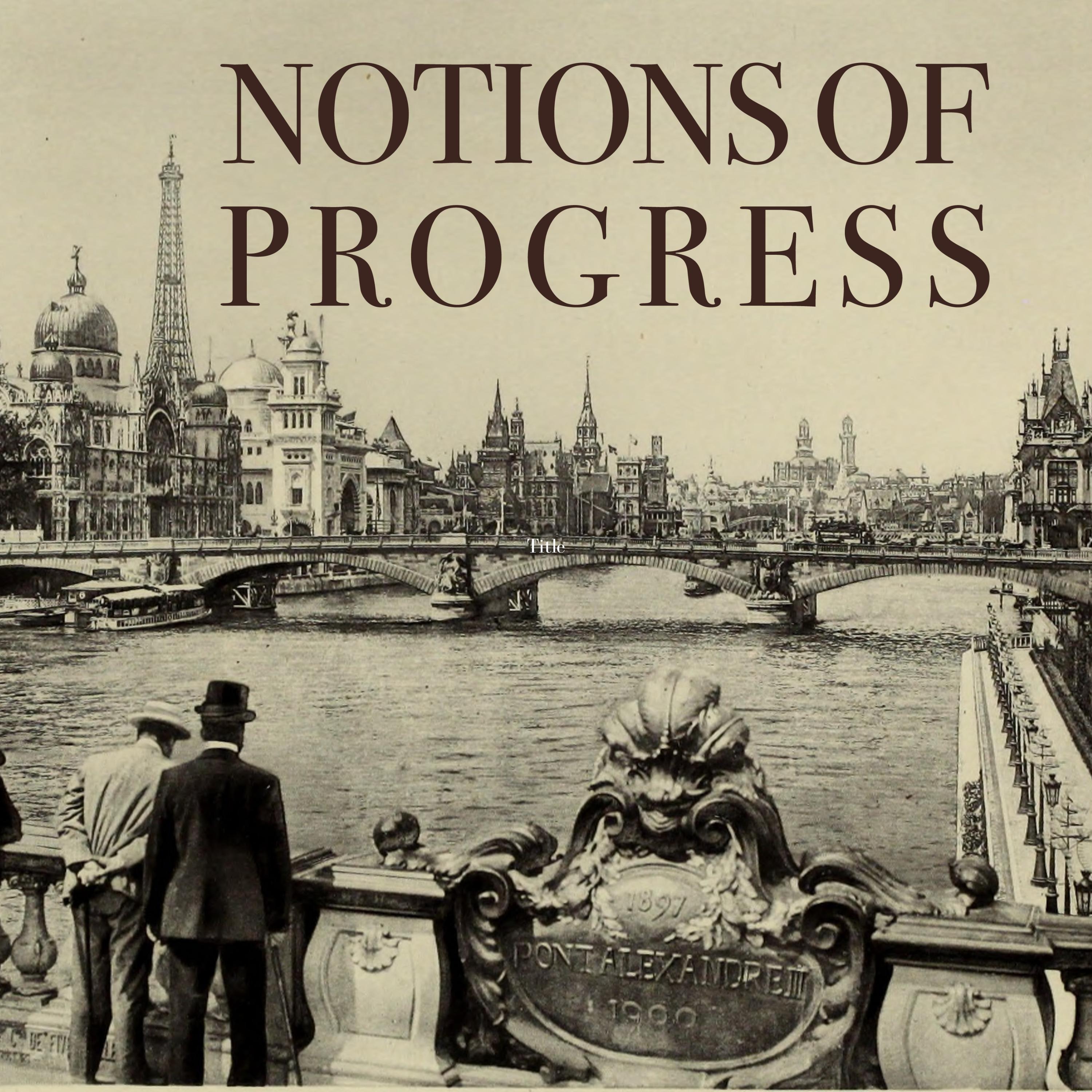
Notions of Progress
The idea of progress — that humanity advances through time toward something better — has been a contested assumption throughout history. The question of whether we as a species, a nation, or as individuals are progressing is being interrogated with a renewed urgency that the present moment demands. Whether that advancement is real, illusory, unevenly distributed, or simply beside the point depends on who is asking, from where, and by what measure. Notions of Progress is a podcast that takes those questions seriously, tracing how the idea of progress has been understood, contested, and reimagin...
No dejes de visitar la web del podcast y apoyar a su creador: podcast.show
Autor
Marshall Madow
Categoría
Web del podcast
Último episodio
3 de nov. de 2026
¿Dónde escuchar?
Podcasts en la app Replaio Radio Muy prontoLos podcasts llegarán muy pronto a la app. Instálala ahora y sé el primero en descubrir una forma totalmente nueva de vivir los podcasts
 Instálala gratis
Android casi 10 M de descargas · valoración de 4,7+
iOS muy pronto
Episodios
From Liberal to Liberalism: Helena Rosenblatt on the History of a Word 03.11.2026 38:13
In this first part of a three-part conversation, historian Helena Rosenblatt traces the history of the words “liberal” and “liberalism,” the subject of her 2018 book The Lost History of Liberalism. She calls her approach a word history, asking what these terms meant to the people who used them, and begins with the Latin liber, which she says means both free and generous. She follows the word from...
Is Capitalism Past Its Use-By Date? Michael Roberts on Three Futures About This Episode 19.10.2026 13:02
In this third and final part of the conversation, Marxist economist Michael Roberts brings the argument of his 2016 book The Long Depression into the present. He begins with the view that the system works as long as decisions are good, which he finds unconvincing: a system that produces for profit, he argues, delivers both vitality and grotesque inequality, and cannot continue as it is. He describ...
Two Depressions, One Cause? Michael Roberts on 1873, 1929, and the Rate of Profit 05.10.2026 15:29
In this second of a three-part conversation, Marxist economist Michael Roberts takes the central claim from Part One — that the 2008 crash opened a long depression — back to the two historical cases on which his 2016 book The Long Depression rests. He begins with the 1870s, answering the Austrian-school argument that no depression took place and a rival monetary explanation tied to the gold standa...
A Marxist in the City of London: Michael Roberts on The Long Depression 21.09.2026 29:54
In this first of a three-part conversation, Marxist economist Michael Roberts joins Notions of Progress to lay out the central argument of his 2016 book The Long Depression: that the 2008 financial crash was not an ordinary recession, but the opening of a longer structural depression driven by capitalism’s own tendency toward falling profitability. Before getting there, Roberts traces his own path...
Nothing About This Is Inevitable: Gavin Mueller on Automation, AI, and a Different Future 07.09.2026 12:39
This episode closes out a three-part conversation with Gavin Mueller (University of Amsterdam), author of Breaking Things at Work. In Part 2, Mueller traced Marx's own ambivalence toward machinery through the split between orthodox and heterodox Marxism, Frederick Taylor's theory of workplace control, the Technocracy Movement, and Norbert Wiener's early warnings to organized labor about automation...
Theorizing the Machine: Gavin Mueller on Marxism, Taylorism, and Cybernetics Interview pt 2 of 3 24.08.2026 23:41
In Episode 17, Gavin Mueller (University of Amsterdam) traced the Luddites back to the guild economy of England's Midlands. In this second installment of a three-part conversation, Mueller follows that struggle into the twentieth century: Karl Marx's own ambivalence toward machinery, and the split between Karl Kautsky's “orthodox” Marxism — which treated capitalist technology as a scientifically i...
Breaking Things at Work: Gavin Mueller on the Luddites and Labor Resistance pt 1 of 3 14.08.2026 34:48
They've been remembered as machine-smashers who tried to stop the future with a hammer — but historian Eric Hobsbawm called what they were doing “collective bargaining by riot.” In this episode, Prof. Gavin Mueller (University of Amsterdam), author of Breaking Things at Work, walks through who the Luddites actually were: skilled textile workers in England's Midlands, organized under the mythical b...
After Alexander: Diogenes, the Cynics, and a City With No Walls 27.07.2026 10:14
What happens to an ethics built on belonging to a city once that city stops being able to protect anyone? This episode opens the Hellenistic arc of Notions of Progress by tracing how Philip and Alexander's conquests brought organized Greek political independence to an end, and how philosophy responded once the polis could no longer guarantee anyone's flourishing. At the center of that response is...
Aristotle on Human Nature — Blueprint vs. Destiny 17.07.2026 15:55
Aristotle claimed that human beings have a built-in purpose — but is that idea a foundation for a good life, or a blueprint for control? This episode, the second half of a two-part look at Aristotle, brings five thinkers into the conversation across twenty-five centuries of philosophy. Karl Popper, writing in the shadow of the Second World War, warns that a fixed idea of human purpose can curdle i...
Aristotle, Telos, and the Good Life: What Human Flourishing Actually Means pt. 1 29.06.2026 11:14
In the last three episodes, Matt Ehret argued that the history of progress is a contest between two competing visions of civilization: one that develops its internal capacities, and one that manages and depletes them. At the center of that argument was a framework introduced in Episode 11 — the open system and the closed system. That framework raised a question we deliberately set aside: what exac...
Interview with Matt Ehret Pt. 3: Plato vs. Aristotle: The Divide That Still Shapes How We Think 15.06.2026 10:41
What if the divide between Plato and Aristotle is not a chapter in the history of philosophy — but a structural fault line that still determines how civilizations think about knowledge, progress, and discovery? In the final part of his three-part conversation, Matt Ehret presents his argument that this ancient divide carries forward as a kind of civilizational operating system — one whose conseque...
Interview with Matt Ehret Pt. 2: The Allegory of the Cave 01.06.2026 30:35
What if the most cited passage in Western philosophy has been deliberately misread — by both its critics and its supposed followers? In Part 2 of his conversation with Matt Ehret, Marshall examines the Allegory of the Cave, the Sophist movement, and a lineage of misuse running from ancient Athens to Leo Strauss and the neoconservative movement. Ehret argues that the Republic is not the blueprint f...
Interview with Matt Ehret - Plato vs. Aristotle: The Flame, the Vessel, and the Fate of Human Progress 18.05.2026 38:28
Matt Ehret argues that the divide between Plato and Aristotle is not a historical curiosity confined to the ancient world — it is a living fault line that continues to shape how civilizations understand learning, discovery, and human advancement. In this first of three episodes with Ehret, he makes the case that the Platonic method — learning as recollection, knowledge as something awakened from w...
Aristotle vs. Plato: Two Theories of Progress — and the Institution That Produced Both 04.05.2026 19:24
The Academy was built on a wager: that philosophy could be institutionalized, accumulated, and transmitted across generations. Episode 10 asks whether the bet paid off — and finds the answer in the man Plato trained himself. This episode traces Aristotle’s intellectual break with Plato, the philosophical distance between their two theories of human advancement, and the founding of the Lyceum as a...
How Did Plato’s Academy Teach What Could Not Be Taught? 20.04.2026 29:26
Plato named philosophy. But naming it was only the first move. The harder question was whether an institution could be built to make the progress he was wagering on actually work. Episode 9 examines the Academy — not as an idea, but as a place, a community, and a method. Drawing on Prof. W.K.C. Guthrie’s account in A History of Greek Philosophy (Vols. IV and VI), Prof. Werner Jaeger’s Paideia: The...
The Word and the Wager: How Plato Named and Claimed Philosophy | Ep. 8 pt 1 06.04.2026 16:38
About This Episode Where did the word “philosopher” come from — and who got to decide what it meant? In Episode 8, Part 1 of Notions of Progress, we trace the moment Plato took a word that had begun as a mocking label and transformed it into an institutional claim. Prof. Christopher Moore’s Calling Philosophers Names (Princeton University Press, 2020) shows us how the coining of philosophos was no...
Plato vs. the Sophists: Rhetoric, Power, and the Making of Callicles | Ep. 7 pt 2 23.03.2026 31:49
About This Episode Can rhetoric make better citizens — or does it simply make better manipulators through the art of persuasion? In Part 2 of the Plato vs. the Sophists arc, Notions of Progress follows Plato’s argument from the Meno to the Gorgias to answer that question. Building on Part 1’s examination of the Cave allegory and the doctrine of recollection, this episode turns to Plato’s two remai...
Plato vs. the Sophists: The Allegory of the Cave As His Answer On Progress | Ep. 6 pt 1 09.03.2026 20:37
In this episode of Notions of Progress — the first of a two-part examination of Plato — we ask what happens to the Sophists’ theory of progress once Plato is done with it. The Sophists had argued that human beings advance through the accumulation of teachable skill: collectively, cumulatively, and through the civic power of persuasion. Plato systematically dismantled each of those claims. This epi...
The Sophists: Fifth Century Enlightenment? | Ep. 5 Pt.1 24.02.2026 22:16
About This Episode In this episode of Notions of Progress — the first of a two-part solo series — we ask a deceptively simple question: were the ancient Greek Sophists the original enlightenment-like thinkers of human progress? These were the famous and sought-after educators of fifth-century Athens. They charged fees, itinerant, and claimed that human excellence could be developed, not just inher...
Five Faces of Progress: The Road to Anti-Progress |Prof. Tyson Retz Pt.2 | Ep. 4 09.02.2026 44:35
About This Episode In this episode of Notions of Progress - Part Two, we continue exploring the fascinating evolution of progress thinking with Professor Tyson Retz, author of "Progress in the Scale of History" (Cambridge University Press, 2022). In this episode, Professor Retz discusses categories 3-5 of his framework: Relative Progress, Everybody’s Progress and Anti-Progress. He starts this open...
Five Faces of Progress: A Conceptual Framework for Historical Change |Prof. Tyson Retz | Ep. 3 Pt.1 26.01.2026 31:36
About This Episode In this episode of Notions of Progress, we explore the fascinating evolution of progress thinking with Professor Tyson Retz, an intellectual historian at the University of Stavanger in Norway and author of "Progress and the Scale of History" (Cambridge University Press, 2022). Professor Retz introduces his innovative five-category framework that traces various conceptions of pro...
The Promethean Question: : Greek Views on Technological Progress | Ep. 2 13.01.2026 21:16
In Episode 2 of Notions of Progress, we explore the "Promethean Question" - examining Greek antiquity's perspectives on technological progress from 700-300 BCE. Did the ancient Greeks view technology as a divine gift or a dangerous curse? SUBSCRIBE & LISTEN: → YouTube: https://www.youtube.com/@notionsofprogress?sub_confirmation=1 → Apple Podcasts: https://podcasts.apple.com/us/podcast/notions-...
Show Trailer - The Long Road To Progress | Ep. 1 18.12.2025 12:26
In "Notions of Progress," host Marshall Madow explores the concept of progress through history, examining technological advancements and philosophical ideas. This trailer delves into themes like AI, transhumanism, and technological determinism, tracing progress from ancient Greece to modern times. It questions the assumptions behind progress and its impact on human life, offering a glimpse of what...
Podcasts similares








Escucha el podcast Notions of Progress en Replaio
Radio y podcasts en una sola app - gratis y sin registro. Instálala hoy y no te pierdas el estreno
Replaio no es editor de podcasts; los nombres de los programas, las portadas y el audio pertenecen a sus autores y se distribuyen a través de canales RSS públicos