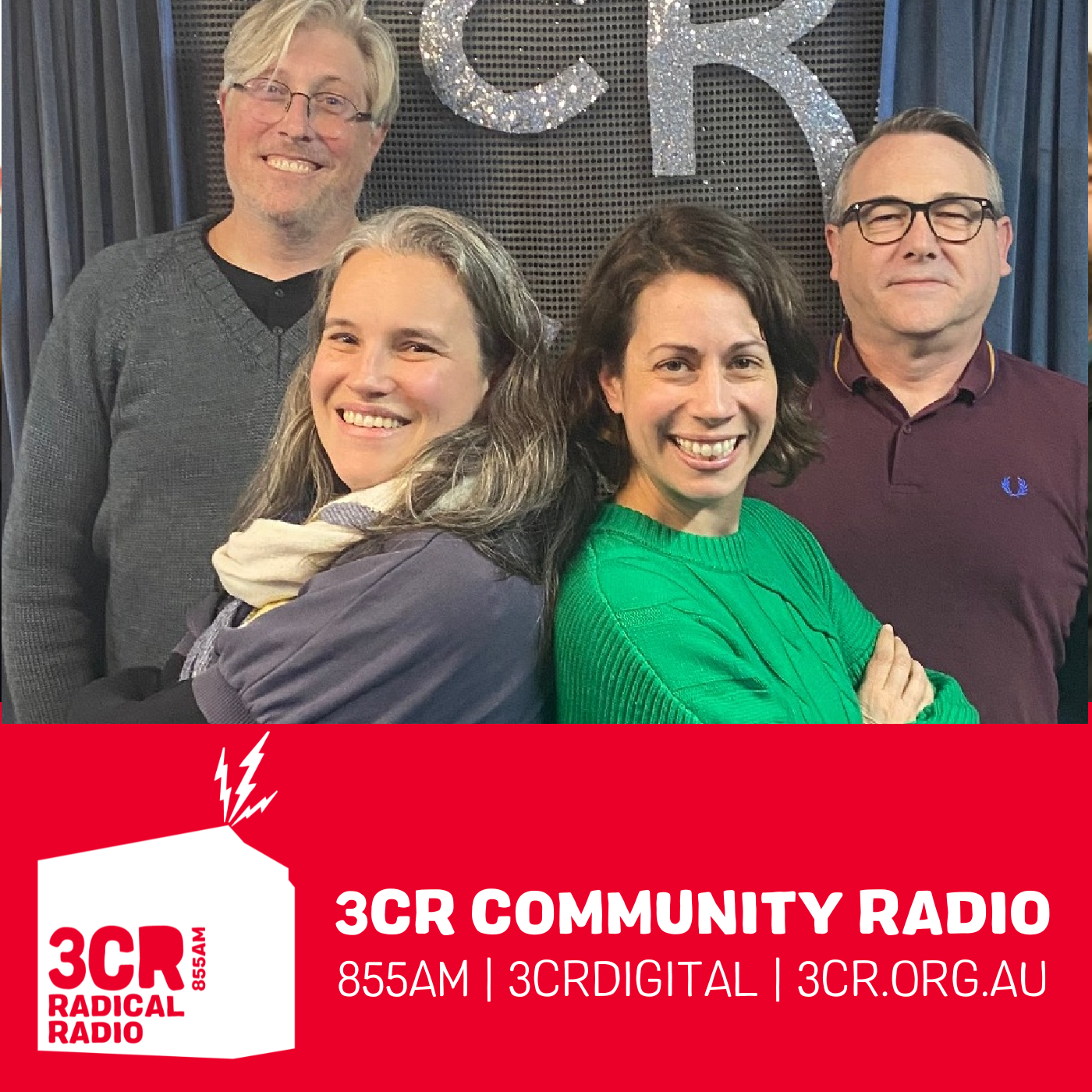
Chris Lassig, Stuart Burns, Claire Farrugia and Linden Ashcroft.
Lost in Science
Lost in Science is your weekly hit of mind-blowing science, strange facts, and big ideas. From cutting-edge discoveries to the science behind everyday life, our curious and passionate hosts make it fun, fast, and fascinating. If it’s weird, wonderful, or just worth knowing - we’re on it.
No dejes de visitar la web del podcast y apoyar a su creador: www.3cr.org.au
Autor
Chris Lassig, Stuart Burns, Claire Farrugia and Linden Ashcroft.
Categoría
Web del podcast
Último episodio
21 de oct. de 2026
¿Dónde escuchar?
Podcasts en la app Replaio Radio Muy prontoLos podcasts llegarán muy pronto a la app. Instálala ahora y sé el primero en descubrir una forma totalmente nueva de vivir los podcasts
 Instálala gratis
Android casi 10 M de descargas · valoración de 4,8
iOS muy pronto
Episodios
How does the Sun cause auroras, and does social media rot kids’ brains? 15.05.2024
This week, Chris gazes at the recent spectacular auroras, and explains how matter ejected from the Sun leads to pretty lights in the sky; and Stu digs deep to find out what the actual research says about the effect of social media and internet use on the mental health of young people.
Quantum Computing and Macro fossil macropods 08.05.2024
Chris tries to figure out if the federal government's promise of a quantum computing centre in Brisbane is huge or a mere quanta, and Stu talks to Isaac Kerr from Flinders University about the discovery of 3 very large kangaroo-like fossil relatives of modern marsupials .
Blood Breakthroughs and Pig Kidney Transplants 01.05.2024
This week on Lost in Science, Claire explores revolutionary research that uses a gut bacteria enzyme to convert blood types, aiming to make all blood donations universally compatible. And Catriona discusses the latest in organ transplants, including a successful pig kidney transplant into a human facilitated by groundbreaking CRISPR gene editing. Tune in to learn how these innovative scientific br...
Long Covid treatment and recovery 24.04.2024
This week, Chris talks to rehabilitation specialist Professor Steven Faux about his new book on Long Covid, to find out what we know about it and its causes, and current best practice for treatment and recovery. We also speak to comedian Alanta Colley about the Sci Fight comedy debates, with the next event on 2 May 2024 discussing Elon Musk’s Neuralink brain implants. Long Covid by Professor Steve...
Ant Invasion & Bird Evolution 17.04.2024
This week on Lost in Science, Stu examines the invasive fire ant crisis and innovative control measures. Meanwhile, Chris explores bird evolution, spotlighting the Hoatzin, or "stink bird," known for its unique digestion and ancient traits. Tune in to discover how science is tackling ecological threats and unraveling avian mysteries.
Out of the Sun 10.04.2024
Even though we’re staying out of the Sun this week, we can’t stop thinking about it! Cat tells us all about the Sun’s corona, its crown-like atmosphere, and the solar wind of particles streaming out from it; and Claire runs us through the science and history of solar eclipses.
Energy costs of AI and energy transfer in forests 03.04.2024
Chris looks into the energy costs and economics of AI and how wider use will affect them, while Stu looks into the science of some of the claims around the supposed forest communication networks some authors have described.
Infectious diseases - TB vaccines & big COVID data 27.03.2024
This week on the show Catriona takes us into the realm of tuberculosis vaccines, describing the latest breakthroughs and how they diverge from conventional approaches. From novel formulations to enhanced efficacy, explore the promising advancements reshaping the fight against TB. Meanwhile, Stu delves into COVID-19 research, analyzing global data to uncover insights into mortality rates and the ef...
Antarctic life and Great Barrier Reef bleaching 20.03.2024
We’re getting into hot and cold water this week, as Claire talks to Dr Jarrod McKenna about the importance of Antarctica and its wildlife, including plankton, whales and penguins; and Chris speaks to Dr Maya Srinivasan from James Cook University about the current mass coral-bleaching event on the Great Barrier Reef, what causes it, how corals can recover, and what needs to be done to protect the r...
What colour are blueberries anyway? And what's happening with the moon boom? 13.03.2024
This week on Lost in Science, Chris asks the question are blueberries blue? And answers it with a question, what is colour anyway? And Stu looks to the skies to wonder why the sudden renewed interest in landing stuff on the moon, and whether anyone is having much success doing so.
International Women's Day: Breast cancer screeners and AI innovators 06.03.2024
Join Claire and Catriona this International Women's Day for a special edition of Lost in Science! Catriona explores cutting-edge technology transforming breast cancer screening, enhancing efficacy. Discover the latest breakthroughs shaping the future of healthcare. Meanwhile, Claire spotlights two pioneering women at the forefront of Artificial Intelligence, unraveling the mysteries of AI innovati...
Sun-eating quasar and Moon-making crash 28.02.2024
This week, Catriona tells us about the brightest-known object in the universe, a quasar 12 billion light years away that’s in fact a supermassive black hole that gobbles an entire sun every day; and we replay Claire’s story about new evidence for another theorised cosmic event, the Moon’s formation through a collision of the early Earth with the Mars-sized protoplanet Theia. Wolf et al. 2024. The...
Night Parrot genome and how time flies 21.02.2024
This week on the show Claire chats to CSIRO researcher Leo Joseph about the recent publication of the complete genome of the Night Parrot, the elusive nocturnal bird thought to be extinct for much of the 20th century, and what this means for conservation efforts for the bird. Also on the show, Chris asks the question, how can time fly without wings? Or more specifically, is there is any scientific...
Asbestos update and why moths go to light 14.02.2024
This week on the show Stu looks at the science of the material asbestos in light of this dangerous substance being found in mulch in public areas in Sydney. Also on the show, have you ever wondered why moths and generally insects are attracted to lights? Chris talks through some new research that sheds some light on the matter.
Love voles and Buruli ulcer mozzies 07.02.2024
This week, Catriona celebrates Valentine's Day the science way, showing what research on monogamous prairie voles can tell us about how hormones like dopamine and vasopressin affect our craving for love and affection; and Chris shares new research that suggests the bacteria that causes Buruli ulcer is spread between possums and humans by mosquitoes, and how to protect yourself from it. Lim et al....
Summer Series: Physics vs evolution, Defrosted pathogens & jumping nematodes 31.01.2024
The final Summer Series for the year, Chris talks Physics vs evolution, Claire talks about pathogens defrosting in long frozen ice and Stu discovers nematodes lurking everywhere, and some that can jump!
Summer Series: Australian animals in danger and how science is saving them 31.01.2024
This week on our Summer Series Claire speaks to Dr Kylie Cairns all about dingoes, and her groundbreaking research using new genetic tools that has changed the way we understand the lineage of dingoes, as well as discovering endangered dragons with Jo Sumners from Museum Victoria.
Summer Series: Antimicrobial ants & gene therapy 17.01.2024
This week on the summer series we reach back into the archives to hear from microbiologist Dee Carter about her research into the active antimicrobial and antifungal molecules produced by the honeypot ant. Also on the we revisit Chris's story, which explains the new clinical trial taking place in NSW using gene therapy to treat muscular dystrophy in children.
Summer Series: Life on Earth and clever gulls 10.01.2024
This week on our summer series we bring back one of our favourite interviews with geologist Ashleigh Hood and her research studying the origins of life on Earth and how it has been sustained for billions of years. Also on the show Stu takes a look at the research showing that the humble seagulls might be a lot smarter than we give them credit for.
Summer series: clogged pipes & conspiracies 03.01.2024
It's the Lost in Science Summer Series, in which we replay some of our favourite stories from the past year! This week, Claire tells us why certain things, like fats and oils, leftover paint, flushable wipes, bamboo nappy liners and cat poo should not go down the drain or sewer; and Stu runs down research about how to prevent or pull people away from beliefs in conspiracy theories.
End of Year Quiz and Environmental impact of AI 03.01.2024
Our last show for the year looks back at one of the big themes of the year, Artificial Intelligence and Machine Learning - it is having an impact on society, but what environmental impact does it have? And Chris tests our listening skills with an end of year quiz.
Sciencemas! Fake vs real trees and El Niño in Australia 20.12.2023
Stu looks at the sustainability of artificial vs real Christmas trees and why they might be an odd choice for Australia. While Chris looks into why the El Niño climate cycle is acting strange for us in Australia this year.
Moon origin and space water 13.12.2023
This week, Claire tells us about new evidence for the leading theory of how the Moon was formed, through a collision of the early Earth with the Mars-sized protoplanet Theia; and Catriona updates us on where water can be found in our Solar System, and where it may have come from. Qian Yuan et al. 2023. Moon-forming impactor as a source of Earth’s basal mantle anomalies. https://doi.org/10.1038/s41...
Sitting sickness & bat viruses 06.12.2023
This week, Catriona tells us about the health dangers of sitting, and new research giving the good news that any alternative form of activity is beneficial; and Chris looks into why bats harbour such dangerous viruses, with a new study that predicts high virulence for viruses from them and a surprising other order of mammals. Blodgett et al. 2023. Device-measured physical activity and cardiometabo...
Giant ancient eagles & potato disease breakthroughs 29.11.2023
This week on the show we speak to Dr Ellen Mather about the huge birds of prey that ruled ancient Australian skies, including the new discovery of an Australian vulture and giant eagle. Also on the show, Stu talks about the new research helping to protect potatoes against disease like the horrid potato blight.
Podcasts similares








Escucha el podcast Lost in Science en Replaio
Radio y podcasts en una sola app - gratis y sin registro. Instálala hoy y no te pierdas el estreno
Replaio no es editor de podcasts; los nombres de los programas, las portadas y el audio pertenecen a sus autores y se distribuyen a través de canales RSS públicos